Article/blog post written and published by Linden Alexander Pentecost, published only on this website and published in the UK. This blog post was published on Christmas day, the 25th of December 2025. No AI was used in this publication nor in any of my writings. I (the author) also took the photo in this article, which has not been published before. This publication is unrelated to any and all of my other publications, including those in which other aspects of the topics discussed here, are discussed. This article contains 1863 words. The photo description just below the photo and before the main article text, contains details not in the main text. Some in-text citations are included. The main written content of this article begins beneath the photo below. Some of the topics in this article also make mention of or connect to other topics I have discussed recently in other articles/blog posts and other publications, including my Tiree blog post on this website, and also another article published yesterday on another website, and others.
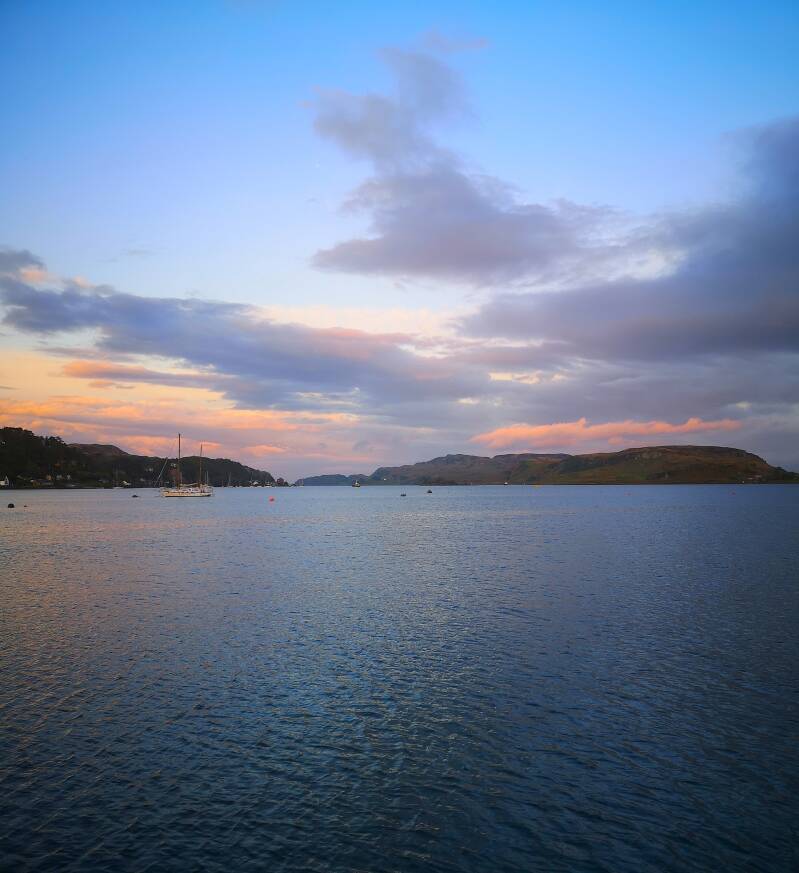
Photo above: Oban Harbour, with a sunset, and the island of Kererra to the centre right of the image. Photo taken by the author in 2023. The landscape above represents another of the ancient coastlines, which seems to have been important to the prehistoric peoples of Argyll in Scotland. These ancient cultures are I believe connected to Scotland's witches in some way.
Did some tribes of ancient Scotland practice polyandry? This is of course a bizarrely specific question. But there is a subject to discuss here.
Roman authors wrote about a tribe of people living around Scotland, a people who, I believe represent one of the indigenous tribes – or suggestions of indigenous tribes and peoples, which do not match up to our common definitions of British history.
According to the Romans, the attecotti practiced polyandry – i.e. a wife could have several husbands. It is not explicitly stated that the same worked the other way, i.e. that attecotti men could have several wives, but this is also a possibility. Nevertheless, the evidence seems – to me, to suggest a society where women held a different kind of position in community and marital relations, to what we are accustomed to in societies as a whole today.
The attecotti are certainly a mystery. In other publications I have discussed much more on them, and their possible connections to cultures and linguistic influences in Scotland. But needless to say, they remain a mysterious people.
Their name bares some resemblance to the Gaelic word ciuthach, a word describing an often hairy, giant ancestral figure, some way between being described as a holy, spirit being, and a physical being. They are associated with sea caves and with brochs in certain parts of Scotland. This word is not thought to be of the same etymology as attecotti, but nevertheless, there are strong connections I think.
The word attecotti also bares some resemblance to the Gaelic word Sgitheanach, the Gaelic name for the “Isle of Skye”, and to the name of the witch-like goddess figure Scáthach, associated with the Isle of Skye, and said to have taught the Irish hero Cú Chulainn the arts of war.
I have discussed all of this in a lot of detail elsewhere, but I personally think, there is some kind of connection here. These words also bare some resemblance to the word Scythian, a word we use to describe certain ancient peoples of the Eurasian steppe, some of whom also have legends about them, describing tribes of female warriors.
The Isle of Eigg is associated with the “giant women” of Eigg, warrior women who, according to legend, occupied the highest mountain on Eigg, An Sgùrr. They did not like priests coming to the island, and there are, in addition, also legends of the ciuthaich on Eigg, and other aspects to this picture.
The Isle of Mull was well known for its legends of witches. In fact, legends of wise women, powerful witches, able to influence the sea for ill or good, are found across many parts of Scotland. In my opinion, there is implication in these legends that these women were not isolated individuals who practiced a little herbal magic, but were rather organised, spiritual leaders, semi-supernatural in nature, with ancient indigenous history in these islands, women who were greatly feared and respected.
Whilst I have yet to come across exact accounts of witches practicing polyandry in indigenous Hebridean legend, there are certainly suggestions of this across Scottish and British folklore in general. This is, of course, normally described as a negative and unholy thing, whether it be witches dancing together with ancestor beings, or whether it be the concept of witches manipulating and deceiving men, the latter of which could be thought of us as corrupted form of an original knowledge possessed by witches about love and working with it.
And it is important I think, that sometimes witchcraft in indigenous British history does seem to have been genuinly terrifying and greatly misused.
But, the original knowledge was I think neutral, a knowledge of connection and nature, that could be used to hurt, or to love. And I like to believe that in its original form, it was about healing and love, and that polyandry may have been a part of their original knowledge of love. This is – at least, a nice thought.
But perhaps that is a thing about polyandry and polyamory in general, and, relationships in general for that matter, but especially in polyamory – is that it is a doorway to a kind of energetic chaos, that goes beyond the boundaries of what is normal cultural human behaviour and our sense of “self” and what it means to love. Such a thing takes great responsibility, and humanity has abused it, in every way, whether through intent or not. This is perhaps why much of the knowledge of the witches has been lost – we were irresponsible with it.
But empathy may well pave the way back. And for me at least, the idea of a universal god or Great Spirit, does not contradict with the idea of ancient polyandrous witches, who are themselves a part of that creation, and have purpose within it.
I am not saying here whether or not I think polyamory or monogamy is more spiritual or right. Whilst I personally have not been polyamorous in any physical sense, and whilst my own spirit longs for something monogamous, something like a "twin flame", this does not necessary exclude the possibility or disregard polyamory as wrong or incompatable with my own existence. I do not think "which is more spiritual?" is a question that is necessarily important. It would be akin to comparing a love for one place, to a love of many places - the two are not comparable, they represent different journeys, but fundamentally they are I think the same journey of "love", however that is taken. The whole perspective has the potential to be both toxic and beautiful, dependent on our relationships to ourselves and to the world around us.
On a slightly different note, there are some, albeit vague implications, that Northern Europeans are more open to polyamory, in a general way. There are similar implications that some of the Central Eurasian Steppe peoples practised polyandry - tribes such as the Massagetae. Whilst, as I have mentioned, some Scythian peoples, also on the Eurasian Steppe, are said to have had female warriors and spiritual leaders. In addition, the land of the Kvens in Northern Norway, Kvenland in Norwegian, is sometimes itself associated with tribes of Amazons, warrior women, sometimes with implications of semi-supernatural nature.
Whilst I have written about many other aspects to these subjects elsewhere, I came across a very interesting thing which I would like to mention. I have already discussed elsewhere relationships between the magical traditions of the "Finns" and similar peoples as they appear across different cultures, including those in Scotland, where in places "Finns" are also known by this name.
I have read in a few places, how, in historic maritime history, Finnish sailors were "feared" due to that they possessed some kind of ancient magic that pertained to nature, to sound, and to the sea. This is an concept connected to specific places more than others, but also seems to have been generally known among mariners up until relatively recently.
The some manifestations of this, one aspect of this is that they are said by mariners to have made a magic material with three "knots" in it. The precise method seems I think to vary, but anyway, three "knots" were tied in this material, and when used at sea, the knots could be untied in order to "call" the wind, helping the ship to move. Presumably some sacred chants were also involved. I have discussed much on this elsewhere, for example Shaetlan charms connected to Finns, and their similarity to Finnish rhyming, and yesterday I published something on a Shaetlan "trow" charm (not connected to the Finns or to this subject precisely).
In the book I have quoted in a few places recently, The Gaelic Otherworld, original text by John Gregorson Campbell, edited by Ronald Black, the Finns are also talked about on pages 180 and 181, and I quote from the aforementioned book:
"The belief that witches can trouble the sea and raise is the wind is widespread, reaching even to the naive Africans. It is part of the regular traffic of Finland witches to sell wind to mariners - as in their case of their Celtic sisters, tied in knots upon a thread"
Note that I am not sure if this is implying that the Finnish witches went to Africa or not, but this is interesting. Also, in more general maritime tradition and in other places, the "Finns" were often also male, wizards or male witches.
Further down this page, a story is described from Lewis, where a man unfortunately misuses this example of magic, by untying the third knot without reason or understanding, releasing a powerful stormy wind, and causing his boat to capsize and be smashed to pieces. When using this "three knot" spell, one had to be very careful.
Also in this story, the names of these three knots are given in Gaelic (I am not sure of their Finnish names), in Gaelic, they are called, in order from the first knot to the third: Thig gu fòill - meaning: "come gently", Teann nas fheàrr - meaning: "come better", and Cruaidh-Chàs - meaning "hardship".
These names represent a potency of language, and I write about them with no illusions about their power and energy. Again, humanity probably isn't prepared nor ready to fully understand this knowledge again. But I believe that this is a start, and that this will one day change.
I hope that this article was an interesting read. Tapadh leibh, thank you. This article is written in honour of the ancestral forces that watch over Scotland and her people.
Add comment
Comments