A new disc. (2ndofDecember 2025) on Barra Gaelic, N. Rona, Gaelic, Shaetlan & connected topics
Written and published by Linden Alexander Pentecost. Published in the UK and only on this website. The author is also a UK resident, lives in the UK and is from the UK. This article was published on the 2nd of December 2025. No AI was used in this article nor in any of my publications. This article is unrelated and contains different content from any of my other publications, which includes it being separate from and unrelated to my many other publications which discuss different aspects and examples of Shaetlan, Barra Gaelic etc. The two photos in this article, both showing parts of Barra, have not been published elsewhere, and both photos were taken by the author. The smaller text above the photos also contains important information not in the main text. This article contains both Barra Gaelic and Shaetlan example sentences, not published before,and etymological links and many other topics not discussed before (nor is anything in this article published before or elsewhere). This article contains 3857 words. For reference purposes, this article's URL is: https://www.languages-of-linnunrata.co.uk/a-new-disc-2ndofdecember-2025-on-barra-gaelic-n-rona-gaelic-shaetlan-connected-topics This article contains the following sub-sections:
1. More on Barra Gaelic (December 2025): (with text above photo and first photo at end)
2. More (December 2025) on the etymology of "Barra"/Barraigh
3. On the Gaelic dialect & ancient language of North Rona, Rònaigh
4. More on Shaetlan and ancient language, and more possible Shaetlan - Finnish cognates (December 2025) (includes text above second photo, second photo, and references at the end plus a dedication at the very end)
The sub-section titles do not indicate all of the things disucssed in those sections.
For reference purposes, this article's URL is: https://www.languages-of-linnunrata.co.uk/a-new-disc-2ndofdecember-2025-on-barra-gaelic-n-rona-gaelic-shaetlan-connected-topics . Note again that this article is unrelated to any of my other publications discussing related topics, including to related (but separate) other publications (including articles, print-only books, pdf-only books and more) earlier this year that and in previous years that specifically discuss other parts of these subjects, and the article in front of you is also separate from, and contains different info. from for example, that in my article published elsewhere, titled: The Northern European link to language in Northern and Western Scotland. Note that the aforementioned article discusses different aspects of and gives different examples of some of the topics in the article in front of you, but that again the two articles contain separate examples, separate information, are distinct and are entirely different publications. One (of many) of my other publications where I discuss other aspects of Barra Gaelic, available at archive.org, is titled: Second Version Of Scottish Gaelic Dialects Of The Outer Hebrides, And With Comments On Spirituality And On Folk Beliefs (standalone Article, Only Published On Archive.org). Some of my other publications on these topics also talk about both Barra (and other Hebridean Islands) and Norway in context together, but again the info in those publications is unrelated to and different from that in the article in front of you, on this page. Note too that both this article and the article published on this website about the Narvik dialect in November 2025 both contain photos taken in 2011. I also mention connections to the Narvik area in the article in front of you, on this page.
1. More on Barra Gaelic (December 2025):
The Outer Hebrides - a majestic collection of islands, where the Gaelic landscape of Scotland meets the Atlantic Ocean. The southernmost inhabited islands, Eriskay, Eirisgeidh, Barra, Barraigh and Vatersay, Bhatarsaigh, are some of the most special places in the world to me, and they have an interesting linguistic history.
All of the Outer Hebrides were historically Gaelic-speaking. There were other languages too, Norse, perhaps harking back to some kind of “pre-Norse” language influence. And there were other tribes too, peoples who also occupied this land, who were identified as being “other” in Gaelic folklore; and evidence of archaeological sites that must truly have come from cultures that were quite alien to the modern Gaels, and who probably spoke distinctive non-Celtic, possibly pre-Indo-European languages.
All of this survives to some degree, I think, in the place-names and language, with the Gaelic dialects of Vatersay, Barra and Eriskay being in a sense perhaps a Celticised continuation of various strands of ancient, indigenous history on these islands.
The Scottish Gaelic language, Gàidhlig, was once spread throughout most of modern Scotland, through complex dialects, with high variations between them, particularly in their phonology. The Gaelic dialects in the Outer Hebrides can themselves be very different from each other. But the general dialectal complexity of Scottish Gaelic tends to be not so easily represented, partially because most of the dialects are now extinct or nearly extinct, and partially because the Scottish Gaelic spelling system was designed as a system to communicate Christian literature, concepts, and certain facets of Gaelic poetry and metre through a common spelling. The standard spelling of Scottish Gaelic, has generally been, and remains unsuitable for writing the different dialects of Gaelic, so myself and some others have taken to adapting historic Gaelic spelling principles to extend into the language’s complex dialectology. The following 5 example sentences demonstrate how I have adapted the spelling for Barra Gaelic.
1. Chuala mi fuam a ndreachgo̊ - “I heard a sound of the snow”
2. Bha sinn a’ daunnso̊ aig a’ chéilidh - “we were dancing at the céilidh”
3. Siud ceunn na tìđo̊ - “over there is the head of the land”
4. Is e -àito̊ naomh a th’ann an Allathasdal - “Allasdale is a sacred place”
5. Tha sinnsearan a’ seasu os cionn na ceòthadh - “ancestors are standing above the mist”
6. Seo ballo̊ na tæigho̊ - "this is the wall of the house"
The above sentences do not show the most divergent, “broad” ways in which Barra Gaelic differs from standard taught Gaelic. But you will notice the character đ, which I employ to write the slender “r” sound of Barra Gaelic, which is not really an “r” at all, but something more similar to the Gaelic slender d although articulated closer to a palatal “r” or even a slight “z” sound. To English speakers it somewhat resembles the “j” in “just”. This is not found on all of Barra however. The o̊- sound is a special sound in Barra Gaelic, that resembles an unstressed ‘o’, and typically replaces the schwa sound word finally, but it can also be found word medially, especially in the -ach, -each suffixes, for example in the Barra Gaelic word smeòro̊ch - “thrush” (bird). Another example of where this word occurs at the end of a word is in the word rætho̊ - "ram", standard Gaelic: reithe. Note ceunn is pronounced with the vowels [ɛu] on Barra and is equivalent to standard ceann. Note also that the word siud is pronounced with the vowel [i].
Photo below: sunset colours near Brevig, in Gaelic: Bréibhig / Bđéibhig on the eastern coast of the Isle of Barra, taken in early September 2011. I have included another photo of this Bréibhig / Bđéibhig sunset in a different publication, showing mountains and the other direction, hence the two photos are unrelated. This photo I hope helps to show the supreme beauty, majesty and magic of the Isle of Barra and its surrounding world of seas and sky. The form Bđéibhig is a Barra Gaelic spelling of more-standard Bréibhig.
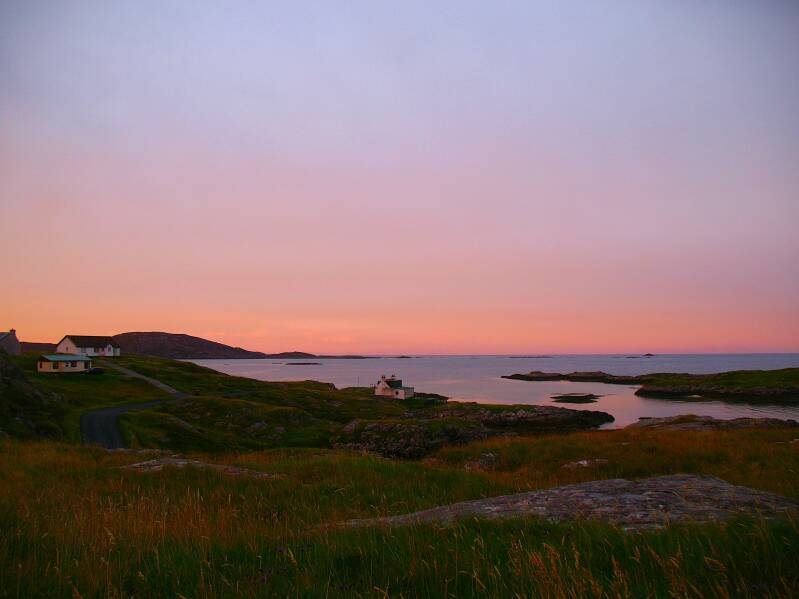
2. More (December 2025) on the etymology of "Barra"/Barraigh
The Gaelic dialects of Barra and South Uist are distinct from each other, but nevertheless, the South Uist dialects might give us some more clues about the meaning of Barra-. There are several words in South Uist Gaelic with a prefix like bàr- or bar-, such as bàrcan - "a swelling wave" (1), possibly from bàrc-thonn, with tonn meaning "wave". The word barra in South Uist Gaelic, means something like a "centre of gravity", but can also be used to refer to a wheelbarrow.
There is also the word barrach in South Uist Gaelic, which refers to a place on a beach, a kind of hollow scooped out to place boats in, once they are taken out of the water and beached. Could barrach pertain to the name Barraigh in some way? Was Barraigh a kind of haven for boats, a place to come ashore and find peace? A person from Barraigh is also known as a barrach in South Uist Gaelic. According to (1), there is also a place on the east of the Isle of Barra, known as Am Barra Làchadh, where barra rather than barrach here means a place for keeping boats. The second word, làchadh could be related to Gaelic lach - "laugh loudly", but more likely relates to Gaelic lachadh, meaning to "dive like a duck" from lach - "duck", the implication perhaps being that boats went steeply into the water, akin to how ducks enter water. The word barra - "centre of gravity", and barra and barrach - "a place for boats" may ultimately connect to Gaelic bàrr meaning "summit" or "top".
We can also see connections to Nordic languages, for example, the similarity between all of the aforementioned words, especially bàrcan, and for example Norwegian båra - "to make waves", and Icelandic bára - "wave". Another South Uist Gaelic word, bearradh, meaning a "ridge" (1), may also be related to the ancient origin of these root words in some way, as might the English word "bore" (tidal bore) and various Afro-Asiatic and other words.
In the north of Norway, not far from the city of Narvik, is another, much smaller island, called Barøya, an island, the name of which which may be directly cognate to Barraigh in Scotland. Whilst bar can mean a "pine needle" in Norwegian; I doubt that this is the meaning behind the name Barøya. The name Barøya also exists alongside the Northern Sámi name for the island, which is Bárka. See another article I wrote on this website if you are curious about the Narvik dialect of Norwegian, the aforementioned article is titled: More on languages around Narvik & more on the Narvik dialect & other topics, published 25/11/2025, and the link to the aforementioned article is: https://www.languages-of-linnunrata.co.uk/more-on-languages-around-narvik-more-on-the-narvik-dialect-other-topics-published-25-11-2025
It may be that this island name is connected to "waves" in some way, especially given that bárru is a Northern Sámi name for a wave. But "wave-island" does not quite make sense to me. Perhaps, the names in Northern Sámi and Norwegian relate to a more ancient sense of this etymology, which, like the many Gaelic words, has the implication of rising out, for example, taking a boat from the water, and "waves" in the sense that waves rise. Indeed the island of Bárka does rise rather dramatically from the sea. Could the Gaelic name Barraigh come from a root word meaning something similar, a place that rises from the sea like a wave?
3. On the Gaelic dialect & ancient language of North Rona, Rònaigh
North Rona is a very isolated island, far to the north of Lewis, and a long way from both the north of Lewis and from the northern Scottish Mainland. There is not to my knowledge any evidence of this island being inhabited before the Middle Ages, although in my opinion it is highly possible that prehistoric peoples visited the island. In attested history, the island seems to have had the strongest ties with the Isle of Lewis, at least in terms of contact.
There are no records of the Gaelic dialect spoken on North Rona, but I suggest that the dialect could well have shared some similarities with the Gaelic of northern Lewis, as it seems that it was the people of Northern Lewis who had the most contact with North Rona. That Gaelic was the main language of the island is well attested, including by the large number of Gaelic place-names. One particular place name on North Rona, known as Geodha nan Gàll is particularly interesting. This name means "Geo (deep coastal chasm) of the Gall", the word gall in Gaelic often refers to some other culture which was non-Gaelic, and often refers to prehistoric ancient sites rather than to Norse ancient sites. I have discussed other aspects of this word a lot elsewhere. This place-name could be indicative that there was a Norse, or rather, pre-Norse culture also present on North-Rona. The spelling of Gall as gàll could be a spelling difference, or it could, possibly, indicate that this word had a long [aː] sound on North Rona, although I am not so convinced of this being the case, I think it is more likely a spelling difference. One thing I can say about the dialect of North Rona from the place-names, is that the word poll - meaning approximately "pool", was used more frequently than in many dialects. There are also some very curious place-names on North Rona, for example Thairsgeir, the word sgeir means "skerry", but I have no idea what the element Thair- means, but it could perhaps be related to Irish thiar - "west" and to Scottish Gaelic iar - "west".
What is also for sure, is that the Gaelic dialect of North Rona would have been, not only the most northerly spoken modern Goidelic language, but arguably, the most Northerly-spoken Celtic language, this is assuming that the "Celtic word elements" in the Northern Isles, Faroe Islands and Iceland are pre-Celtic rather than Celtic.
There is much more to discuss on North Rona's place-names, which I will not discuss more on here. But, as a general remark, I personally think that the place-names show a mixture of Gaelic and more ancient, possibly Norse and possibly much-more-ancient place-name elements.
4. More on Shaetlan and ancient language, and more possible Shaetlan - Finnish cognates (December 2025)
I have a large number of other publications that go into detail about different Gaelic dialects and possible prehistoric languages and language influences, and the Norse or pre-Norse of these islands. But here I wish to write more specifically about certain aspects to these languages not previously discussed.
But to introduce: Norn is a language, or rather, group of related Nordic and/or pre-Nordic languages that were once spoken in Shetland, Orkney, Caithness and in the Western Isles. “Norn” is often used more specifically for the language attested in Shetland, Orkney and Caithness, and it is best attested in Shetland, where it also had several dialects.
Shetland, Orkney and Caithness, also have their own unique languages, of which certainly Caithness Germanic or “Kaitness” can be referred to as a variety of Scots, arguably Orkney Germanic can be too, but Shetlandic, or Shaetlan, I do not personally consider a form of Scots. Perhaps like Orkney Germanic, Shaetlan shares many of its base structures with Scots, but is culturally and linguistically distinct from Scots in other important ways. Below are five examples of sentences in the Shaetlan language:
1. Dey wiss at da idders wad help dem te spaek Shaetlan - “they wish that the others would help them to speak Shetlandic”
2. Wha is da Finnman at maks da kröls? - “who is the “Finn man” who makes the oatmeal breads/scones?”
3. Dan I saa da shaela skaap i da watter frae da caizie - “then I saw the dark grey mussel bed in the water from the boat”
4. Shö tocht at da kröl wis güd - “she thought that the scone was good”
5. Is da caizie ida voe? - "is the boat in the sea inlet?"
You can see for example that the dental fricative sound in English “others” and “the” is equivalent to d in Shaetlan for example, e.g. idders - “others”, da - “the”, dan - “then”, dem - “them” etc. There are also other word and grammar, and sound differences when compared with English, and when compared with Scots as a whole. Shaetlan writers also frequently make use of the characters ö and ü for writing these specific sounds, which can be thought of as a larger Germanic influence in spelling, with ö being found in Swedish and Icelandic for instance. The letter ö can be seen in the above sentences, in the words kröls, kröl and shö. The letter ü which represents a different sound, can be seen in the word güd in the above sentences.
You will also notice some of the language’s unique vocabulary, for example kröls and caizie (the latter of which I discuss in detail below), a perhaps ancient word meaning a type of scone made from oatmeal, based on likely ancient cooking practices, the word shaela which refers to a dark greyish colour, and the fascinating word skaap, which refers to an underwater bed of mussels. The word voe is a word in Shetland referring usually to sea inlets, and it is cognate to the Norwegian word våg which can mean both a "bay" and "wave".
You will notice also that I mention the word Finnman in one of the sentences. In Shetland, the Finnmen or Finns are sort of described as being another tribe or group of peoples associated with the sea, who are seemingly not Norse or Shetlandic in the modern sense. One could argue, as I have done, that the Finnmen were a kind of divine group of ancestors, ancestral indigenous peoples, associated with divine powers and wizardry which was often used to protect Shetlanders.
As I have discussed other aspects of in detail elsewhere, there are some linguistic and other possible links between Shetland and “Finland”, Finnish, to the Sámi and elsewhere. Some other recent examples of word similarities I noticed include Shaetlan paap, meaning “a small whalebone, or a small iron rod about 18 inches long, connecting the ball of lead used in fishing, with the lines to which the hooks are attached” (2). Considering how highly specific this word is, and considering that fishing technology is something that the very, very first people in Shetland would have had some knowledge of, and considering that the “Finnmen” are associated with the seas around Shetland, it is interesting to see that the Shaetlan word paap appears quite similar to the Finnish word vapa meaning “pole” or “fishing rod”, assuming that the first p- in paap is equivalent to the v- in Finnish vapa.
Another example of a possible link with a Finnish word can be seen in the similarity between Shaetlan caizie - “fishing boat” (2). This bares some similarity to Finnish haaksi “boat” or “ship”. Both vapa and haaksi also have a mysterious origin within Finnish, indicating that these words may have belonged to an ancient, pre-Uralic linguistic landscape. There are far more examples of connections between Uralic and the languages of Scotland, including South Uist Gaelic and Shaetlan and others, which I have discussed elsewhere. My different discussions elsewhere, and those in this article pertaining to vague connections between the Scottish Gaels and the Sámi, e.g. in the name “Barra”, are also interesting I think.
Could the Shaetlan word caizie - being a word for a "fishing boat", be connected specifically to the Finns in Shetland, given that the Finns in Shetland are associated strongly with boats and the sea? And given the similarity between caizie and Finnish haaksi this is interesting. This idea of divine, seafaring ancestors, sometimes known as "Finns", sometimes associated with magical boats and waterhorses, is found in various parts of northern and western Europe, and there are similarities to other legends and cultures as far away as South America, as well as many, many language similarities, something I have published about extensively elsewhere.
Photo below: the wild Atlantic Ocean (known as Na Haf in Barra Gaelic), not far from the village of Borve on Barra (Borgh in Gaelic). Although this photo lies in the part of this article concentrated on the Shaetlan language, the photo below does represent and show, also, the same kind of wild oceans visible around Shetland, and furthermore, whilst I took this photo below in 2011, and in the days surrounding, Shaetlan and Norn were also on my mind a lot. Note also that the Barra Gaelic Na Haf is cognate to several other Norse and other words I have discussed elsewhere, but I have not yet discussed how this word is also cognate to the Shaetlan word haaf, but haaf in Shaetlan does not mean "The Atlantic Ocean" as it does in Barra Gaelic, nor does it mean "sea" as it does in Nordic languages; the Shaetlan word haaf does instead refer specifically to the "deep sea", and is also a verb used to mean to "go fishing at deep sea". In some other dialects of Scottish Gaelic, the word tabh is also used to mean "deep ocean", and is related to the aforementioned words etymologically.

Despite that Shaetlan is often described as a form of Scots with a strong Norse influence, the actual truth of Shaetlan’s origins seems to be far more nuanced and complex, and arguably more ancient in my opinion, with again many of the words in Shaetlan being of unknown origin, and showing possible relationships to more distant Indo-European and non-Indo-European languages. The “Vikings” very frequently get all of the attention, when really I think it would be more fruitful to focus on Shaetlan as an indigenous language, arguably containing connections to both Anglic, Nordic and other more ancient indigenous languages, rather than approaching the subject with the overreaching assumption that Shaetlan is simply a mixture of Scots and Norn.
Norn is also a complex subject, and whilst much of the recorded Norn proverbs and texts from Shetland can be described as Norn, Norse languages, some of the examples of Norn sentences and rhymes are somewhat unintelligible - particularly those rhymes that refer in some way to “other” ancient ancestors, such as the trows, another Shetland concept of spirit ancestors, distinct from the Finnmen. That many of these more unintelligible examples of Norn (and Shaetlan, as discussed elsewhere) reflect an act of acknowledging and speaking to these ancestral beings, may imply in some way that it “was” these ancestral beings who left these influences in the Shaetlan language - at least this is my personal view.
(Update: some time after publishing the article on this page, I wrote another article on one of my other websites, titled: 86: On magical phrases, spoken by "trows" on Shetland, published 24/12/2025, which gives more information on the trows' language and what's content is unrelated to that of the article in front of you. Earlier this year I also published a print-only book with other details about a different Shaetlan charm).
References:
(1). Gaelic Words and Expressions from South Uist and Eriskay, by Rev. Fr. Allan MacDonald
(2). An etymological glossary of the Shetland & Orkney dialect, by Thomas Edmondson
Other information in this article comes from my own research
I have dedicated other, separate publications pertaining to Barra to others, including to my cat Gmork. This article in front of you is dedicated to a different individual, and is dedicated to my grandad, who loves the islands of Scotland, and the Sea, just as I do.