Written and published by Linden Alexander Pentecost only on this website. This, like my other publications is published in the UK. This blog post/article was published on the 20th of December 2025. This blog post or article is unrelated to and separate from all my other publications - including others which discuss the Duddon Valley and even some of the names and places mentioned in this article, albeit in a different way & with different information & different photos. Photos also taken by Linden Alexander Pentecost. Note that the smaller text in italics above the photos contains a lot of details not in the main text. Note I published an unrelated (different content to other publications) PDF-only book not so long ago which talks about Logan Beck, its mines, other mines, Logan Beck and other etymologies, and more details on etymologies and archaeology in relation to this area and to the Pengennet in the Duddon Valley in more detail and different details to those discussed here (there is also much more information in the aforementioned book not in this article, and much more in this article not in other publications). I also published another PDF-only book recently where I also discuss underground places, and have published recently, and will publish more things in the near future that pertain to the underground, again unrelated to this and the aforementioned and all other publications. Note that exploring mines is dangerous and that many of the mines mentioned in this article are far too dangerous even for experienced mine explorers to safely explore. This article/blog post contains 2665 words and 3 photos not published elsewhere.
The Duddon Valley in Cumbria is a very beautiful place. Out of all the valleys of Cumbria, it perhaps has the most underestimated abundance of rocks and crags. The mountains around the Duddon Valley rise to a great height - for England at least, but the valley itself is a complex landscape of crags, rocky areas, green, lush Atlantic rainforests and places of historic interest.
There is an absolute abundance of prehistory in and around the Duddon Valley - which I have discussed in other publications. But in this blog post I would like to talk about some other sites. To briefly give an overview of the prehistory in some new words: this valley runs from the central mountains of the Lake District and into the Duddon Estuary, between the Furness Peninsula in the south and Millom to the north.
The coastal orientation of this valley seems to coincide with an abundance of Goidelic-like place-names in and around parts of the Duddon Valley. For example the place-name "Logan Beck" in the Duddon Valley likely takes its etymology from something akin to the Scottish Gaelic word lagan meaning a "small hollow".
Photo below: a long exposure close to sunset, showing the River Duddon. The flash-like effect on the right is caused by the sun hitting splashes of water in the long exposure. To me, the Duddon Valley is such a sacred place. This image helps I think to give an idea the beauty of these natural ancient rainforests of oak, birch and other species. Our ancestors would have acknowledged the sacredness of the water and the sacredness of these ancient forests, and I would love to know an ancient prayer of acknowledgement which I could say to honour the Great Spirit's creation in these places. Sadly, no such prayers have survived to my knowledge, but they will still exist I think, with the ancestors in their heavenly realm, in the ether of our memory and in the memory of the stones and land. I came back to this exact spot years later, the day after one of my cats died, something which I have also discussed in other publications (the death of the cat that is, not that I went to the Duddon River the day afterwards). I remember walking down this river and being unable to stop myself from crying. I felt the presence of my cat with me in that nature, and I feel that, just like the ancient songs and languages of the Duddon, the rocks, trees and water will remember my tears and longing, in our world. And I know that my cats are now in that heavenly realm too, and that after being an old man, when old age takes me, I will meet them again one day and join them there.

Another example of a Goidelic-like place-name is "Kinmont", not far from Corney Fell. Kinmont is I believe a pre-Celtic name belonging to a linguistic pre-Celtic or more specifically "pre-Gaelic" substratum that existed in Cumbria, the Isle of Man, Scotland and Ireland - in different ways, during the Bronze Age. This substratum later became more thoroughly formulated into the Goidelic languages in Ireland, The Isle of Man and Scotland, but I do not believe that Cumbria ever became "Celtic" in such a sense, I believe that Cumbria contains words and place-names from the pre-Celtic substratums shared with the Celtic lands, but that these words and names in Cumbria were never Celtic per-se.
The place-name element *logan in "Logan Beck" and the place-name elements in Kinmont, which might be reconstructed as *cenn-mon(V)d meaning "head moor" or "head mountain", are all of pre-Indo-European origin. This is to say that these words might exist within Celtic languages, but they belong to a substratum of words and language which is not originally Celtic. However, this is not to say that these pre-Celtic languages did not share a lot in common with Celtic languages, and did not greatly influence them, which is why Kinmont or extra-Brittonic *cenn-mon(V)d can easily be seen as being equivalent to Scottish Gaelic ceann mhonadh of the exact same meaning. In Scottish Gaelic we would call this place-name Gaelic or Celtic, but the actual root words ceann - "head" and monadh- "moor, mountain" are perhaps likely of pre-Indo-European origin.
So even though we can say that there is a Goidelic-like or Gaelic-like language influence around the Duddon Valley, these names are generally pre-Celtic in origin, and I personally think that they are ancient, and that these languages were still quite widely used up until the Bronze Age, especially given that there was a lot of Bronze Age activity in the areas where these names exist. These people may have also mined copper in the Lake District, of which there is some evidence, although exact mining sites have not yet been identified.
This is a completely different take on the idea that Cumbria was once a "Celtic Kingdom". Essentially, I do not think that this was the case, and believe that for the most part, Cumbria's "Celtic" influences are pre-Celtic influences also shared with different Celtic languages. In other words there is a common linguistic heritage that connects Cumbria to the Celtic lands, but that this heritage is not itself Celtic and pertains to more ancient ancestral cultures.
The name "Duddon" itself may I think take its name from something akin to the English dialectal word dodd for a "hill", a word which has various similar-looking words in some Indigenous African and Indigenous American languages. Many of these place-names are I think "pre-Celtic" rather than being specifically Celtic in origin, as many of the root words present in these names seem to be of pre-Indo-European origin, although I have many other reasons for thinking this is the case, which I have dedicated many other publications too.
Many of the names in the valley also reflect an Anglo-Norse or pre-Norse language influence. For example, the village of Ulpha likely contains an Anglo-Norse word ulf meaning "wolf". The actual historic Germanic languages of this region are confused, we often tend to like to call names "Viking" or "Norse" these days, but in reality many of the Cumbrian place-names reflect a language which shared things in common with both Old Norse and Old English. It is also my belief that many of the Germanic elements in our place-names may come from prehistoric languages, although of a separate timeline to pre-Celtic and Celtic names in many cases.
Another group of Celtic or pre-Celtic place-names in the Duddon Valley show a stronger correspondance to the P-Celtic languages, although again I indeed think it more likely that these names came from some kind of pre-Brittonic, possibly non-Indo-European language, rather than from Brythonic languages like Welsh and Cornish, per-se. This is why I tend to less often use the term "Cumbric" when describing this language influence nowadays. It is also not entirely separate from the other possible ancient language influences. A good example of a place-name from this language influence is the place-name "Pengennet" not far from Logan Beck. The first element of this name, *pen- is equivalent to Welsh pen and to Cornish pedn, both meaning "head". This word is not of Celtic origin but of pre-Indo-European origin.
Certainly in terms of fully-attested Indo-European languages, the only such language of the Duddon Valley is the local Germanic dialect, which is generally considered a dialect of Cumbrian English nowadays. This Germanic language is very endangered, and has no kind of official status.
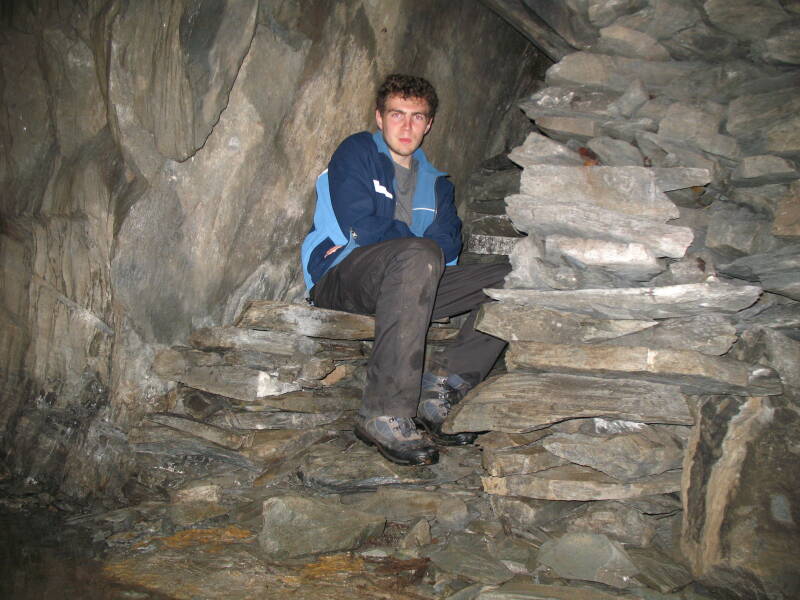
Photo below: a self portrait taken within one of the smaller slate mines around the Duddon Valley, this one being the Caw Slate Mine, a possibly ancient working, with a well-constructed cart track leading up the side of Caw mountain to the mining site. The older mining would have taken place where the slate naturally outcrops, the underground closehead I am sat in is likely much more recent. In the photo I am sat in some kind of a blast shelter, or storage area. The slate miners may have eaten their "bait" (food) (in local dialect) on this crude bench, in this wee shelter, and they may also have used it for protection when blasting. Although I suspect they probably would have simply left the mine altogether when blasting - that would have made more sense. Note, normally I would be wearing a helmet underground, but since this mine is so small I did not on this occasion, however, there is still potential for roof falls in here, and one should not enter without a helmet, and lights, of course. Compared to some of the slate mines in this valley, this one is a bit safer, but still should only be entered by experienced individuals. I was of the age of 18 in the photo below.
I have discussed the copper mines at Logan Beck elsewhere - but the Duddon Valley also contains a large number of historic slate mining sites. I have spoken with Alastair Cameron before, the author of the book Slate from Coniston, which describes the slate industry around Coniston, not far from the Duddon Valley. He has told me that the slate "veins" or "bands" in the Duddon Valley were notoriously difficult to work and "rive" (split) into roofing slates.
I have seen this from exploring the mines here. Many of the slate mine workings are merely trials. I have followed tunnels, knee-deep in water, only to find that the end in tiny closeheads "slate mine chambers" or end in no chamber at all. These are trial attempts at reaching the slate bands or veins, and many of those in the Duddon Valley were seemingly abandoned, because the slate was not of good enough, or workable enough quality. There are also many small slate mines which only operated on a smaller scale, but which were nevertheless important, such as the Bockbarrow Slate Quarry, Caw Slate Mine etc.
In a number of places though, sizeable slate mines and quarries were developed in and around the Duddon Valley. The largest slate mining and quarrying operation around the Duddon Valley is the slate quarry on Kirkby Moor, overlooking the Duddon Estuary. But in this blog-post I am mainly discussing the Duddon Valley as it manifests in its rocky and craggy areas above the lower valley.
In terms of the slate mines and quarries around the upper Duddon Valley, the slate mines and quarries of Walna Scar are arguably what was one of the largest connected slate quarrying and mining operations in the area. According to what Alastair Cameron has told me, these slate mines and quarries work the same light blue-grey slate band or vein which is worked on parts of the Coniston Old Man and elsewhere. Walna Scar is a pretty dangerous quarry site, and the underground workings have a mine shaft and unstable roofs within them.
Another large slate mine in the Duddon Valley is the Common Wood slate mine. This site consists of two somewhat separate working areas, most of the slate extraction took place underground, although many of these mines are collapsed. None of them are safe to enter. The site also contains cliff faces, which result from the underground chambers collapsing. The place is interesting, but hard to interpret.
In the case of the Walna Scar workings - their history likely goes back hundreds of years, to a time when different languages were still spoken here and there, as well as the local Germanic dialect. I am less certain about the age of the Common Wood workings. The Common Wood workings also worked a different band of slate to those at Walna Scar. The slate worked at Common Wood was darker in colour and more difficult to work, Several of the smaller workings that can be considered as a part of Common Wood, were in a sense more like trial workings, and were abandoned before their closeheads became too large, presumably because the area of slate reached was not of good enough quality to afford keeping the mines open. But some of the closeheads at Common Wood became very large indeed.
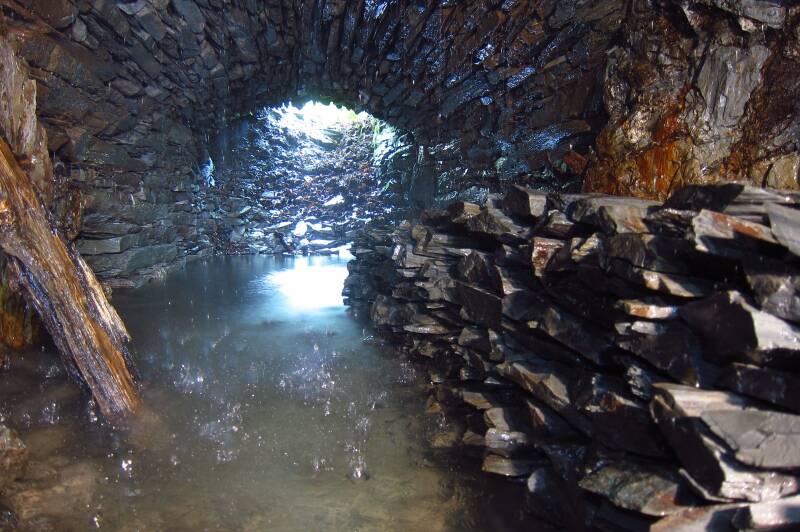
Photo below: a photo looking out of one of the adits at Common Wood slate mine. This particular adit was partially infilled at the entrance, but it has been excavated, possibly by the mine-explorer Erik Holland, a friend of my grandad. Nearly all of the underground workings at Common Wood are highly unstable and unsafe, even though this adit has been partially excavated, to go along it means crawling under dangerous collapses, and it doesn't actually lead into any significant closeheads anymore. Despite my comments earlier about not being sure how old the Common Wood slate mine is, this particular tunnel has an arched entrance, built with small slabs of slate placed in such a way to support the ceiling above, this section of tunnel is visible in the photo below. Now, this is particularly interesting, because this is not typical of the "matt-spedding" arched tunnels built from slate slabs, found more commonly in Cumbrian slate mines. No, the type of masonry visible in the tunnel in the photo below - appears to be something older, with similarly masonry being visible around a slate mine tunnel at Fisher Bank workings on the Coniston Old Man, a tunnel which, from what Alastair Cameron has told me, may well be very old, hundreds of years old, long before the industrial revolution. It is possible that the masonry in the photo below is equally old - or at least comes from that older tradition, back in a time when older forms of language would have been more prevelant.
I hope that this article was interesting to read. Please note, I am very serious about the dangers of the mines in this valley, including slate, copper and iron mines. They should not be entered.
I hope to soon(ish) write a blog post about Eskdale, which again will be unrelated to my other publications, including those about Eskdale. In the aforementioned upcoming blog post I will talk even more about the etymology of "Esk" and also share information about a flint find in the valley - and of course, more on ancient history not previously discussed in relation to the valley.
Add comment
Comments