Written and published by Linden Alexander Pentecost, published in the UK. The author is also from the UK and lives in the UK. This blog post article is published on the 21st of December 2025 and only on this website. This article is unrelated to any and all of my other publications, including others where I discuss some of the places in this article, albeit in a different way.
I have written, and published this blog post on the winter solstice of 2025 (21/12/2025), and it is likely not a coincidence that in this blog post/article, I have written much about the ancestors, and mythical traditions. I believe that this stuff is real. I believe that there are ancestral guardians who can make themselves known in the northwest of England today. This article is also an acknowledgement of those ancestors, and - for thousands of years, our ancestors in Britain would have been in touch with their ancestors and spiritual guardians, especially on the Winter Solstice. This article, as well as sharing some beautiful places in Cumbria, and one in Lancashire, and their mythology, traditions and my own research and thoughts, with language, archaeology, and magic, blended in - this article also I hope invites us to look upon our ancestors, to have empathy for them and for the living nature around us. The 5 photos in this article (each pertaining to one of the places discussed) were also taken by the author and have not been published before. This article contains 3242 words. The photos are placed at the end of each place discussion, before the next place discussion, with separate text above each photo. I mention two separate dreams in this article. The otherworld is mentioned often in this article, with regard to different places and things.
I recently said to somebody that my four favourite places in the Lake District are perhaps the Coniston Old Man, Great Langdale, the Duddon Valley and Eskdale. I decided to extend this list slightly, and in doing so to try and describe these and other places, with different information, in a new way. The places I discuss in this article or blog post, are:
.The Coniston Old Man
.Great Langdale, Langdal
.Hawes Water, Hawswatter
.Longsleddale, Longsleddal
and
.Eskdale, Eshdal
I have decided not to include the Duddon Valley in this blog post, as yesterday I wrote an unrelated blog post on this website about the Duddon Valley. The blog post about the Duddon Valley, which also talks about ancestors, ancient history, language, mining in the Duddon Valley and other topics, can be viewed on this following link: https://www.languages-of-linnunrata.co.uk/2890983_exploring-the-duddon-valley-in-cumbria-more-on-place-names-history-other-topics-20-12-2025 , and is titled: Exploring the Duddon Valley in Cumbria, more on place-names & history & other topics 20/12/2025 . In the article published yesterday I talk about wanting to write more on Eskdale. I talk more about Eskdale in the article/blog post in front of you.
The Coniston Old Man
I like the Coniston Old Man because, it has an interesting history. There is a potentially ancient history of copper mining around the mountain, and the mountain also has slate mines and quarries, some of them perhaps pre-medieval in origin. The mountain is historically interesting - to me.
But also, it just has a nice feeling. It feels like a sacred mountain, a safe place. Which is not to say it isn’t dangerous, but, I feel that the mountain is a guardian of sorts. Its presence and the sight of it comforts me.
It probably had ancient significance to, perhaps in-part related to the copper mining, perhaps for its general energetic and spiritual qualities. There are stone circles and other ancient sites not far from the mountain. There is also Erin Crag, not on the mountain itself, but nearby. This name is curious because of the similarity between “Erin” and the Irish word Éire meaning “Ireland”, Scottish Gaelic: Éirinn, and the name of the Irish goddess, Ériu. I do not know the original meaning of these words, but I feel that the goddess’ name has connotations connected to the land.
The name “The Old Man” itself contains the root-word *man-, in the Lunesdale dialect this refers to a pile of stones or a cairn, it is likely related to the Welsh word maen - “stone” and to the Cornish word mên - “stone”. The original language of this name may connect to prehistoric peoples in the landscape - perhaps to those who built the stone circles. The element “Old” in the name may be related to Welsh allt - “slope”.
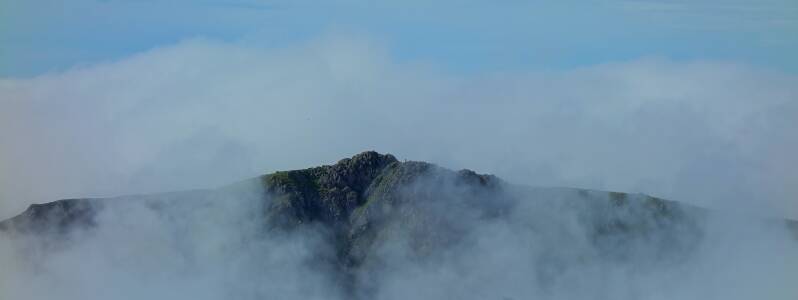
Photo below: a view to another mountain from the top of the Coniston Old Man, taking during a cloud inversion. I hope this photo shows the magic of this mountain environment, and its clean, misty air.
Great Langale, Langdal
I like Great Langdale, locally pronounced: Langdal, again - because of how it feels, and its abundance of ancient history. The ancient people would likely have had specific stories and narratives connected to the surrounding mountains and to the valley itself. During the Neolithic period, certain parts of this landscape were considered sacred, and stone was extracted and mined to create axeheads. The locations from which the stone was taken, and mythology surrounding such axes, indicates I think that they were ritual and ceremonial to some degree, as was the process of mining for them.
One of the main Neolithic mining sites is known as the Langdale Axe Factory, even if the word “factory” is not very accurate I think. This site stands high on Stickle Pike, and below it can be seen several arrangements of stones, as well as cairns, likely prehistoric in origin.
At Copt Howe in Great Langdale, there are Neolithic petroglyphs carved into large stone boulders. Many of these show spiral shapes, similar in appearance to the way that complex sound waves might appear on the surface of water or sand for instance. In a sense, I feel that they also represent a form of sacred language and geometry.
Thunacar Knott is an area of mountaintop with another Neolithic axe mining site. This is interesting, because there is some folklore surrounding the connection between these axeheads and lightning, i.e. with implications that these, and sometimes similar stone tools were created by lightning, and other things. Perhaps the name Thunacar is an ancient name in some way related to this, with the noteworthy similarity between the *thun- element in “Thunacar” and the word “thunder”. I wonder if this element *thun- might be related to the word "thunder", but of pre-Germanic origin. It could even be connected to some kind of thunder god, which would lead us onto the subject of the "thunderstones" or thunnerstians in parts of Cumbria, large boulders. Sometimes these thunnerstians look similar in shape to giant bird heads, which, along with other things, leads me to think that perhaps, if there were "thunder gods" of ancient Cumbria, they may have been seen as appearing bird-like, akin in a sense to the thunderbirds found in the indigenous traditions of the Sioux and many other indigenous American tribes.
The exact kind of stone which was mined, makes a kind of metallic sound, when you knock two pieces of it together. This, and other things, make me think that the sacredness of this valley, its stone, and the petroglyphs, could pertain to a knowledge of acoustics and energy in some way. The mountain Stickle Pike is also very dome-shaped, appearing a bit like an enormous church bell, and of course the rock from this mountain also “rings” in a particular way. This, and the possible connections to thunder, make me curious.
There is also a legend, represented in Cumbria, but found in different forms throughout much of Britain. Sometimes the sleeping hero is King Arthur, in Ireland, it is sometimes Fionn MacCumhaill. In some of these legends, a person enters a cave in a mountainside, and finds a chamber full of sleeping knights, often alongside King Arthur, or another cultural hero. When he passed into and out of the tunnel, he has to be very careful not to knock the large bell which is placed hanging in the middle of the tunnel.
Although the link between this and the “bell-shaped” mountain of Stickle Pike is not direct, I find it curious. The stories often indicate in some way the connection between “sound” and the “Otherworld”, and to awakening the heroes and gods that live therein. I wonder if the ancient mine chamber on Stickle Pike - although small, might be connected in some way to these stories.
Photo below: the site of the Copt Howe petroglyphs in Great Langdale/Langdal. Some of the spiral, line, and other petroglyph markings are visible on the rock around the lower right of the image.

Hawes Water, Hawswatter
There is a Haweswater, a larger lake, located in the eastern Lake District, not far from upper Longsleddale. But there is also Hawes Water, or in local dialect: Hawswatter, a small, but ancient lake, located not far from the village of Silverdale in Lancashire. This lake has evidence of ancient human activity, and I have found other possible archaeological sites around the lake, including a large, semi-megalithic wall, possible burial cairns, possibly stone rows and a possible passage tomb and cave associated with those stone rows. These areas are now largely overgrown though, and I hope that they are left alone, if I am honest. They are not confirmed as archaeological sites, but I have published about them elsewhere and shared the information with people.
More generally in this article I want to discuss the feeling and atmosphere of the lake itself. To me, Hawes Water has a very spiritually, electrically charged atmosphere. The reedbeds around the lake, and the Scots pine trees, combined with the beautiful skies, forests, and birdsong, take one mentally to an ancient sense of peace, a very ancient feeling, that I think connects to the spiritual nature of this site.
The atmosphere does not feel off or spooky - at least, usually. Sometimes it does feel a little spooky actually. But, that’s the thing about these places, often they are both scary and peaceful, depending on how we respond to them, and they to us. Certainly, Hawswatter feels like an entrance to the “Otherworld” in some way. In many ancient cultures, any body of water could be an entrance to the spirit realm.
But Hawswatter is surprisingly deep for its small size. It is a bit like a strange waterhole, akin to Montezuma’s Well in the United States, which is considered a very important entrance to the spirit realm or underworld. So, perhaps Hawswatter was similar in this sense.
There is also a reference to legends of a giant eel or serpent living in this lake. This may strongly put us in the territory of deep indigenous history, especially combined with the archaeological sites, long history, and general sacred atmosphere of the place. As I will go on to discuss about Eskdale, eel or serpent-like spirit beings are associated with rain, and waters, especially sacred water holes akin to Hawswatter, with these legends found in many parts of the world, throughout many cultures.
In the case of the Hawes Water serpent or eel, it was said to wrap around a large rock, called the Buck Stone, some distance from the lake, and to have sometimes eaten sheep and taken them into the lake.
The connection between the serpent, and this specific rock, the Buck Stone (unconnected to the other Hawes Water archaeological sites I have already mentioned), is akin to a common thread of mythology regarding serpents spiralling around sacred hills, mountains and rock formations.
This can be interpreted in a way as describing the flow of energy and sound, with serpents often representing the physical flow and cycles of water, but also being connected to the invisible “waters” and energies that flow throughout the landscape.
When you stand beside Hawes Water, and feel its peaceful, sacred air, and feel as though you have stepped back into Mesolithic times - it is easy perhaps to imagine this lake as an entrance to a spirit realm, guarded by a prehistoric spirit being of an ancient, previous world. But I at least do not think this guardian spirit feels unfriendly. Nevertheless, Hawes Water should be treated as a sacred place, and its ancestral spirits respected.
The name "Hawes Water" or in the original local language, Hawswatter, can be related to a hypothetical Anglo-Norse name: *hals-wattr or *haws-wattr meaning "neck water", as in, a "water" or lake which is situated at the "neck" of a valley or stream system.
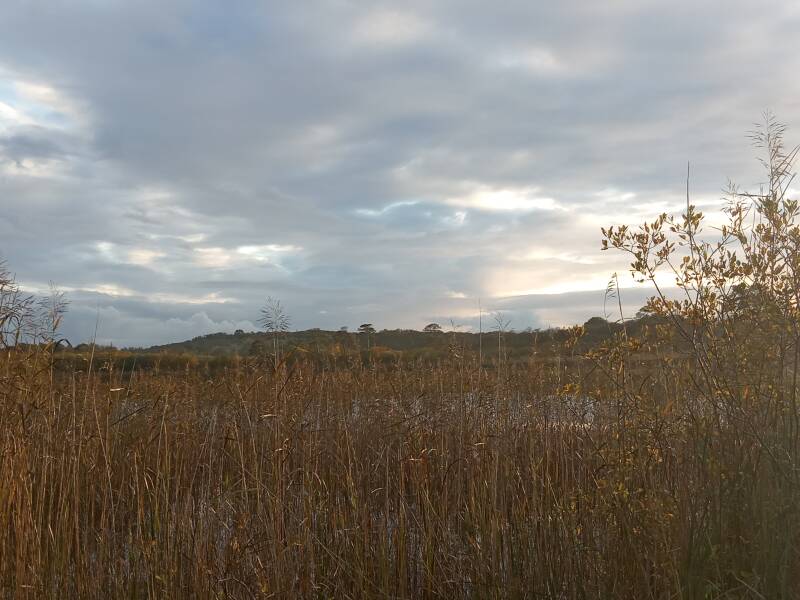
Photo below: Hawes Water in autumnal, evening light, showing the reed beds, water and great skies above. This I hope gives some idea of the place's spiritual energy. Note, be careful near the shore of the lake, the reeds and roots also make it dangerous to swim in.
Longsleddale, Longsleddal
Longsleddale, or in the local dialect: Longsleddal, has appeared in my life recently. I have been before. But recently it has popped up often, including my mum having a dream about Longsleddale. In this dream, she went to a tunnel behind a waterfall in Longsleddale, perhaps one of the tunnels in the Wrengill Slate Quarry, which has tunnels behind its waterfalls. However, in the dream in question, when she reached the other end of the tunnel, she found herself in something like the “Otherworld”, a different world, where the colours were different, and had more blueish and greenish tints. My mum may in the future decide to write a story based around this dream and others. Note that I also mention in this article a separate, prophetic dream by my mum, pertaining to Upper Eskdale.
This was a dream, but Longsleddale has no shortage of magic. The valley does not feel sad to me, but its energy feels heavy and imposing. When I go there, I feel as though I'm deliberately isolating myself and stepping into a kind of wilderness. I have been there in the snow, besides the waterfalls in the high valley, the prominent rocky crags that rise around. It feels like a place of trolls, giants, and also in a sense, a lonely place, one which I only venture to when I think I specifically need to feel lonely, and to be in touch with the raw, ancient expanse of mountain, stream and rock.
I have gone there a few times during a romantic break-up. Maybe I do go there to feel comfort in a way. I don’t mean the kind of comfort which is ordinary or easy, because the landscape at the top of Longsleddale is raw, lonely, haunting. But in that place I also become small, in touch with something far bigger than myself.
There are some very interesting place-names in and around the valley, including for example the name Ulgraves, a place-name that I think could be connected to the god Ull (or Ullr in Old Icelandic), with the second element, -graves, referring to caves or to graves. The god Ull is also I think connected to the Ullstone or in local language: Ullstian in Kentmere Valley, very close to Longsleddale. The more local understanding of this figure Ull seems, in my opinion, to have been of a giant, warrior type figure. I believe that his name is also especially attested towards the east, for example Uldale, in local language: Ulldal, near the Howgills. There are also other legends of giants from elsewhere in Cumbria, including from the Troutbeck Valley, also not far from Longsleddale. I have written on this a lot in other publications.
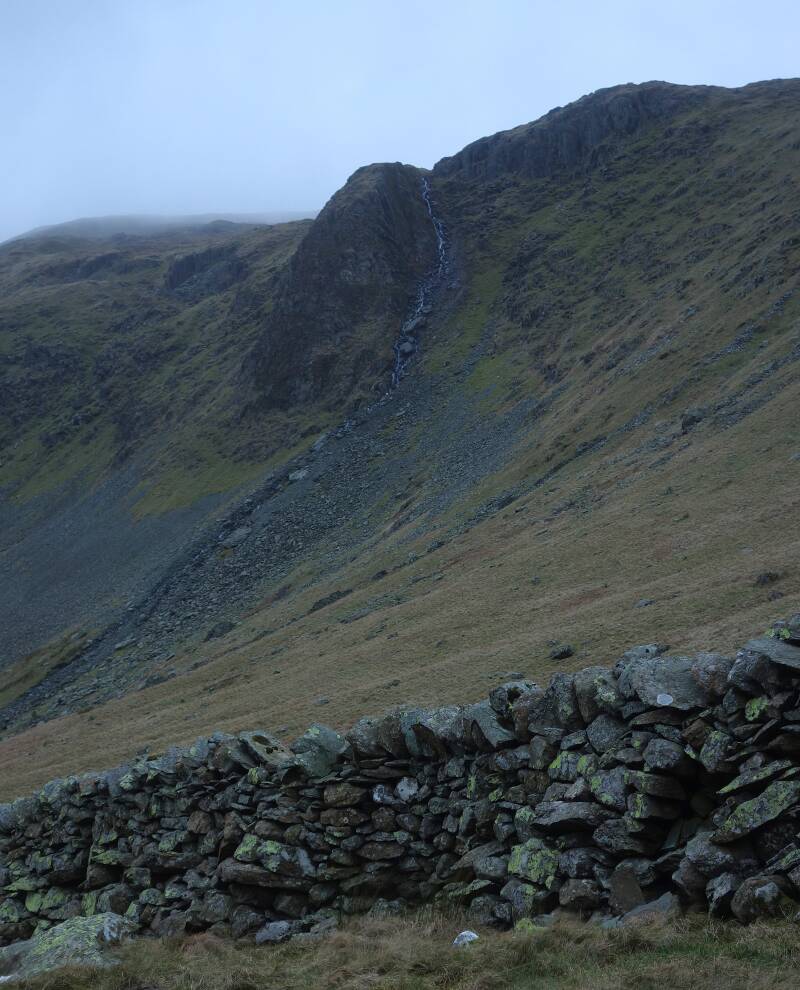
Photo below: mountainous scenery in Upper Longsleddale. Indeed I hope this image helps to give an impression of the valley's wildness in winter, with mists, waterfalls, rocky mountainsides and slopes. This particular area around this drystone wall feels like a place where trolls or giants might walk, especially at dusk, like when the photo below was taken.
Eskdale, Eshdal
Eskdale, locally pronounced Eshdal, is another of my favourite valleys in the Lake District. This valley feels really sacred, and, somehow deeply romantic to me. I love the forests near the village of Boot, but also Upper Eskdale, below Hardknott Roman (or pre-Roman) fort, which stands in a majestic place above the valley. It is really breathtaking and hard to put into words I think. There is a sense of peace, and a feeling of warriors and guardians, that I strongly feel at Hardknott Roman Fort. It’s a nice feeling.
The River Esk itself is also lovely. There are pools like Tongue Pot in Upper Eskdale, which is arguably one of the best wild swimming locations for miles around. There are rowan trees that blow in the breeze, mossy river banks, and craggy mountains. The valley and areas just beyond it are also full of prehistoric sites, and I feel strongly that the valley itself was considered to be a sacred and special place.
Once, someone I know had a dream about a particular boulder, high in the Eskdale Valley, a large boulder in the higher mountains. She dreamed that beneath the boulder she found a worked piece of flint. At the time she did not recognise the place, but a few days later, in her waking life, she walked up Eskdale. She found the boulder in question, in physical, waking life, and looked underneath the boulder. There in the mud, a worked flint scraper had become exposed from erosion. I wonder, was the scraper used to work hide - in which case, did this boulder form a kind of hunting shelter? Or, was the flint perhaps deposited there as an offering to the spirit of that boulder and place? I will not reveal the exact location of this boulder, for I feel it should not be disturbed. I have not been there personally, but I would like to go there, and to see if there is more vulnerable archaeology there. If there is not, I may tell people the location - if it feels right to.
I have talked quite a bit about the etymology of the name “Esk” before, with it being similar to words for “water” and “fish” in Celtic, and/or, pre-Celtic languages. Compare specifically Old Irish escong - “eel”, perhaps indicating an idea that this river could have been connected to a water goddess with fish-like and/or eel or serpent-like attributes. I feel strongly that the “water” of this valley is very sacred.
Another possible etymological connection appears in the Orkney Scots language. In Orkney Scots, esk means to “rain slightly” (1), so perhaps if there is a connection here, then the “Esk” goddess of Eskdale might not only be connected to river water and to fish, but also to rain in some way. In many cultures throughout the world, serpent-like water deities are frequently associated with rain, with water, and with life itself.
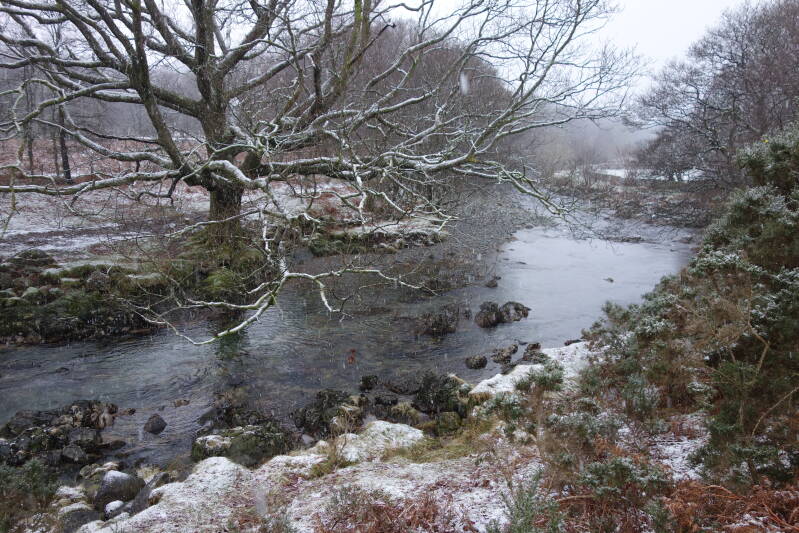
Photo below: the River Esk in beautiful winter light, with light snowfall. Higher up the valley, the snowfall was much more of a blizzard. To me, the scene of this image is quiet and beautiful. I wrote about the snow in Eskdale in an unrelated publication not that long ago, and in others longer ago.
I hope that this article was interesting, thanks, and may we honour the ancestors and nature, and each other.
Add comment
Comments