Written and published by Linden Alexander Pentecost on the 30th of December 2025. The 6 photos were also taken by Linden Alexander Pentecost, which have not been published before. This article is unrelated to any and all of my other publications, including those where aspects of the topics in this article are discussed in different ways and including other publications recently. No AI was used in this article. This article was only published on this website, www.languages-of-linnunrata.co.uk and was of course published in the UK, and the author myself is from the UK and lives in the UK. The photo descriptions above the photos contain information not in the main text. The main written content begins below the photo below the photo description below. This blog post or article contains 4190 words. This article uses some in-text citations. The topics discussed in photo descriptions relate more to my recent explore in the valley and discuss different aspects e.g. Wrengill slate mine and other things, often different topics from the the main text, both are equally important, as are the photos. Note - this blog post is rather long. This article contains many topics that go far beyond Longsleddale itself, its history, place-names, wizards, and my experiences and also recent journey there, but which also connect to a more esoteric range of romance, fantastical and spiritual topics. Note I have published much recently including other unrelated publications that relate to witches and sorcery etc, unrelated to the topics of this blog post.
Photo below: looking up Longsleddale, the River Sprint visible in the foreground, running near beautiful old oak trees here and there.

In accordance with recently writing about this valley in an unrelated blog post on this site - I wanted to write more about it in a new blog post. Since writing the previous article where I talk about Longsleddale, I have been back there. And learned some fascinating things, I think.
Before entering the valley proper, close to the hamlet of Garth Row, I noticed several earthworks, the remnants of earthen banks on the grassy hills, and below the hills. Furthermore, I noticed a possible ancient wall or even stone row. This is an area I only passed through briefly, and I will have to get back there. These could I think be connected to ancient extra-Goidelic cultures of the Bronze Age and later, note that Skelsmergh near Garth Row contains the word element *-ergh that appears in Old Irish as airghe, generally referring to a place where cows were milked, and a name-element found in various ancient agricultural locales in the area. If the earthworks around Garth Row were part of an agricultural ritual landscape, this would make sense to me.
We headed down into the valley through Garnett Bridge, and then along the valley towards Sadgill. Close to Garnett Bridge is another place-name, Mosergh, which also likely contains the *-ergh element related to Old Irish airghe.
I forgot how beautiful and unique this place is. Some areas are so gentle, but quite rocky, steep hills, with beautiful oak woods rising steeply. At this time of year, the oaks and birches look bare, and form pale grey and purple hues. Some of the crags and fell tops around the lower valley are impressive. But as one goes north, the mountains become more dramatic. We then walked towards the uppermost parts of the valley - along what is likely a medieval (or earlier?) road, where the mountains become truly steeper and dramatic.
Some of the gullies or gollicks (in Cumbrian dialect) still contain large boulders, stacked or positioned in a somewhat unstable way. One of us commented how one could imagine the ancestors on these mountains wearing Neolithic clothing, their hair blowing in the wind.
We commented on how the valley runs closely in line with a Roman road. The, presumably later road up the valley, also gives another aspect to Longsleddale being a kind of place of transition in a sense, a place, where probably many have passed through, over the thousands of years.
And yet, its history is somewhat mysterious. Its folklore - equally mysterious. The place-names give no clear indication of what the ancient meanings attached to this valley might have been - apart from the name Ullgraves at the bottom of the valley, which I discussed in another blog-post, and two names on the very lower edges of Longsleddale which contain the element found in Old Irish as airghe. This may imply that the land immediately below Longsleddale was a culturally, linguistically, and ceremonially distinct area
There are legends about giants living in Cumbria in the past, including in Troutbeck and nearby, and elsewhere. Yet Longsleddale - to me, feels very different from these nearby valleys. The landscapes share a lot in common, yet on a more subtle level, they are so different.
Kentmere feels ancestral to me. Foreboding. There are some ancient sites there. Borrowdale to the east of Longsleddale also feels different - more connected to the Eden Valley.
But Longsleddale, has no legends of giants, to my knowledge. It is a beautiful, unusual place of transition and travel. But something there feels hidden, unseen. It doesn't seem to be about "giants" as the only reference to a giant is the name Ullgraves at the bottom of the valley. So what is it? Within the main valley itself, there are no easily identifiable prehistoric sites. Were most of them covered with sediment? Or did they not build them here - for some reason?
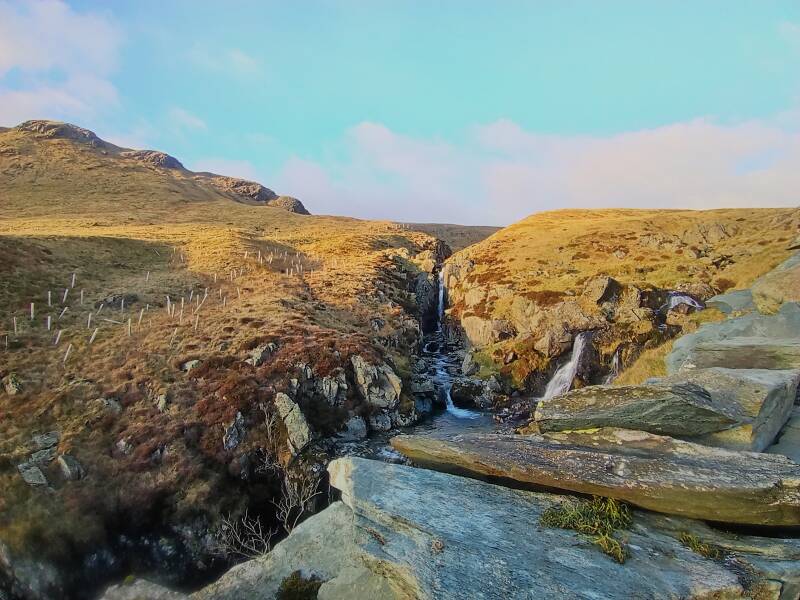
Photo below: one of the impressive, pretty waterfalls on the upper parts of the River Sprint, at the very top of Longsleddale. The photo is taken over the wall to the left of the old packhorse road. The Wrengill slate quarry/mine is just to the left and above the waterfall, and is out of view in the photo below. Note the golden colours of the grass in winter.
One of the most fascinating facets of this, is how things, places, can be spiritually "cloaked". We know, collectively, about the places with the stone circles, with the ancient sites. Archaeology and folklore, and linguistics, can help us to understand these places.
But what people rarely pay attention to, are those places that do not stand out in terms of archaeology and folklore, but which in a sense seem removed, almost invisible. Not the kind of places that people think about. This is not always the case of course. But instinctively we can feel when certain places are special. And sometimes, in finding things out, we can perform a complete reversal of the traditional method of asking questions.
As people I think we naturally want to see all of the things that stick out to us, and which make sense to us. But sometimes, it is also possible to look more specifically at what does not fit, what is unnoticed and stands out precisely for its lack of presence rather than its presence.
This does not mean that every place which has a vague and in some ways unextraordinary history has the same kind of meaning or importance as Longsleddale. The spirit of a place is something we feel, and the parts that individual places play in our world, are I think all important equally, but different.
And Longsleddale is one of those places, that, for me, feels like on the surface, it's a beautiful valley. Like others in the Lake District, but with less substantial history. From a purely surface level study, one could argue that the most important things historically have been the presence of a Roman road, a medieval or earlier road, and slate mining, around and within the valley. There is beautiful scenery. But there is not much to "see" in terms of particular points of interest for tourists and visitors. People in a sense pass through it now, much as they have done for thousands of years.
Photo below: the "waterfall closehead" at Wrengill Quarry. Please note that this is not safe to get close to. This is where the river cascades into a partially collapsed underground closehead. Clearly this complex of closeheads is quite old, with some areas of it completely collapsed, and others completely flooded. There is also a tunnel, visible just to the left of the waterfall. This is the tunnel that my mum dreamed of, where she followed it to find herself in the Otherworld (see my other blog post published some days before this post in front of you, in the other post I discuss other things on Longsleddale including this tunnel. In physical reality, the tunnel does not appear to go far, but rather, seems to lead into a flooded, underwater area of the closehead, presumably flooded because the collapse material in front of it has blocked the water from escaping. The water does escape from this closehead however, further back towards where the photo was taken, as it cascades down and across a collapse of slabs and bounders, tumbling downwards into the abyss, to then whoosh along a lower tunnel, where the water flows out into a different area of the Wrengill Quarry. The aforementioned area also has an old, collapsed Matt-Spedding tunnel, leading towards the cliffface, which would presumably have also accessed the "waterfall closehead" complex. This is indeed a fascinating place. It's not often that one comes across a mine which has a river flowing through its workings. Behind where the photo is taken, the closehead also extends into a dry area, although this area has always looked too unstable for me to thoroughly explore. These underground closeheads are seemingly unconnected to the closehead I mention with regard to the next photo (after the photo below). Furthermore, there is another small underground closehead higher up, which I did not visit on my most recent trip.

But, instinctively, I don't feel that is all there is to it. Because it feels like something is not visible, not spoken, in the landscape. Explaining the history of the valley and summarising it is somehow too easy and yet, whenever I explain it, my explanations seem to lack something. It is this "lack" of being able to perceive something, which I think makes me feel that there is indeed something not visible.
I had also been drawn to this valley before, at certain times, when I was having romantic breakups usually, as I talked about more in another blog post. Why this place though? The reasoning makes sense, it felt magical to go there, important. Yet I cannot make sense of why there, precisely, which again implies to me that there is something about this place, at least to me.
When we reached the uppermost parts of the valley, when I recently visited, I tried to become a bit more in tune with, and conscious of the way that the landscape felt. There were clouds, mist, that looked like it carried snow, glowing with the late afternoon light over the golden winter grasslands. It felt somewhat like, this was a protected place, the access point to a heavenly place, with its own rules. Certainly one of the strongest feelings I got was one of it being "protected" in some way. It felt powerful, heavenly, divine, yet somehow hidden and invisible to those who have forgotten how to see magic. And perhaps this magic can only be seen even more subtly, but its immense power can still be felt. The landscape made me think of Roman knights and of protective Iron Age and earlier warriors.
Photo below: an unusual arrangement of narrow gauge railway track, with some points, sticking out of the side of a slate tip, likely resulting from rock falls covering much of the original railway. Below is also another section of railway track sticking out from the tip. The upper railway track likely lead into the underground slate mine (closehead), the entrance to which is visible at the top right hand corner of this image.This closehead in question is of course not the only underground closehead at Wrengill (see comments above the previous image). The railway track and closehead entrance in the photo below are located a little further down the gill from where the waterfall closehead is located.

It was only on the way home, when I realised another possible clue in the mysteries of Longsleddale. One which indeed makes sense for me. I had no idea, that the valley was connected with "wise men" and with "wizards". Sometimes there is a more general association with the valley and these wise men, but for the most part, the legends focus upon a man named Doctor Lickbarrow, a healer who lived in the 1600s. But there are other implications that Doctor Lickbarrow's whole family possessed magical abilities, and that there were many "wizard-like" figures. Could this family have been descended from a much, much older tradition?
There is quite likely then, an association between Longsleddale and wizards, and healers. But, I believe that this could also translate into an ancestral sense of spiritual guardians of this valley. Perhaps the valley itself, and its spiritual forces are connected to wisdom in some way. Perhaps, the "warrior"-type figures I was able to imagine at the top of the valley, were magical warriors, wizards in a sense.
We tend to associate good magic and protection with - again, what is clearly visible. We associate many temples, churches and dramatic ancient sites with sacred powers. But - I believe in a sense that, sometimes the most powerful of these ancestor spirits, those who can teach a very specific and particular type of wisdom, are not going to be met in churches or in the "obvious places". Rather, the whole point in finding them is to seek them and feel them outside of what is normally visible. This always requires some kind of journey and courage, as I do not believe that all wisdom can be accessed through the traditional means.
Photo below: a somewhat lower.down part of the Wrengill, showing a curious rock formation on the left, which could have in-part resulted from quarrying. On the upper right can be seen slate tips, whilst ahead can be seen the

Take this for example. Imagine if ancient megalithic sites can teach us about science and reality, they - like other types of ancient sites, can teach us literally so much about our history and spirituality. But they can't necessarily teach us about other levels of spirituality, which cannot be searched for, nor accessed in the same way.
The fact I have become so drawn to Longsleddale during certain romantic times might be connected to this in some way. I have always gone to this valley, when I have felt the need to seek and understand what I truly need in terms of love. I think that, the ancestral presences around many ancient sites, can teach us important knowledge. We often gain this knowledge by seeking these ancient places and - respectfully seeking communion with the ancestors there. But there are some kinds of knowledge and wisdom, associated with particular places, which cannot be sought. This is an odd thing to try and explain but, essentially, there are certain things we cannot find through seeking them. Just as there are, paradoxically, certain spiritual doorways which cannot be opened by trying to open them - certain doorways that knowledge and wisdom cannot open.
I hope that my readers can follow this. But take for example, a person visiting a stone circle. They notice and pay attention to the ancestral presences there, they can feel them. The ancestors then notice the person's focus upon them, and respond, sometimes through feelings, sometimes through telepathy. Or of course they may not respond at all, depending on the situation, person and place.
Whereas if a person walks in Longsleddale, and seeks the ancestors, tries to ask them questions, identify ancient sites, as I have done - they may receive no answer. The doors may be shut, as it were. These doorways to ancestral wisdom cannot be opened through seeking knowledge or connection, nor can they be opened by somebody who is trying to look for them. So how are they opened?
Paradoxically, certain doorways can only be opened when we are not actively seeking nor trying to open them. The first stage is to look at this, not from a perspective of how a whole pattern can become visible and known to us, but to look at things in that pattern which do not make sense, which seem to be deliberately or purposefully missing. Then we have to ask - why are these things missing? An example of this is how Longsleddale has few archaeological sites and few references to ancient history. Longsleddale is therefore, in a sense, more important than other valleys, because it teaches us that something is deliberately missing from it. Spiritual arrogance can make us see the whole pattern and feel proud. But there is a totally different, and in many ways, more extraordinary type of wisdom that starts to appear - when we surpass our ego and look at the silent, empty, blank spaces, rather than looking at what we can make sense of.
When a person becomes more spiritually aware, they come to see patterns, and energies, that surpass time and space. Time becomes understood and seen differently, the present, past and future become aspects of the same patterns and truth. But this vision can become a trap, it can teach us knowledge, but this is not where our innermost truth is going to be found. So we have to see beyond that, look into the silent spaces, the gaps, the missing bits - and ask, why are those areas missing? This, or a similar concept, is touched upon in Maurice Cotterell's book: The Lost Tomb of Viracocha, on page 34 of which, it is written: "Omission served as the fundamental mechanism that facilitated the encoding of information".
The second step is to realise that in order to seek these "missing parts" of the pattern, we have to forget we are even seeking them. This doesn't mean we literally forget our search, but it means that something, namely, our inner self and inner joy, needs to override our "search", causing us to temporarily forget that we are searching. Paradoxically - to find these sacred doors - we have to be joyous in your heart, and to forget we were even looking for them in the first place. This is because God, or the true Creator, Great Spirit, is akin to our truest nature. And when we were young adults, before the World often broke us, this god, this joy, was all we knew. We need to remember our real identity, which is not about wisdom, power, or intellect and understanding - it's about knowing that we are a part of God, remembering that joy and love is our natural state. And in doing so, we become complete. We forget what we were searching for, because there is nolonger a need to search. This is when we, metaphorically, look into the palm of our hand, and find that we already possess the key. Note that I published an unrelated article a few days ago where I also talk about different types of key in symbolism related to the Picts & a cave.
And the difference is also one of this key being entirely personal to us. When we talk of spiritual knowledge, we are using the same keys to open the same or similar doors. But when it comes to seeking God/The Great Spirit and our absolute truth - the only key that is going to work is that which we already possess. But we have to temporarily forget our knowledge and ego in order to find it.
In terms of most sacred places, empathy opens the doorways. Empathy will immediately draw the attention of ancestors and guardians towards us. But places like Longsleddale - at least to me, they require a more personal empathy. And this could be for example, saying something like: "I want to know love again and I want to feel joy again - because this is my true and only nature - it always has been this, and it always will be this. I have tried and searched and suffered - I have felt lonely innumerable times - but I release all of this and let it go".
Many people mistake choosing oneself for choosing one's ego. Many of the people I've met who talk about "self-love" and "choosing oneself" entirely miss the mark in terms of understanding what this really means. The thing about this knowledge of self is that it cannot be abused or misused, because, like the spiritual doorways and guardians of Longsleddale, it simply cannot be sought nor accessed by one who doesn't have pure intentions.
I am a fan on the author Neil Gaiman. I watched the film Stardust, based on his book Stardust back in 2008 when I was staying in London. I don't exactly know why this film has come to my attention again lately. Not everything about the story is so nice, for example, the fact that the main male character basically kidnaps a woman who is in fact a "fallen star". But the story is beautiful in its internal, deeper spiritual meanings, and really - I think it's about seeking true love, and the true self. At the end of the film, when the main characters both become stars, this is akin to the journey to God and to the source of all things, to shine eternally over the world and to become a light that guides others. Furthermore, the main character seeks the star for his first love interest, but in doing so, finds his one true love. This is in a sense akin to how we might seek love in the wrong place, but are, nevertheless seeking love and our true self, which inevitably leads us towards that, even if we have to forget what we were searching for, in order to find it.
Another of Neil Gaiman's books is called Neverwhere, and this is arguably one of my favourite books. It is a mystical fantasy, coupled with themes of arcane history and hidden secrets, set in London, or rather under it, although I first read this book when on a plane to Helsinki, and not in London. In Neverwhere, the main female character is called Door, who's magical abilities bare a resemblance to this concept of "opening doors" with magic, which I have discussed in this post and elsewhere. In my opinion, the reason why books like Stardust and Neverwhere are so popular, are of course in part due to the writer's ability to write and describe. But all great writers, Neil Gaiman included, perhaps feel that the author does not choose the book - rather, the book, the story, chooses the author. Fantasy writing can be far more mystical, and convey true things, far more ancient than the book itself. For me, the stories of Stardust and Neverwhere are not just made up stories, but rather, they remind us of something that we already know and feel inside. And so reading these books is not about following a story, but rather about remembering a piece of who we are. Which is why, reading Neverwhere coincided with a massive change in my own consciousness. And why, reading Stardust filled my life with magic, as it reminded me of, and made conscious, something which deep down, I already knew.
Photo below: the sun setting behind the mountains, casting golden and pink light into the mists. The golden-pink flow is also reflected beautifully on the pools of the River Sprint below, mimicking the idea of "as above, so below", as the waters below are also the waters above.

When I initially thought of writing this blog post, I did not initially think that something about a particular valley, would open up into a vaster range of topics. But in connection to what I said earlier, I think that the topic or writing chooses the writer, as much as, if not more so, than the writer chooses the topic. This will be the last piece of writing I will publish on this website this year (I will however publish on other websites before January 2026).
I think I have some understanding of why Longsleddale feels special. There is also one part I don't understand and do not know. With an open heart I will go forth into the new year (in around 2 days) with hope, a fair amount of Finnish rock music, and blessings to all. I feel as though humanity is on the verge of a great shift. May it not lead us astray, nor lead us to neglect ourselves. May it instead lead us home, back to ourselves. May we remember why we are here on this Earth. May we have love in our hearts. I thank the guardians of Longsleddale.
Add comment
Comments