This blog post/article was written and published by Linden Alexander Pentecost. Published on the 2nd of January 2026. No AI was used. This publication on this page is only published on this website (www.languages-of-linnunrata.co.uk) and this article on this page is unrelated to and separate from all of my other publications. No AI was used. This article was published in the UK, and the author is from the UK and is a UK-resident. The main written content of this blog post begins beneath the photo description below the photo below. The photo descriptions contain content and information not in the blog post's/article's main text. This article/blog post contains 2880 words. Some of my other blog posts on this site also connect to the topics in this article, but each blog post or article is unique and the commonalities in the topics are never discussed the same nor with the same information from publication to publication. Note I mention horses in this article about Ull/Ullr, but that few days ago I published another unrelated article but about about the Finnish language, where horses and words for "horse" are touched upon in a different way, e.g. English "hobby" and Finnish "hevonen" and their similarities etc. For reference purposes, the URL of this article/blog post is: https://www.languages-of-linnunrata.co.uk/2908176_searching-for-ull-an-ancient-god-of-eastern-cumbria-and-other-discussions-published-on-02-01-2026 . This article contains two photos, one of which I, the author, took, the other of which my mum took, and the photo by my mum is included in this article with her permission. Updates were added to this blog post on the 8th of January 2026.
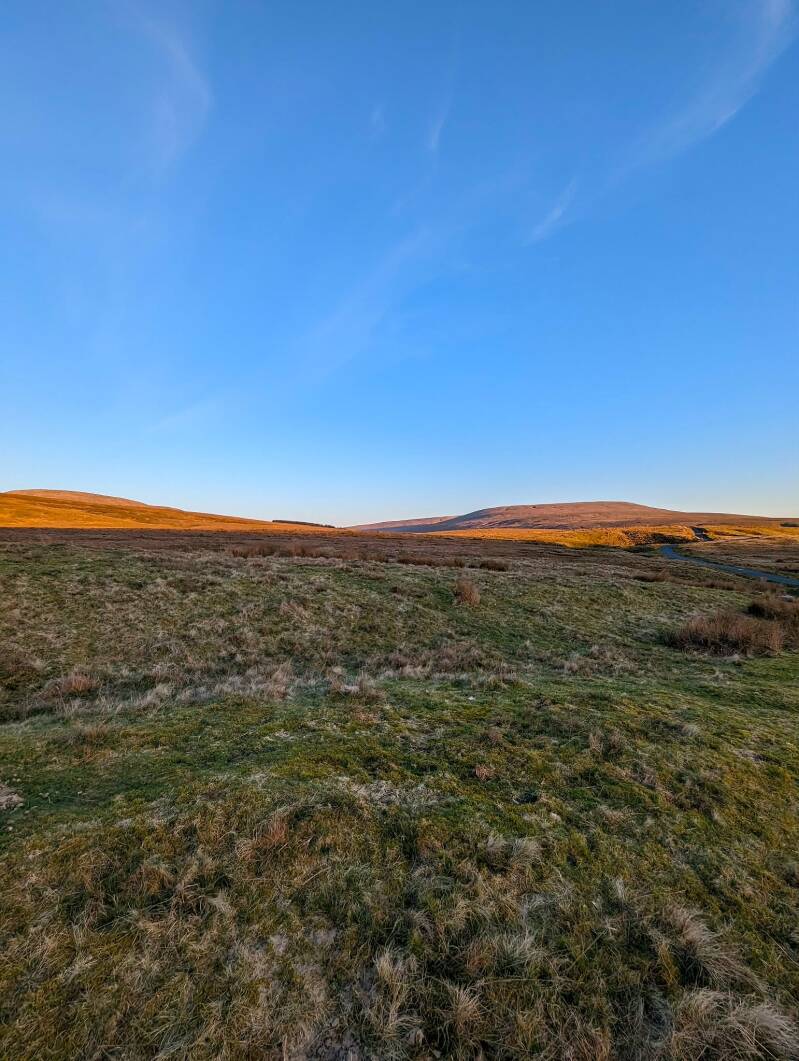
Photo above: an early Spring evening view, looking towards the mountains in the Upper Eden area, with Ulldale, Ulldal, visible as the valley in the distance, in the centre, with the large pine forest on the left side of the valley. It is possible that the valley was in some way spiritually important as a place associated with Ull, the god, or with "Ull" being also a possible title to refer to giant beings. The photo was taken by me in Spring 2023.
When we think of the Norse gods in modern society, we are generally talking about only a certain perspective of them, as explained and elaborated in Old Icelandic literature. Most people have heard of Odin, Thor, Freyja, and Loki - for example. These gods are given central parts in the narratives of Norse mythology, as explained and handed down to us through Icelandic literature. But Icelandic literature is just one facet, one version of a much larger picture, which stretches back in time to long before the Norse as we understand them.
The irony is that, people in the north of England all know about Odin and Thor. We wrongly assume that this "version" of Norse mythology and language must be the exact same mythology and language which we identify as being "Norse" in Northern England. This is why English Norse pagans might learn Old Norse (Old Icelandic) and pay attention to these well known deities like Odin and Thor. But, at least in my opinion, the reality is somewhat different.
For one, my own research has lead me to believe, that what we identify as "Norse" place-names and elements in Northern England, may actually represent an older kind of language to the "Old Icelandic" language that we generally call "Old Norse". Furthermore, many of the archaeological sites, folkloric features, names, words, attributes of Northern English culture - which can be associated with "Norse" culture, may have been in Northern England much earlier than when the Vikings were supposed to have arrived. I have done a wealth of discussion about this elsewhere, but I will include some more examples in this article to demonstrate what I am speaking of in the context of Ull.
Furthermore, "Norse" languages are Indo-European languages, but I am not convinced that all of the words we identify as "Norse" are even of Indo-European origin. Imagine for instance that, over a period of over 10,000 years, the people of Britain and Scandinavia have been in contact, and that many of these "Norse connections" in England may come from previous linguistic and cultural manifestations, long before the Vikings, some of which may be entirely non-Indo-European - despite that these non-Indo-European elements would have become incorporated into the later Norse and Norse-like languages in Britain and Scandinavia.
In England, we are drawn to the popular version of Norse mythology because it gives us a sense of ancestry and spiritual connection. But in a sense, we have a lot more work to do, before we can accurately reconstruct and understand how the ancient Norse and pre-Norse in Northern England, related to their spiritual world. There are for example, churches and crosses in Northern England, with depictions of a horned deity. This is usually assumed to be Loki, from Icelandic tradition. But we actually have no idea what this local horned deity was called. And it will have to be a discussion for another blog post.
Ull, or in Old Icelandic: Ullr, is a very mysterious deity. Whilst people in Northern England have mostly heard of Thor and Odin, and associate these Gods with the Norse in Britain - Ull was, in my opinion, a much more widely recognised God by the pre-Norse and Norse peoples of Northern Britain. In Icelandic literature, Ullr is occasionally mentioned, but seems not to have been a major part of Icelandic religious tradition. Saxo Grammaticus, the medieval Danish writer, implies that Ullr is a kind of wizard, who used a certain "bone" to cross the seas.
Ullr is sometimes associated with, and possibly even depicted with having skis, and it could be that this "bone" he is said to ride, is rather skiis, made from bone. This actually shows a partial similarity to the Finnish deity and wizard Väinämöinen, Whilst Väinämöinen does not create a boat out of bones, he does create the first kantele (an ancient Finnish instrument) from the jawbone of a giant pike, and is also associated with traversing the sea. Although Väinämöinen tends to perform this by shapeshifting into an animal, or, later on, by singing magical runes (in the Finnish sense meaning "magical poems") to create a ship out of copper - but this is another topic which verges on the subject of how sound and vibration influence matter. A deep topic, I have discussed elsewhere in terms of Finnish.
Ullr is perhaps first and foremost associated with hunting, and is associated with bows, and is also said to have made a home in a place called Ýdalir, which is Old Icelandic for "Yew Dales". This is likely in reference to that the wood of yew trees was particularly effective for constructing hunting bows. Ullr is also associated with the winter, especially perhaps due to his skis, although personally I think that Ullr/Ull is neither simply a "hunting god", nor simply a "god of winter", but is a far more complex figure. Ullr/Ull is also associated with making oaths, so we can assume perhaps that Ullr/Ull was also a deity of high authority, and associated with honour, and with good work, in some way.
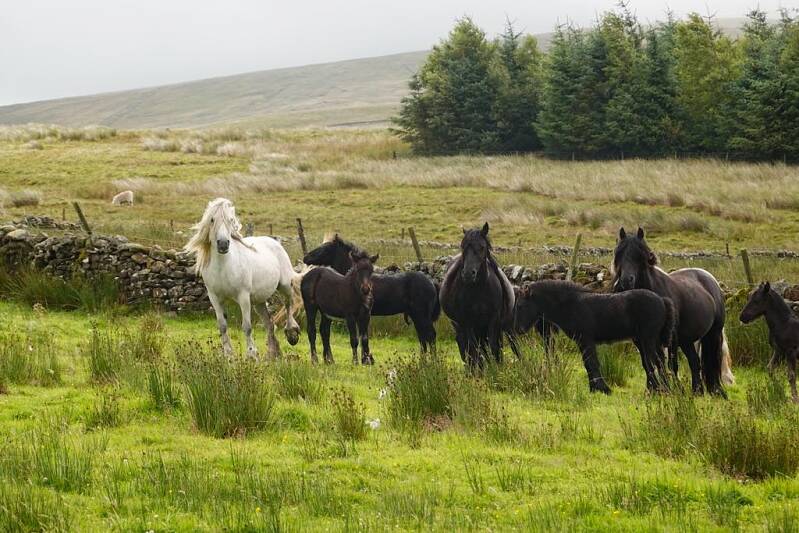
Photo below: wild horses in Uldale, Ulldal, Upper Eden. These wild horses or "fell ponies" are descended from ancient wild horse populations in Northern England. Just as horses are well known to the steppe cultures of central Asia, so do the landscapes of the Upper Eden Valley also remind me of steppe landscapes. Horses had great spiritual and cultural significance in ancient Britain. Not far from Uldale, near Sedbergh and on the Howgill Fells, there is a possible ancient motif of a horse, made from small stones on the mountainside, similar to the chalk figures of Southern England. The aforementioned figure is sometimes known as the "Bush Howe Geoglyph". The photo below was taken by my mum and was included in this article with her permission.
Ullr/Ull probably wasn't widely known across the whole Norse-speaking World, but seems localised to specific areas. There is for example Ullsfjorden in Troms, in Northern Norway, and for example Ullensvang in Western Norway.
In Cumbria, particularly in eastern Cumbria, place-names that mention "Ull" abound, but they tend to be, in my opinion, mistakenly assumed to be place-names in reference to wolves or to Viking individuals. In Britain place-name studies, if a Norse-looking place-name contains an uncertain first element, it seems common practice to simply assume this was the name of a certain Viking, even though there isn't always much evidence for this. I personally think that many of the Ull- place-names in the Eastern Lake District are referencing Ullr/Ull, but this is speculative, and I need more evidence and context to be more sure.
For one, in Kentmere there is a large boulder called the Ullstone, or in local dialect: Ullstian, which is connected to a giant named Ull. So clearly a magical figure called "Ull" did exist in this part of Cumbria. Therefore it seems reasonable to suggest that other Ull-names in Eastern Cumbria and in the Eastern Lake District may well be referring to this god. However, the legend about this giant "Ull" is obscure, and is only mentioned in a few places online, one example being in a photo description of the Ullstone by photographer Joan Martin. In her photo description she relays a story about Ull being a giant, who lost a bet and that the Ullstone/Ull Stone in Kentmere was part of a dice, thrown by this giant Ull from Cockermouth. I did since contact Joan Martin, and learned that the legend about the Ullstone was told to her by an elderly man in Staveley, and that afterwards she also found a written reference to the legend, but cannot remember exactly where. The legend does indeed seem authentic to me, and in time I hope to learn the written source, although the fact that an older gentleman in Staveley told her the story is to me just as authentic as it being a written source. Indeed my whole theory on the god or title Ull being once known in Cumbria rests upon the authenticity of this legend about Ull as a figure, and I feel convinced and sure that the legend is true. In addition, Uldale near Caldbeck was recorded as Ulvesdal in 1216, implying that Anglo-Norse ulv, meaning "wolf", whether as a personal name or meaning "wolf", was certainly an etymological meaning attached to the name Uldale in Caldbeck, even if that was not its original meaning. According to Steve Bulman's website for example, Uldale is derived from the River Ellen, "Ellen" which runs through the valley, and this is connected to the Roman name Olena, but I do not know the original reference for this connection. The webpage in question of Steve Bulman's website is: http://www.stevebulman.f9.co.uk/cumbria/1901/uldale1901_f.html . Note that I also have published about the Ullstone elsewhere.
I list a few of the examples below:
.Ullswater (Eastern Cumbria), local dialect: Ullswatter, possibly from Anglo-Norse: Ullswattr - "the lake or water of Ull"
.The Ullstone (Kentmere), local dialect: Ullstian, possibly from Anglo-Norse: *Ullstian, *Ullstein - "Ull-stone"
.Ulgraves (Longsleddale), possibly from Anglo-Norse *Ullgraves? - "Ull-Graves/Excavations"
.Uldale (near Caldbeck), possibly from Anglo-Norse: *Ulldal - "Ull-Dale/Valley"
.Ulthwaite Rigg (Mosedale), possibly from Anglo-Norse: Ullþweit Rigg - "Ull farmland area back/ridge"
.Uldale (Upper Eden Valley), possibly from Anglo-Norse: Ulldal, "Ull Dale/Valley"
.Uldale Force (Upper Eden Valley), possibly from Anglo-Norse: Ulldalfors - "Ull Dale/Valley waterfall"
It is noteworthy that some of these Ull- place-names coincide with the subject of Cumbrian giantology. We know already that Ull is described as being a giant in relation to the Ullstone in Kentmere, at least if that legend is authentically old. But more generally, there are other references to giants in that same area, and especially in the Upper Eden Valley, for example near Ravenstonedale, local/original pronunciation and name: Rissendel.
It is perhaps likely that if this Ull figure did exist in Cumbria, that he was associated with pre-Norse sacred sites, and that to some degree these names could be pre-Norse in origin. As well as being an individual god, could Ull have been a name - in some way applied to the "giant" entities, which, if we are to believe the folklore and old archaeology reports, lived in the Upper Eden Valley, and lower down the valley, and in other parts of Cumbria in the past? I guess I'll need to visit some more of these Ull-places in order to find out, and I will observe and be aware of my feelings in these places. Indeed this god (or gods?) is, without doubt, mysterious.
Note that in this article I write both the forms Ullr and Ull. Ullr is the Old Icelandic name. I do not (personally) believe that the Anglo-Norse languages in England generally attached masculine nominative -r suffixes onto nouns and adjectives, thus I also write Ull, and this is I think the appropriate name by which to call this deity (or giants?) in Northern English spiritual contexts - Ullr being an Icelandic rendition of the name, I believe. Whether or not Ull is also connected to the "wizards of Longsleddale" which I discussed in my previous blog post before publishing this one in front of you - is also an intriguing possibility, especially given that Ullr is described by Grammaticus as being essentially a wizard.
I think these names in Cumbria could be referring to Ull as a god, and could also be using the title "Ull" as an honorary way of referring to powerful giant entities, but also in the etymology there is indication that the word is also connected to for example, Welsh gwylio - "to see", so perhaps this was also a title applied to giants and to seers, i.e. wizards? Maybe all of these possibilities are somewhat true.
On the website: Taliesin's Map, a blog post titled: Ullr and Bres: Identifying the Germanic and Irish Sun Gods, is an interesting read. Whilst I do not believe that these deities are necessarily the same deity, I do think it possible that Ull as a god and title, is associated with justice, honour, splendour, brightness and truth, just as the Irish god Bres is in many ways associated with these attributes, and that both of these deities may have solar connections, to do with light, and midday, and the unveiling of truth - but I do not think they are "sun gods" in such a categorical sense. Note that in Irish tradition, Bres is also associated in some way with horsemanship, which is interesting given the possible Bush Howe Geoglyph of a horse, near Sedbergh.
According to Irish tradition, the father of Bres is Elatha, a fomorian or "giant", which is interesting to me, given that Ull in Northern England seems to have some association with giants. The name Elatha is perhaps connected to Irish eolas - "knowledge", but we can also see comparisons with Afro-Asiatic root words, and for example with Uralic words meaning "live", "alive", e.g. Finnish elää - "to live". Elatha is also known as Elier. The name Elatha is also quite similar to the mysterious Welsh male name: Elidir.
The Eastern Lake District and Upper Eden Valley is absolutely full of mythology. The Upper Eden Valley has tales of giants and vampires. But personally I also feel it is a very romantic place somehow. Around Uldale in the Upper Eden and the Howgills for example, it is so bleak, akin to the steppes of certain parts of Kazakhstan and Siberia. But it is so beautiful in its emptiness. And I think I've thought about it lately so much in part because I have felt the heart-currents of love lately. And I think, in this mindset, I want to seek lonely places. Sometimes when I feel love - I feel like it is only empty places and time alone, endless skies and steppes, that are big enough for what I feel, and yet, I also feel so small in them, a single individual dot in a vast ocean of sky and grass. And I guess this kind of sums up all love - one does not want the ego nor to feel big, power, substance, body - are all temporary things in life. But love is eternal. And I think when I'm in love, or, a few times, when I've been in love, including lately - I imagine my soul and body expanding and merging into that eternal sky, my purpose fulfilled.
This is not of course to imply that I want to physically become the sky and mountains, but rather to imply that this feeling of "oneness" with the cosmos, and at the same time, individuality within it, this feeling of "expanding" into all things, feeling the skies and mountains as part of oneself - is I think spiritual purpose fulfilled, and this same cosmic love is also exactly what romantic love comes from, the latter being a personal individualisation of the former - the whole cosmos born again in the heart.
I hope this article was a good read. It is written in honour of the ancestors of Upper Eden and the Eastern Lake District.
Add comment
Comments