Written and published by Linden Alexander Pentecost, this article was published on the 10th of January 2025, and only on this website Languages of Linnunrata, which is not my only website - I have 3 others currently active. This article is published in the UK on this UK-based website. The descriptions above the photos in the italics contain a lot of important information that is not in the main text, but is relevant to it. The two photos themselves were taken by me, and are protected by copyright - naturally. One of the photos shows Stanley Force, another shows Oddendale Stone Circle. Neither this article nor the photos have been published before, and this article is separate from and unrelated to all of my other publications, even if some of the topics in this article, but not by any means all, I have discussed different aspects to elsewhere. I also also published a lot recently, including on this website and elsewhere, about different aspects to these topics, for example an article the day before yesterday about some other, different archaeological sites in the Eden Valley, and an article/blog post before this blog post, the previous one being about Ull in Cumbria. Other different aspects to Ull and the Ullstone are included in this article/blog post on this page. No AI was used in this article. This article/blog post was published in the UK, and I the author am from the UK and live in the UK. This article/blog post contains 2644 words. Updates were added later on the day of the 10th of January 2026, the article here was originally published early in the day. I also discuss some aspects to ancient polyamory in this article, but include much more in other publications, including in one of prehistoric polyandry in Scotland which is published as an unrelated blog post on this website, different from the article/blog post on this page you are on.
Cumbrian folklore, like the folklore of Britain as a whole, and, well, the World, is full of references to spiritual forces, divine beings, being connected to the formation of the landscape, to sacred sites, and which continue to inspire and to appear to people in the present time.
Some places in Cumbria, like Elva Plain, with its stone circle, Elfhowe, with its mysterious, perhaps not entirely natural rocks, and Elfa Hill near Setmurthy, make reference to elves.
In South Cumbria and North Lancashire, where the archaeological and prehistoric cultures and languages also seem to have been different from those elsewhere in Cumbria - it is more common to find place-names that reference fairies. I have known about people seeing them occasionally too, in parts of Northern England. I, to be honest, have also seen them, but not with my physical two eyes, rather, I have seen them several times with my spiritual eye, when my eyes are closed. I have discussed some of these experiences in detail elsewhere, but not all of them.
Cumbria has so many legends, and I have covered many of them and aspects to the ancestral beings elsewhere. But we also have lots of giants, which I have also discussed a lot, including with regard to Ull in the blog post before this one. The legend of the Ullstone in Kentmere is an example of a Cumbrian giant legend, where this enormous boulder was said to have been thrown by the giant Ull when in rage, the boulder having originally been an enormous dice. I have discussed the Ull legend in different and other details elsewhere, as well as all I have found on other giant topics in Cumbria and beyond. Whilst I am confident that the aforementioned story is real (see my previous blog post), I have recently come across mention another legend of giants throwing boulders, connected to the Bowderstone in Borrowdale, and another legend connecting a giant with Loughrigg Fell, although I cannot confirm if these two legends are authentically old or have attested foundation.
Cumbria also has legends of strange "screaming skulls", ancient human skulls which were are seemingly guardians of certain houses or places, skulls which scream when removed from their locations. I personally think that this dates back to the belief that the bones contained a different aspect to the spiritual self, which sometimes remained with the physical form after death. I also think that this is in many ways not good for the person's spirit, because it could imply that it remains fragmented in some way.
There are legends of serpent-type beings in Cumbria and Lancashire too, one of which I have already discussed elsewhere on this website is that of the giant eel or serpent living in Hawswater, near Silverdale in North Lancashire. Legends of similar flying worms are also found nearby, as unusual as this may sound, and I have discussed this and the area's ancient history and connections between these worms and oilliphéist and other type beings elsewhere in a lot of detail. Another example may exist near Blackpool, although I do not know of any original sources for this third example, but there is in a few places online, discussion or implication that there is a legend of a giant serpent that once lived in Marton Mere, near Blackpool. Marton Mere is a small wetland area, which is what remains of what was once a much larger system of coastal lakes. If I can confirm that this legend is true, I will write a separate blog post about it, with new, different information.
The subject of serpents or giant eels also connects to that of waterhorses, or kelpies, and to much more I have discussed elsewhere. I will say only in this blog post that last year I was walking in the Lake District, and we came across a certain lake in the mountains. One of the people I was walking with asked me quite suddenly, as we were walking back from the lake, what a kelpie is. After I told her, she then explained that she had a feeling that such a being resided within the lake we had just visited. And indeed this lake is surrounded by many ancient features. Whilst I am not aware of any mythology involving such a being in that lake, the actual etymology of the lake may refer to a spiritual guardian of some kind. I have talked about the etymology elsewhere in detail, but the important point is that, I think it totally makes sense that the lake could have a "guardian" of some kind. I will discuss other, different details of the ancient sites around this lake, and name it, in a future publication, probably not in a publication on this website however.
Cumbria also has legends of many other ancestral and nature spirit beings. But I personally think that we can also connect to these things through our instincts and spiritual sight. Because sometimes this can be unnerving, we have to stay alert, and notice when our body is giving us the feeling of a bad vibe in a certain place for example. I've had many experiences, not seeing things with my physical eyes, but, with an inner eye, many of which I have discussed before elsewhere.
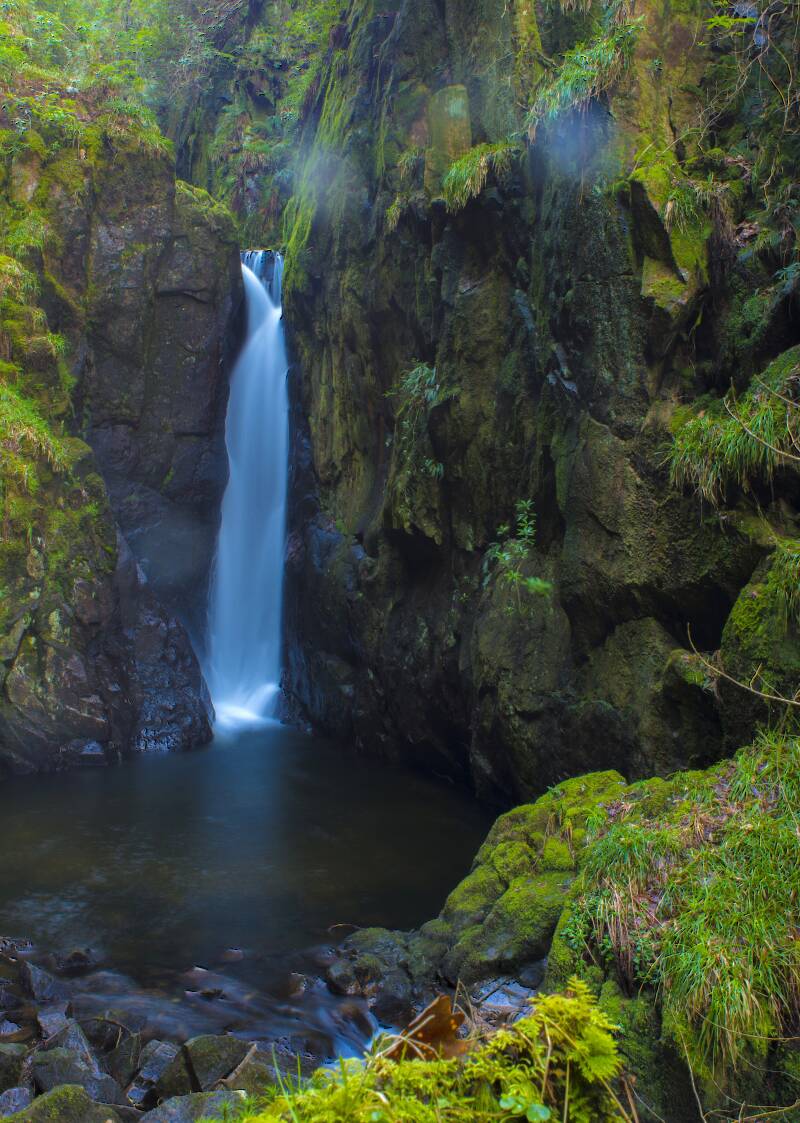
Photo below: Stanley Ghyll Force in Eskdale. I have written about other aspects of Eskdale in other blog posts on this website. The Force below, or in Cumbrian Anglo-Norse: fors, abounds in rare plant species, although it is nolonger possible to walk so close to the waterfall, as the ground is dangerous and collapsed. Nevertheless, this waterfall and the ghyll it is within, is a good example of a place that might be seen as "infused" with fairy magic, in the greenery of its plants, its atmosphere, and feeling of magic. I think that the photo below gives a good example of a fairy energy place, even if to my knowledge it is not associated with them specifically in folklore, it is nevertheless a good example of such a place.
There are references to the beings called "Hobs" in some Cumbria place-names too, such as the name Hobgrumble Gill near Mosedale and Shap, and possibly for example in the name Hobcarton Crag near Keswick, although the latter seems less likely. However, Hobcarton Crag does have an eerie atmosphere, and several people have told me this, and I have felt it. "Hobs" are not generally considered hostile to people however, and vary from being thought of a small, elf-like beings, often hairy, to being something more akin to a sasquatch or bigfoot. Similar beings such as brownies, the gruagaich in Goidelic tradition, and the fynoderee in Manx tradition, also share many of these attributes.
As well as Ull as a god or honorary name for giants - the Manx god, Manannan, a mysterious figure, akin to the Old Man of Utrøst in Northern Norwegian legend, and in many ways connected perhaps to the Icelandic sea god Ægir or Hlér (I have discussed many more different aspects of the this in much detail elsewhere), may have been known in Cumbria. We can assume that knowledge about this deity must have existed in Cumbria and in Northern Lancashire. I personally think that the existence of a ship-shaped Norse burial mound on the Isle of Man may symbolically connected in some way to Manannan and to Ægir or Hlér, with the similar word Hlýr also meaning the "prow of a boat" in Icelandic, as well as being another name for Ægir. Hlér and hlýr also bare similarity to the Irish name Lir, said to be the father of Manannan. There are many other connections too which I have discussed elsewhere, including with regard to these deities and "cormorants", and much more. But I feel that this idea of the prow of a boat being connected to these deities in some way, and the connection to the ship-shaped burial on the Isle of Man (which is made of quartz rocks), is really interesting - and connects to topics I have discussed elsewhere about "horned giants" in Northern European folklore and in ancient rock art. I have not discussed these connections to ship burials on the Isle of Man before, however, and what I have discussed here contains different information to what I have published elsewhere.
The wife of Manannán Mac Lir was named Fand according to Irish and not Manx mythology, to my knowledge, (note I discuss other connections with Irish mythology in my blog post before this). Fand is also associated with seabirds, and Fand is also a very interesting name. It bares a similarity to the Danish word fanden meaning "the devil" (although likely used simply as a way of describing certain spirits and entities originally). This word fanden is likely connected to Germanic words meaning "tempt" and "find out". In Irish, her name is sometimes connected to an etymology meaning "teardrop", There are also implications in the mythology of Fand that she was of a more polyamorous relationship mindset, and seems to have had a connection with the god Cú Chulainn as well as with Manannán. Note I also wrote a separate unrelated blog post recently about polyandry in ancient Scotland, which connects in a sense to Fand's possible polyamorousness. I also do not think that the modern translation of Danish fanden as "devil" is accurate, with the idea behind the etymology of fanden having implications of "curiosity" and "finding out", not being bad things, when not misused. In a positive interpretation and connection to polyamory - both the implications of "curiosity" and "finding out" are connected to polyamory.
In Norse mythology, the wife of Ægir or Hlér is Rán, a deity who is also seemingly polyamorous, in that she is the wife of Ægir or Hlér, but also who seems to derive energy from the souls of her other loves, namely aspects to the souls of men who have died at sea. Some aspects of these men's souls, seem to, in a sense, become her loves for all eternity. Rán also shares some attributes that seem to connect her with the Northern Norwegian version of what drauger are, in that both are associated with the dead, and with the sea, and both are said to have seaweed or tentacle-like features, with Rán's hair sometimes described as akin to seaweed, and with drauger sometimes described as having seaweed instead of hair. These beings also share similarities with the näkki of Finnish tradition, and with more kelpie-like or serpent-like beings.
Another ancient god we may be able to identify and name in Cumbria, is Odin, who's name may well be the etymology of the place-name Oddendale, near Shap, Oddendale having a stone circle and being in the heart of a megalithic landscape. This may imply that, to some degree, the god Odin, perhaps locally: Odden, was associated with the wisdom of some of these megalithic complexes, in some way.
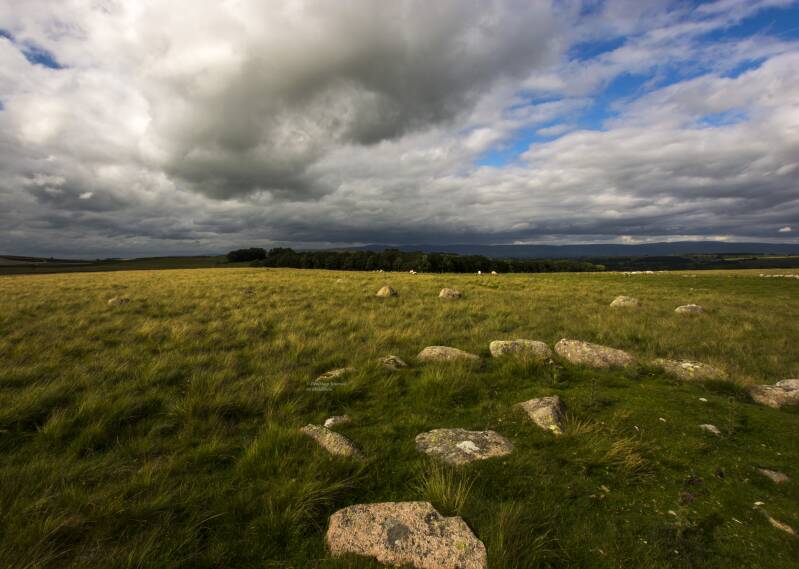
Photo below: The Oddendale Stone circle, close to Shap in Cumbria. Could this area and perhaps the circle itself have a connection to the god Odin or Odden? Despite that I said in the article before this that Odin and Thor were not so well known in Northern England, there are nevertheless some examples of place-names that may well connect to these gods in some way. Note also that Uther Pendragon is associated with Pendragon Castle, in the Upper Eden Valley. Uther Pendragon is described in Cumbrian lore as having been a giant, among other things. Note the curious similarity between the name Uther and Old Icelandic Uðr, which was another name for Odin. Could this imply that Odin/Odden and Uther Pendragon also share some kind of connection? I feel that the photo below gives a good impression of the wildness of the sacred landscape of the Eden, and the way in which the vast skies and farmlands, and fells, interact. Note that Uðr is sometimes translated to mean "foam", and is also the name of one of the daughters of Ægir/Hlér and Rán. Manannan/Manannán Mac Lir's horse is also known as Enbarr, whos name means "one wave" or "one sea" but whos name is also sometimes translated to mean "foam". In many ways, Odin can be seen as somewhat akin to Manannán Mac Lir, which is interesting. But I do not believe that they are the same deity.
Another god, or god like figure, is likely attested in the name Mabbin Hall near Levens, and in the name Mabbin Crag near the "Other Borrowdale". This deity is likely connected in some way to the Gaulish deity Maponos and to the Welsh deity and sacred figure Mabon Ap Modron.
In the book, Paranormal Cumbria, by Geoff Holder, the works of the psychic Geoffrey Hodson are discussed, including many experiences that Geoffrey Hodson had in Cumbria, seeing nature spirits and divine beings of many kinds. According to the aforementioned book, one such deity was described as the "God of Helvellyn", a god of immense size, with eyes ablaze with power. According to the aforementioned book, Geoffrey Hodson also saw many other spirit beings in Cumbria, including specifically around the Thirlmere region. He also reputedly saw with spiritual vision, other nature spirits on Helvellyn, including, according to the aforementioned source, an eight foot tall nature spirit woman, with wings of red and gold.
This blog post has only covered a very limited number of examples of, and aspects to this subject, many other different ones I have discussed in other publications.
I hope that this blog post/article was an interesting read. It is written in honour of the ancestor and nature spirits of Cumbria, of the gods and of the Great Spirit.
Add comment
Comments