This article/blog post was written and published by Linden Alexander Pentecost, and was published on the 11th of January 2026, being published very early in the day on the 11th of January 2026, and only on this website www.languages-of-linnunrata.co.uk . This article or blog post was published in the UK and on this UK-based website. No AI was used in this article nor in any of my publications. This article is unrelated to and separate from any and all of my other publications. The author is from the UK and a UK-resident. This article contains a total of 3555 words. This article contains 3 photos taken by myself the author, also showing landscapes and parts of the possible new archaeological site at Halton Gill (not the actual Giant's Graves).All three photos are important for showing different aspects of the new site and its location. I hope to head back to Halton Gill in the near future and successfully visit the actual Halton Gill Giant's Graves, after which I will write an new blog post about this site, with more information, which will be unrelated to and separate from this first blog post published on this page you are currently on, about certain aspects to this site, the possible new site, and related topics. Note I have published many things recently, including other, unrelated things about giants and other, different archaeological sites. Note that I have briefly made other references to this site elsewhere, but this article in front of you, and the next about this site, discuss entirely new aspects, as well as personal experiences connected to this site, a dream possibly connected to the giants of Yorkshire and to the Nuckelavee, and other feelings about giants on the mountains of North Yorkshire, and other personal experiences in Yorkshire and its magic, including about meeting someone and falling asleep on a chair, and other things. I have discussed more on Yorkshire giants and giants elsewhere in other publications, with only specific, newly discovered aspects discussed in this article, although I have briefly talked about the Halton Gill Giant's Graves elsewhere a few times, with different details to those in this article/blog publication and to those that will be shared in my upcoming, different article to the one of this page, about this site. The photo descriptions above the photos also contain important information not in the main text, but related to it. This blog post/article was updated on the 17th of January 2026.
Visiting prehistoric sites, and trying to locate them, can be a little confusing and difficult. A few days ago, I went to try and reach the Giant's Graves, a site located next to Halton Gill, in a valley that runs between the village of Stainforth and the valley of Littondale, below the southeastern flanks of the mountain of Pen-y-Ghent.
A thing that really strikes me about these upland landscapes of North Yorkshire, is that, like those in East Cumbria, they are so wild and vast. The weather, especially in winter, can be dangerously harsh, and walking across these landscapes is itself difficult and risky. These "Giant's Graves" are not the only so-named site in this part of the world, with several such sites given this name existing in Cumbria for example, both in the west and east of the county.
What is perhaps even more strange about these landscapes, is that, they were not always like this. Thousands of years ago, these upland landscapes were occupied by substantial cultural groups. Some of these peoples had a particular connection to caves, and, although it is rarely talked about, there is evidence that ritual and funary use of caves in Yorkshire, spans from prehistoric times into more recent times, and the area around Halton Gill is no exception, with many of the caves in this area having ancient finds, and also for example the Skoska Cave further down the valley. "Scoska" is also an interesting name - and although it may have a connection to for example Norwegian skog - "forest", but the etymology of this Norse word is also disputed, and I wonder if perhaps "Scoska" could be a connected, but older name.
But, there are also plenty of references to "giants" in Yorkshire, just as there are in much of Cumbria. A couple of places online say that this ancient site, with its passage-tomb-like appearance, is so named as this was where the giants who lived in Littondale in the past, were buried. There is clearly some mythology behind this, as indicated by the name, and there are also implications of a legend told to archdeacon W. Boyd, according to information written by Paul Bennett on The Northern Antiquarian website, though I have yet to find a source describing the legend in specific detail.
I managed to reach the area behind Pen-y-Ghent where the Giant's Graves are in this area. I thought I had found the site, as when I looked at the ground, I saw vague circular shapes and rocks, that appeared to be in some kind of formation. In some of the photos I took, the edges of these features are clear, but they did not look like the photos of the Giant's Graves at Halton Gill which I had seen others take.
I was trusting a map, which seemed to show the graves as being to the southeast of the river. It was only when I got back to Settle, that I realised the graves were on the northwest side of the river, and subsequently, I had been in the wrong location. Ironically, I can even see the actual Halton Gill Giant's Graves in some of my photos, in the distance on the other side of the river. So I will have to go to this site again and to go onto the northwest side of the river this time!
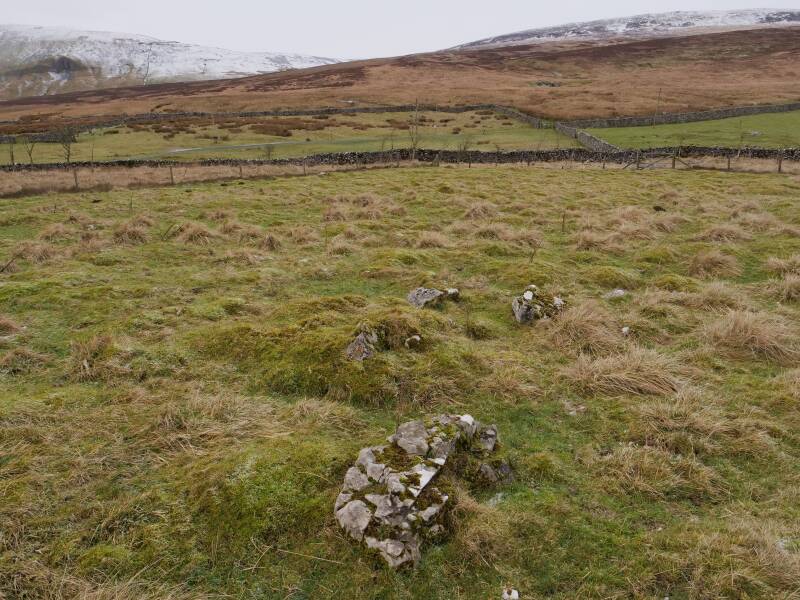
However, in not finding the actual Halton Gill Giant's Graves, I may have found another possible archaeological site, and feel that in fact this was a part of the universe's plan (and the plan of the spirits of the giants?). The circular and ovalar mound shapes in the place where I was (on the other side of the river from the Halton Gill Giant's Graves), seemed doubtful as an ancient site, when I discovered in Settle that it was not the right place. However, when I later used satelite imagery to zoom into the area I was stood, I came to notice several interesting, and clear, somewhat circular and somewhat rectangular and ovalar shaped enclosures. Could these perhaps be an ancient settlement or other feature - associated with the Halton Gill Giant's Graves? The GPS coordinates of this possible new site are: 54°09'18.3"N 2°13'13.5"W. The aforementioned coordiates are for the possible new site, with its circular and ovalar shapes viewable from satelite imagery, and with photos of it shown in this article. The Halton Gill Giant's Graves themselves, which I plan to visit on my next trip there, are located at the GPS coordinates of: 54°09'20.9"N 2°13'17.0"W. Note that there are also many other known archaeological, upland settlement sites, not far from the Halton Gill Giant's Graves, as well as the possible new site I have found with its enclosure-like features.
Photo below: the possible new ancient site, visible here as an arrangement of stones, possibly natural, but I am inclined to think it is not entirely natural, especially given the satelite imagery. In the background can be seen part of Pen-Y-Ghent to the left, and Plover Hill to the right. The actual Halton Gill Giant's Grave can just about be seen as a circular formation and stones in a field in the distance to the upper right of the image, in the field below the wilder moorland above.
In a strange way, I have always felt connected to the giants of these upland regions, and have felt their presence. I feel how they once occupied this upland landscape, and how now, it seems so empty. Something happened I think, a deterioration of climate, a dramatic natural event, which changed their world. I remember going to this region a few times when I was 18 (and of course many other times). One of the times, when I was eighteen, I remember going to Malham Tarn and taking out a boat there on a beautiful spring day. Later in the year, I attended a series of lectures at Malham Tarn, when I spent some of the evening speaking to a beautiful tall brunette woman, who was about ten years older than me. In other parts of the lecture day, I was falling asleep on my chair, and waking as I slightly knocked my head on the chair - as the lectures continued into the evening. This is not because the lectures were boring but rather because I had barely slept the night before.
On another day that summer when I was 18, I walked up Whernside, and when I came home, had a series of dramatic dreams and nightmares, in which I was being chased around a series of spiral staircases in what appeared to be a broch-like structure in the Northern Isles. I never saw exactly what was chasing me, but I briefly remember it being zombie-like, and possibly being a cyclops, somewhat akin to the Nuckelavee (note I discuss similar beings in the blog post on this website previous to this blog post on this page, and ordinary horses & aspects of their mythology being discussed in the blog post on this website before that). Anyway, it was a very odd dream. It started when I felt a bit heartbroken as a girl my age I liked spent much of the evening talking about her partners, which was difficult for my emotional brain at the time, because I liked her, so I went home, fell asleep, and for what seemed like hours, was being chased around a broch by this being. The weirdest thing was that I was only asleep for around 45 minutes, and even whilst I was dreaming, I was aware of being in my body and lying down, and kept waking up. But I thought that perhaps nine or ten hours had passed, not 45 minutes. Note that brochs are connected to giants in Scotland, and to other beings, which I have discussed much elsewhere. And I do feel in some way that the aforementioned dream was somehow also connected to the haunting upland landscapes of North Yorkshire, and to their ancient giants, in some way.
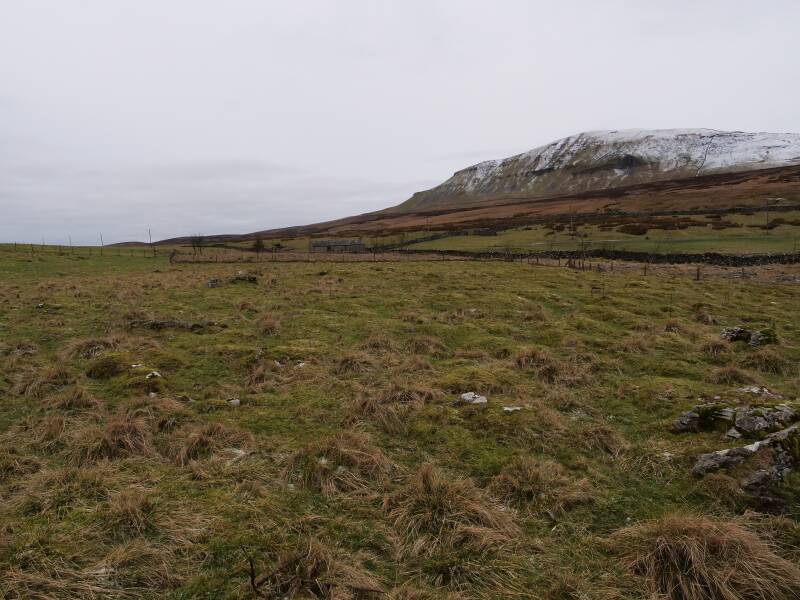
Photo below: another photo showing the possible new archaeological site near to the Halton Gill Giant's Graves. This is, again, separate from known settlement and ancient enclosure sites in this immediate area. Pen-Y-Ghent can be seen rising and capped in snow on the right of the image. A rough ovalar shape can also be seen in the field where the photo is taken, as a part of the possible new archaeological site. I do not think this shape is natural, and it is one of several in this field and at this site. Note how both earth and somewhat larger stones seem to form this ovalar shape. This is also unrelated to the ship-shaped burial sites I have discussed elsewhere, including in the blog post before this blog post on this page. The ovalar shape in the photo below can be seen heading around the bottom centre of the image on both sides, and off into the further reaches of the site.
There are many very interesting place-names in this particular area, apart from Scoska, discussed in this article, and Pen-y-Ghent, which I have discussed many aspects of in different publications, including recently. Another interesting place-name near Littondale, is Yockenthwaite, a name thought to derive from a local form of the Irish name Eoghan, from Old Irish Eógan. If this is true, then, like elsewhere, it may imply a connection between legends of "giants" and ancient connections to Ireland. However, the etymology of this name is not certain.
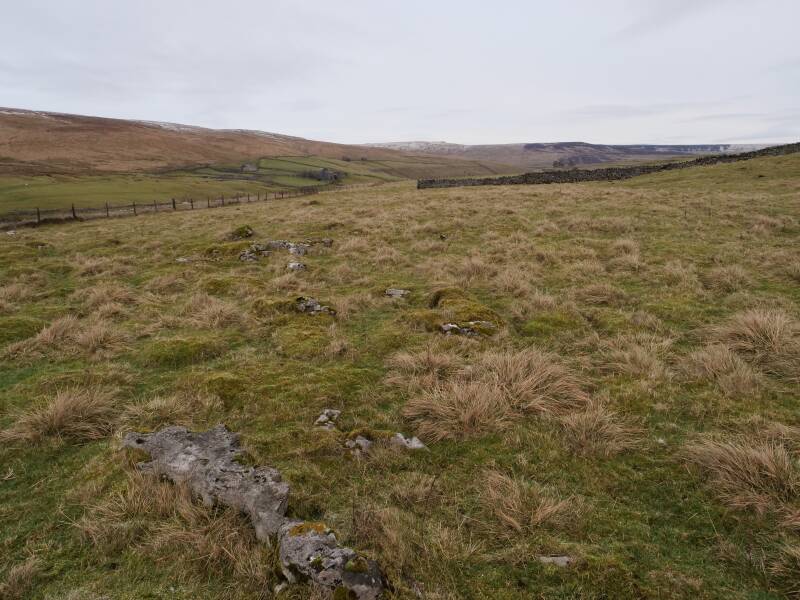
Photo below: an again different view of the possible new archaeological site looking towards Littondale, again showing a part of an ovalar arrangement of bank and larger stones, in this photo below, visible as a line of stones in the field that heads away from the bottom centre of the image, and to the central mid left of the image.
My friend Dawn Hilton, who's research I have discussed different aspects of elsewhere in other publications, has helped me to examine this site using satelite imagery, and has told me that this area may have alignments, with a possible sacred trackway leading to the Halton Gill Giant's Graves, intersecting the possible new archaeological site I have found on the other side of the river from the Halton Gill Giant's Graves themselves. She believes that the geometry of this site is akin to the mixture of Neolithic and Bronze Age cultures, at least one of which, I think, was the "giants", whilst the other I think was more identifiable with people today. When I visited the possible new archaeological site at Halton Gill, I did feel a very strong ancestral presence; not immediately, but after having spent around 20 minutes or more at this site.
She has also commented on how the ground water and underground springs in this region would play into its energy, which makes sense given that there are indeed large cave systems and underground streams, including one right next to the Halton Gill Giant's Graves. Her comments on the sites in this area containing features of both what we call Neolithic and Bronze Age geometry is also consistent with how the Halton Gill Giant's Graves are likely Neolithic, whilst there is also a lot of Bronze Age activity in the area. Does this imply that the "giants" were in this case the Neolithic culture, and that by the Bronze Age their numbers were fewer? To my knowledge, no evidence has sufficed at this site (unlike at other sites in Northern England) of actual giant sized skeletons. However, the graves were not I think connected to giants for no reason, whether the "giants" connected to this site are understood to be physical beings, or not. It is also true that evidence of giants at this site has simply been lost, especially given that giant bones, when uncovered, are sometimes said to have "disintegrated" upon exposure to air - and the site is badly damaged, although as I said, I have only been to the new site and not to the Halton Gill Giant's Graves themselves.
I have discussed other aspects and legends of the giants of this region in other publications in detail. I also recently read a fascinating web-page article titled Ingleborough Hill – Yorkshire Dales, on the Brigantes Nation website, wherein I found another new (to me) story of a giant from this region, under the title: The Giant’s Causeway and the Giants of Ingleborough. The aforementioned webpage includes a legend stating that Ingleborough, a mountain near Pen-Y-Ghent, was once the home of giants, and that the hills in the region formed a giant's pathway (leyline or other mythical energy line?). It is also stated on the aforementioned webpage that one such legend speaks of a giant trying to build a causeway between Ingleborough, Pen-y-Ghent and other mountains, a little akin to the legend of the Ullstone in Cumbria which I discussed in the blog post previous to this, along with other possible examples of this legend in Cumbria, as well as discussing much more and other aspects to the Ullstone and to Ull in the blog post before the one before this one on this page. Whernside, one of the places connected to the dream I mention in this article, is also among these "giants' mountains".
Also on the Ingleborough Hill – Yorkshire Dales Brigantes Nation webpage which I discussed in the previous paragraph regarding giants on and around Ingleborough, there is included another story about Ingleborough, under the title: The Ingleborough Caves and the Land of the Dead, wherein it is implied that the cave systems on the mountain were entrances to the realm of the dead and to the underworld, with the cave systems acting as portals. This is akin to many other things I have published recently discussing different aspects of different underground places. I knew already about several of these legends in the Ingleborough region, including that of the giant and fairies at Yordas Cave, which I have discussed a lot elsewhere - but did not know until now that Ingleborough itself was connected to giants, and that giants were said to live upon it. Nor did I know until now that Ingleborough was considered as having caves as entrances to the Otherworld. I do not however know the original references to either of these legends about Ingleborough specifically, and cannot confirm with absolute certainty the extent of giant mythology regarding Ingleborough, but I am sure there is something to this association. The website where they come from also mentions a "white horse" on Ingleborough, akin to the horse associated with the giant Uther Pendragon in Cumbria (discussed in the blog post previous to this and elsewhere, as well as horse-like beings being discussed in the blog post previous to this on this website (and in other ways in my other publications), and horses being discussed in the blog post before the one previous to this on this site). Note that I also discussed other aspects to fairies in the unrelated blog post I published on this website yesterday, and have also discussed yet more aspects to them and their places in many other places.
Although to be honest, I have felt for many years that Ingleborough, and its caves, are an important entrance to the underworld in some way. This is certainly true in a literal sense of course, but also I think in an interdimensional and metaphysical sense, as physical caves I think, as I have implied elsewhere, are just the physical dimension, and entrances, to the normally invisible spirit realms below, which can only be entered by "unlocking" the physical walls of the cave using certain sound frequencies or words, thereby creating a portal - not that I would recommend anyone trying to do this. Thankfully this is unlikely to happen as people today do not know the magical songs and words that can unlock such portals in Yorkshire - if you believe in such things, that is. I have discussed many other aspects and examples of these spirit doors elsewhere in other publications, including recently. That caves are also connected to the spirit realm, is of course another reason to revere caves, but also to respect them and to make sure we are safe when visiting them. The caves around Ingleborough and Pen-y-Ghent and other nearby areas should not be entered by those who are not professional cavers, and even then, there is a lot of potential risk.
I hope that this article/blog post was an interesting read. In the future, I will publish another blog post about this site and area, after I have visited the actual Halton Gill Giant's Grave, although I am glad that on my frist visit I found a possible new archaeological site and have discussed and included photos of that in this article as well as lots of other information. The upcoming future article will be different, and focus on the Halton Gill Giant's Graves themselves and on other aspects to these topics. I hope to go back to this site for my second visit in the spring of 2026 (it is currently January 2026) for writing the second article about this site (my first trip is what is discussed in the article on this page, along with many other things also being discussed on this page which will not be published in the different, future article). This article is dedicated to my family and to the giants and other ancestral beings of North Yorkshire. May all who walk there also remain safe and protected. Update, 17th of January 2026: I visited the Halton Gill Giant's Graves the following week after my first trip, and on the second visit located them correctly. This will be published about in an unrelated blog post on this site which will be uploaded tomorrow (on the 18th of January 2026). On the same day that I visited the Halton Gill Giant's Graves for the second time (when I successfully found it, unlike on my first trip as discussed in this article where I found another site nearby), - on the same day that I visited the site on the second time, I also visited another potential archaeological complex elsewhere near/connected to Littondale, which I will be publishing a separate blog post about in a few days time, separate from this post in front of you and separate from my second blog post about the Halton Gill Giant's Graves to be published on the 18th of January 2026).
May the Great Spirit guide and protect us all.
Add comment
Comments