Written and published by Linden Alexander Pentecost, published on the 12th of January 2026 and only published on this website, as are all publications on this website. No AI was used in this article nor in any of my publications. This article is unrelated to and separate from any and all of my other publications. I, the author, am from the UK and am a UK resident, and this article was published in the UK. The three photos in this article were also taken by myself, the author, and have not been published before. There are details in the Silly Linguistics article I wrote I mention the Oitti pyramid, and there are details in that other article which are not in this article or blog post. The aforementioned Silly Linguistics article is unrelated to and separate from this blog page or article in front of you, which does itself contain a lot of details not in the Silly Linguistics article, and the two publications are generally completely separate. This publication also contains photos not in the Silly Linguistics article in question. This article in front of you, on this web page (not the aforementioned Silly Linguistics article) contains a total of 1317 words.
Not too far from the town of Riihimäki, an inland town in southern Finland, is the village of Oitti. Some believe that in the forest not far from Oitti, is a complex of prehistoric structures, with this being centred around the "Oitti Pyramid", or in Finnish: Oitin pyramidi, and the Oitti Stone Henge, which is located a short distance from the possible pyramid, described in Finnish simply as: Oitin Stonehenge. I visited these sites late in the summer of 2024, and wrote a little about them, including a picture (not one of the pictures in this article on this page), in a Silly Linguistics article published in 2024, where I discussed it in relation to wider themes of Finland's prehistory and language. In this article though, I wish to discuss more aspects to this site and to my visit there. The site has been described in Finnish groups by the Finn, Arhi Kuittinen.
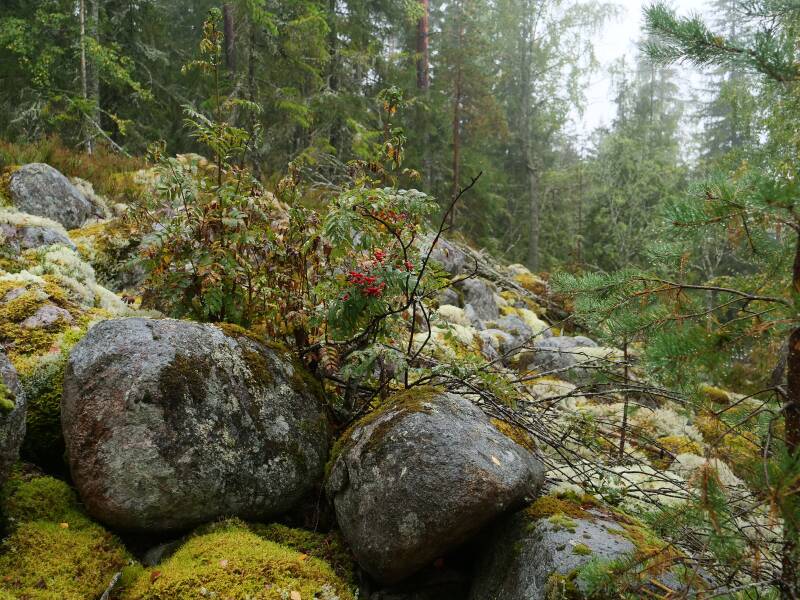
Photo below: part of the possible walling at the Oitti Pyramid, with two "levels" or "steps" possibly visible in the photo below, one towards the middle right of the image and going left across a part of the image, the other visible at the bottom centre of the image, and going towards the centre of the image and somewhat left, although it is in part obscured by the pihlaja (rowan tree) with its berries visible in the photo. I included a similar, but different and less details photo to the one below in the Silly Linguistics article I mentioned in this article on this page. Note the early autumn colours in the photo below, and the misty air.

Firstly, I do find it difficult to see how this site has been described as a pyramid, specifically. It is difficult to work out. However, having said this, parts of the site are very strange, and show evidence of stone-lined slopes and structure, akin in a sense to the face of a pyramid. Plus, I have reason to think that such structures could indeed have existed in Northern Eurasia, and, as I discuss in detail in the Silly Linguistics article where I discuss aspects of this site - the presence of a pyramid in Finland would make a lot of sense to me, given other aspects of Finland's ancient history and its linguistic and other connections.
The Oitti "Stonehenge" is located a short distance from the possible pyramid structure, and this I found also interesting, because it is in a sense akin to an arrangement of stones, made by humans, other ancestor beings or by supernatural means. In some ways it is akin to some of the chambered-cairn like structures I see in parts of Cumbria and Lancashire.
Photo below: a possible section of the side of the Oitti Pyramid, showing a rather smooth possible pyramid face of loose pieces of rock, perhaps once stacked together and forming a face.
When I visited the Oitti Pyramid, I had taken a train from Helsinki to Riihimäki, and then another train from Riihimäki to Oitti. It was misty all day, the air was warm, and the atmosphere was beautiful. I wandered away from the train station, and found a road that would lead me closer to the area of forest where the possible ancient sites are. I then cut through the trees, eventually finding a footpath which lead me near to the site.
The atmosphere was lovely and mythical. The pine forests, with other trees within them, spread all around me, although a part of the forest had been cleared near to the pyramid, and there are also some fields in the area, which were adorned with mist, and mysterious in and of themselves. After wandering in this misty landscape, and seeing various wildlife around me, I eventually located some of the faces of the possible pyramid, where some kind of ordering of the stones and structure was visible. I felt somewhat exposed and isolated, being the only one in this great misty forest, but I did not feel afraid or uncomfortable. Did I have the presence that something else was there? Yes, absolutely.
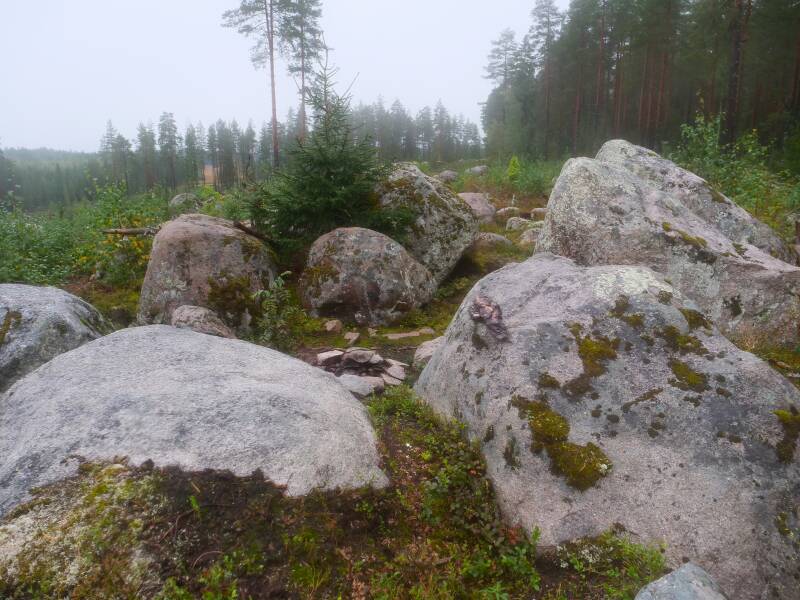
Photo below: the Oitti Stonehenge, a group of large rocks with seemingly some geometric formation that seems perhaps to have not been created by nature alone. The Oitti Stonehenge is close to the walls of the pyramid structure. Note the way in which the large boulders in the photo below are arranged, as well as their large size. Note that someone has also made a much more recent fire pit within the centre of the Stonehenge structure.
I have not come across any other reports of pyramids in Finland, but Finland does possess examples of polygonal masonry, some of which I think is very old (I have discussed this and been to, and taken photos of and published many examples of polygonal masonry in Finland in other publications). There are also other mysterious sites in Finland, some of which, like the temple in Southern Finland I published about recently on another website (and elsewhere) - I have visited. I have no doubt that the forested land of Finland has far more archaeological secrets to reveal. There are also those who have identified possible pyramids to the east (along with a lot of other megalithic structures). Some possible pyramids have been identified in the Kola Peninsula, the Ural Mountains and in Siberia in a more general way. Some of these ancient rock formations, particularly in eastern Finland and over the border into Karealia, do not look natural to me, and some seem to be giant megalithic walls using polygonal masonry. I have not visited any of these, and have only visited several seemingly more recent examples of polygonal masonry in Finland (some of which could still be very old though). There is of course Vottovaara mountain, and other archaeological sites in Finland, which I have discussed elsewhere.
The Oitti Pyramid and Oitti Stone Henge are located around the area with the GPS coordinates of: 60°46'37.5"N 25°00'45.7"E. I hope that research into these two sites continues, and I encourage others to research them, respectfully, and to make up their own minds about the origin, meaning and age of these sites. I hope that this article was an interesting read. I hope to soon publish another unrelated blog post on this website, about a different set of prehistoric sites in Southern Finland. This article is dedicated to the ancient ancestors and guardians of Finland, and to the Finns themselves, and to my family.
Add comment
Comments