Written and published by Linden Alexander Pentecost, published on the 14th of January 2026, with important updates made to this article on the 15th of January 2026. This article/blog post is unrelated to any and all of my other publications, and contains different content from them. No AI was used in this article, nor in any of my written works. This article was only published on this website www.languages-of-linnunrata.co.uk (this is not my only website), and this article was published in the UK, the author is also from the UK and lives in the UK. This article contains 5 photos, all taken by myself, Linden Alexander Pentecost, 1 of the photos showing a part of Hell Gill, two showing different angles of the Devil's Bridge in Hell Gill taken from below, one showing me dipping my feet in the waters of Hell Gill, and another showing part of the possible stone alignment complex on Helsfell near Kendal. This article discusses both Hell Gill and Helsfell, and moves between the two subjects, and related etymological, archaeological and spiritual discussions about the names and history, archaeology and mythology, and potential theories about them - including details on a possible newly found stone alignment complex on Helsfell, with GPS coordinates given for various sections of it. The descriptions above the photos contain important information not in the main text. This blog post/article contains a total of 2649 words.The photos in this article/blog post have never been published before. Some important notes and dedications are at the end of the blog post/article. Like in my other publications, the photos in this article are very important and relevant to the topics in the photo descriptions and general text, which makes even more sense when one can see the places I am speaking about.
I recently visited a place near the town of Kendal, more specifically a hill, known as Helsfell. I planned to try and find a cave on the fell, but was unsuccessful, even though I was in the right area - the area itself was very overgrown.
The name here is quite interesting, Helsfell being Anglo-Norse for "cave's mountain/hill". If a place-name of the exact same etymological origin and meaning was in Iceland, it would be Hellisfell, although the double ll's would be pronounced differently in Icelandic. It is generally thought that Icelandic hellir - "cave" and hel, the Icelandic name for the goddess of the underworld, and of the underworld hel itself in Norse mythology - are of separate etymological origins, although, I suspect that the words are in some way related. In terms of the name Helsfell and for example the name Hell Gill referring to a ravine near Mallerstang - the meaning is more likely related to the idea of a "cave", rather than to hel as a goddess, and to the underworld associated with her.
Having said this, there seems to be a legend implying that the old bridge over Hell Gill was created by the devil, although I do not know the original source of this story. This story does however imply a closer connection between the name Hell Gill and the idea of the Underworld known to the ancient Icelanders and hel, and etymologically equivalent to hell in English, although, let's keep in mind that hell in this ancient sense was, in many respects, like a cave, or Icelandic hellir, a cold, damp place, but not a place of suffering, rather, a place of rest and decay at the roots of the tree Yggdrasil. Note that I discussedYggdrasil in relation to the Níðhöggur, fungus and other things - a few days ago, in an unrelated, different article, published on a different website. I personally do not think of this ancient idea of hell as a place of suffering for sinners, nor do I think of it as a permanent state of being, for the part of the spiritual self that might go there.
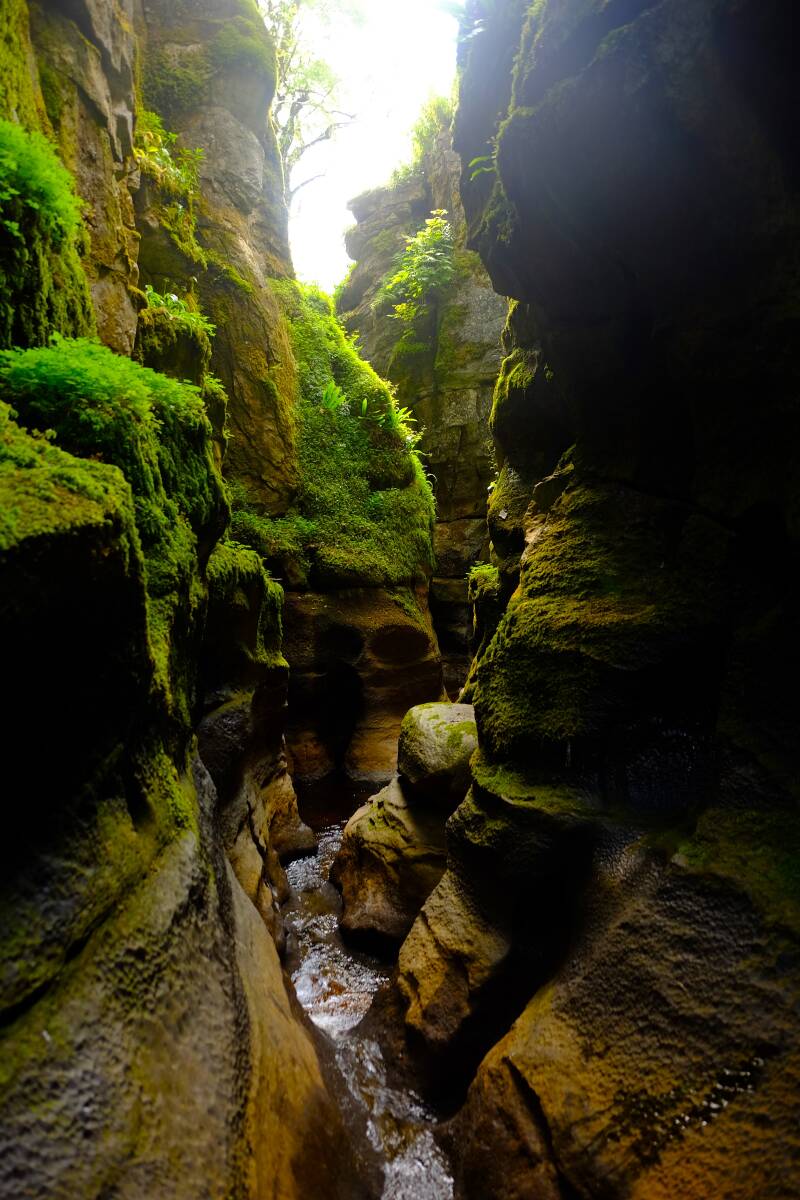
Photo below: within the dark reaches of Hell Gill, near Mallerstang. The place can only be visited in very dry weather, but it is utterly magical. It's strange how you can be walking on the moors and mountains near Mallerstang, and the landscape is quite barren, yet when you go into this gill, it has its own rainforest microclimate. It definately feels like a place connected to the Underworld in my opinion.
In Norse tradition, hel as a place, is at the base of Yggdrasil, just as at the base of every tree, is a microcosmic world of damp, cold and decay. Anyway - this realm of damp and decay is of course necessary to provide nutrients for the tree, and that nutrients, or energy, doesn't just stay in the soil forever, but helps the tree to grow. The movement of the damp from the roots of the tree, through the tree, and then much of it evaporating through the leaves, is also akin to the cycles of the spiritual self, not the permanent spirit but rather the cycles of spiritual energy which all things in our world are a part of. So, anyway, we probably shouldn't fear hell in the ancient Germanic sense of the word's meaning. The term in English was of course later used to describe the monotheistic idea of "hell", and I'm sure, in a sense, such a realm of inner pain does exist on some level of reality. But I do feel that this was unfairly and wrongly confused with our ancient understanding of what this word means, and, originally, as I've implied, it did not mean a terrible place.
As for the Christian idea of "hell", yeah, I think that, if such a place does exist in some dimension then it would indeed be terrible, but I personally think of the Christian "hell" as more of a state of consciousness and being. So whenever we use the term "hell" to describe that state of being, I think we are actually, in a sense, severing the link between our ancestral wisdom and us. We are using a word for a neutral "realm" of dampness and cold, known to our ancestors, to describe a monotheistic realm or state of being, associated with fire and suffering. Of course, none of us should ever go to such a place of long-term spiritual suffering, and I think that the way to avoid that is to simply not make ourselves nor others suffer in this life. Regardless, I believe that the spirit is eternal, and that even hell in the Christian sense is not forever, I don't think. Even when in many cultures there is the idea of a "second death", this reduces the spirit to its original breath, power, but in a sense "unforms" the personality and energy, at least, from what I understand. Even in this case, the spirit is not entirely destroyed, and its base essence survives. Essentially - we should just be nice people, and also at the same time, not confuse the Norse realm of hel with the Christian idea of "hell" as a state of spiritual torment (as opposed to heaven) - at least in my opinion. But follow your instincts and the Great Spirit with this topic.
Obviously, it is quite clear why such a confusion of two distinct things, might cause a schism in memory and awareness between us and our ancestors, when it comes to this. We could also get onto the subject about how many place-names associated with the "Devil", e.g. bridges built by the devil such as that at Hell Gill, might be using the term "devil" to refer to other spiritual beings or guardians, who's names we no longer know. For example, the bridge over Hell Gill might have been said to have been built by the "Devil". But this is perhaps through a relatively recent lens of perception. Taking this apart and back to its core roots, the legend implies that some kind of entity or guardian, perhaps hostile or a trickster type figure, might be associated with "Hell Gill", and with the "Underworld", and with having built or influenced the construction of the bridge over the gill. This firstly implies that the bridge itself could date to a time before the original knowledge was lost, due to that this entity (or some ancestor) is associated with having built it, but it also I think implies that the use of the word "devil" to describe this entity or guardian, is part of a later naming system for such entities, and does not mean that in the original version of this legend, people would have understood this place to be associated with the "devil" in the sense of the Devil in the Bible.
Certainly it seems that the age of the bridge over Hell Gill, also known as Devil's Bridge (not the one at Kirkby Lonsdale), is of unknown age, and may follow a prehistoric track way. Could all of the "devil's bridges" be along ancient trackways, with the bridges themselves ancient - and could the stories of the devils or entities associated with these sites, be akin to the sacred relationship that giants play in the landscape, and also, like these devils, in the formation of ancient pathways, whether walked or energetic in nature?
Photo below: the Hell Gill Devil's Bridge, taken from below, whilst we were exploring the gill. Note the impressive stone masonry visible on the underside of the bridge. Could this bridge perhaps be ancient? This photo was taken in the summer, when the light within Hell Gill seemed to reflect that of the lush plant life within it. It was magical, but it can be dangerous underfoot, and also one has to watch for rockfalls from above - and, in addition, the gill should only be entered in the dryest of conditions, otherwise it is impossible or too dangerous.
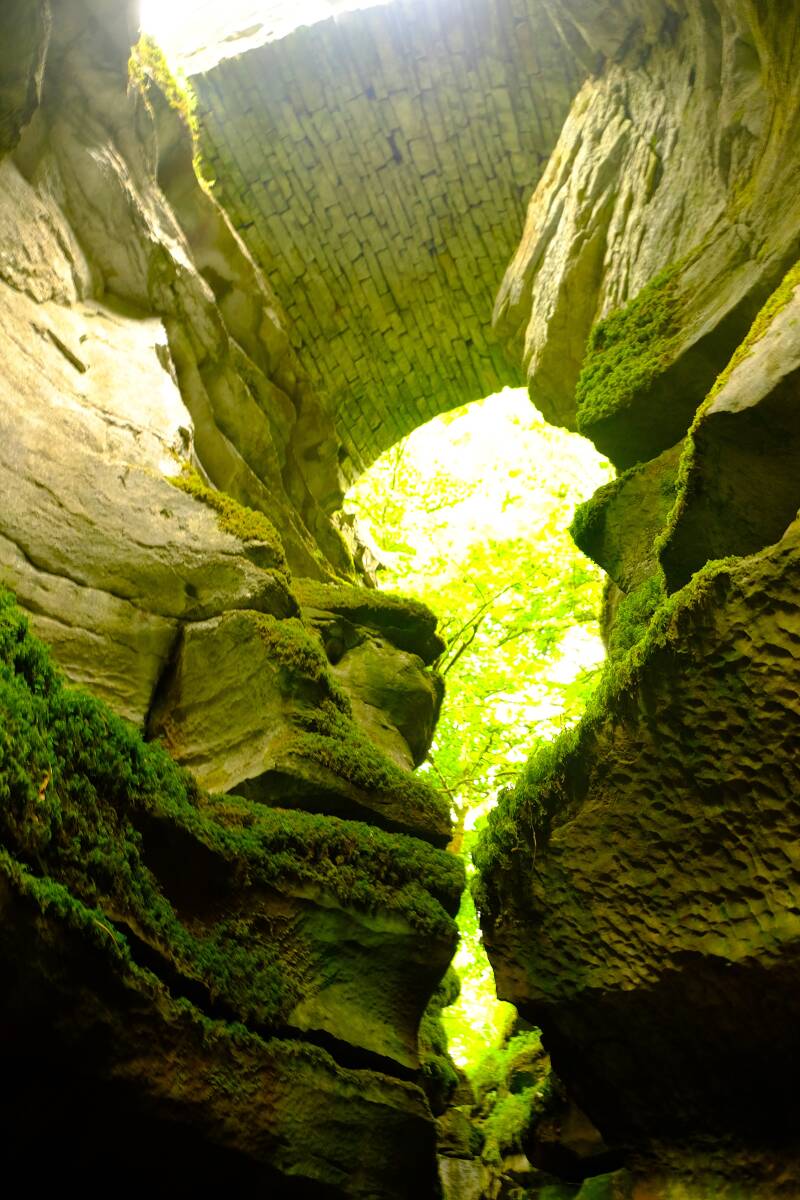
Photo below: a different view of Hell Gill Devil's Bridge taken from below. Note the beautiful stone construction, and the beautiful light of the gill, shining on moss, the natural rock walls and upon the bridge. It seems that the foliage of the trees around the top of the gill, turns the whole light "green" in summer. What an utterly magical place.
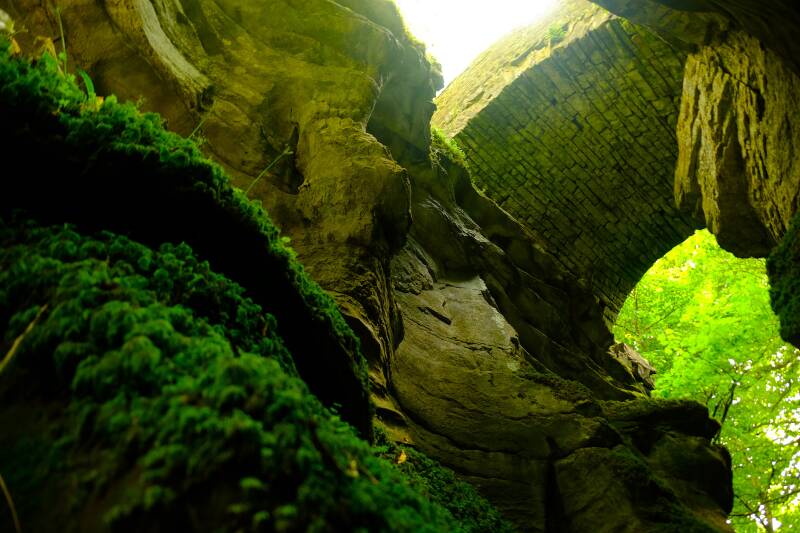
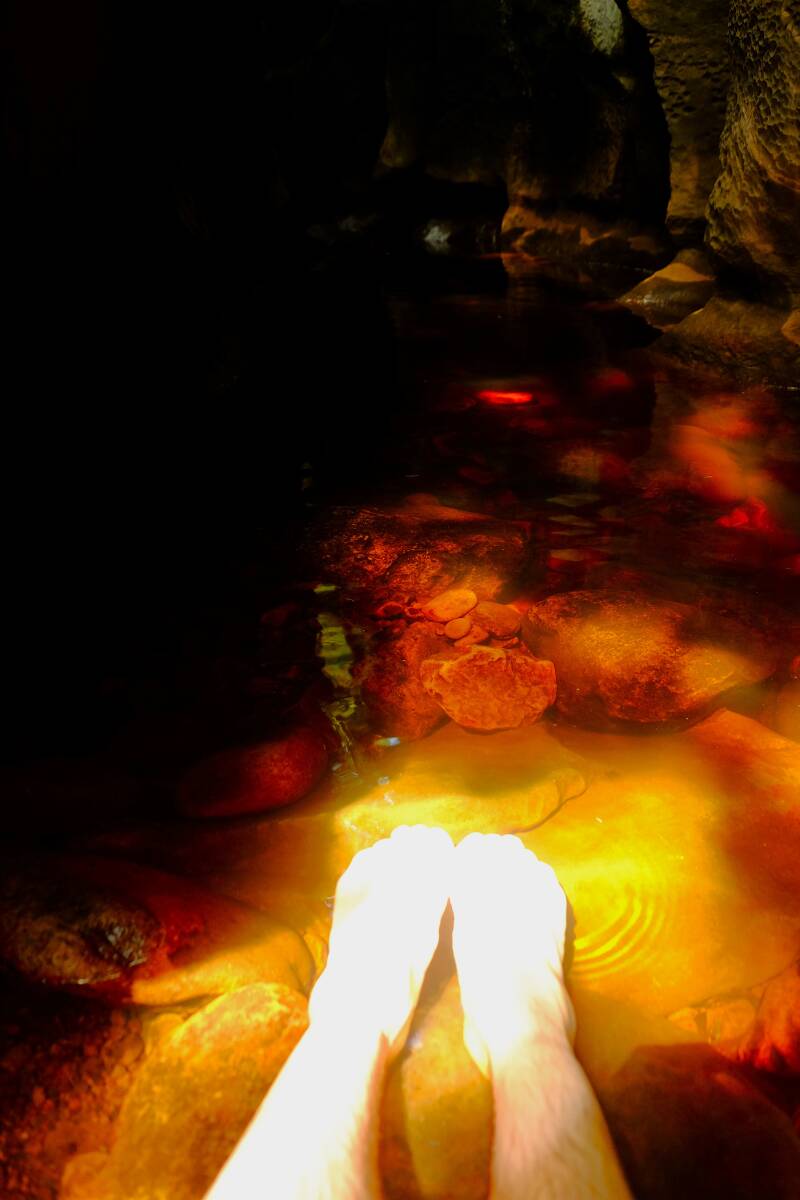
Photo below: a self portrait showing me paddling my feet in the waters of Hell Gill. I took when I was paddling in the water. Note, the rocks are slippery and one cannot simply walk up this gill in bare feet. Nevertheless, when I had a moment, I took of my shoes and socks, and sat down, dipping my feet in. This felt very earthing and grounding for me, especially considering the sacred and ancient connections to this place - and the sacredness of water. Note how the water appears orange-red in colour, which is a result of the green light in the gill shining into the slightly peat-coloured waters of the gill. I liked the way that my feet are glowing in the light in this photo - it looks kind of magical, just like Hell Gill itself.
Anyway, as I said, I did not manage to find the cave on Helsfell, the cave also being presumably why the hill was given this name, especially considering that the cave is of archaeological significance. At least one ancient human skeleton is reported to have been found in the cave, although, as with in a lot of cases, the bones have been lost, and it appears that there was not, at the time, any means of dating the bones, nor of dating them through their archaeological context. From what I understand, the cave is pretty narrow, the entrance is narrow, then there are some kind of "steps" going down, then after some distance, it narrows, then narrows further. I am not sure where in the cave the ancient human remains were found.
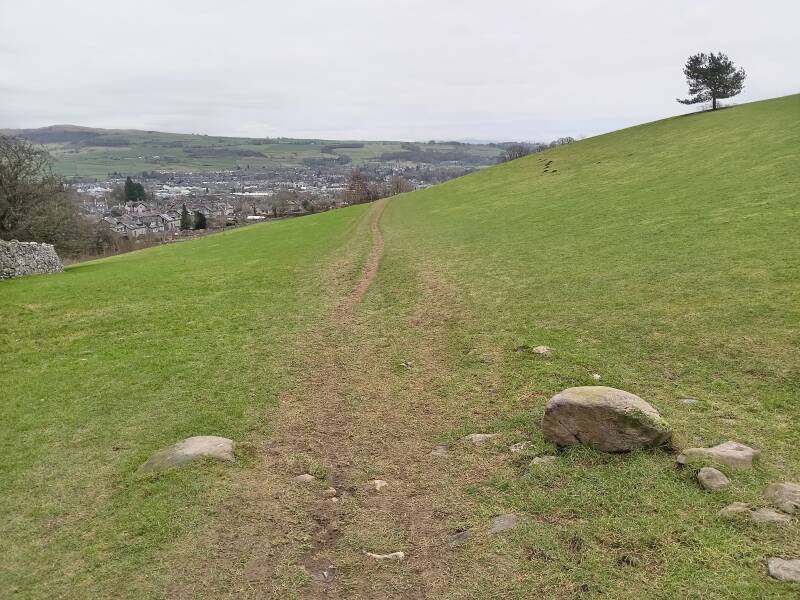
When looking for the cave, I did however notice a possible archaeological complex, I wouldn't call it a "stone row" but rather a potential alignment of stones leading from just above Kendal, towards the base of the crag, wherein the cave definitely is - somewhere. Whilst there is no spring marked on the map, there is a water source, possibly a spring, at the base of the Helsfell Nab, i.e. the crag where the cave is. Some of the arrangements of stones around this water trough, which appears to be fed from a spring, look ancient. I have seen many other such sites in South Cumbria. Below this and next to the adjacent wall are some large stones, as one goes downhill beside the wall - stones that generally people call "erratics", but this does not exclude the possibility that people or ancestral powers moved them into position. These stones are located at around: 54.336191, -2.766996 . Three large stones, possibly megaliths moved by people, are spaced along the line of the wall, and close the wall near the coordinates: 54.335002, -2.763370 . As one goes southwest of here, towards Kendal, and through another gate, there are a number of largish rocks located at around: 54.334586, -2.762072 . The aforementioned rocks include two "gateway stones", i.e. stones that would served as acting as a threshold or entrance into a spiritual place, as well as having other important purposes. This would only be correct of course if the stones have not been moved much from their original positions. The pathway, almost straight, from the two stones, then leads through this field, to another large-ish rock, located at around: 54.334097, -2.759955 . This is not the most promising alignment of stones in the world - but it could be some kind of alignment and "route" towards the cave and spring.
On a different note, Cunswick Tarn is not far from this place, if one goes in a general westerly, and slightly northerly direction, although there is a bypass in the way. Cunswick Tarn also has some very interesting possible stone alignments, which I have not yet published anything about.
On a magical note - when I was walking back from Helsfell Nab, and the light was getting a little darker, I looked towards the east, to the fells of Longsleddale, the Howgills and beyond, and thought how, at times, Kendal as a town I have found somewhat uninteresting as a place. In fact, modern England in general I feel pretty disconnected from. But when I saw those mountains in the evening, and was walking along that possible stone alignment, I realised that, to me, when I engage with the Kendal landscape this way, of ancient mountains, their alignments, and deeply rooted spiritual symbolism and ancestry, I find it anything but uninteresting.
Photo below: part of the possible stone alignment on Kendal Fell and Helsfell, towards Helsfell Nab. Note how the two stones in the foreground (if in their original position) are acting as a kind of gateway, potentially. I have seen many other similar megalith features nearby. Another large stone is located down the path in the centre, around where the path turns a corner, but this stone is not easily visible in the photo below.
I hope that this article was a fascinating read. It is dedicated to my family, who love the sacred places of Northern England and Scotland - and it is dedicated to the ancestral figures of these places, who I believe, continue to guide me and to help show me these places. My grandad in particular really loves Hell Gill and my grandad is, himself, akin to a wizard and a guide to the caves and underground of Yorkshire and Lancashire. I am pretty sure in fact that my grandad is a reincarnated wizard and spiritual teacher, he has always felt a love for Egyptian cosmology especially - deeply within his spirit.
Add comment
Comments