This blog post/article was written and published by Linden Alexander Pentecost, published on the 20th of January 2026, and only on this website www.languages-of-linnunrata.co.uk (not my only website). No AI was used in this nor in any of my works. This article/blog post is entirely separate from and contains different content from any and all of my other publications, even if I have discussed these topics elsewhere in different ways and with different information. This article/blog post was published in the UK, on this UK-based website (my other websites and publications are also published in the UK). The author is also from the UK and a resident of the UK. This article contains 3 photos showing the inscription on the Beckermet Cross from different angles, all of which were taken by me and have not been published before, just like the article has never been published before. This article discusses the inscription, ancient inscriptions in Britain, gives its possible translations and Goidelic or extra-Goidelic transliteration, and also discusses more on the Giant of St Bees, not published before, although I discussed other aspects of the St Bees Giant also in an entirely separate blog post published before this blog post in front of you, not I discuss different and more numerous aspects of the St Bees Giant in this blog post/article in front of you. This article/blog post also discusses other topics. This article/blog post contains a total of 2775 words. Note also that in the unrelated blog post before this one I also discuss aspects of the connection between giants in Britain and extra-Goidelic & Goidelic links with Ireland and other Goidelic areas, but in the blog post before this one, I discuss these topics in different contexts and with different information to what I give in this blog post, all my publications on these topics are equally relevant.
In Western Cumbria is situated the village of Beckermet, pronounced "beckERmet" with the stress on the second syllable by people in West Cumbria, although I admit that personally this form of stress pattern is not my natural way of speaking, so I tend to put the stress on the first syllable.
If you head in the general direction of the sea from the main part of Beckermet Village, you will come to an old church, within the grounds of which are two crosses, which I would personally describe as Norse-Gaelic in form and design, although some suggest a more Anglic origin of these crosses.
One of the pillars contains upon one side an inscription. Whilst Cumbria possesses several early Latin and runic inscriptions, the alphabet used in the Beckermet Cross inscription is, well, even more problematic, because nobody is quite sure what alphabet exactly it is, and thus nobody really knows how to read the letters, nor what language it is in, nor what the inscription means. In a sense it is like Cumbria's own equivalent of the Phaisos Disk from Greece.
I remember reading somewhere that the inscription seems to be using a form of the Latin alphabet, similar to that used on some early Christian stones, somewhere in the east of England. I have a distinct feeling that the paper I read this in is in a large box of papers about such monuments in my house, if I find the reference again I will write another publication on this. But anyway, in essence, it does make sense that the inscription would be in some form of the Latin alphabet, or at least, in a kind of extra-Latin alphabet, by which I mean an alphabet but that might be fundamentally connected to the Latin alphabet but not necessarily of identical origin.
Photo below: a close-up of the Beckermet Cross Inscription. Note how some of the letters are identifiable & similar to letters of the Latin alphabet, whilst other letters resemble Latin letters, but not quite enough to be completely sure of them. Other letters do not really resemble Latin letters in any absolute sense.
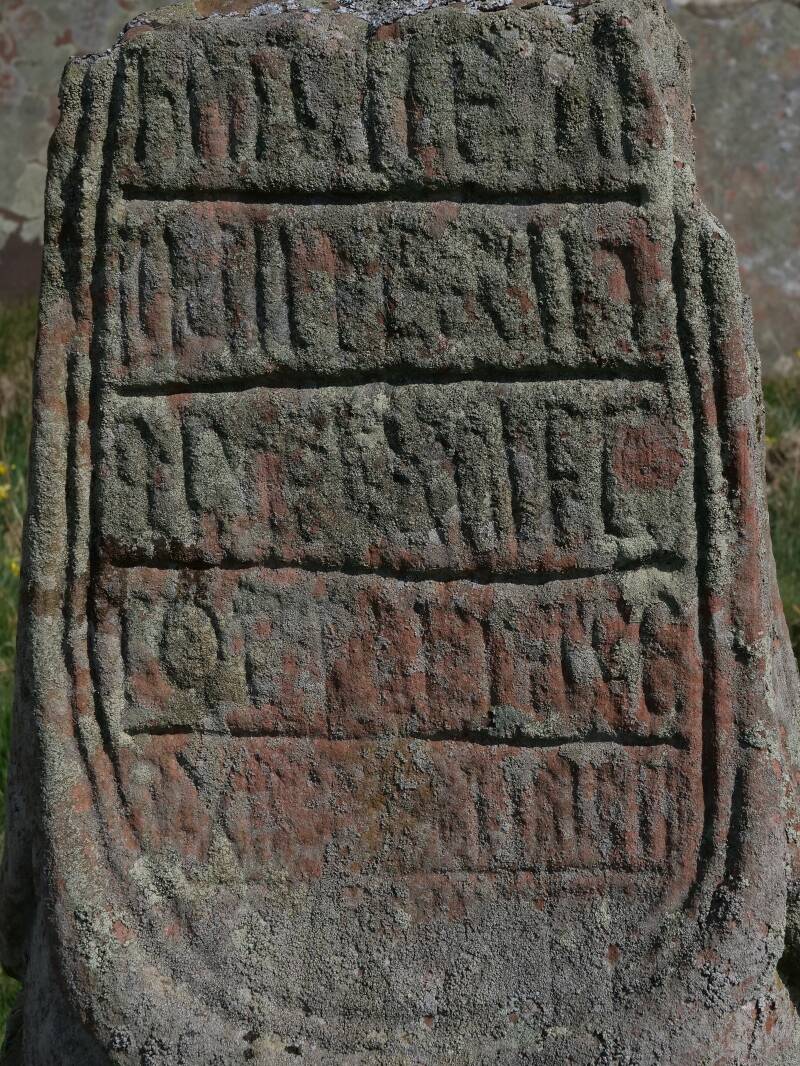
With regard to this - the actual origin of the Latin and runic alphabets are disputed. The common, and in my opinion, more boring interpretation, is that all of the alphabets indigenous to northwestern Europe were based on Latin. Personally, I am more inclined to think that they developed alongside the Latin alphabet since ancient times, but do not necessarily come from it. There is also evidence certainly of some kind of writing and alphabetic, rune-like writing and symbols being used at Neolithic sites in parts of the UK, for instance. And some of these letters or symbols at Neolithic sites show a connection to later runic, Ogham and witchcraft letters or symbols used in Britain and Ireland. This is another topic in and of itself, but I thought I would mention it here because it is relevant - and is it also possible that the inscription at Beckermet is representative of an unknown, earlier form of language. The Iberian script for example, is known to have some kind of relationship to the Phoenician and Greek alphabets, but does not appear to directly come from either. Similarly some of the inscriptions in the Canary Islands have been read as having a similar script to the Iberian and related scripts.
Anyhow, in terms of the inscription at Beckermet, there are possible translations, which are entirely different from each other, depending on how the inscription is read, and upon what language it is thought to be in. Sometimes I do go down the thought path of thinking that written evidence of ancient language is sometimes more sure and solid than that gained through studying more recently attested spoken languages. Then I remember that actually written language is in no way a more "sound" form of evidence because, if there is any certainly about the lettering, or even, in this case, the whole alphabet and language, then the inscription can be read in a whole myriad of ways. Many of the runic and Ogham inscriptions also have a rather vague relationship to actual languages and sentences we can identify, with many examples having formulaic use of language which can be understood, whilst the rest of the inscription may be entirely unintelligible. Still, there are other inscriptions which have been translated - but only if we presume that several letters are missing, that others must be substituted, and if we are assume that certain letters, or symbols, are exactly what we assume. I find early examples of written language in Britain to be utterly fascinating, but they are also a very painstakingly difficult pursuit, and I have a feeling that our entire understanding of them must at some point be re-calibrated to incorporate newer and older ideas about these inscriptions in a more balanced way.
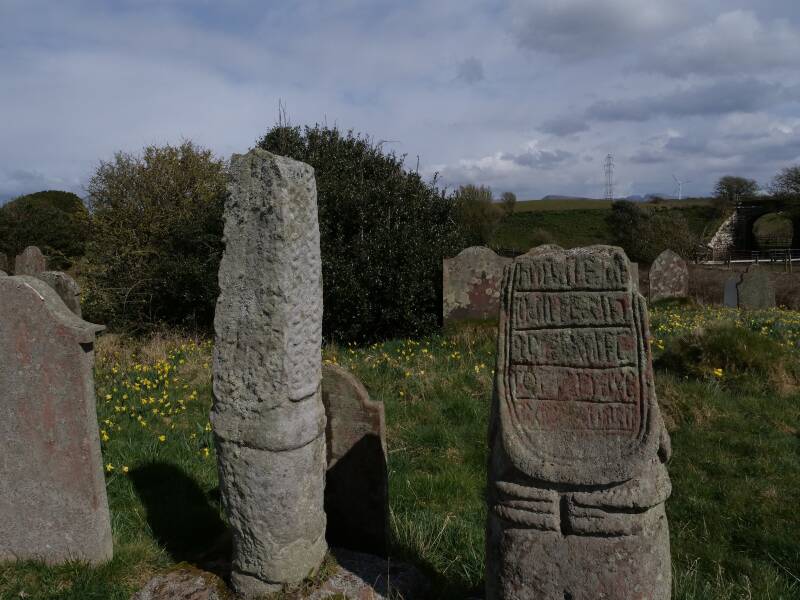
Photo below: a different view of the Beckermet Cross Inscription, with another old cross monolith to the left of it. More upland areas can be seen in the far distance behind the crosses.
In the book, The cross in the life and literature of the Anglo-Saxons, various translations of the Beckermet Cross inscription are included, and it is quoted that Calverley in Archæologia Æliana 6, 6I, quoted by Calverley, p. 29, gives a Goidelic transliteration of the inscription, which is reported on page 49 of The cross in the life and literature of the Anglo-Saxons to be specifically in Manx Gaelic, the Manx or Goidelic interpretation having been made of the Beckermet Cross by a Mr John Rogers. Although the Goidelic transliteration of the cross inscription is not given in The cross in the life and literature of the Anglo-Saxons, it is included in the St Bridget, Beckermet webpage on the Old Cumbria Gazetteer website, and I presume that the version given on that webpage is the "Manx Gaelic" version described in The cross in the life and literature of the Anglo-Saxons, although the precise kind of language given is not typical Manx nor Goidelic, and it is certainly not using a transcription system that resembles modern Manx orthography! Nevertheless it makes sense that the language would be close to Manx in some way. Below I include the transcription as included in an image on the St Bridget, Beckermet webpage on the Old Cumbria Gazetteer website. The inscription at Beckermet has been transliterated as:
----------------
RINtdlEGNE
IUdN : lCdIR
qbRE : IMIEC
FOS : Fd : SElFE
Î.XSt. ' . RhN:SI
CR
Which was translated as meaning in English:
----------------
made for
John Mac Cair-
bre gone to
rest in the keeping
of Christ . be gracious to him
Oh Christ
Certainly, some of the transliteration is identifiable with Goidelic words and phrases that I know. Note that the second name Cairbre is written on two lines. I do find it tempting to see a connection to Ireland and to the Goidelic and pre-Goidelic World here. Especially given the other historic and linguistic connections between West Cumbria and the Goidelic and pre-Goidelic worlds. But nevertheless, the above transliteration and translations both rely upon the assumption that certain letters are what they are, and that there are abbreviations used. Now, I do write about ancient written language in Britain, and have I hope contributed some fascinating things. But this does not mean I am good at reading ancient alphabets, not really. I identify and see stuff yes, but I do not regularly work with Latin inscriptions for example, nor do I have an "eye" for identifying different variations of Latin writing. So, this subject of the Beckermet inscription is something that I hope somebody else takes up. And yes, it is important. It should be looked at and studied more. And like many such inscriptions in churchyards, it is badly degrading. Even within the time frame from when the stone was first described til the present, the inscription at Beckermet has degraded. This, sadly, is a common occurrence. And I do think that it might be down to these monuments being better cared for in a more distant past, but also I think it's down to changes in the climate and environment. The rain and elements nowadays seem to be degrading these stones, particular sandstone carved or inscribed stones, much faster now. And in this country we are not doing enough to protect nor to properly study and understand these things. And time is running out. I hope that my urgency makes sense.
I am inclined to think that perhaps, the inscription might be in some Goidelic or pre-Goidelic language though - because of the strong links to the pre-Goidelic and Goidelic worlds in this part of Cumbria, and also because Beckermet is so close to St Bees, the most western point in Cumbria. It is not that far, for a boatman, to travel from here to the historically Goidelic (Manx) speaking Isle of Man. Nor is it far to travel to the historically Irish-connected and perhaps once pre-Goidelic speaking island of Anglesey, or in Welsh: Ynys Môn. Nor is it far to the once Goidelic or pre-Goidelic speaking region of Galloway in Scotland, and of course all of these places are connected, historically and linguistically, to Ireland. The Irish connections to Cumbria are definitely some of the most under-represented and under-studied. Which is really sad, because I feel that our kinship is natural, ancient, and should be remembered and re-lived again.
I will nevertheless give the other translations as quoted in The cross in the life and literature of the Anglo-Saxons. A Mr Haigh, presumably through reading the inscription in Old Northumbrian, proposed the following translation of the Beckermet Cross Inscription:
Here enclosed
Tuda Bishop
The plague destruction before
The reward of paradise after
According to The cross in the life and literature of the Anglo-Saxons, an R. Carr Ellison translated the Beckermet Cross in yet another way, reading it as:
O. thou loved
offspring Edith
little maid
in slumber waned
Years XII. Pray ye for her soul
Year MCIII.
Also, according to The cross in the life and literature of the Anglo-Saxons a Reverend John Maughan translated the Beckermet Cross Inscription in yet another way, as:
Here beacons
Two set up
Queen Arlec
for her son Athfeshar
Pray for our
souls
As you can well see, these four different translations have pretty different meanings. Perhaps it is time that someone, preferably an expert in medieval forms of the Latin script, took another look at this inscription - because it is still quite plainly a mystery.
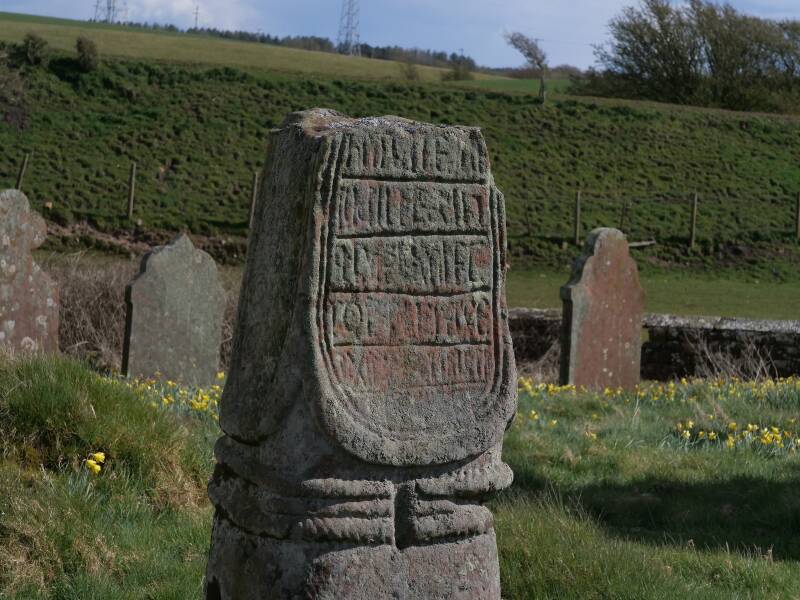
Photo below: a different view of the Beckermet Cross with its inscription upon it. I feel that showing this monolith from multiple angles is important to give a scope of what exactly the text upon the monolith looks like.
As I mentioned in an unrelated article/blog post I published on this website recently, and in other publications before - there is also a report of an ancient giant being dug up at St Bees, some hundreds of years ago. This individual was said to be 14 and a half yards long, or around 13 and a half foot tall, over 4 metres in height. He was said to be wearing a suit of armour. This whole topic of giants is very confusing, and we have very different manifestations of it. The Fomorians, which I mentioned in my article published yesterday with regard to these connections with Ireland, often came to embody, as an idea, the more destructive qualities associated with giants. They were sometimes described as though in some way other and different from us. Yet, the giant of St Bees was said to be wearing armour, and this is also a sporadic, and relatively common occurrence in reports of ancient giant being found in North America. Some giants were described as hostile towards humans. Whilst others, seem to carry the role of divine heroes.
Note, that the St Bees Giant is not the same individual as the so-called St Bees Man, The St Bees Man being a medieval knight who was found buried in the 1980s, on part of the St Bees Priory site. The St Bees Giant on the other hand, was found hundreds of years earlier, and is reported in the book: The History and Antiquities of Allerdale Ward, Above Derwent, in the County of Cumberland: With Biographical Notices and Memoirs, written by Samuel Jefferson and first published in 1841, a long while before the more recent discovery of the ordinary-sized St Bees Man was discovered. The St Bees Giant, i.e. the 13 and a half foot tall giant knight, was, according to the aforementioned source, discovered in a corn field at St Bees. Sadly I do not know within which field exactly where the giant was found, but one can presume that it was likely in one of the corn fields at St Bees, close to the sea cliffs.
One can only imagine, why this giant might have been buried in armour. Was he some kind of divine guardian, protecting other peoples? Was he buried close to the sea at St Bees, in a place sacred to him, between the land he protected, and the sea, looking across to the ancestral lands of his cousins? The report of the discovery of this ancient knight does invoke in me such feelings. Whilst I am absolutely more a fan of a "feminine" spirituality, that embraces the sacred feminine and goddess figures - the concept of the knight, of the divine masculine protector, also has an equal presence in the world. Of course, both have become corrupted many times. The knights that we know from history, sometimes worked for money, and were not pleasant people. This is a twisting of a purer masculinity. But for many things that are broken and corrupted, there must be an older, non-corrupted form. And I for one think that such divine knights did exist. Masculinity repressed femininity, which humanity is slowly realising. But that doesn't mean that the original, holy concept of the knight did not also exist. Oh, how little we know of the events and circumstances of an ancient world, where such giant protector beings could have existed. May we one day come to understand it.
I hope that this article was an interesting read. This publication is dedicated to my family, and to the Giant of St Bees, and to the Goidelic & extra-Goidelic speaking ancestors of West Cumbria. In my other publications you can see more information and evidences of extra-Goidelic and Goidelic connections to West Cumbria.
Add comment
Comments