Written and published by Linden Alexander Pentecost, the three photos were also by Linden Alexander Pentecost. This blog post was published on the 20th of January 2026, and only on this website, www.languages-of-linnunrata.co.uk . This blog post/article was published in the UK on this UK-based website, and I the author am from the UK and live in the UK. Neither this blog post/article, nor any of its written content and photos, have been published before, and this blog post is separate from and unrelated to any and all of my other publications, including those which also discuss different aspects of the topics I mention in this article/blog post. No AI was used in this publication. This article/blog post contains a total of 2578 words. The text in italics above the photos in this blog post, like in my other blog posts and articles, contains important information not in the main text which is not in italics. Note that I also published another unrelated blog post on this website earlier today and will publish another in half an hour or so after publishing this blog post on this page.
Galloway, or in Scots: Gallowa, in Scottish Gaelic: Gall-Ghàidhealaibh, and in reconstructed Galloway Gaelic: Gall-Gháedhealaibh, is an ancient region of southwestern Scotland. The root gall in Goidelic languages is often translated to mean "lowlander", but in my opinion at least, it originally referred to tribes and peoples who were considered "non-Gaels". This is often interpreted to mean "Norse" in terms of Galloway, but I suspect that the ancient identity of the gall in this region far pre-dates the Norse, and may be described for instance as pre-Norse. I have written much more about the use of the word gall elsewhere.
The ancient linguistic history of this region shows us a range of root-words, which can be compared to Goidelic, Brythonic, Norse and Anglic words, many of which, in my opinion, may actually be pre-Goidelic, pre-Brythonic, pre-Norse and pre-Anglic. Having said this, some kind of Middle Welsh-like language would have additionally been spoken here in a later period, albeit perhaps by only a small number of people, and in addition, a kind of Gaelic, known as Galloway Gaelic or Gallovidian Gaelic would have been spoken in Galloway at least in certain areas, up until only a few hundred years ago.
Whilst I am of the opinion that a large number of the P-Celtic/Brythonic and Q-Celtic/Goidelic place-name elements are pre-Celtic in origin, these later, in a sense I think, "became" the basis for a Goidelic language here, just as Goidelic languages similarly came to develop elsewhere in Scotland, Ireland and the Isle of Man. Since Galloway is close to Ireland, the Isle of Man, and to Gaelic Scotland, it is quite likely that Galloway Gaelic shared specific features with all three of these languages in some way - but this is not to say that Galloway Gaelic could be classed as any of the aforementioned three.
Sometimes it is thought that Galloway Gaelic was essentially a dialect of Scottish Gaelic, and there are efforts to teach Scottish Gaelic in this region of Scotland. But whilst Galloway Gaelic was a Goidelic language spoken in Scotland, that does not necessary mean that it was the same language as Scottish Gaelic, as we identify Scottish Gaelic today. The implications are also very clear, that the region of Galloway was considered distinct and different from other parts of Scotland throughout history.
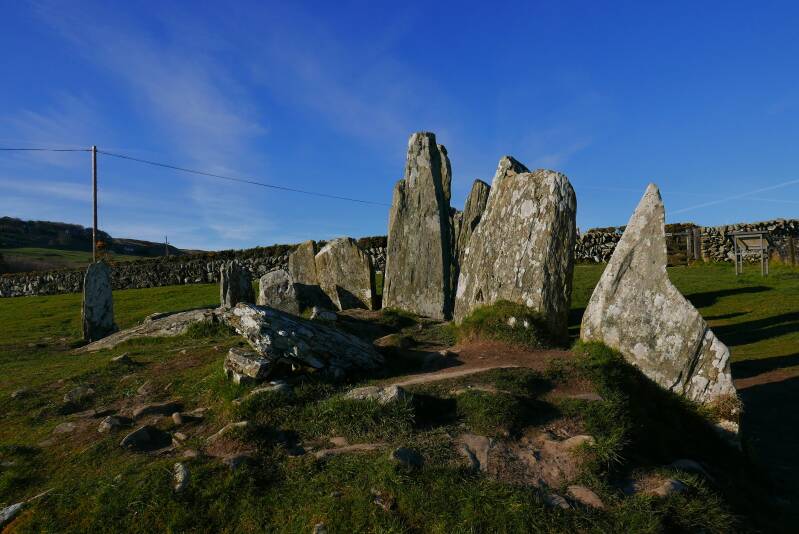
Photo below: an photo showing the Cairnholy 1 Chambered Cairn, with the upright standing stones being a visible reminder of the way in which this site appears to "reach" towards the sky. Much of the site has sadly been destroyed over the thousands of years, but these upright stones still attest to its importance. This photo was taken on a beautiful March afternoon in 2022.
When the Romans built Hadrian's Wall, it may have been tribes of people in southwestern Scotland who they were defending themselves and their trade networks from, which is not to say that the Romans were the ones who were in the right. The idea that some of these tribes, who spoke a different indigenous language to Gaelic, whatever that was, lived into relatively recent times, is in my opinion indicated in archaeology and folklore, which I have discussed elsewhere. These, what were indigenous tribes, did in my opinion, come to be described as gypsies and travellers in later periods.
In later times, the place-names of Galloway have likely become changed by reinterpretations. For example, the megalithic structure featured in the first two photos in this blog post, is Cairn Holy 1, the larger of the two chambered cairns at Cairnholy. One can see here how the adjective comes after the noun, which is typical of Goidelic word order, and that the second word "holy" is readable through English and Scots as meaning, well, "holy". Which would imply that an Anglic word has been applied to a place-name by a Gael, who has used the Anglic word "holy". However, it is more than likely that Cairn Holy could be a changed form of an original Galloway Gaelic: *Cárn na h-Ulaidh meaning "Cairn of the Treasure", although *Ulaidh could also refer to "Ulster", and so the name could mean "Cairn of the Ulster folk", which could be possible, given how close Galloway is to Ulster, as the crow flies. The exact etymology of the second element is uncertain, although, according to folklore, the cairn is the tomb of the otherwordly Scottish king Galdus. In a mythological sense I think there is truth in this, if we infer that Galdus is a name based upon an ancient, mythical god-king type figure, rather than being an entirely physical king of the medieval era.
Whilst prehistoric human remains have been found in other, smaller cairns near Cairnholy, Cairnholy 1, the megalithic tomb visible in the first two photos of this article, was found not to contain human remains, although a jadeite axe was found within the structure, as was a flint knife, both being likely placed there for spiritual reasons. The Cairnholy 1 megalithic structure bares quite a strong similarity to the chambered cairn of Cashtal-yn-Ard located on Mannin/The Isle of Man, which is not a huge distance by sea from Cairnholy. Both Cashtal-yn-Ard - meaning "Castle of the Height(s)" and the Cairnholy 1 chambered tombs seem to be deliberately located in locations that are quite high and open, giving the impression that these ancestral sites might have been associated with the sky in some way.
Despite that these chambered cairns are generally considered to be burial tombs, and indeed, some are found with large amounts of prehistoric human bones, I am unconvinced that these sites served only as tombs. I tend to think of them more as portal places between our world and the world of the ancestors. In Neolithic chambered cairns in the Northern Isles for example, and in Neolithic chambered tombs elsewhere, when bones are found - they tend to be distributed in such a way to suggest a more "collective" idea of burial. For instance, bones were often gathered and stored together in the chambers, not as individual humans, with the bones becoming mixed out, and likely taken out, used in ritual purposes etc. The tradition of Halloween, when we make effigies of a human head out of a pumpkin, or originally a turnip, and then place them outside homes etc, may relate back to these much earlier traditions, although, if this is the case, then one can imagine that it was rather an actual skull of an ancestor, which may have been removed from the cave, and consulted, etc. It is important to understand here that in many indigenous cultures, the spiritual self was not simply a "spirit", but rather had multiple aspects, so, in other words, upon death, a person's spirit may have been thought as returning to the sky, whilst another aspect to the spiritual self, the soul for instance, remained connected to the body and particularly to the bones. This "bodily soul" or "bodily spirit" is not necessarily the exact same thing as the individual spiritual self, and it may have been considered as a different kind of entity and aspect of the person.
Similarly, the way in which the bones in these burial sites were not placed in order to preserve the individual separately, is implicative that certainly the physical aspects of the spiritual self were considered less individual than how we perceive it in most spiritual beliefs today. In a sense it is the idea of being owned by oneself, spiritually, and being owned by and connected to others, spiritually. Precisely how they defined the idea of an individual is a curios topic. Of course, they would have done - they would have of course acknowledged that no people and no spirits are the same. But they may not for instance have believed that the existence of the individual spirit contradicts with the idea of another collective spirit and body. Nevertheless, my Native American friend, and my own research, leads me to believe, that the spiritual and ritual practices of the Neolithic spacetime sometimes contradict with more widely held views about spirituality. According to my Native American friend for instance, the idea of moving, re-arranging, and ritually using bones in this way, is likely to disturb the different aspects of the spiritual self, and to slow down the process of the person's spirit being able to integrate these different aspects in the afterlife. However, perhaps the Neolithic peoples did this in such a way that did not trap the individual spirit nor prevent it from transcending. This is my belief. But, the Neolithic is a pretty alien period, and whilst we can see glimpses, we really do not know how they understood these concepts exactly.
That they continued into more recent times is clear though. The Neolithic traditions and peoples never really died out, they became a part of us, the traditions and practices may have changed slightly, but they also remained, under a different guise. Take for example the Cumbrian legends about "Screaming Skulls" which I have talked about in another post on this blog. These "Screaming Skull" stories imply that this idea of the bodily spirit, or of a part of the spiritual self that remains connected to the bones, did not ever die out. Or, take for example the story of Granny Mann, the White Witch of Dartmoor, who would consult a human skull for knowledge and wisdom. She placed the skull in a hidden place, perhaps in a cave, on Easdon Tor in Dartmoor, a place associated with witches, where she would consult the skull. This, to me, is basically an account of Neolithic and earlier spiritual practices being continued up into the 1900s, the exact same concept of using the skull for divination and contact with the ancestors has continued for thousands of years almost til the present day. This is of course, one of a multitude of examples of these practices being continued into relatively recent times. Of course, I am not suggesting that anyone should ever practice these things today, even if one is legally in possession of for example a human skull used for medical purposes, it would not be a good idea to try and use that skull in rituals without the spirit's permission, such an act would be heresy including within modern paganism, not to mention the likelihood of angering the spirit that the skull belongs to.
The people of the Neolithic and their ancestors, possessed an advanced spiritual, scientific knowledge of materials, symbolism, and ritual, for interfacing with the different spiritual forces and worlds around us, as they interact with and influence our own world. Their knowledge was so incredibly advanced in this respect, that we can only grasp pieces of it. We don't really know just how far the level of their knowledge and wisdom surpassed our own. Later witchcraft traditions in Britain did, I am sure, continue this knowledge into more recent times, but of course many of the witches were wiped out in a horrific way, so we cannot ask them about it either. This has for many years presented to me the full force of our modern, post-medieval injustices. And I also find it sickening that we teach teenagers and university students a fake version of our history, which positions modern society at the "peak" of human development - when in reality, the very groups of rich people and slavers, people who wished to control us, people who in the 1800s decided upon this version of history that we get taught, were people with the same mentality as those who killed witches and tried to destroy our native spirituality, replacing it with the quite-frankly laughable notion that society today is at its most advanced. Of course, there are some things about modern society that are advanced, such as medical cures and technology which can be useful and helpful, when used responsibility. Although, at the same time, modern society has destroyed environments, native peoples and languages, and committed atrocities that would make our ancestors weep.
Photo below: another view of the Cairnholy 1 chambered cairn, from a different direction, with uplands visible behind the tomb, under the cloudless blue sky. Some cup markings can be seen on one of the stones on the left of the image. Note that I have not included in this article anything about the Cairnholy 2 chambered cairn, but will discuss Cairnholy 2 in a future publication.
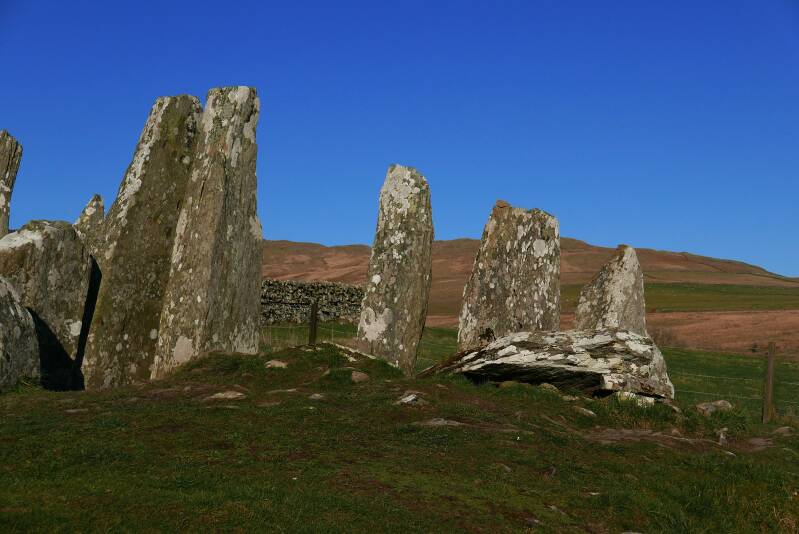
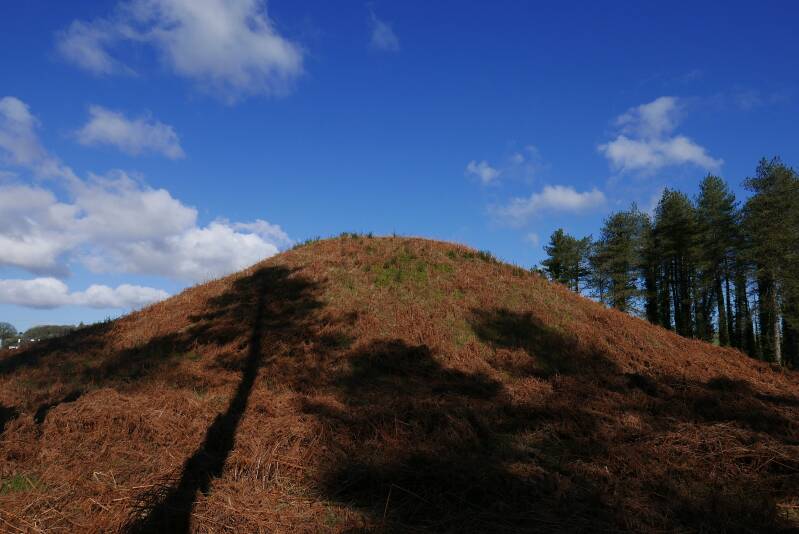
Photo below: the Droghduil Mote, a large earthen mound that is a focus of the important Dunragit prehistoric complex, at Dunragit in Galloway. The mound itself is Neolithic in origin, but the area around it has been important since at least the Mesolithic period. Also during the Neolithic period, a massive timber henge was constructed at Dunragit. A curious point of observation is that the Neolithic complex of Dunragit, with its large earthen mound and timber henge, are of a different kind of Neolithic architecture to the Clyde or Manx-style chambered cairns at Cairnholy, for instance, which may in part represent a cultural difference. What is also relevant here is that the name Dunragit may come from an extra-Brittonic *Dýn-Ragit, "Fort of Ragit", with the latter component: *ragit being possibly cognate to the Welsh name Rheged, which described an ancient kingdom in Yr Hen Ogledd, "The Old North". If we take continuity into account, this may imply that the extra-Brittonic-speaking culture was ancestral to the builders of the mound and timber henge at Dunragit, whilst the extra-Goidelic culture was ancestral to Clyde or Manx-style chambered cairns like those at Cairnholy, although, such a distinction is unlikely to be clear cut. If there is truth in this, and considering the similarity between Clyde or Manx-style chambered cairns and some of the "giant" sites in Northern England, as discussed in other blog posts and elsewhere - are in some way more orientated towards extra-Goidelic languages and Goidelic languages, which could also make sense given the other things I have recently discussed including in other blog posts about other aspects to these connections and relationships.
I hope this article was an interesting read. It is written in honour of the people, the ancient folk and the ancestors of Galloway.
Add comment
Comments