More on Kintyre Gaelic & on the Gigha Ogham stone, published on the 12/04/2026
This article was written and published by Linden Alexander Pentecost, adn was published on the 12th of April 2026, it was published on this UK website only and was published in the UK, I the author am also from the UK. This article is unrelated to and separate from any and all of my other publications, including those wherein other aspects of Gigha and Kintyre Gaelic are discussed for example. The two photos in this article were also taken by the author, and the photo descriptions above the photos contain information not in the main text. No AI was used in this publication nor in any of my written works. This article contains a total of 2186 words. This article was last updated at around 2:20 AM UK time on the 12th of April 2026.
The Kintyre Peninsula or in Gaelic Ceann Tìre “Head of the Land”, is that peninsula in Scotland which reaches closest towards Ireland. For this reason, it is perhaps not surprising that links with Ireland have existed on the Kintyre Peninsula since the first people of this landscape, but the Gaelic of Kintyre is nevertheless, very much a form of Argyll Scottish Gaelic, although, like the Gaelic of Arran to the east, it shares a number of radial features with Irish - although, the same can be said, in a different way, some of the Gaelic dialects of Wester Ross, for example, that have some different similarities with Irish, so I will not overstate the connection between Kintyre and Ireland. The connections between Kintyre Gaelic, Arran Gaelic, Islay Gaelic and Irish, do I think go back a long way into the mists of time, although it is important to point out that contact between these areas and Ireland never ceased, just that these areas and their dialects were already established as distinctive and that it would be unfair and completely inaccurate for example to say that Kintyre Gaelic was, for example a “mixture” of Scottish Gaelic and Irish.
Kintyre Gaelic aligns with the Gaelic of Arran in a lot of senses, but in other ways, the Gaelic of Argyll as a whole is more aligned with that of the rest of Argyll and the Hebrides in a general way, and apart from Arran and some inland areas to the north, it shares also several similarities to the insular dialects spoken around Loch Linne, perhaps particularly so with the Gaelic of Jura and the Slate Isles in certain senses, which I believe to be due to ancient population and linguistic connections. Kintyre Gaelic also has its own unique features, words and pronunciations, and in addition, the dialects of Kintyre also contain unique differences between them, particularly in the pronunciations of vowels and of certain suffixes.
I have discussed Kintyre Gaelic elsewhere, but in this article I will focus specifically on two forms of Kintyre Gaelic spoken close to Tarbert, my information about these dialects comes from the Survey of the Gaelic Dialects of Scotland, edited by Cathair Ó Dochartaigh, and are represented by informants 41 and 42. Informant 41 came from the southern side of West Loch Tarbert in Kintyre, and close to where the loch enters the sea. Informant 42 is from close to East Loch Tarbert, the much smaller harbour a short distance away, but East Loch Tarbert faces the Firth of Clyde, this part of the Firth of Clyde goes north into Loch Fyne, whereas West Loch Tarbert is a much longer and generally larger sea loch, which goes out into the North Channel and ultimately to the Atlantic Ocean. West Loch Tarbert is also not so far from Gigha, Islay and Jura.
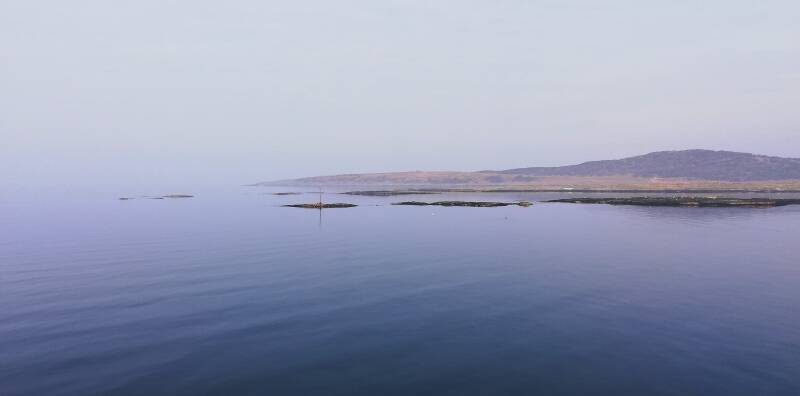
Photo below: a calm, misty morning near the mouth of West Loch Tarbert on the Kintyre Peninsula, the sky and sea seeming to merge, and the ancient coastal landscape seeming to float in a "gap" of mist and water, as though outside of time. Such environments can also be very treacherous, and folklore also indicates that supernatural beings, or dangerous portals, sometimes appear in the mist. You can just about see some raised beaches above the shoreline in the distance.
Note that the words of the Gaelic dialects of Informants 41 and 42 given in this article in bold letters, are spelled, in-part based upon the phonetic notations used for these and other Gaelic dialects as presented in the Survey of the Gaelic Dialects of Scotland, edited by Cathair Ó Dochartaigh.
As in Arran, the dialects of speakers 41 and 42 exhibit a common change from [a] to [ɛ], although to a varying degree different parts of Arran and Kintyre will sometimes have a preference for an [æ], and where these changes occur varies greatly between these dialects - in different positions these changes also take place in other parts of Scotland. The way in which these changes happen across parts of Kintyre and Arran also varies, but Kintyre Gaelic lacks the distinctive [w] found alongside these changes, e.g. Arran Gaelic mwȧ - “good”, but the form is mȧ̰ in the dialects of informants 41 and 42 (this word is equivalent to standard Gaelic math). Another instance of this change on Kintyre is Standard Gaelic màthair - “mother” which is pronounced mæ̀ȧir in the language of speaker 41, pronounced [mæːɛɾ], in the language of informant 42 the word for mother is máȧir, pronounced [mɛːɛɾ]. Between the language of informants 41 and 42 there are also other variations in vowels, for example standard Gaelic samhradh - “summer” is sæmhradh in the language of speaker 41, with a preference for an [æ] sound again, whilst in the language of speaker 42, the form is sȧmhîra, with a preference for an [ɛ] and with epenthesis, not present in this word in the language of speaker 41. Note that the -adh in sæmhradh is pronounced [ɣ], whereas in sȧmhîra there is no final consonant. An example of a long vowel variation of this sound can be seen in how standard Gaelic snàmh - “to swim” is pronounced, which is snæ̀mh in the language of Informant 41, and snámh in the language of informant 42. Note that in all the aforementioned Kintyre forms with broad mh, this mh is consistently pronounced [v].
There is also variation in these two dialects between the pronunciations of what is commonly written orthographically as ao. For example standard Gaelic laogh - “a calf” is pronounced lȯ̈ in the language of speaker 41, and lᴇ́ in the language of speaker 42. Note that in some parts of Western Kintyre this initial broad velarised L becomes a voiceless dental fricative, I discuss this in my other work on Kintyre Gaelic and in my other (not the work I published yesterday) work on Jura Gaelic, and in relation to Mull Gaelic and in other more general publications too. The letter ᴇ́ represents a long sound similar to [e] but distinct from it, it also occurs in Arran Gaelic and in some other parts of Scotland, including in the Cairnforms to some degree. In Arran Gaelic this sound becomes ö in the North of the island, a long version of a slightly different [ø] sound to that found more commonly on Kintyre and Jura for example (see my Jura Gaelic and other topics article published yesterday). Another example in the dialects of Informants 41 and 42 is the pronunciation of standard Gaelic saoghal - “world”, which is pronounced sȯ̈al in the dialect of Informant 41 and sᴇ́al in the language of informant 42.
Another curious couple of pronunciations are found in how speakers 41 and 42 use this ᴇ sound in different ways in the word maighdean - “maiden”, "nymph" or "virgin", I would write how speaker 41 pronounces this word, as: mᴇidïn, with the final n not being slender, but the d being slender, and an [ei]-like diphthong in use; speaker 42 pronounces this slightly different and with a long [e]- like sound, which I write as mᴇ́dïn. Speaker 42 also pronounces diphthongs which are not found in the dialect of Speaker 41, for example standard Gaelic seachdain - “week” is pronounced as though seachgon in the language of speaker 41, with an [ɛ] vowel, whereas for Speaker 42 I would write this word in their dialect as sëachgan, with the ëa representing [ɛa]. As well as in the words for “summer”, there are other important distinctions in the pronunciation of final -dh between these speakers, for example standard Gaelic sealladh - “view” is sealladh in the language of speaker 41, but seallaïbh in the language of speaker 42, similarly sgrìobhadh - “writing” is sgrìobhadh in the language of Informant 41 but is sgrìïbh in the language of Informant 42.
Words for “snowflake” vary greatly in Gaelic dialects and are likely I think prehistoric words, I have discussed something on their grammar and phonology in the following article on one of my other websites: https://www.clwaideac-na-cuinne.co.uk/articles-about-scottish-gaelic-dialects-pre-gaelic-language-s1-to-s25/s1-words-for-snowflake-across-different-gaelic-dialects-and-etymological-comments-other-topics . The website to which the aforementioned article link is posted on is called Clwàideac na Cuinne which is also Ardnamurchan Gaelic for “Snowflake of Memory”. I do not discuss Kintyre forms in the aforementioned article, and will give here the forms in the dialects of informants 41 and 42, which are clàdag and clòda respectively, with the West Loch Tarbert/Informant 41’s language form clàdag being notably more similar to the Ardnamurchan form clwàideac, the form clòda of Informant 42’s language is also not similar to the Arran forms which I discuss in the article which I linked to in this paragraph.
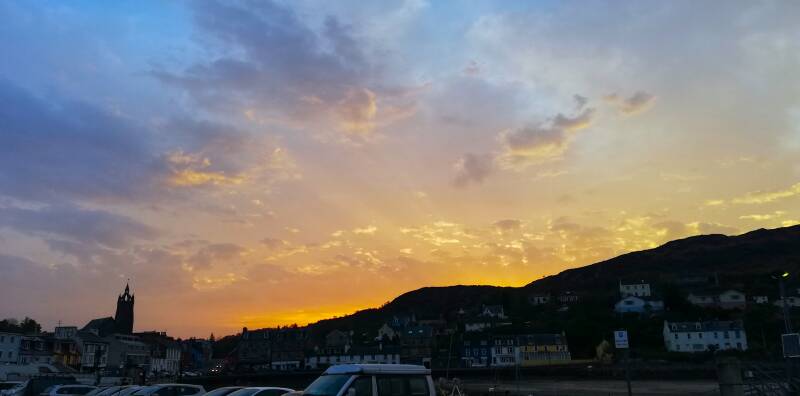
Photo below, a beautiful, late Spring sunset over towards the west, the photo showing the hills and village of Tarbert around East Loch Tarbert on the Kintyre Peninsula. The photo was taken in 2019. I remember some curious experiences here, I talked with someone at a bar, and then when walking back along the front at night, I felt like I was being watched, only for a seal to pop into the water seconds later.
I have discussed the Gaelic of Gigha in another publication dedicated to it, and to a less degree elsewhere, but Gigha also has an Ogham stone which I have not yet discussed. Sadly, this Ogham stone is not looking in a good state, judging by recent photos. I really hope that what I write about Ogham, runic and other inscriptions really helps to get it out there that a lot of these inscriptions are in a very vulnerable state. The Ogham inscription on Gigha, known as the Cnoc na Carraigh stone, has always, in academic memory, been in part unreadable. But if you look at photos of the stone taken today, you can barely see three or so of the Ogham letters barely visible. These stones with inscriptions should at least have a small fabric roof placed over them or something, otherwise they are literally going to become invisible during a few generations. There seems to be something strange with the rain, over the last century, I am sure that carvings are degrading faster than ever before.
I have never been to Gigha, but my grandparents have. They had a great time, it was a beautiful summer. They got invited to a wedding. Someone thought that my grandparents looked Italian. I myself have never been to the island, but one day I shall. Another thing I want to say with regards to Ogham is that, I did not know until recently that in Munster in Ireland, there are caves which appear to contain some kind of pre-Ogham writing. Rest assured I shall write about this in the near future. Anyway, the Ogham stone on Gigha, the readable parts of the inscription likely transliterate to:
FI.....MAQ.....O.....GI..... . Right, yeah that is not a lot to go on. Apart from that the MAQ is clearly a part of the "son of" formula and is etymologically from the same root as Scottish Gaelic mac - "son", demonstrating that the language of this inscription, at least in sense of its Indo-European formula, was more connected to Goidelic than to Brythonic. However, some parts of the other letters are, to a degree, readable. According to: The Ogham Stones of Scotland on babbelstone.co.uk, Forsyth transliterates the inscription, with what are they think the right missing letters, as: VIQULA MAQI COMGINI, whilst MacAlister transliterates it as: VIQULA MAQ CUGINI. On photos of the inscription, I can only see the MAQ and a few other parts, the previous letter to the M being unclear and in some senses this Ogham M looks more like a G and as a part of the previous letter, but this is probably just the unusual way in which the letters are spaced. Further up the inscription, there are bits of letters visible, but nothing that I can properly discern from photos. I will have to visit this stone in person to get a better look at it, I suppose.
I hope that this article was an interesting read. It is dedicated to the people of Kintyre and Gigha and to their ancestors and spiritual guardians.