On three Ogham inscriptions of the Isle of Man, published on the 31/03/2026
This article was written and published by Linden Alexander Pentecost, published on the 31st of March 2026. The three photos showing three Ogham inscriptions were also taken by myself, the author. This article is unrelated to and separate from any and all of my publications. No AI was used in this publication. This article was published in the UK and I the author am from the UK and live in the UK. The photo descriptions in italics contain a lot of information not information not in the main text. This article on this page contains a total of 1684 words. Note that yesterday (on the 30th of March 2026, the day before I published this article on this page you are currently on) I published an unrelated article on a different website about the Pennington runestone in Cumbria and related topics. This article on this page also discusses things about the Isle of Man and language and prehistory and other topics. This article on this page was published on the 31st of March 2026.
The Isle of Man has several attested historic language, and I think there were likely others which are no extinct or obscured. The Norse connections to the island are profound, with the Isle of Man containing the highest concentration of Norse runic inscriptions anywhere outside of Scandinavia.
But the main language of the Isle of Man has historically been Manx Gaelic, and I think personally that the Norse connections to the island pertain to a certain part of that larger so-called “Norse-Gael” culture, which connects to parts of Ireland, Scotland, the Hebrides and Northern Isles. Furthermore, the folklore of the Isle of Man aligns much more closely with that of other Goidelic-speaking areas, which is not to say that the Isle of Man does not have its own take on these things, nor its own completely unique cultural and linguistic aspects.
The everyday language of the island has historically been Manx Gaelic, Gaelg or Gailck, commonly assumed to have come from a settlement period in which “Middle Irish” replaced a Brythonic language. However, there is no evidence for such a linguistic change, nor is there evidence that a Brythonic language was once the native language of the island. There are however, Ogham inscriptions, in the language known generally as “Primitive Irish”, although some of the Ogham inscriptions show a language more akin to Old Irish, Goidelc. Manx is generally thought to come from Middle Irish, yet we have inscriptions on the Isle of Man in what is generally considered to be a much earlier form of Q-Celtic language, even Manx is not necessarily “younger” than Primitive Irish.
Personally I think that what we might call Primitive Irish became established in parts of Ireland, the Isle of Man and Scotland at around the same time, and that what we call Primitive Irish is more like a formulaic mixture of a Celtic dedicational “formula” combined with elements and names from whatever indigenous language is more commonly used in any particular area. In this sense Primitive Irish is not necessarily “older” than Manx, because Manx might have become formulated earlier, and Primiive Irish may not represent an earlier form of Goidelic, but rather a formulaic method that does not necessarily represent how people spoke. I also think though that other languages which lent themselves to Manx have not also become extinct, there must also have been other languages in the history of the Isle of Man which we do not know about.
The use of Norse language on the Isle of Man is again primarily formulaic. Even the naming of place-names is formulaic and does not necessarily tell us that most of the “Norse-Gaels” on the Isle of Man during the Viking period spoke Norse. Furthermore many of the Norse place-name elements in the landscape and in the language may be of pre-Norse origin - i.e. if we imagine that Nordic language may in part originate from pre-Indo-European, ancient languages, pre-Norse in the sense that they connected to later Norse cultures and areas, then some of the vocabulary from those earlier languages could be mistaken for Norse vocabulary, when Norse is not necessarily where it came from originally, nor how it came to be in certain parts of Britain, The Isle of Man, Ireland. There was also an Ogham stone found in Silchester in England. This find may indicate that the “Primitive Irish” formulaic language was more widespread, and could this formulaic use of Ogham for example have arrived even earlier than the Silchester inscription?
The origins of Ogham are also rather mysterious. Ogham-like markings are found in a prehistoric context, including for example on the Star Carr Pendant found in Yorkshire, which is of Mesolithic origin. It’s entirely possible I think that Ogham may have been used as some kind of magical symbolic system, long before it manifests in the inscriptions we know of and tend to assume are Christian in origin. There are some subtle similarities between the transcription of letters in the Ogham and Latin alphabets, and this is sometimes assumed to mean that Ogham only became a writing system after the introduction of Latin. But considering how utterly different the two writing systems are, I think it very unlikely that Ogham “came” from Latin, even if Latin writing may have influenced or connected to its usage as a strict writing system. Could some of the similarities between Latin and Ogham writing instead pertain to similarities within the Italic and Celtic languages as a whole, and their ancient connections, for instance?
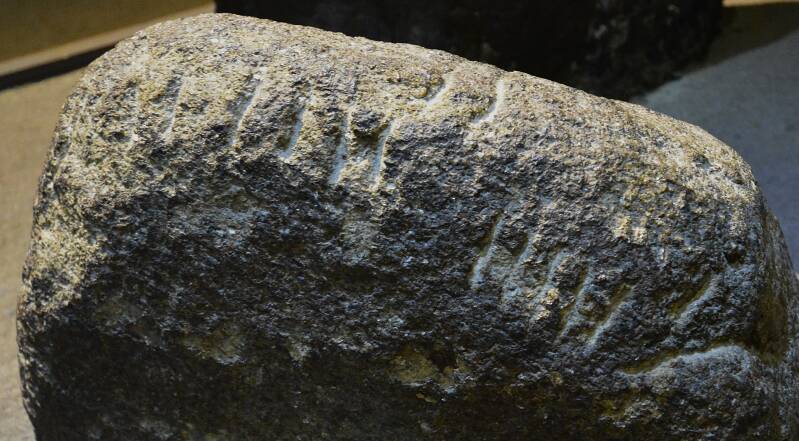
Photo below: the Bimaken Friary stone number 2. The inscription on this stone in Ogham reads MAQLEOG or in Ogham writing: ᚋᚐᚊᚂᚒᚑᚌ . The language in this inscription is a bit more akin to Old Irish than to Primitive Irish, and perhaps this also pertains to the fact that the stone was found in association with a friary. Whilst the MAQ element means “son”, and is cognate to Irish mac, Scottish Gaelic mac, mahc, machc and to Manx mac, the second element, the name LEOG is of less certain origin. This stone is located in the Manx Museum in Douglas, not that the inscription in the photo appears back to front compared to how it is generally written in text, so the Ogham lines furthest to the right represent the word MAQ or ᚋᚐᚊ when reading right to left, note that in the Ogham font on here the vowels look like dots upon the line, in this case the vowels EO, or in Ogham: ᚒᚑ , but in the photo below it can be seen that in this example in the photo from Bimaken Friary stone number 2, the vowels are written as longer lines slightly below the main axis line, and not as dots on the main axis line as they are written in the font used in the text of this article.
The Ogham stone shown in the photo below is the Bimaken Friary number 1 Ogham stone, and it seems to read as something like: CUNAMAGLIMA- with a final letter visible, which may represent a Q/C in which case the MA- part would be MAQ - "son (of)" The personal name CUNAMAGLI is easily readable for those who know other Celtic formulaic languages, CUNAMAGLI is from the roots CUNA - "dog" (Manx: moddey) and MAGLI which is the genitive form of the word for "Prince", Welsh "mael" and Irish "mál", the nominative form may have been just MAGL but more likely there was a vowel stem, although quite how this manifests in the masculine o-case endings of literary formulaic Celtic languages, can depend, and there is uncertainty about the pronunciation of this nominative case in this formulaic language as a whole. In Ogham the letters CUNAMAGLIMA- are: ᚉᚒᚅᚐᚋᚐᚌᚂᚔᚋᚐ -. On the stone below, where not all of the inscription is visible, one reads "up" the stone, but the letters ᚉᚒᚅᚐᚋᚐᚌᚂᚔ or CUNAMAGLI are visible in Ogham going up the stone from bottom to top, note again that the vowels as shown on the stone below are written as lines, in this case I think slightly to the left of the main axis line, rather than being written as dots on the line as they are in this text. This stone is also located in the Manx Museum in Douglas.
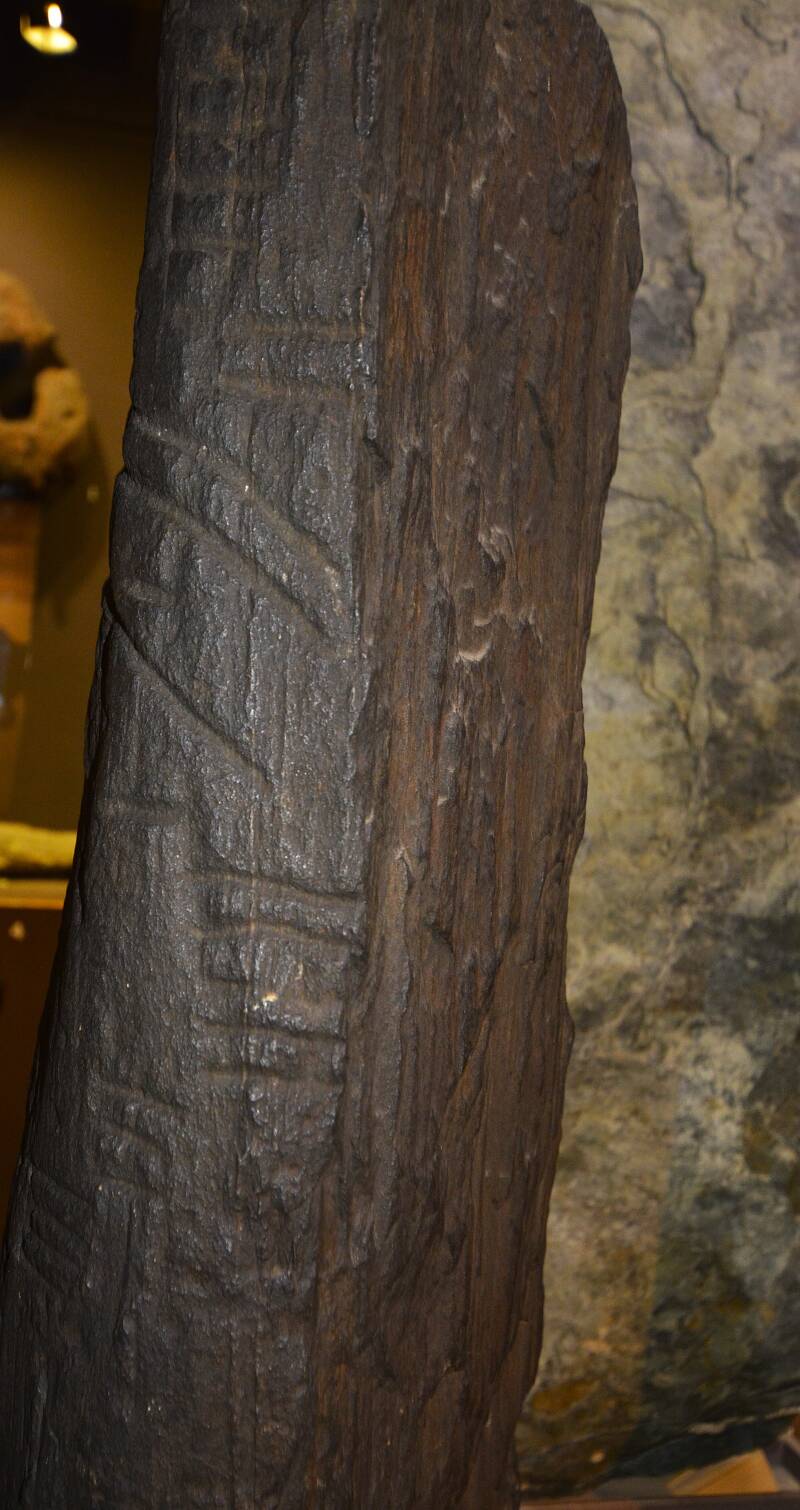
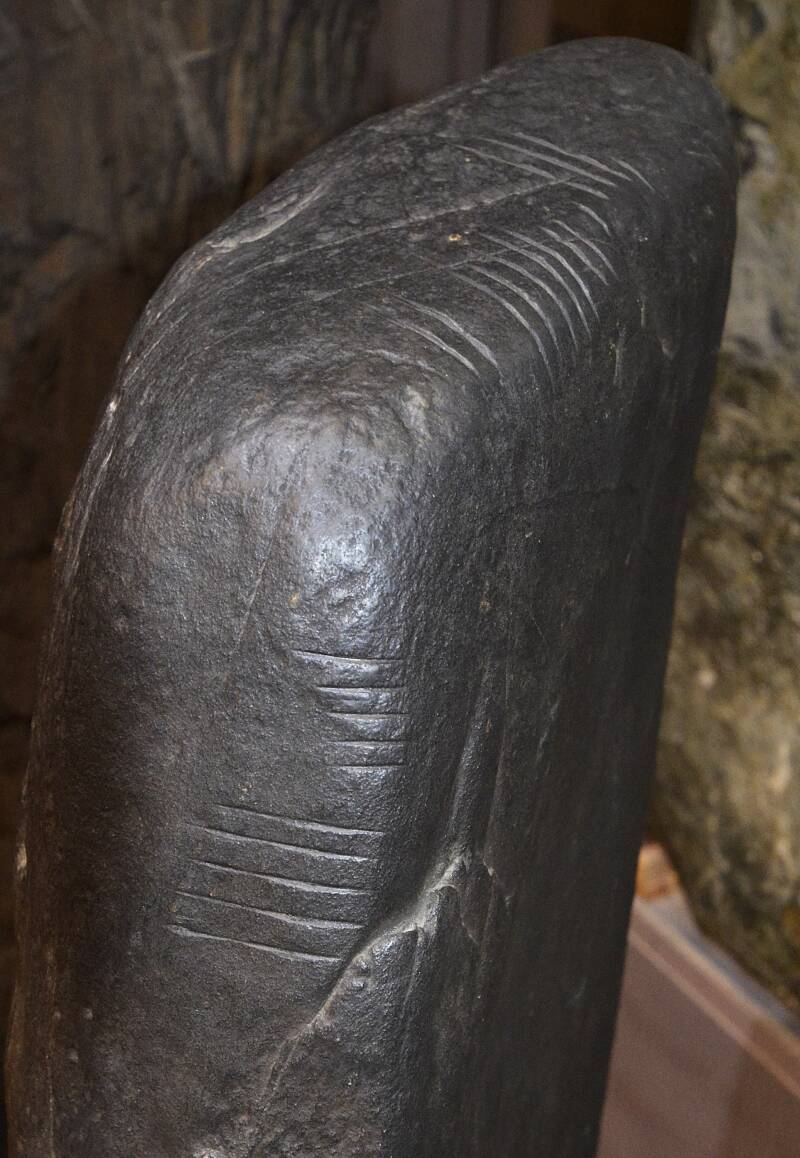
Photo below: the Ballaqueeney number 1 Ogham stone, located in addition to the other two stones, in the Manx Museum in Douglas. The Ogham stone below reads as: DOVAIDONAMA QI DROATA or in Ogham: ᚇᚑᚃᚐᚔᚇᚑᚅᚐᚋᚐ ᚊᚔ ᚇᚏᚑᚐᚈᚐ . Even though there is word separation between DOVAIDONAMA/ᚇᚑᚃᚐᚔᚇᚑᚅᚐᚋᚐ and QI/ᚊᚔ the -MA at the end of DOVAIDONAMA post likely relates to the QI and so to simplify things this inscription can be transliterated as: DOVAIDONA MAQI DROATA. The exact meanings of the presumed personal names in this inscription are less certain, but DOVAI-/ᚇᚑᚃᚐᚔ- may mean "black" or "dark" and relate to Irish dubh - black, Manx doo etc. Only part of the inscription is visible in the photo below, and the Ogham in the photo below also uses again, lines, rather than dots for vowels, but the letters ᚊᚔ ᚇᚏᚑᚐᚈᚐ or when transcribed: QI DROATA are clearly visible in the photo below, reading "upwards" and then back along the top of the stone. Note that there is a space on the corner between QI/ᚊᚔ beneath the corner and DROATA/ᚇᚏᚑᚐᚈᚐ going back and to the right from the corner, but the gap between the -MA/ᚋᚐ and QI/ᚊᚔ which I find kind of unusual, hence why the ᚇᚑᚃᚐᚔᚇᚑᚅᚐᚋᚐ / DOVAIDONAMA part is not visible in the photo below, and is lower down the stone. Note that MAQI/ᚋᚐᚊᚔ is the typical Ogham formulaic/Primitive Irish genitive form of MAQ/ᚋᚐᚊ .
I hope that this article was an interesting read. The linguistic history of the Isle of Man is extremely interesting, and there is still more to uncover about these Ogham inscriptions. This article is dedicated to my grandad. For reference purposes, this article's URL is: https://www.languages-of-linnunrata.co.uk/on-three-ogham-inscriptions-of-the-isle-of-man-published-on-the-31-03-2026 . God bless all.