More on the Jura Gaelic dialects, ancient Jura & connected topics, published on the 11/04/2026
This article was written and published by Linden Alexander Pentecost, and was published on the 11th of April 2026. The three photos in this article were also taken by myself the author, two of them show different angles of raised beaches and the Paps of Jura, the Paps of Jura are in all three photos from different angles. This article is unrelated to and separate from any and all of my other publications, including those that include other, different discussions on Jura Gaelic and on some of the other topics discussed in this article. The photos in this article have also not been published before either. The photo descriptions in this article in italics also contain topics and poetic information not in the main text of the article, the main text of the article discusses a great many topics in addition to those primary ones that are mentioned in the title and which are the focus. No AI was used in this publication nor in any of my written publications. This article was published in the UK, on this UK website, and I the author am also from the UK and live in the UK. This article contains a total of 4092 words and was fully completed at 4 AM in the UK on the 11th of April 2026.
The Isle of Jura is a very mysterious place, with an ancient human history. Most of the settlement in recent history has been along the eastern facing coast of the island, where the landscape is somewhat gentler, more fertile and with at least a few more trees. The eastern side of the island has an interesting history, with many known archaeological sites from the Mesolithic and post-Mesolithic periods, for example, the standing stone at Tarbert, and the Knockrome Standing Stones to the south, also on the east coast.
The survey of the Gaelic dialects of Scotland, edited by Cathair Ó Dochartaigh, contains the pronunciations of words as spoken by two individuals on Jura, both of them from the eastern coast of the island. I do not know when Gaelic was most recently spoken on the west of the island, nor when larger numbers of people last lived on the western coasts of the island for that matter.
In other publications I have discussed Jura Gaelic in general, looking also at the language of both the aforementioned speakers, but in this article I will discuss Jura Gaelic as attested through informant 52 in the Survey of the Gaelic dialects of Scotland. Some of the peculiarities of Jura Gaelic in general are not attested in the language of this speaker, but I have chosen to study and then write about the language of informant 52 here, because they were the more southerly of the two informants from Jura, and I have only been to the south of Jura myself. Speaker 52 is from close to Knockrome, where some of the standing stones are located. It is interesting that the megalithic monuments (standing stones, stone row and passage tomb) on Jura are mainly towards the southern end of the east coast. Could this in some way pertain to the dialectal differences between northern and southern Jura? Some of the particular features of North Jura are present in areas where there was much Mesolithic activity, and could this again, as I suggest, play into some of the language features of North Jura Gaelic?
When I write the language of informant 51 here, I am basing the spelling, to some degree, off the phonetic forms given for this speaker in the Survey of the Gaelic dialects of Scotland, edited by Cathair Ó Dochartaigh. I have used similar spellings many times before, including for Jura Gaelic. The spelling might seen cumbersome or strange, but it does help to show the phonology of south Jura Gaelic, whilst also maintaining a connection to the Gaelic written language.
The slender d sound in southeast Jura was generally, but not always pronounced as [dz]. This sound occurs for example in the words: dzeoch - “a drink” and in sʏ̇idzear - “soldier”, i’dzir - “at all”, théidz - “will go”, crȯ̈idz - “believe” and ẏisdzï - “water”. This sound is not universal in this Gaelic dialect however, and it does not occur for example in crɤ̈idich - “will believe”, where the sound is a palatal d, nor does it occur in the word gɤ̈rid, where in this example in final position it is pronounced as a d followed by [ʃ]. Note that this [d] may also be perceived as voiceless, but sometimes on Jura it is fully voiced. In standard Gaelic spelling the aforementioned words are spelled: deoch, saighdear, idir, théid, creid, uisge, creidich and goirid. The word ẏisdzï is also an interesting example of where a change from a palatal [k] or half-voiced [k] in Jura Gaelic becomes this dz sound - similar changes occur in some other Insular Argyll Gaelic dialects, and similar changes occur in St Kilda Gaelic. A similar change can occur in Manx Gaelic, the Manx word for water being: ushtey which shows a similar change which is fundamentally connected to changes between [k] and [t] sounds. St Kilda also has the form uiste pronounced with a palatal t. Note that the e in dzeoch and the i is ẏisdzï are included only to indicate that the dz and s are pronounced slender, although dz is to my knowledge always a slender and palatalised sound in Jura Gaelic.
In Jura Gaelic, like on Arran, the medial broad -mh- is often pronounced as a [v] sound. This occurs in the language of informant 52 in for example, the words: ɹæ̀mh - “oar”, sæ̀mhach - “quiet”, sæmhïradh - “summer” and geamhïradh - “winter”. In standard Gaelic spelling, these words are: ràmh, sàmhach, samhradh and geamhradh. The word ɹæ̀mh - “oar”, as well as the word ɹé - "level", standard: réidh, are also examples of a voiced alveolar approximate, or of similar r sounds in Jura Gaelic, which occur in certain forms of r in initial position. In northern Jura, as I have discussed elsewhere, the initial broad r sometimes disappears entirely.
Sometimes the Gaelic of the southeast part of Jura exhibits differences which are more sporadic. For example, soirbheas - "a breeze" is soras, and feitheamh - "waiting" is feiᵹ or feʔiᵹ, the first variant pronounced with an [ei] diphthong followed by a "broad gh" sound, [ɣ], normally written gh/dh, but spelled here as ᵹ due to the previous vowel being slender; the second form is also pronounced with a glottal stop, written: ʔ. Glottalisation and glottal stops are quite common in the Gaelic of southeastern Jura, this sound also occurs for example in: rȯʔȯinn - "choice" and in goʔo - "a smith", normally spelled: roghainn and gobha. The unexpected presence of a [ɣ] sound also occurs for example in the forms fiiᵹ and fiʔiᵹ - "weave", again with the [ɣ] after a slender vowel, and occurring alongside a glottal stop as in feʔiᵹ. Note that the ii in fiiᵹ is pronounced as two separate vowels.
You may have noticed that there are quite a number of unusually-spelled vowels in southeastern Jura Gaelic, this is because the vowels are quite unusual and rare within Gaelic dialects. Some are more common however, although their position in words differs greatly across Gaelic dialects; an example is the [æ] sound, similar to the ‘a’ in the English word ‘hat’. This is spelled as æ in this article, and has already appeared in some words I have included here. Some other examples are: gæineach or gaineach - “sand”, and dæ̀n - “poem”, the standard spellings of which are: gainmheach and dàn. Note that this sound, and others, are normally written long with a grave accent on this page, as in the æ̀ in dæ̀n but that these long vowel sounds in this dialect are generally somewhat shorter than being true long vowels, and are perhaps better described as being half-long vowels, unlike in most other Gaelic dialects.
Various [ʏ]- and [y]-like sounds are also found in Jura Gaelic, the spelling of which in this article is generally based upon, albeit not identical to, how these sounds are spelled in the Survey of the Gaelic dialects of Scotland, edited by Cathair Ó Dochartaigh. Some other examples, include: ÿ̰ḭchï - "night",
fȯ̈-ÿ̰inn - "some (people)", snÿ̰m - "knott", crÿinn - "round", and tʏ̇ch - "house", which in Standard Scottish Gaelic are spelled: oidhche, feadhainn, snaidhm, cruinn and taigh. Note that nasalisation, where it is necessary to indicate it, is indicated with a tilde accent below the vowel, as in ÿ̰ḭchï, compare for example, Kintyre Gaelic: ȯiche, ỳ̰iche - I have discussed other examples elsewhere.
This is all I will discuss on this Gaelic dialect now, but I have shared some new points of information here and lots of new words, which along with my other different publications on these dialects should present a good overview. In the next section, starting below the photo description and photo below, I will talk about ancient linguistic and historic topics connected to Jura, and other topics which are related.
Photo below: the Isle of Jura as seen from the Sound of Islay, note the colour of the sea, and the Paps of Jura, known in Gaelic as Sgùrr na Cìche. The origin of the term "Pap" is thought to connect to a Norse word for "breast", and indeed the mountains are very breast-shaped, although there are three of them; only two of them visible in the photos in this article. The Gaelic name means "rocky peak of the breasts" also attesting to this origin, also implying that the name is not connected to the Papar known elsewhere in Scotland and to the north.
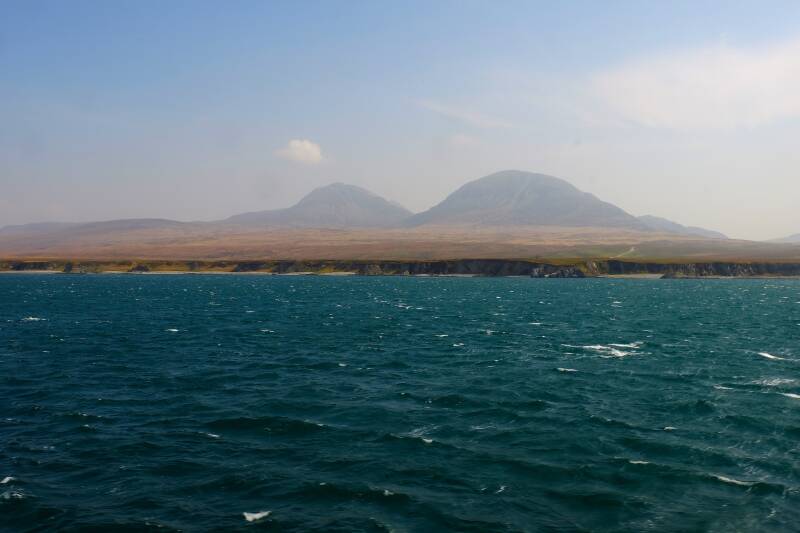
The western coasts of Jura are in my opinion some of the most beautiful and also wild landscapes in Britain, and back in the Mesolithic period, around 8,000 to 9,000 years ago, people were on the west of Jura, whether seasonally or otherwise. During that time period, the land was much lower to the sea than it is today. For this reason, the areas around the western coastline of Jura, down to the sea but also a fair distance inland, have a great number of raised beaches, some of them very large. Jura, and parts of Kintyre and Islay have some of the largest raised beaches in Britain, although I reckon that those around the west coast of Jura, are perhaps the most impressive and numerous within one area.
The raised beaches around the western coast of Jura, closely resemble those found around some of the most northern coasts of Finnmark in Norway, which face the Barents Sea. Several such enormous raised beaches can be found on the Varanger Peninsula for example. Why exactly these two environments have such good examples of raised beaches, I am not sure, and as I have stated elsewhere, raised beaches are not in all parts of Western Scotland, and sea level, and land rise did not happen consistently throughout the Hebrides. As I have discussed in detail elsewhere, the islands of Tiree and Barra have legends connected to them regarding ancient land inundations. Shetland has also dropped in relation to the sea since the Mesolithic period, and it and Orkney have possibly experienced up to three tsunamis since then. The legends regarding Tiree and Rocabarraigh (and by extension Barra) seem also suggestive of a similar event. Whilst there is no absolute evidence of people in the Faroe Islands before the medieval period, burnt Barley and other signs of earlier inhabitants from around 500 AD have been found there, these people may be those referred to as Papar in other places, although I am inclined to think they go back much further than the Christian period. I recently learned that there is also possible indication that people “could” have been in the Faroe Islands longer ago, due to the presence of ribwort plantain on the islands appearing in prehistoric times, a plant often associated with farming. I had long suspected people were there before, and these tsunami events for example could also be responsible, in part, for what is considered to be a lack of evidence of prehistoric activity on the Faroe Islands. I have previously discussed pre-Norse people in the Faroes mainly in the context of Mykines, but an interesting other article I previously noticed, which I think may refer to the post-Iron Age history of the Faroe Islands rather than an earlier history, is: The pollen content of so-called 'ancient' field systems in Suethuroy, Faroe Islands, and the question of cereal cultivation by Kevin J. Edwards & D.M. Borthwick. The aforementioned article is I think interesting although I have not yet read it. I myself have written much on other aspects to this elsewhere in other publications.
The most known Mesolithic sites are from the eastern side of Jura, for example at Lussa Bay, but the western side of the island has a large number of sea caves, at least some of which are connected to Mesolithic activity, although there is very little information I have come across detailing precisely which caves on the west coast of the island are connected to Mesolithic activity. I don’t know if this is because the caves on West Jura with Mesolithic finds are so numerous, or if there is a deliberate effort to not share this information with the public, which I can kind of understand, but at the same time, indigenous history does and should not belong merely to academics - it belongs especially to the people of Jura and those who have ancestors from Jura.
The only photo I have been able to find with regard to this subject is one that I saw in the article: Hunters and gatherers on the edge: Foraging for the past at continental limits Karen Hardy and Raquel Piqué , which seems to show a limpet shell midden within one of the caves on the northwest of Jura. A general impression I get is that some of these caves on Western Jura do have shell midden piles, which are generally associated with the Mesolithic, but that there seems to be little in the way of being able to date these middens, and furthermore, there is very little information about which of the very many caves in Western Jura contain such middens.
Although conventional archaeology is presented in terms of specific periods, like the Mesolithic and Neolithic, a great number of archaeologists feel that the cultural activities we might commonly ascribe to certain periods are not limited to those periods. I have discussed this a lot elsewhere. But in terms of Jura, essentially the Mesolithic people on Jura may not, in my opinion, have died out, even when there was Neolithic, Bronze Age, and Iron Age, and later activity on the island, the Mesolithic culture of shell middens and the use of caves, may have continued, as may have the language and beliefs of these people to some extent. On the Isle of Mull for example, I feel that the earliest cultures also survived and later became associated with the pre-Christian witchcraft known from the island. I have also discussed this and its many related topics in lots of details elsewhere, including with regard to many other parts of Scotland, but in terms of Jura for example, the historic records of the indigenous people on this island are vague. Sure, we have records that record the Christian history of the island, and records which record society as we understand it.
But my general feeling is that there have been outposts of society and culture in Scotland into recent times, which did not fit the society and ways that society was measured at the time. These people may have been considered as irrelevant, not to mention the great trend there has been in the past 500 years to suppress indigenous people, to refer to them as travellers or bandits or outlaws, and to whitewash their indigenous beliefs with the same aggressive types of beliefs and centralised society that caused the witch trials, for example. We know that King’s Cave on Jura was occupied in the Iron Age, and was also used later. This does not alone demonstrate Mesolithic continuity, but it is worth noting that, at least from my research, the use of caves in the Iron Age in Scotland often also seems to coincide with similar types of shell midden mounds and cultural behaviour that we find during much earlier periods in time.
Sculptor’s Cave is another good example of a cave likely of a very different cultural and linguistic context to those in Jura, which becomes linked with witchcraft and mythology in later time, and is also associated with ritual activity during the Iron, Bronze and Neolithic periods. I have discussed this much elsewhere including in an article dedicated to this site. Another possible example is the cave of Uamh an Dùin on the Isle of Barra, a cave, which, confusingly, is about 10 metres above sea level, despite that the western sides of Barra and South Uist have tended to slowly sink, unlike the west coast of Jura, which has greatly risen. A piece of pottery from Uamh an Dùin dates to the Iron Age, yet shell debris were also found in the cave, similar to shell middens found elsewhere, indicating that these Iron Age cultures were at least, in a sense, culturally and materially similar to the Mesolithic peoples in Argyll. In Gaelic folklore, the ciuthach (also discussed in great detail in a recent unrelated book I published) - is a kind of giant, sometimes hairy ancestor figure, associated with both caves and with brochs. The ciuthach was also known on Barra, and it is curious to see the possible association between Uamh an Dùin and Dun Scurrival, a broch-like dun, located just above it. I have discussed more on this elsewhere in terms of different examples, but the trend is the same. The main text continues after the information in the photo description and below it, photo, below.
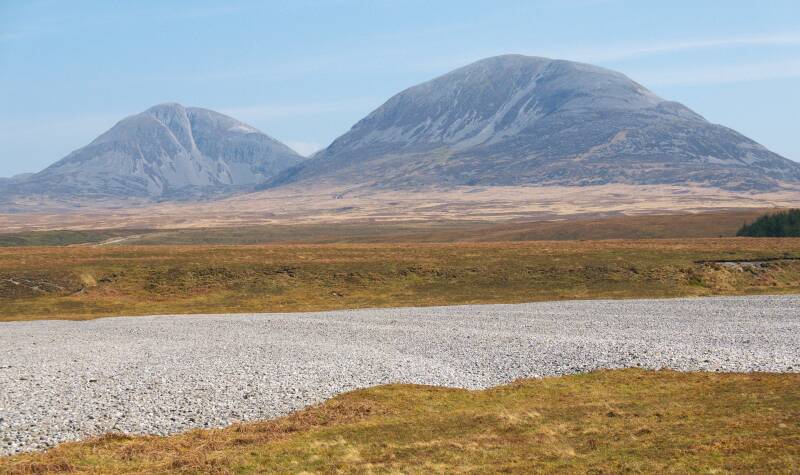
Photo below: another, closer and different view of the Paps of Jura, showing their shape, in front of which is the raised beach, known as Tràigh nam Feannag or "Beach of the Crows", a curious name, given the mysterious nature of crows and the general vibes of this beach. This is by no means the only raised beach on Jura, but it is the only significant one I have visited, and even it is vast, its atmosphere is strange. You can see in the photo below the ridges of shingle going across the beach, each ridge slightly higher than the last as one moves from left to right. These ridges represent the different sea levels, including during the Mesolithic period. It is amazing how these ridges still stand, and the atmosphere of this beach is so strange, lonely, beautiful, I felt as though it was still silently watched over by the ancestors who once fished and lived on this coastline, and who doubtless would have walked this beach many times, during a time when the sea came up to this height. Note that I included a different photo of this beach in an unrelated article for Omniglot, and include a still further different view of it further down this article.
Uamh An Dùin was also used into the medieval period, and I find that the only reasonable explanation to this is that “other” cultures associated with these caves, existed somewhat independently until relatively recently. As I have discussed elsewhere, the Gaelic dialects, and even the Gaelic of Barra, contain linguistic influences of unknown origin which sometimes align to the distribution of these different peoples. The same occurs on Jura. In Barra though, the land has got lower in the west in relation to the sea, and so in a sense the cave of Uamh An Dùin might represent the periphery of a now flooded cultural landscape, without these people ever settling to a large extent on Barra as we know it, which would might explain why some the “Argyll-like” features found in certain localised forms of Barra Gaelic,St Kilda Gaelic, and some localised forms of South Uist Gaelic such as a stød-like stop, are not used by everyone on Barra or South Uist.
Whereas on the Isle of Jura, features like the glottal stop are far more common, the Mesolithic landscape has risen, not fallen, and Jura also seems to have fewer connections to Norway for example, than Barra does. Many of these connections with Scandinavia are not necessarily of Viking origin, but as a general trend, and perhaps from a much earlier time period, the culture and language in the Outer Hebrides has tended towards connections with the Northern Isles, Faroes, Iceland and Norway. This is audible for example in the pitch accents used by speakers of Hebridean Gaelic, but not by speakers of Argyll Gaelic. The pitch accent could originate from the Vikings, but I am doubtful that it does. There are also few records of the Gaelic dialects in the west of Barra, perhaps further research into them will yield more information on how the cultural makeup of the west of the island could have been distinct. Below is another photo and photo description showing a different view of Tràigh nam Feannag on Jura, which is below its photo description, after the photo, the main text continues.
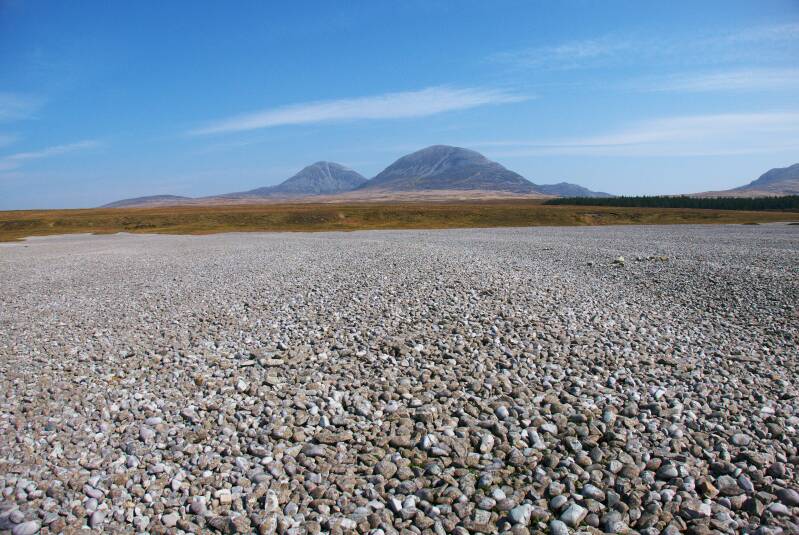
Photo below: another photo showing a different angle of the Tràigh nam Feannag raised beach on Jura, the photo below as well as being different from the photo above is also different from that in the unrelated Omniglot article. The photo below, taken on the beach itself, shows this beach in a way that I think truly invokes the true atmosphere of this place. Strangely, is like a desert, not only a physical desert, but a desert in time, reflecting the ocean that was once there, now an otherworldly and distant ocean nolonger in this reality, whilst the sky above is the flip of that vast cosmic ocean, itself blue in the sky, and with the breast-like mountains in the distance, the body of a goddess, bridging the raised beach towards the blue-white heavens above.
There are shell midden sites that continued to be used over thousands of years, although for Jura I know of no such examples. But there is I would argue evidence of the late survival of a kind of “cave culture” in Western Jura into more recent times, this is something which pops up in Gaelic folklore, and I will discuss most examples of it in a future publication, but one other possible example I will mention here is that of MacLean’s Skull.
Near Glengarrisdale in western Jura there is a cave known as MacLean’s Skull Cave. Glengarrisdale is known for its Mesolithic activity, and we know that Mesolithic people in western Scotland made great use of caves. MacLean’s Skull Cave takes its name from a more recent manifestation of, what I believe is, the same culture, or a related culture. It is said that this skull belonged to a clan chieftain, and was placed into one of the “raised” sea caves near Glengarrisdale. The skull has since disappeared. I hope to God that nobody has taken it as part of a private collection or something, I do hope that somebody has simply put the skull, somewhere around Glengarrisdale, and that it is very well hidden. The point to this being something ancient, is that I get the feeling that to place a chieftain’s skull in a cave in this way, must be ritualistic, almost as to imply that the skull, and an aspect of the chieftain’s spiritual being, is protecting the island. This practice of placing individual ancestor bones into caves is something that dates back far into the prehistory of certain cultural groups in Britain. Another example I recently learned about, I was told by the cave archaeologist Tom Lord, about a cave near Settle (not one I previously discussed), in which there is an adult female prehistoric rib bone placed into a crack. The later traditions of witches digging up bones and using skulls in rituals also no doubt relate to this, as I have discussed elsewhere.
I hope that this article is interesting. God bless all. This article is dedicated to the people of Jura and to the ancestors of this island.