Written and published by Linden Alexander Pentecost. Photos also by Linden Alexander Pentecost. This article/blog post is published on the 20th of January 2026, and is unrelated to and separate from the other two articles/blog posts which were also published on this website on the 20th of January 2026. This article/blog post is also unrelated to and separate from all my other publications. No AI was used in this article/blog post. This article/blog post was published in the UK, and I the author am from the UK and live in the UK. This article/blog post contains 8 photos showing different parts of this potential archaeological site. The text of the article is very important, but the photos are also very important for showing images of the archaeological site I am describing in the text. The text in Italics above the photos also contains a lot of important information which is not in the main text. This blog post/article contains a total of 2301 words. In this article/blog post I also talk about some things related to the topics in this article but which are not about the site itself, but most of the writing is about the site.
Over 6 years ago, I went up past Malham Tarn, over the tops and into the valley of Cowside Beck. I crossed the bottom of the valley on the footpath, at around the grid reference of: SD885689, and then crossed onto the hill on the other side of Cowside Beck, the hill being known as Cowside. Upon this hillside I noticed several arrangements of large stones which could indicate a prehistoric megalithic complex. Recently I visited the site again, and took more photos, before going on to visit the Halton Gill Giant's Graves, also for the second time, both visits to the Halton Gill Giant's Graves I have discussed in two separate blog posts on this site, with entirely different content and information from each other.
Anyway. The site area on Cowside contains a lot of features, which are quite spread out. Firstly, there are several cairn-like structures some distance from the main site, which I have not had time to check out yet. In terms of the site itself and what I noticed, I will describe it as follows:
The main potentially archaeological features of the site consist of stone arrangements. There are several examples across the site which have each three large megalithic stones, which are arranged in a particular way, in some cases in a straight line, in other cases as though facing each other. There are also arrangements of just two stones in places, as well as single, large megalithic stones, which appear to be in some way aligned to the other arrangements. There are also longer arrangements of stones, which appear to constitute examples of stone rows or megalithic walls of some kind.
Many of the stone arrangements seem to be along certain larger "lines" or alignments which go from Cowside Beck at the bottom, to further up the hill. These "lines" may not be that significant however, and if there are three distinct "lines", then not all the stones align to them, and many from the lines appear to be missing. These "lines" point generally further up the hill, where I found larger megalithic rocks, some of them standing alone, others in arrangements of two or more stones. I got the impression that in a sense the larger stones, which are often in more defined groups, or which are solitary, are "looking over" or "watching over" the lower parts of the potential complex. Personally, I think that these "lines" might actually be lines of stones on either side of different partially man-made water channels which go down the hill, but which are now mostly dry. This would seem to connect the site to water and possibly also to the springs further down the hill.
Some of the arrangements of stones are also akin to some of the passage-tomb-like structures in parts of South Cumbria and Northwest Lancashire, which I have discussed elsewhere, although if this is the case, then all but one of them must have had multiple stones removed from it over time, and the ones on Cowside are sometimes most cist-like.
Most of the megaliths are made from limestone, but some of them are of another type of rock, megaliths made of which I have frequently encountered at other megalithic sites in this area. This second type of rock has an almost-vitrified looking appearance, and often contains several small holes, akin a little to cup marks, yet likely formed by a different process. I am not suggesting that these rocks are vitrified, unlike those at many Pictish sites, but they do have that appearance.
At the top of the site, towards limestone pavement, I came across a structure that looked to be a building of some kind, the base of which looked very ancient, and was in-part made of megalithic stones of a relatively large size. Unfortunately, I did not have enough time to make a map of this site, but I may do so in the future. Sadly, I am not able to confidently give the coordinates of where the features are on the site, as most of them are not visible via mapping software, nor did I take a GPS with me when visiting, on either occasion. Nevertheless I believe that this article/blog post will give a good overview of the site and give a lot of information, and it is my hope that others will look at the site.
What is also relevant is that there appears to be at least one megalithic wall or stone-row-like structure on the other side of the Cowside Beck, as well as there being some possible standing stones on that side of the valley, the standing stones and cairn appearing to align in some way with the possible megalithic complex on Cowside.
The photos on this page are important for giving visual images of the site I am describing.
Photo below: an arrangement of megaliths in a line up the hill, seemingly connecting with another line of megaliths going across the hill.
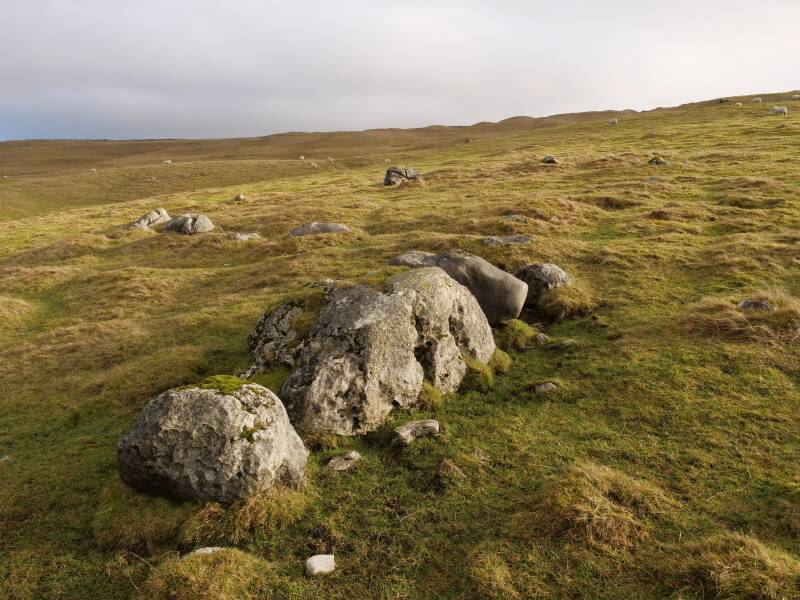
Photo below: another view of the same area of stone arrangments/stone row visible in the photo above, but this time looking down the hill, with another stone down the hill visibly aligned with the three in the foreground.
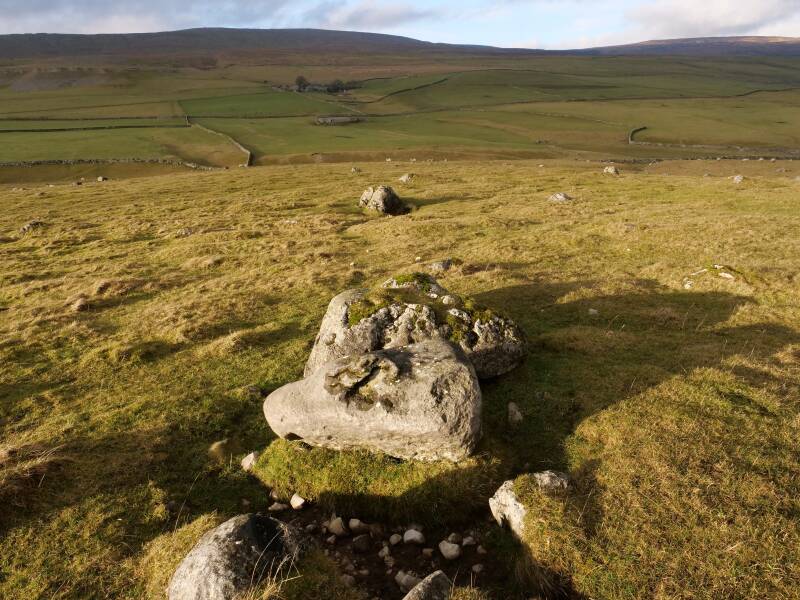
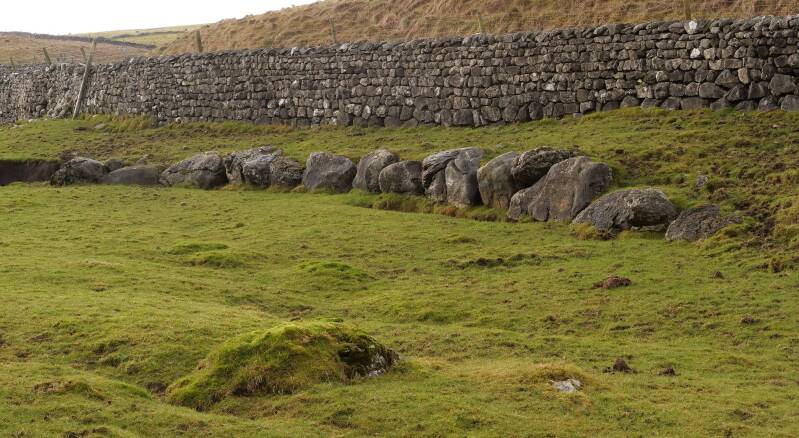
Photo below: three other stones shown in a line, which stand opposite and on the other side of a small stream from the three main stones visible in the previous two photos. You can also see other stones in that stone row/line above and below the three main stones on the other side of the stream, as well as the three stones on the side of the stream where the camera is, in the foreground.

This potential archaeological site on Cowside, reminds me of certain other sites in Northern England, some of which I have discussed elsewhere, many of which seem to be connected to springs and water channels in some way. I think that because we do not yet have a name to describe these types of site, they are often missed. One of my friends from Lancashire recently noticed one of these smaller arrangements of stones around a water source recently, somewhere north of Kendal, I do not yet know where. I have also found many, and written about some of them, including lately. As far as I know none of these sites have been properly studied.
One of the arrangements of stones, not included in a photo in this blog-post, is basically a three-sided small room or cairn, very cist-like, but not constructed with flat-slabs, and rather with less specifically shaped pieces of limestone, which nevertheless are "flat" enough on certain faces to enclose the structure on three sides. I am not sure however whether or not this particular structure on the site might be to some extent more recent, as the farmer, and perhaps other farmers before it, seem to use it to store hay, I think, as there is a metal container inside it. The entire structure could be ancient, but it could also I think be in part ancient, with perhaps farmers more recently arranging some more stones as parts of the structure to enclose it on three sides - although in a sense this does not itself seem very likely. I also do not think that any of the other arrangements of stones at the site are recent in origin.
Photo below: an impressive line of stones or arrangement of stones at the bottom of the valley, on the side of Cowside Beck itself. If coming from the road between Settle and Littondale, these stones in the photo below are nearest to where the footpath goes onto Cowside.
I have not included photos of all features at this site, on this webpage, because there are far too many features to this site to discuss on this web page/in this one article/blog post, but in the future, I hope to publish more about this site - particularly if others take an interest in seeing it, although I ask anybody curious about this site to please, of course, respect the land, its livestock, and its usage by farmers, and to also be aware that this could indeed be a sacred site, and so it should be treated and honoured as such, which might mean, for example, asking the ancestors' permission before entering the site, or at least acknowledging in some way that they are there.
I do not know how this site might relate to the subject of the Giants of Littondale, as the style of the usage of megaliths on Cowside is different from that at Halton Gill for example, imply perhaps a cultural difference, although, the sites and cultures in question are no doubt connected through some threads, in some ways.
Photo below, a large megalith, standing alone, with what appears to be another large, but smaller rock, placed upon it. Note the other megalithic in the distance atop the hill, behind and slightly to the right of the stone that fills much of the image. A stone just in front of the large megalith in the foreground may have cup marks, but I am not convinced, and think that they are caused by natural erosion.

Photo below: an area higher up the hill, showing two possibly-aligned stones in the foreground, with three other megaliths on the other side of the small stream valley. This appears to be an arrangement where groups of megalithic stones are arranged either side of old, perhaps not entirely natural, stream beds, the positions of which may relate to the "lines" of stones.

Photo below: another view down the hill, with two stones visible in the foreground, and four other stone arrangements visible below. The group of stones directly in line with left stone in the foreground, are the three stones visible across the stream in the previous photo. Note the other arrangements, and the long, wall-like arrangement of stones also on the other side of the stream from the three large stones in the photo above, this other, long, wall-like group is not visible in the photo above but is in the one below (i.e. the photo that this paragraph relates to).
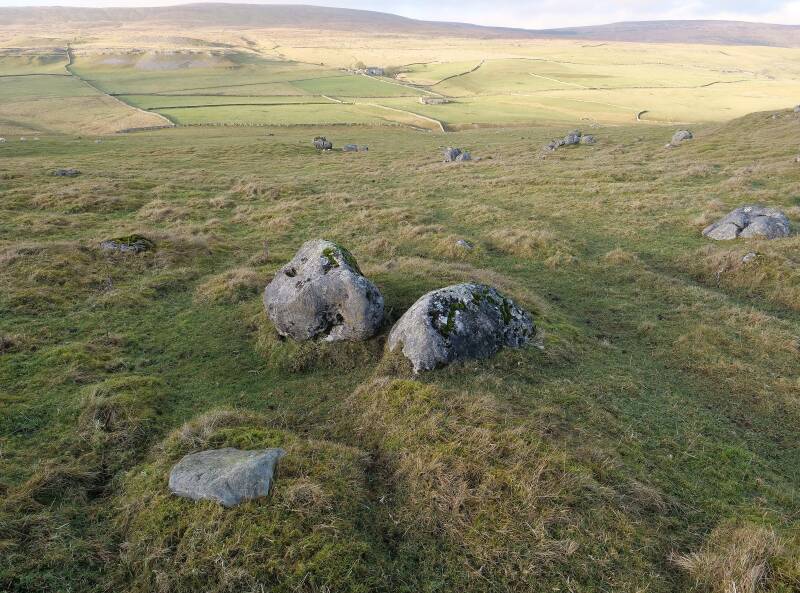
Photo below: the large, house-like structure with its large stone walls, some way above the main site. Between this house and the main site there is what appears to be a propped stone on some limestone pavement, as well as other arrangments of large megaliths.

I first came across this site in September 2020, but could not find my photos from that trip. However, I took plenty more on my recent trip for inclusion in this article. When I was visiting this site for the second time, I remember thinking back to this geography field trip I had in 6th form when I was 18. We did not go to this archaeological site of course, but to look at some "natural!" erratics at Austwick, but these are a different topic. Nevertheless, when I was walking on Cowside recently, I was reminded of the 6th form trip, and how I used to really love the subject of geography at one time - until 6th form's focus on human geography, globalisation, big businesses "rebranding", and other such questionable subjects that felt more like societal conditioning than geography - inevitably made me somewhat bored by geography, although I did like my geography teachers.
Nevertheless, recently I feel I have been getting evermore in-touch with the ancestral cultures of North Yorkshire, and I remember feeling this connection and love very strongly on that particular geography field trip. I mean, I say field trip, but we were only gone from the 6th form for like an hour or two. I remember feeling on that trip, the start of something important, a feeling the land and to language, and spirit, which was expanding beyond what I had known before (I was already interested in the aforementioned things at that time though, and had been for some years). And it's only really recently when I've been in North Yorkshire that I have started to understand what that feeling is.
This article/blog post is written in honour of the ancestors of Cowside, and is also written in honour of my grandad's homeland and in honour of him. I hope that it was an interesting read.
Add comment
Comments