Written and published by Linden Alexander Pentecost, published on the 18th of January 2026 and only on this website, www.languages-of-linnunrata.co.uk . This website was published in the UK, the website is UK-based, and the author is from the UK and lives in the UK. This article/blog post is completely separate from, and contains different content from that in any and all of my other publications. No AI was used in this article nor in any of my writing. This article/blog post contains 5 photos, 4 of them were taken by me, the author, the other photo, a photo with me in it, was taken by the person who I visited the site with, and was taken on my camera, and also used with their permission - as they took the photo. These photos have never been published elsewhere & above each photo are photo descriptions in Italics which contain important information not in the main text. This blog post covers many topics, including ones related to linguistics and language, of of course giants, and ancient history, and connections. This article/blog post contains a total of 3510 words. Three of the photos (including the one with me in) show different parts of the Halton Gill Giant's Graves site, whilst another photo shows the cave passage almost beneath the site, and another photo shows prehistoric farming/settlement terraces in Littondale. Note that in my blog post before this one on this page regarding ancient Hell Gill and Helsfell I also include a kind of self portrait (of my feet) and talk about unrelated caves and underworld spaces. Note that Hell Gill and the other topics I discuss in that article are completely unrelated to Halton Gill and the subjects discussed in this article/blog post in front of you. The article/blog post on this page is also unrelated to and contains separate content from that in my other blog post wherein I discuss my first attempt to visit the Giant's Graves at Halton Gill.
Since my last visit to the Halton Gill Giant's Graves over a week ago, after which I also published an unrelated blog post/article to this one in front of you about the site, including a possible other archaeological site on the side of the river - the Giant's Graves at Halton Gill kept calling to my soul, and so, a few days ago, I went back into what I now term the "Highlands" of North Yorkshire to locate the actual Giant's Graves at Halton Gill.
On this second trip, I managed to locate the Giant's Graves at Halton Gill, unlike on the previous visit, where I was following the instructions on a map which showed the graves as being on the other side of the river. However, in being slightly in the wrong location, I may have located another archaeological site on my first visit, as discussed in the other blog post about this site, with different information and content from that in the blog post/article on this page.
However, I did feel the urge to go back to the area and to visit the actual Halton Gill Giant's Graves, sooner than I initially planned to. And so, we went up into the "Highlands" of North Yorkshire, this time taking the road above Langcliffe towards Malham Tarn (the place about which I mentioned my experiences in my other previous, separate blog post about Halton Gill Giant's Gaves). From here we headed towards Littondale on the road above Cowside Beck, past Darnbrook Cottage and towards Arncliffe in Littondale. Actually, I spent most of the afternoon looking at an unrelated potential archaeological site near here, but I will publish about this in a separate blog post in a few days time. So, I will not discuss that here, but will carry on from when we left the Darnbrook Cottage area, and started to head down into Littondale.
Now, if the folklore is indeed correct, and that Littondale was occupied by giants in the past - I can well see why. The descent from near Darnbrook Cottage into Littondale is arguably, I think, one of the most impressive, and also terrifying bits of road in England. Suddenly, the river in the valley drops away into a massive gorge surrounded by cliffs. On the other side are waterfalls and other deep gills, and ahead, Littondale itself is on the far side, protected by cliffs, giving the impression that, as you head down from the fells near Malham, the whole landscape "sinks" or "drops" down, as though collapsed, down large areas of cliffs, revealing a lower landscape, invisible from above. This would have meant that, in the past, Littondale was likely easily defendable. If, say, there were physically large giant people living in this valley long ago, then they would have been living in a valley, protected by large cliffs, rugged moorland, and rugged limestone terrain, which would have deterred or even stopped any potential invaders. Although at some point, if we assume that this culture of giant people was physically real, then at some point they either died out as a culture, or were overwhelmed by the encroachment of other cultures. It is also entirely possible that there were multiple cultures existing at the same time in, and around, the valley of Littondale.
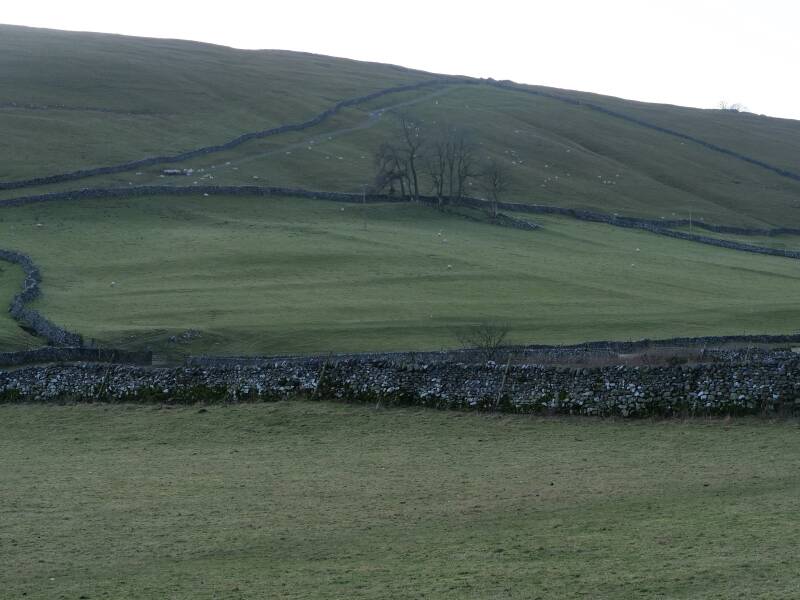
After the road steeply descended into the village of Arncliffe, and after my ears had popped due to a sudden change in air pressure between the "Yorkshire Highlands" and the gentle valley below, we took the road going north, to then follow it a different way up into the "Yorkshire Highlands" and towards Halton Gill. In the upper part of the valley, several of the ancient field systems became visible before the ascent. Might these field systems have once been worked by the giants of Littondale?
Photo below: the more-eastern of the two cists at the Halton Gill Giant's Graves, with the sun setting in the distance. At least, to some degree, the positions of the two cists seem to be aligned west-east. Note also the presence of various pits and holow areas, behind the cist, some of which appear to be large, ancient burial areas, although their shapes are somewhat distorted by later disturbances, some of which resulted from archaeological digs.
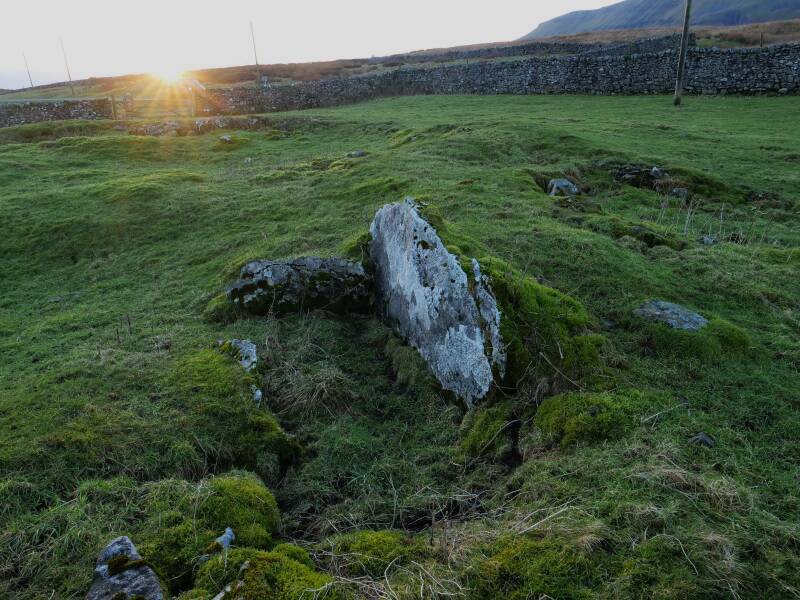
It was getting towards dusk by the time we reached the Halton Gill Giant's Graves, dusk being one of the "in-between" times, when, according to folklore, ancestral beings of the faerie-realms are most likely to be seen. Indeed, upon reaching the Halton Gill Giant's Graves, having, this time, gone to the right side of the river, I looked around the site, an impressive enclosed area, within which were hollow areas that looked like where giants might have been buried. I have seen similar giants' graves sites elsewhere containing large pits of hollow areas, including several in Cumbria, and one on Tiree for instance, to my knowledge, the one on Tiree had not been previously discovered before my visit, although there is another giant grave on the island, both of which I have discussed in detail, along with other aspects of Tiree's ancient history and language, elsewhere.
Anyway, as well as the areas of the site, separated from each other with banks, and having the appearance of enormous, shallow grave pits, the Halton Gill Giant's Grave also contains two cist-like structures, similar in a sense to similar arrangements of stones I have seen on the Isle of Man and elsewhere. The site also had a similarity to some of the giants' graves sites in Cumbria, particularly to one near Kirkby in Furness. Essentially, the Halton Gill Giant's Grave, to me, shares similarities with some structures in East Cumbria, but more so to those in West Cumbria and the Isle of Man, which might again be indicative of a connection between some of these giants, and Ireland, and the Goidelic-speaking and pre-Goidelic speaking worlds. There are several places connected to West Cumbria, and some of the Isle of Man, that I have discussed elsewhere regarding giants, including in West Cumbria: several giants' graves sites, other large graves, and the reputed discovery of an ancient giant buried at St Bees, said to have been 4 and a half yards long, or, in other words, over 13 and a half feet tall, or just above 4 metres tall. A big lad, in essence. This is reported in the book: The History and Antiquities of Allerdale Ward, Above Derwent, in the County of Cumberland, by Samuel Jefferson. I have discussed this elsewhere in more, other details, in relation to other aspects of giants. Note, I will be publishing an unrelated blog post soon wherein I will also discuss this aforementioned St Bees giant but in a different context.
The potential connections between the Halton Gill Giant's Graves and pre-Goidelic and Goidelic areas are interesting, considering also how the nearby place-name of Yockenthwaite, may, as I discussed with other information in my other blog post about Halton Gill Giant's Graves - derive its Yocken- part of the place-name from an etymological equivalent of Irish Eoghan and Middle Irish Eógan, itself being connected to Ogham Irish IVOGENI, also writeable as *iwogeni or in the Ogham alphabet as: ᚔᚃᚑᚌᚓᚅᚔ . This means "Yew-Born". This name is has typical Indo-European formulaic language, but it is also conceiveable that the root words are extra-Indo-European in origin.
In the Old Irish language, what we call "giants" were often described as Fomóir, which is cognate to Irish fámair - "giant", Manx foawr - "giant", and to Scottish Gaelic: famhair - "giant", not including the many dialectal variations, such as Tiree Gaelic foʼɲai̯ʴ (discussed elsewhere including in one place on this website and in a print book in a different context). However, in Old Irish tradition, this term fomóir seems to have been used in quite a specific way sometimes, to describe an ancient tribe, or tribes, of god-like giant ancestors, who are often associated with the sea, and also with farming. Given that the giants of Littondale may be connected to the ancient agriculture in the region, as well as being potentially connected to the extra-Goidelic cultures in West Cumbria, and in the Isle of Man and Ireland etc, perhaps the existence of these ancestors around Littondale, whether physically giant or not, might connect specifically to what ancient extra-Gaels and Gaels described as "Fomorians". The giant at St Bees may also do. Whilst, as I mentioned, there is no physical suggestion that giants were buried at the Halton Gill Giant's Graves, I do wonder if at one time there were large bones or skeletons located in the hollow areas of the site, and if perhaps the cist graves might have dated from a different period.
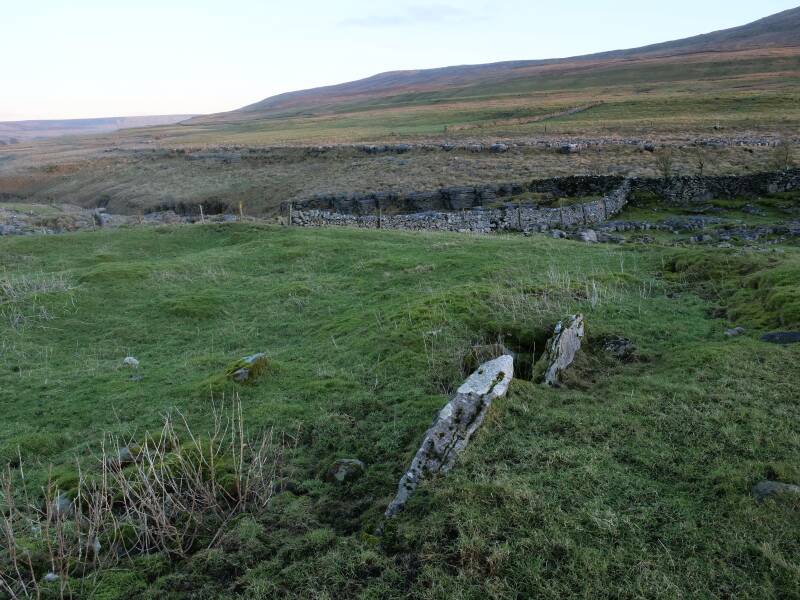
Photo below: a photo showing part of the site, with the giant grave pits visible on the left part of the image, and the more-western of the cist burial cairns also visible, which was seemingly longer than the cist to the east shown in the photo further up this page, but which is also more damaged seemingly. The site which I discussed in the blog post I wrote after my first attempt to visit this site, is across the gill, and further uphill from the limestone pavement visible towards the upper right of the image. I discussed the site over there in the article/blog post on this website, titled: The Littondale/Halton Gill Giant's Grave in Yorkshire, and a possible new archaeological site in Halton Gill, and more on the mythical giants of upland North Yorkshire & related things, published on the 11/01/2026 , the link to which is: https://www.languages-of-linnunrata.co.uk/2923820_the-littondale-halton-gill-giant-s-grave-in-yorkshire-and-a-possible-new-archaeological-site-in-halton-gill-and-more-on-the-mythical-giants-of-upland-north-yorkshire-related-things-published-on-the-11-01-2026 . I made some edits to the aforementioned blog post yesterday (on the 17th of January 2026), before publishing this article currently in front of you on the 18th of January 2026). For reference purposes, the URL of the article/page you are currently on (i.e. not the aforementioned, unrelated article and URL published on the 11/01/2026 and updated on the 17/01/2026, but the URL of this unrelated blog post published on the 18th of January 2026) is: https://www.languages-of-linnunrata.co.uk/2943783_part-two-of-and-the-second-visit-to-halton-gill-giant-s-graves-different-new-information-published-on-the-18-01-2026 .
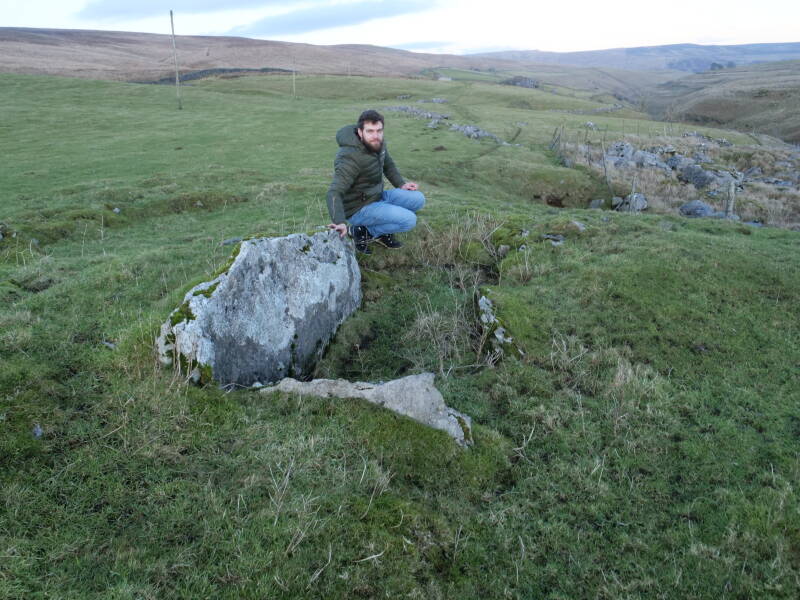
After taking some photos, the person I was with came and joined me in the field. I showed them the different parts of the site, including the cist chambers. When approaching one of these chambers, when in mid conversation, I felt a sudden, warm feeling of peace and happiness. A smile suddenly came to my lips, and I had the urge to giggle slightly. As I have said elsewhere many times, one can feel "vibes" in certain places, but sometimes, it is more personal. This particular vibe I felt at that particular place at the Halton Gill Giant's Graves, seemed to reach me as a sudden answer or realisation. It felt as though me being there was deeply meaningful in my own journey, and I suppose, it is quite random how I suddenly had such a strong wish to visit this place, and of course, I tried to reach it the first time, and wrote a blog post about that, and then went back there and wrote this current different blog post about my second trip. It was as though, on a spiritual level, I was always meant to visit this place, and that, in a sense, the ancestral presence of this place had always known that. The feeling that came over me was very beautiful, it felt warm and joyous, as though I was having a divine "meeting" with the ancestors up high. I think also that this meeting felt profound, because I had been trying hard to understand the ancestors of that landscape, and only by making the decision to properly pursue this, was I able to feel this presence.
Photo below: a photo of me taken by the person I was with, taken on my camera and used with their permission. I am beside the more-eastern of the two burial cists to show its scale and that of the flat megalithic slabs that form it. This is the same cist shown from a different angle in the first photo of this article. Behind me you can see the valley descending towards Littondale. I left a small offering of tobacco at this site.
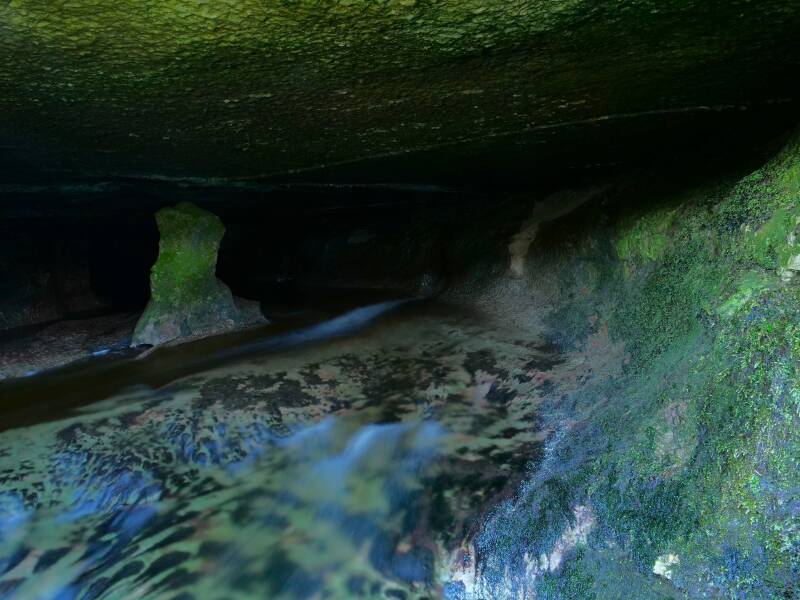
Before I left the site, I also wandered a little back in the general direction of Littondale. I was thinking, on my return "I wonder where that cave is", and then I heard a kind of rumbling sound to my left, and thought "ah". I worked my way around the fence and got to the cave entrance, but, I did not go in, there was a fairly large stream or rather, small river, flowing from it, and also, I did not have time to explore the cave. As I discussed in my blog post about my first visit to this gill, my friend Dawn Hilton, and also I, in other ways, have previously written about about the importance of underground caves and water systems around sacred sites. The presence of the cave so close to the Halton Gill Giant's Graves probably is meaningful in some way, with caves being considered entrances to the underworld, as previously discussed, and of course with giants often being associated with caves in some way, for example, at Yordas Cave in Kingsdale.
Photo below: a long-exposure photo showing the stream/river flowing out of the cave, which is located just below the Halton Gill Giant's Graves. I found the colours of the water and rocks to be very beautiful, although they were very slippy. Note also the column towards the left side of the passage. I do not know precisely what purpose this passage and cave would have served in connection with the Halton Gill Giant's Graves above, but the cave would have been significant, and considered as a sacred place, and likely as an entrance to the Underworld. These places need our respect, as to ancient sites in general.
Unlike near Settle and Austwick for example, the field systems in Littondale, at least in the upper part of the valley, seemed to show less evidence of terracing, although there were some examples, of which I have included a photo of. I always find it fascinating, but perhaps not surprising, that the prehistoric farmers around Austwick and Settle were using systems of terraces, in a sense akin to how the Incas, the Guanches in Tenerife, and many other cultures used terraced farming. Apparently this method of farming was common knowledge across many parts of the world, although, like many things in British prehistory, these connections, and the ancient knowledge that surround them, have largely become ignored and forgotten. It is also quite amazing to me that sometimes the landscapes seem somewhat similar. In the Andes, they have terraced farming, and legends of giants. And, also evidence for, and legends of and other mysterious ancestors which I have discussed elsewhere (along with very extensive language and other work). Meanwhile, in North Yorkshire, they also had legends of giants, alongside a similar, but different form of prehistoric terraced farming, and, sometimes the landscapes look somewhat akin. It always interests me how places, and cultures, so far from each other in terms of officially accepted academia, might actually share common cultural, and linguistic threads. I have discussed a lot on this elsewhere, with regard to ancient gods and ancestors in South America, and their linguistic and mythological connections to other places - especially to Finland and the "Uralic speaking" peoples, having written several books and other works dedicated to these subjects and especially to the strong linguistic parallels.
Photo below: ancient field systems with ancient terraces visibie, in upper Littondale. On maps this area is marked as a settlement, if I am correct, but there are also clear field systems here. The photo below I hope helps to demonstrate the terraces quite well, although the examples near Austwick are arguably more impressive. Could these terraced farming systems be sometimes connected to the cultures we identify as "giants"?
A few of these parallels can be observed in Yorkshire too. For example, both the Guanche and ancient people of the Yorkshire Highlands did terraced farming. The name pen appears in Yorkshire place-names, e.g. Pen-y-Ghent, which I have discussed a lot elsewhere. In the Canary Islands, the similar word beni is sometimes used in the sense of "belonging to a collective of", whether in terms of lineage or in terms of landscape. In a rather similar way, pen in the North of England, as a pre-Celtic word, can refer to the "head" of a collective of something. These words share many other potential cognates which I have discussed elsewhere. In addition, there are many similarities between indigenous South American languages and Germanic languages (and also Afro-Asiatic, Basque and others - but there are more similarities with Uralic).
A newly found example of a Quechua (South America) - Germanic similarity is the similarity between English cot (cottage) and Quechua qutu - "kingdom, rampart, mound" - even though the semantics are not identical. There is a possible place-name element in Yorkshire, "mea" or "maya" for example in the place-names Broad Mea near Hawes and Braidamaya near Whernside. I have discussed this connection elsewhere, but am describing it with new information here. Whilst "mea" or "maya" is connected to words for "meadow" and "to mow", according to the article Meas & Meres by the Heddon-on-the-Wall Local History Society, "mea", from what I understand, is connected to upland boggy moorlands. So whilst there is likely a connection to the word "meadow" and to Old English mǽdƿe - "meadow", there is certainly an implication that "mea" and I think "maya" as in "Braidamaya" implies a watery area of land, and so, it is tempting to see a similarity to Quechua mayu meaning "river", with a possible older root word perhaps encompassing the ideas of "watering", of "life giving water" and "the process of watering which allows one to harvest", because of course, meadows and fields in general require water for plants. This is of course speculative though, and normally when I discuss connections to indigenous South American languages, I have masses more potential word links. But nevertheless, some similarities do exist, many parts of the world talk about "mythical ancestors" who taught us how to farm etc, and archaeology shows that these processes were sometimes similar.
I do hope that this blog post/article was an interesting read. Please do check out my other blog post about my first attempt at finding the Halton Gill Giant's Graves, which contains information about another site, not included in this blog post on this page. Note also that in a few days I will be publishing another blog post about a different archaeological site near Littondale. All the three blog posts in question contain different content and information from each other. This article is dedicated to my family, and to the giants of Halton Gill and Littondale.
Add comment
Comments