Written and published by Linden Alexander Pentecost, published on the 8th of March 2026. This article/blog post also contains 3 photos, which are also taken by myself the author. 2 of the photos show different examples of indigenous written languages on two slabs, both of which are now located at Kirkwall Museum in the Orkney Islands and which were photographed there - I would highly recommend visiting this museum. This article/blog post is unrelated to and separate from any and all of my other publications, including being separate from those other publications in which discuss many other aspects to ancient language on Orkney, including various PDF books including a PDF book not published that long ago via a different website, the PDF book in question being titled: Further explorations of Old Tongues of Orkney and beyond, more on North-Germanic, & more on prehistoric writing & Other Topics, PDF-only book published via BookofDunBarra on the 03/02/2026, I have also published other PDF books and other publications covering different examples of and aspects to these topics, none of the other publications contain the information and examples discussed in this article/blog post on this page which is new for March 2026. Note that I don't usually indicate in titles that a publication is separate from my other publications, because all of them are separate from my other publications, but here I have indicated this. No AI was used in this publication nor in any of my written works. This article/blog post was published in the UK and only on this UK website, I the author am also a resident of the UK and am from the UK. This article contains a total of 2279 words & three photos, none of which have been published before. The photo descriptions above each photo in italics also contain important information not in the main text. This article is also unrelated to my other publications regarding Pictish symbolic writing, for example it is unrelated to those discussed in my article on the Covesea Pictish inscriptions and related topics on a different website to this. Note the title and some other details of this publication were edited a day or so after this article/blog post was first published. The photos & photo descriptions in this article/blog post are also important.
The Orkney Islands were very important in historic times. Although Orkney and Shetland lie not too far from each other (although there is actually a significant area of sea between them), the islands culturally and linguistically, and archaeologically, have a lot of differences. I have discussed many aspects of ancient writing on Orkney elsewhere, including discussing several examples in different books and articles of possible Neolithic writing on these islands.
As well as the Neolithic writing or symbolic language - which belongs to undeciphered alphabets, there are also four identified ancient forms of writing which were used on the Orkney Islands, namely, the Orkney runes, a version of the other North-Germanic runes, with particular similarity to the runes in Western Norway; the Orkney "twig-runes"; the Ogham alphabet, and the Pictish symbolic language or symbolic alphabet.
As well as the more general Orkney Runes, there are quite a number of examples of so-called "twig-runes" in the Orkney Islands. Several of these can be seen within the Neolithic Chambered Tomb of Maeshowe, whilst others are visible at other ancient sites. The term "twig-runes" is often applied to a shorthand form of runic writing, but I instinctively feel that the examples of "twig-runes" found on Orkney are not merely a shorthand form of runic writing, but instead represent a system in and of themselves. As with other runic inscriptions in Britain, interpreting twig-runes is also not an exact science. When we consider the possibility that twig-runes were not just a "variant" of runes, but represent their own magical writing system, which could in a sense be pre-Norse in origin, then trying to interpret twig-runes as simply variants of ordinary Orkney Norse runes would not really be an accurate way of understanding them. The twig-runes on the Ring of Brodgar for example, are hard to interpret, they don't seem to "quite" make sense as being versions of the more common Norse runes, and cannot be entirely read through the assumption that twig-runes are all directly equivalent to the general Orkney Norse runes.
"Twig-runes" and "Norse runes" in general in the Orkney Islands, are often found at prehistoric sites, presumably which were later visited by Norse speakers, although, with twig-runes especially, some of these runes converge with the greater and more confusing subject of Neolithic symbolic writing. In other words, sometimes the "runes", especially "twig-runes" at these sites, bare similarity to the examples of Neolithic symbols and Neolithic writing found for example at Skara Brae, Banks Chambered Cairn and other sites across Orkney, although the Skara Brae and Banks Chambered Cairn examples are the only probably examples of Neolithic writing on the islands, with other examples from these sites, and elsewhere, generally being the use of individual symbols rather than what appear to be inscriptions.
Unstan Chambered Tomb or "Onstan Knowe" is another Neolithic tomb in the Orkney Islands, and is not so far from Maeshowe. Within Unstan Chambered Tomb there are a number of rune carvings, or, carvings of symbols which are rune-like. These in Onstan Knowe are generally thought to be modern, or at least, 19th century or later, but one of the inscriptions cannot be translated, and whilst this could imply the runes are later, the fact they cannot be translated also might imply they are old, and the language is not Norse, but some more ancient language, and that the markings may be something more like "pre-runes" rather than actual runes. I would be interested to know others' thoughts on this. Another part of Onstan Knowe contains a stone with a carving of a bird, perhaps a swallow, alongside some other runes or rune-like symbols. This is again assumed to be modern, or 19th century or later, but hey, maybe this is not the case - archaeologists shouldn't just class things they can't understand as being modern or a forgery, before they can be properly investigated, and whilst the carvings within Onstan Knowe are quite possible more modern, given the long history of writing in Orkney, and the aforementioned subjects in this article & other publications I have written about these subjects, the presence of rune-like symbols at a Neolithic site is not remotely unusual for Orkney. The fact that some examples are questionable does not mean that others are not simply so explainable - especially when their archaeological context dates them to the Neolithic, i.e. in previously undisturbed sites such as Banks Chambered Cairn and Skara Brae.
The Picts are often assumed to be a very specific culture in Scotland, connected to a P-Celtic language, to Pictish symbol stones, to brochs, among other things. As I have written elsewhere many times, I do not believe in the existence of the Picts in this way, as defined by mainstream academia. The "pre-Celtic" theories about the Pictish language have largely been discredited by mainstream academia, but only in my opinion because the Picts are being defined by this idea of them being P-Celtic or even Brythonic-speakers. A certain amount of place-names and other words attributed to the Picts can be shown as being similar to Indo-European formulaic language and at other times to Brythonic or P-Celtic languages, but the existence of these threads within post-Iron Age Scottish society as a whole, does not prove in any sense that the whole of Scotland spoke a P-Celtic language, nor that there ever was a strictly P-Celtic language spoken in Pictland per-se. I have gone into a lot of detail about this rather vast range of subjects in other publications. A certain area of eastern Scotland and the evidence of ancient language there has come to be used to describe Scotland as a whole. Furthermore, many of the Indo-European elements within Pictish inscriptions can also be interpreted as having more to do with Q-Celtic than with P-Celtic, although I am still of the opinion that many languages in Scotland, even into the post Pictish period, could have been pre-Indo-European, with Beurla Reagaird being I think at least in-part a possible example. The "Pechts" as described in Scottish oral history are also not equivalent to the idea of what the Picts are understood to be today, insofar as mainstream academia is concerned.
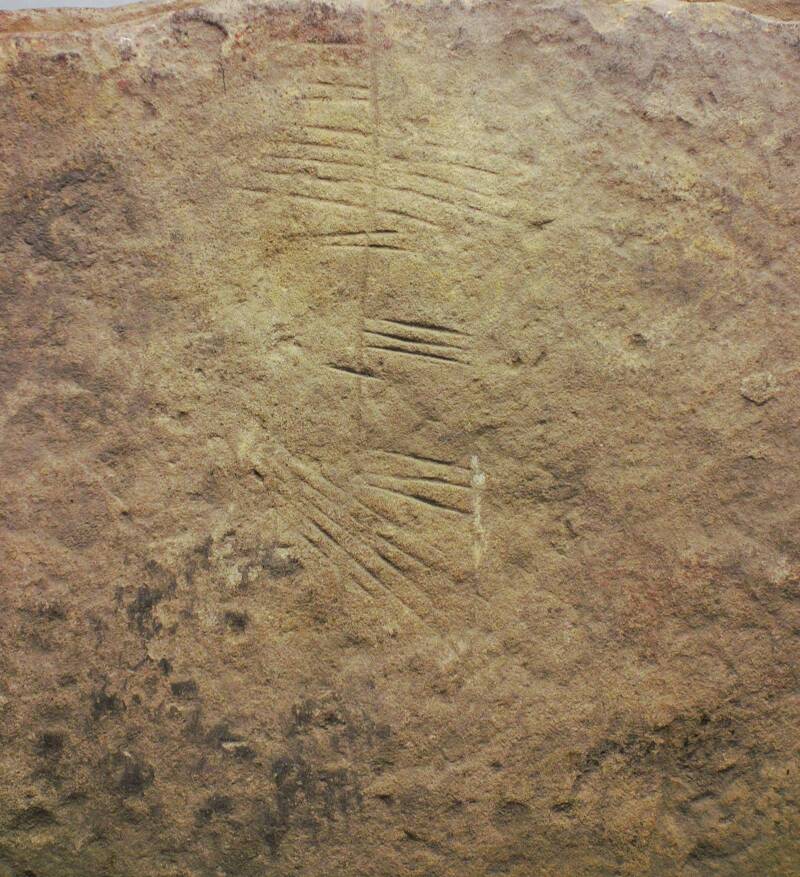
Another way to look at the Picts are by looking at their symbol stones and symbolic language, the distribution of which does not necessarily align with that of the P-Celtic like "Pictish" language attested in parts of eastern Scotland. This symbolic language is also attested on Orkney, with one fine example having been found at the Knowe of Burrian. I will discuss the symbols on this stone above the picture of the stone in this article. I have discussed other examples of Pictish symbolic language elsewhere, including with regard to those at Sculptor's Cave. As I implied, Ogham was also used in the Orkney Islands. The three photos below include one of the Knowe of Burrian Pictish symbol stone, another of the bird carving with some of the runes in Ostan Knowe, taken in Onstan Knowe, and another of the Pool Ogham inscription, above each of the photos are detailed explanations in italics above each photo, giving other details including on how they might be transliterated and interpreted. There is also more text after the photos and their descriptions.
Photo below: the Pictish Symbol Stone found at the Knowe of Burrian, the Knowe of Burrian being a broch. This does not indicate in my opinion that the broch builders were Picts, but that they sometimes made use of what we might call Pictish symbolic language. Upon this stone in the photo below can be seen a V-rod conjoined with a a crescent moon-like symbol, which the V-rod is usually connected to. Above it is a beautiful carving of a bird, which I think on these symbol stones could be connected to some kind of protective sky deity, akin to how totem poles in the Northwest Pacific often have a bird-like sacred figure at the top. Below the V-rod and crescent symbols can be seen what is generally interpreted as a mirror symbol.

Photo below: the different bird carving found within Onstan Knowe, which itself appears to be placed onto a series of reed-like lines, beneath which is a curious circular symbol attached to another line, to the right of which are three rune markings, which could spell out the letters T, K, F, although the two most right could also be interpreted as twig-runes of some kind. At the bottom left of the stone can also be seen what looks like an S rune.
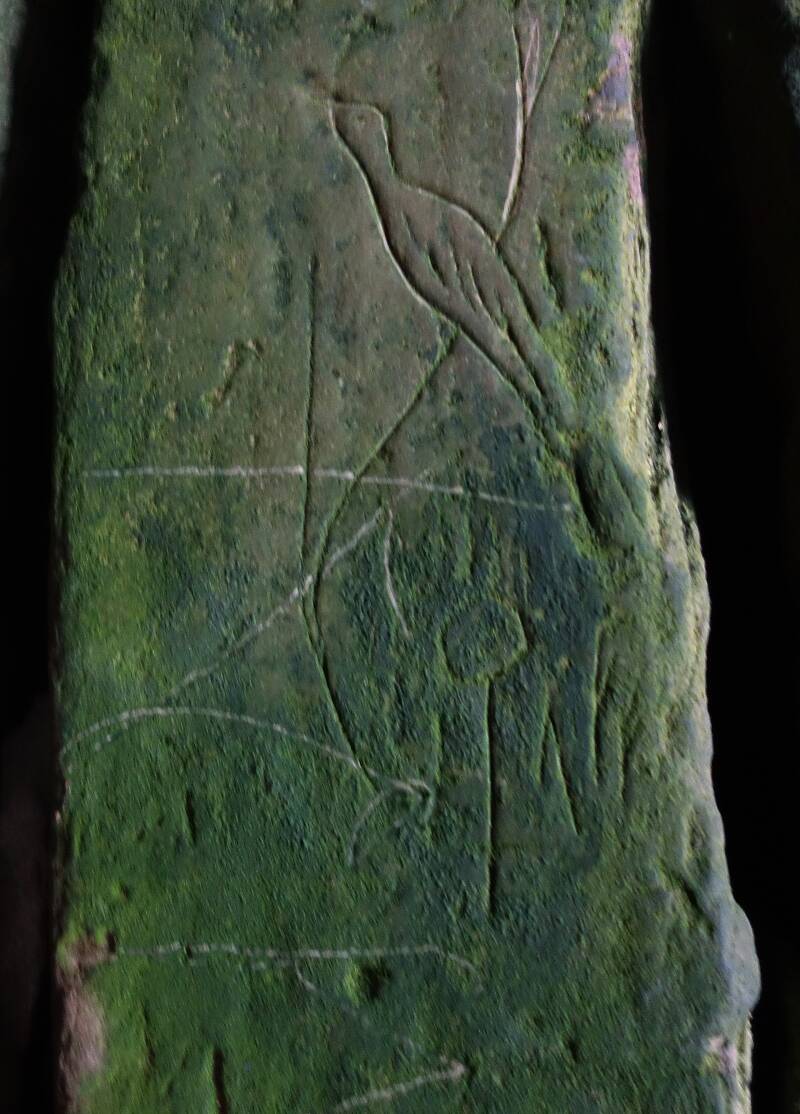
Photo below: the Ogham inscription that was found at Pool on Sanday in the Orkney Islands. The first letter, at the top of the main writing line, is probably an S, although some of the inscription is likely missing. Reading out the Ogham letters, going down, we get the transliteration of SROTATR. The element -TATR could be related to Germanic and Celtic words for "daughter", and a Germanic-like example of this word seems to appear in an Ogham inscription on Shetland. Although, this might also be incorrect. All in all, -SROTATR doesn't immediately seem to be an example of a P-Celtic language, and the inscription is, in general terms, untranslatable.
I find it really interesting too, why and how so many different writing and symbolic systems came to be used on the Orkney Islands. Whereas if we look at for example the county of Sutherland, there is much less evidence of prehistoric and ancient writing systems. This must in some way relate to ancient cultural and linguistic distributions in Northern Scotland, and to the fact that Orkney was clearly significant on a Europe-wide scale in terms of its sacredness and strong connections to other places - which is not to say that Sutherland was not sacred and connected widely to other places, but that this occurred differently to how it did in Orkney, with Orkney likely I think representing an ancient seat of many indigenous cultures, with wider connections. In a sense the presence of writing in ancient Orkney, and in various alphabets and symbolic forms, can be compared to the writing systems of Ancient Egypt and to those of Mesoamerica, with many of the cultures in these places connected to ancient writing, being also megalithic buildings and specifically builders of megalithic temple and tomb sites of a certain magnitute. Writing must in some way connect also to an advanced understanding of time in a divisional sense, and it is noteworthy that all of the aforementioned areas and many of the indigenous languages connected to them all contain within them advanced systems of time calculation. Note that I am not saying that indigenous cultures who lack these specific time calculation elements are in any way less advanced, in many ways they are more advanced - as there are both advantages and disadvantages to working with time and space as a non-abstract subject.
I hope that this article was an interesting read. This article is dedicated to the ancestors of Orkney, to the guardians of time, and to my grandfather. May the Great Mystery love, bless and guide us all.
Add comment
Comments