Written and published by Linden Alexander Pentecost, published in the UK and only on this website, this blog post/article was published on the 9th of March 2026. No AI was used in this nor in any of my written works. This article/blog post is unrelated to and separate from any and all of my other publications. I the author am a UK resident and am from the UK. This article/blog post contains 5 important photos showing carvings, with photo descriptions in italics above them, as well as main text. Yesterday I published another blog post on this website discussing other aspects of ancient writing (concerning newly discussed aspects to this in Orkney), and a bit later today I will publish another unrelated article about a previously undiscussed Pictish symbol stone. The photos and text in this article/blog post on this page have never been published before. This article/blog post on this page contains 1214 words. The photos in this article were also taken by myself, the author, Linden Alexander Pentecost.
Not so long ago I published a different blog post on this website, in which I talked about possible carvings around and in Victoria Cave in Yorkshire. After publishing the aforementioned blog post, I visited another cave in the same area and also re-visited part of Victoria Cave and visited a cave that lies just about 15 metres from Victoria Cave. This article/blog post on this page only discusses those markings in a small cave next to Victoria Cave (with photos of the markings included), the name of which I do not know. I took an awful lot of photos on that day, and it is the case with these carvings that one has to learn the locale's individual signs of erosion and natural processes, and to then be able to distinguish between these natural markings, modern graffiti, and the supernatural protection markings. Whilst I am confident in some of these which I have already published about, some of those which I discussed in the other blog post on this website concerning the markings in Victoria Cave - I was unable to find, and am less sure about in some cases, but it's all a part of the learning process, and my other article is nevertheless relevant for discussing and identifying potential markings and does contain photos of them. In this article/blog post on this page I will publish about some more examples which I noticed in a cave very close to Victoria Cave, not Jubilee Cave nor Attermire Cave, but another narrow cave close to Victoria Cave. Note that on a different website I also discussed in an article the carvings at Victoria Cave, although that aforementioned article contained no photos of them.
This cave was the one in which I noticed several of the markings which I published about in the aforementioned other blog post on this website. Some of these are I think typical witch markings or supernatural protection markings, whilst others are likely more natural, and others perhaps represent stylised later graffiti. The date of these carvings in a general sense is also confusing, some of them could be ancient, possibly. It will be a lot of work to make any absolute conclusions about many of these markings for the time being. Going down this page from here I include photos of several of these carvings and discuss them in the photo descriptions in italics above each photo, there is then more text after the last photo.
Photo below: a clear marking within the cave which resembles the "Awen Symbol", although it also resembles several so-called "masons' marks" found on old stonework. This marking is perhaps the clearest in the cave, and it is located not too far inside the cave.
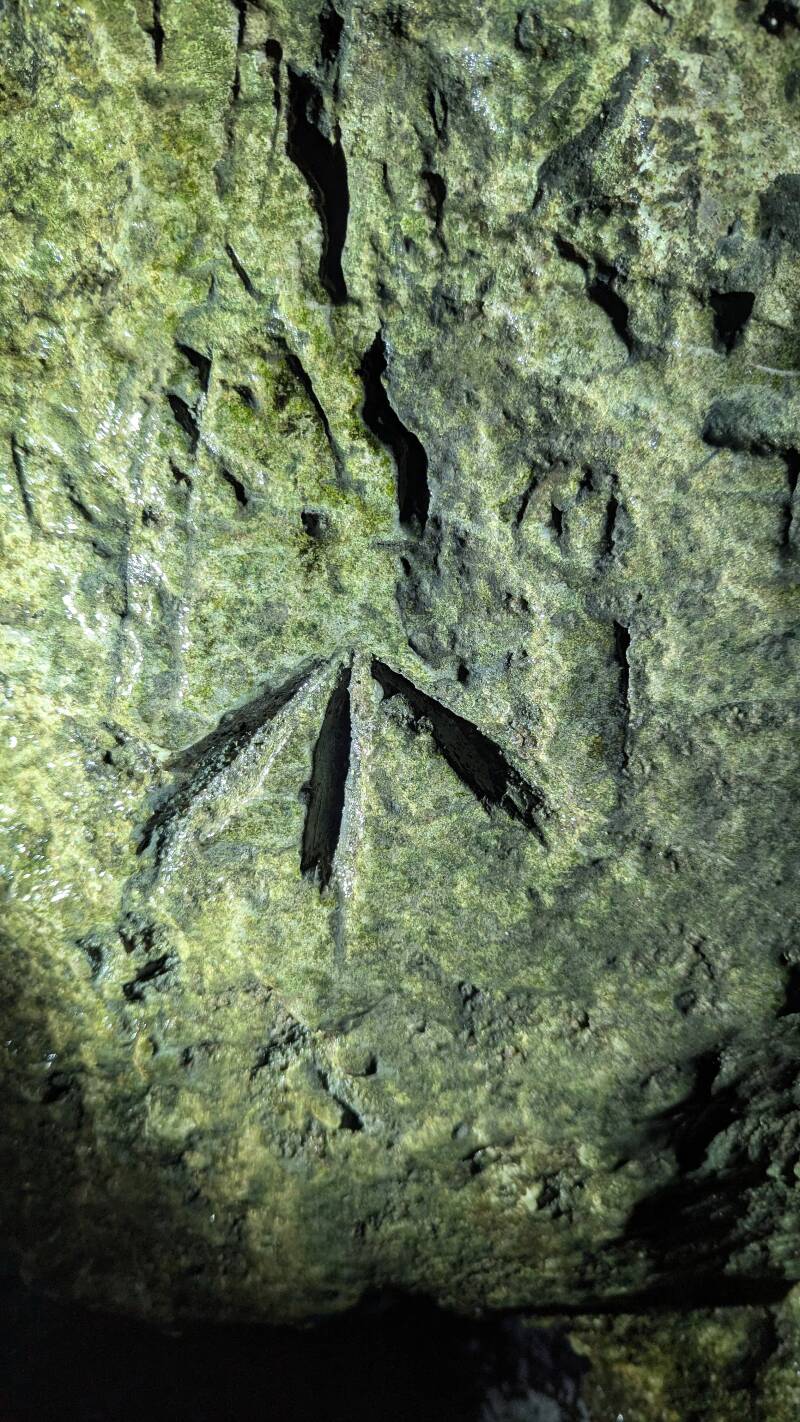
Photo below: another marking, not far inside the entrance of the cave, this one appearing like two letter I's (not L's). Could this be initials, a Roman numeral or could it be a witch mark of some kind?

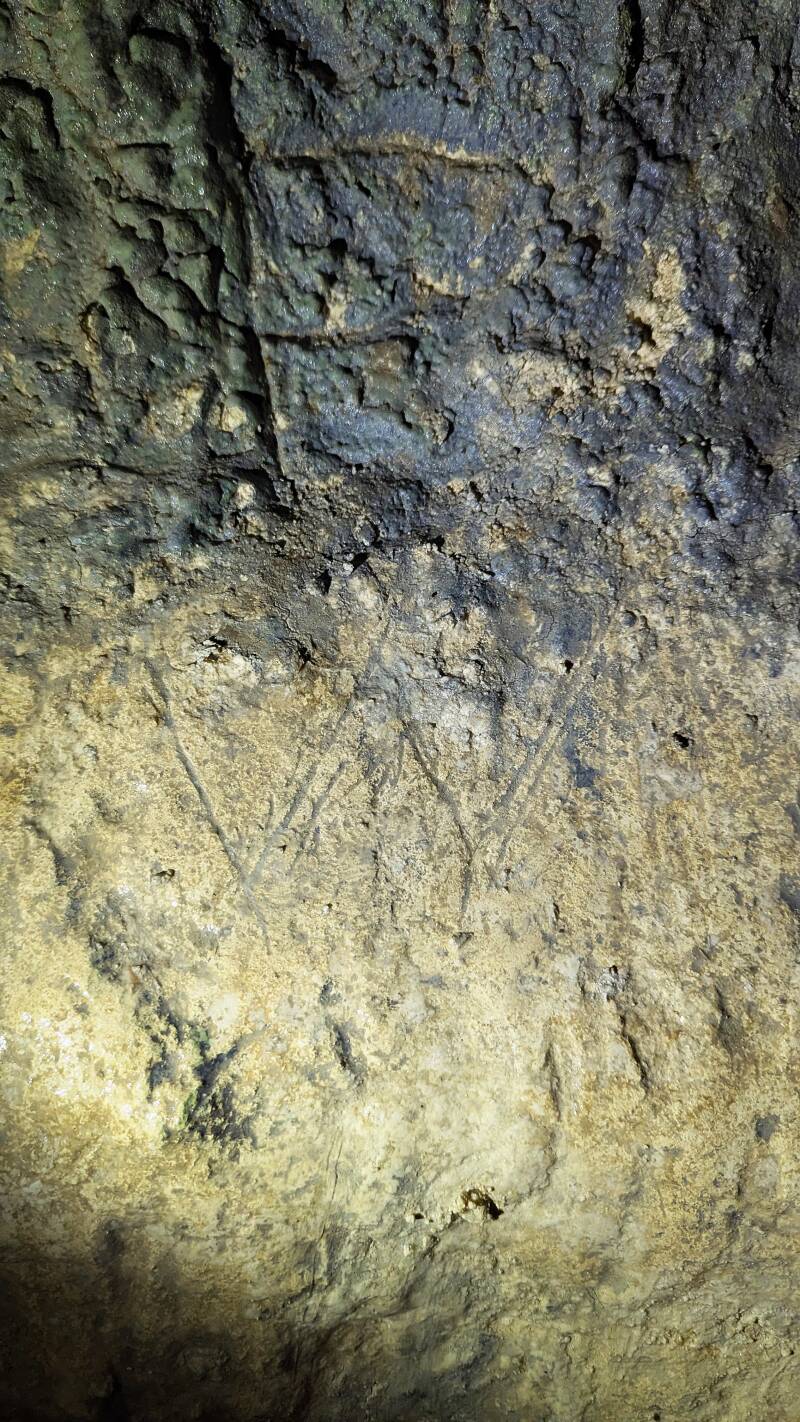
Photo below: what appears to be a VV symbol which looks more like a VVV on the side of the cave wall. This can be seen at the centre of the image. Whilst I cannot confirm that this is a carving, it certainly looks like one to me, and appears to have been outlined with several lines, rather than being a symbol marked with single lines.

Photo below: a part of the cave wall which seems to show another VV symbol or a VVV symbol centre-image which appears to have other faint markings to the left of it, although it is hard to say whether or not this is a carving or whether it results from erosion processes in the rock. I would like to know what others think about this.

Photo below: another different, clearer VV symbol or W symbol on one of the walls of the cave. Again I cannot completely discount that this one might also result from later graffiti, but it may well be a witch mark symbol, in my opinion. The marking can be seen at the centre of the below, portrait-orientated image.
In many senses, this subject of connecting supernatural protection signs to ancient forms of writing and symbolism is in its early stages of exploration. My publications concerning these subjects in relation to prehistoric Scotland (including the blog publication before this on this website, and my PDF book published last month, and other PDF books and other publications) have and will continue I hope to give more context to the publications in which I have discussed some of those in Northern England for example. Creswell Crags is another site which is full of these supernatural protection marks, another is Wookey Hole Cave in Somerset. I have visited neither of these sites (yet). I also recently published an article on another website which connected greatly to the Great Orme Bronze Age Copper Mines at Y Gogarth in North Wales. Although the cultures present at Y Gogarth were likely different, I would be extremely fascinated to be able to check those Bronze Age mine tunnels for markings - that is to say, the ones that are accessible to ordinary sized humans, whereas many of the mine tunnels were I think made by much smaller adult humans of an elven stature - I think. I have already discussed some markings at the Langdale Neolithic Axe Mine on another blog post on this website. To my knowledge none of the markings in Yorkshire Caves have been dated at this present time, and their association with prehistoric human activity makes for curious possibilities, although I am not going to assume those in Yorkshire Caves are thousands of years old, although some of them could be, and the ones in Neolithic contexts in Scotland clearly are thousands of years old.
I hope that this article was an interesting read. I will be publishing about yet other examples and aspects to these topics in the future. Later today I will also publish an unrelated blog post on this website concerning another example of a Pictish symbol stone not previously discussed.
Add comment
Comments