This article/blog post was written and published by Linden Alexander Pentecost, and was published on the 9th of March 2026, after an unrelated new written article concerning more symbols in a Yorkshire Cave was published a short while ago and earlier today. This article on this page is unrelated to and separate from any and all of my other publications. This article was published in the UK, I the author am also from the UK and a resident of the UK. The two photos in this article were also taken by me, the author. Above each of the two photos are photo descriptions in italics which contain information not in the main text, both these, the photo and main text are all important. No AI was used in this publication nor in any of my written works. Note that only a few days ago I published another blog post on this site in which I also discussed Pictish symbolic language, and I have written about it elsewhere too, including for example in an article on a different website about those at Covesea Caves. I will publish more on other aspects of and examples of Pictish writing not previously discussed in the future. The photos in this article and the rest of the article have never been published before. The way in which information is arranged in the title does not follow necessarily how the subjects are arranged in the main text, because I begin with Aberlemno's etymology and discuss the Pictish Serpent Stone after, which is not indicated at the beginning of the title. This article/blog post contains a total of 1613 words.
Aberlemno is a settlement in Angus in eastern Scotland, in the region known to some as Pictland, as this area lies at the heart of some of the influences we commonly connect to this idea of the Picts. At Aberlemno we see certain aspects of this coming together, one being the P-Celtic like place-name Aberlemno, and another thing being the presence of Pictish symbol stones at Aberlemno, although this symbolic language and the language of the place-name may not be the same language per-se. The Pictish name element Aber- is often connected to the Welsh word aber, which refers to a river conflux or estuary, the term also appears in Brittany, although only in place-names. The word also I think has a possible Afro-Asiatic cognate root, Proto-Afro-Asiatic: *ʕabir (1), meaning: "traveling (along a road), passing by, crossing (rivers) (1)". I also think that this root could, more distantly share a connection with Basque abar meaning a small branch, like a twig, or a small or mediocre thing. The word is not I think of Indo-European origin and I think it more likely that it exists well outside of and before the formations of Indo-European languages, even if it has been adopted into at least one of them as a spoken word and not just as a place-name element.
Reference (1) refers to the Proto-Afro-Asiatic vocabulary as reconstructed by Alexander Militarev and Olga Stolbova, the vocabulary is available on starling.rinet.ru .
The etymology of the -lemno element is harder to interpret. In Gaelic, Aberlemno is Aber Leamhnach, the root leamhnach refers to the tormentil plant. It is also possible that *-lemno is related to the "Lemon" place-names in southwestern Scotland, such as Lemon's Glen, the etymology of which may connected to S. Gaelic lìomh - "a shine", or perhaps to the Irish word leamhan "moth" or "destroyer", or to the word likely behind the name "Levens" in Cumbria, Welsh llwyfen and Scottish Gaelic leamhan meaning an "elm" tree. None of these Celtic connections suggest that the *-lemno element is any more connected to P-Celtic than it is to Q-Celtic root words.
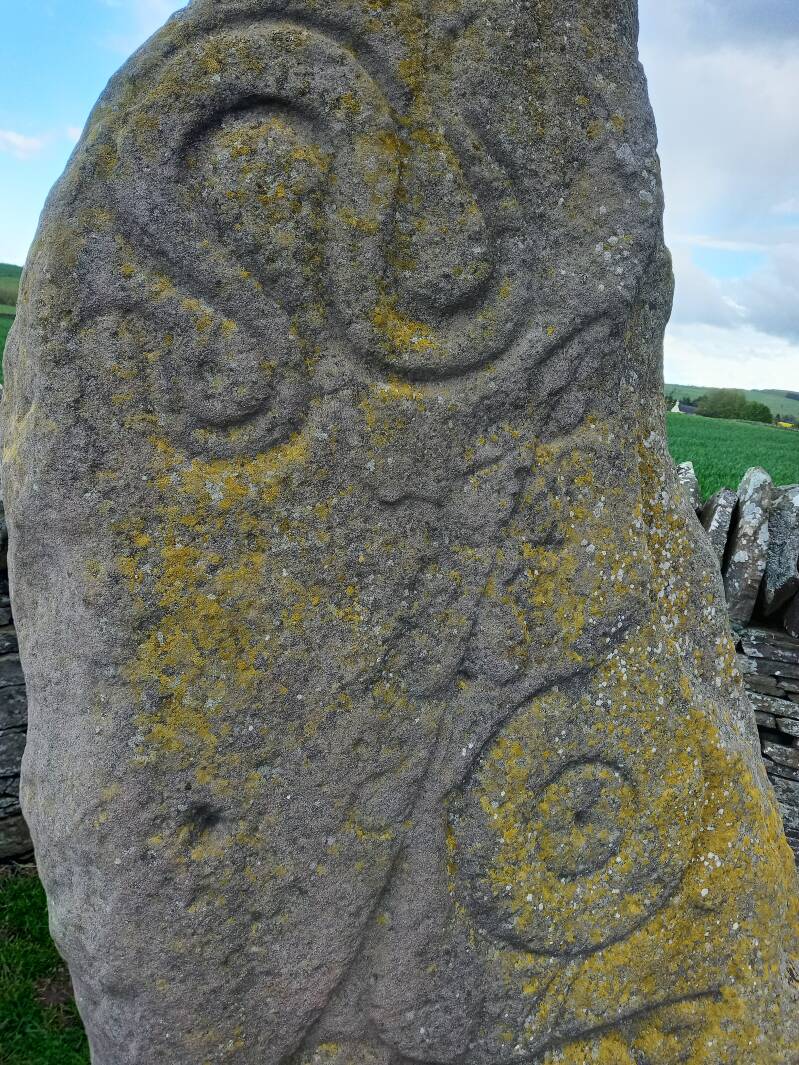
The Serpent Stone at Aberlemno is one of several Pictish symbol stones at Aberlemno, but in this article or blog post I will focus only on the Serpent Stone. The Serpent Stone is a beautiful and impressive example of a Pictish symbol stone, and it is well preserved, unlike most of the others, many of which lie neglected and uncovered. The Aberlemno Serpent Stone is most notably defined by an impressive serpent symbol towards the top of the slab, beneath which is an intricate Z-rod combined with a double circle symbol, beneath which is a mirror symbol, seemingly combined with a plant-like symbol. I wonder why the mirror symbol often appears at the bottom of these slabs, and why an animal, like the bird at the Knowe of Burrian Pictish stone and the Aberlemno Serpent stone appears at the top. This is again I think very totem-pole like, at least in terms of how these symbols are arranged. Could it be that the bird symbol on the upper part of the Knowe of Burrian stone, and the serpent or wyrm-like being near the top of the Serpent Stone of Aberlemno, are in some way indicative of how different tribes or religious groups identified a totem animal or guardian deity of that particular tribe and area? There is I think also a connection between these animals and the sky world, and in whatever more specific meanings this might contain, and in the idea that the serpent and bird are mediators between this world and the sky world.
In terms of why the mirror symbol might be at the bottom, well, if for one, it does represent a mirror, perhaps it should be taken into account that this symbol is sometimes towards the base of these symbolic inscriptions. Does the mirror represent then - the underworld, in some way? Is there an implication here, like in Sámi and in certain sects of Norse spirituality, that the underworld is a mirror of this world, and that reflective things, such as water, represent a gateway to it? I think that all of these symbols have more meaning than just this, and may also represent whole words or sounds as well as concepts, but I do also think that their position on the stones, particularly the particular arrangement on upright slabs, contains linguistic information in a sense.
To me, the Z-rod combined with double circle, and V-rod combined with crescent moon symbol - symbols, are often representing the central part of an upright Pictish pillar, and I feel that, among other things, they represent divine gateways from the horizons of this world. I think that they also represent two different magical staves but also phrases, with the Z-rod combined with double circles symbol in some way representing a magical "phrase" that completes a holy action, whether this was a holy action of protection, or signing a tribal connection and binding with the land, of a binding of the powers of the underworld and sky into the physical realm, or in some other phrasal meaning - I am not sure. Perhaps all of these things are true or untrue to different degrees. I would imagine that this entire "magical phrase" written as the combination of these symbols, their exact representation, positioning, finer, more unique features, and so forth, could also be "read" in some form or other. But I doubt that this kind of magical phrasing was the same language as that in which the name Aberlemno was coined, even if elements of that magical language also existed in the various spoken languages of Scotland, to different degrees. We know that places lacking in P-Celtic-like Pictish names, like Pabbay in the Outer Hebrides, Orkney and Skye, also had the presence of Pictish symbolic writing, but there is no evidence that these aforementioned areas had any language, whether Celtic or non-Celtic, which shared these P-Celtic-like elements. It therefore seems likely to me that Pictish symbolic writing as a system of magical phrases and ritual language existed on its own terms to different degrees in different indigenous tribes, and was not directly equivalent to the P-Celtic-like language spoken in "Pictland" in Eastern Scotland. The distribution of Ogham writing also doesn't directly match up to that of either of the aforementioned languages, at least not in an accurately specific way.
Photo below: the Pictish Serpent Symbol stone at Aberlemno, with the different symbols I have described above clearly visible. Note that I have discussed other serpent carvings elsewhere, including recently where in an unrelated article on another website, I wrote about a possible serpent carving in a cave near the Eden Valley. Note in the photo below how the Z-rod combine dwith double serpent symbol is quite ornate. Slightly to the right of the bottom of the mirror symbol is also what appears to be a box-like symbol with a line through the centre, I did not discuss this above.

Photo below: another photo showing a part of the Pictish Serpent Symbol Stone in Aberlemno, with more detail on the serpent itself, or wyrm. Note the detail on the line coming up from the Z-Rod and double circle combined symbol. This is definately one of the most beautiful Pictish symbol stones I have seen, and I wonder what the serpent meant, precisely, to the Picts, even though I have made my own comments about this.
I hope that this article/blog post was an interesting read. I will be publishing about yet more examples of Pictish symbolic language and "Pictish" language in general in the future. This article was written in honour of those who carved these symbol stones. Perhaps in the near future I will write and publish more about the Pictish symbol stones at Rhynie. Much love to all.
Add comment
Comments