Written and published by Linden Alexander Pentecost, and published on the 6th of April 2026. This article or blog post is unrelated to and separate from any and all of my other publications. Note that yesterday I published an unrelated article on a different website about more on Orkney twin runes and prehistory, and I have also published a great many other articles on runic and other inscriptions recently. Also in this article I discuss many other things not mentioned in the title, including discussions with an ex-girlfriend about wyrms and their connections to language, and many other topics. The photo in this article was also taken by myself the author back in 2017. No AI was used in this article nor in any of my written publications. This article was published in the UK and only on this UK website, the author is also from the UK and lives in the UK. The photo description above the photo and the photo itself also contain important information not in the main text. This article contains a total of 1513 words.
The island of Öland in the Baltic Sea contains a large number of runestones, perhaps the most famous of which is the Karlevi Runestone, or Öl. number 1 runestone, which I will discuss in a different publication. Another runestone which I visited on Öland was the Öland number 21 or Öl. 21 runestone located at Hulterstad Church or Hulterstads Kyrka on the southeast of the island, and close to the east coast of the island of Öland. This runestone is particularly nice, and is not the only runestone located within this church, also within the church are the remnants of the Öl. 22 runestone, which I will discuss in a different publication. The Öland runestone 19 was also found in this church, but I am not sure which of these runestones, Öl. 22 or Öl 19 which I also saw alongside Öl 21. which I discuss here. I will discuss both the others in the future regardless. The inscription shown on runestone :l. 21 is traditionally transliterated as: fr ' lit reisa 'steina 'efti seuar 'faþur ' s-n goþan which basically means "something" (probably a person) let raise runes for Seuar his father the good". There are significant differences between the way that these runes are written in runes, and how they are transliterated, compared to runic inscriptions in Britain, and I recognise some characters in these Öland inscriptions that are unfamiliar in terms of the Norse runes in Britain. One example can be seen below is a rune that specifically represents a [g] sound, which looks like a K rune with a dot between the upper two lines, in runes this is the rune: ᚵ. This is one of the Swedish runes, believed to have been used only in medieval times. In runic inscriptions in Britain, not distinction is generally made between [g] and [k] and they both written as ᚴ, pronounced [k].
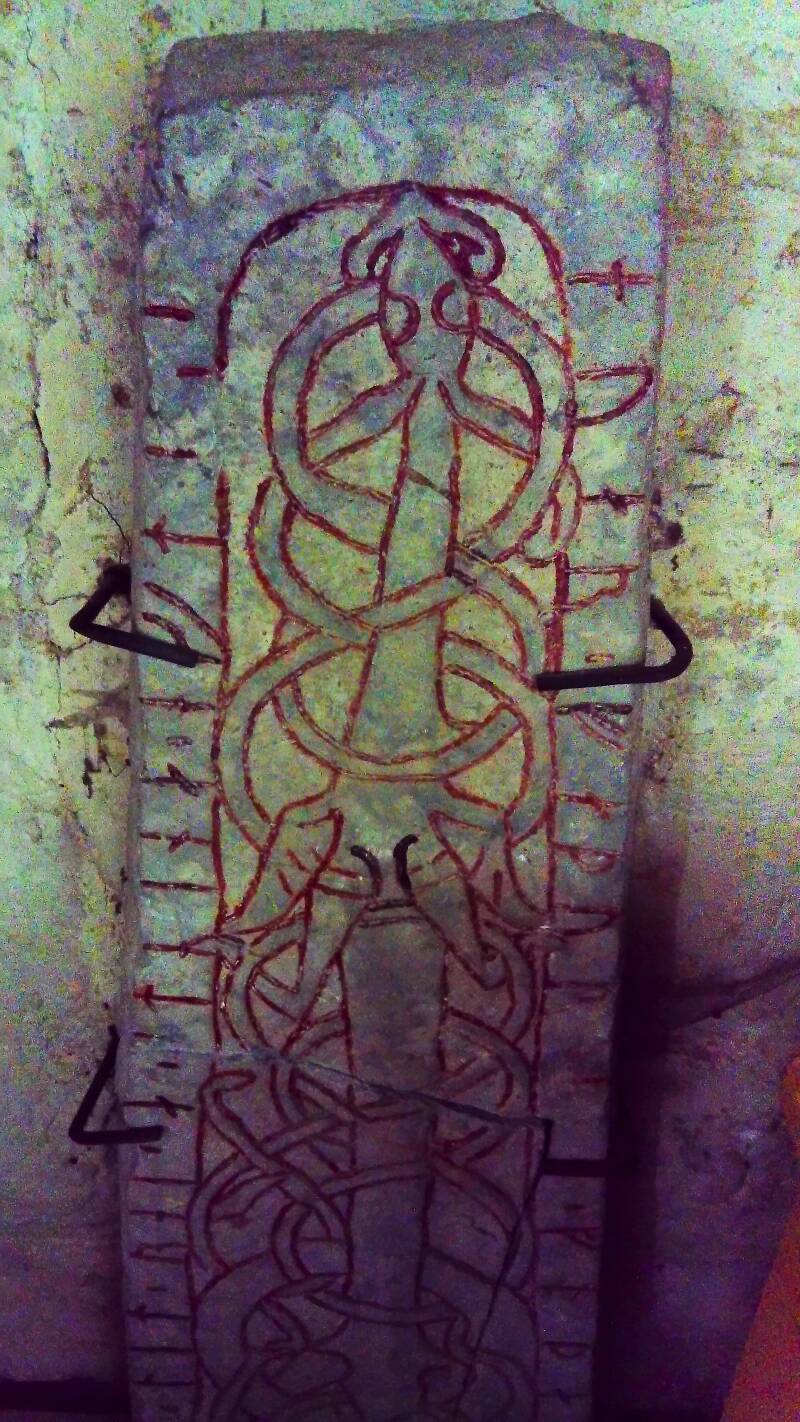
Another really fascinating thing about the Öland 21. runestone at Hulterstads Kyrka is that is a good example of the way in which runes are often written in connection to a supernatural being, known in Swedish as an orm and in England as a wyrm or worm, a being which we also translate as "serpent" or "dragon" sometimes, although the English words wyrm and worm are more specific. On the Öland 21. runestone, the runes are not actually written on the wyrm itself but rather on the space around it. The wyrm on the Öland 21. runestone has eyes, what appear to be feelers, as well as tentacles. Again, these beings that are depicted are not necessarily reptiles or strictly reptile-like but often instead possess worm-like or grub-like attributes, and sometimes they even have tentacles.
I remember at the time when I was in Öland in 2017 and when I visited this and other runestones and ancient monuments, I was dating a lady older than me, I was 24 at the time, and we had this thing where I would refer to her as a dragon, and she would talk about the existence of "rainbow wyrms" that connected us in some way. Whilst this topic was a form of "play talk" between us, I feel that it pertains to a larger spiritual metaphor expressed by these wyrms in mythology, in their transformative associations and also in their links to human spirituality, life and to fertility. The Öland 21. runestone also, in its own way, represents this concept, as it can be seen that the serpent or wyrm on the runestone at its centre seems also to have the legs and arms of an adult human expressed as a part of its form, which seems to be representative of the concept of the wyrm or serpent having originally been an adult human, or having merged with an adult human in some way. This girlfriend and I never talked about transforming into wyrms specifically, although she did once tell me that she would still feel pretty if her middle section became like that of a wyrm, and if she started to grow spike-like scales on her face, such was the unique nature of our connection. I remember when I was in Öland was one of those times when we weren't speaking much, due to things in her life rather than a lack of closeness or love between us.
The fact that runic inscriptions in Scandinavia are often written in connection or even within wyrms or serpents, is certainly very interesting, and it seems to suggest some connections between serpents and language - perhaps it is the implication that the wyrm becomes the holder and transmitter of the sacred language across the ages. Could this also imply, in a sense, the idea, that a part of the person's spiritual self (not their spirit, but an aspect of their soul), becomes a dragon after death, and thus it is the dragon/serpent/wyrm that becomes the aspect of them that transmits the runes in a timeless, eternal sense, just as these carvings also include shapes and patterns of the wyrms which are akin to ouroboros symbols and to the idea of eternity? It can also be considered that as well as an aspect of the person's spiritual self becoming a wyrm, or an aspect of a wyrm, that they are not necessarily its only aspect, and it could even be said that the wyrm is already a spiritual aspect of them and of all of us. Furthermore, the concept of a part of the spiritual self becoming a wyrm as some kind of eternal expression of a part of the spiritual self is also akin to the ouroboros. I have discussed many other aspects to this elsewhere in many publications. The photo description below discusses more on the Öl. 21 runic inscription in relation to the photo below it as well as discussing other topics.
Photo below: a photo of the Öland 21. runic inscription, located with Hulterstads Kyrka on Öland. Note the runic characters and the way in which they differ from those in England, and note the wyrm that seems to stand at the centre of the symbols, as though in a vortex between them, within the runes and also within the knots of the wyrm's own ouroboros-like tentacles. I have discussed other aspects of the mystical, circular aspects of sacred written language and of mystical language in general in other publications, including touching upon aspects of it in an unrelated article I published yesterday on a different website, the aforementioned article being about twig runes. Note the feelers near the mouth, and the human arms and legs half way down the wyrm, note also the other tentacles and the way in which they interlock and form a geometric vortex. Note also how some of the lower tentacles seem to have heads of their own. The context of this photo description also makes a lot more sense when the main text not in italics in this article is also seen in relation to what I discuss in this paragraph.
I hope to write more on this runestone in the future, as well as to write about the other runestones at Hulterstads Kyrka in future publications, and in the future I will also write about this in relation to other aspects of the connections between runes and serpents or wyrms. The large number of runestones in Öland is also curious, and in a sense, when I went to the Isle of Man later in the summer of that year when I went to Öland (2017) the areas felt connected in a sense, even if their use of runes is different. Note I have also written elsewhere on links between Northern England and Öland. This article is dedicated to all that I love, thank you for reading.
Add comment
Comments