Written and published by Linden Alexander Pentecost on the 4th of April 2026. This article/blog post is unrelated to and separate from any and all of my other publications, including in the many other publications recently where I have discussed examples of runes, Ogham and more generally ancient writing and symbolic writing, and other topics. The photo in this article was also taken by me, the author. No AI was used in this publication nor in any of my written works. This article was published only on this UK website and was published in the UK, the author is also from the UK and lives in the UK. The photo description in italics contains information not in the main text, and it, and the photo itself, and of course the main text, are all important. Note that my blog post before this one discussed entirely unrelated possible runes and other symbols, and that, that article, and the one in front of you, are only two of many many I have written discussing different aspects of and examples of these topics lately, I have also discussed many other unrelated examples and aspects to these topics across several unrelated recently published PDF books. This article in front of you contains a total of 1579 words. Note that I discussed different Ogham stones on the Isle of Man in another recent article on this website, titled: On three Ogham inscriptions of the Isle of Man, published on the 31/03/2026 (the aforementioned article is unrelated to the article on the page you are currently on, containing 1579 words).
Another example of Ogham writing on the Isle of Man can be found on the Maughold Stone, currently located at the Kirk Maughold Cross Shelter, within which are kept protected many early crosses, some of which have runic inscriptions, and one of which has both two runic inscriptions and one Ogham inscription. The Ogham inscription on this stone, known as the Maughold Stone, is formulaic, but not in the same sense that other Ogham inscriptions on the island are (I have discussed these other inscriptions elsewhere, including in particular in my unrelated recent article on this site, titled: On three Ogham inscriptions of the Isle of Man, published on the 31/03/2026 . The formulaic Ogham language on the Maughold Stone is not formulaic in a dedicational sense, but is formulaic in the alphabet, or order of letters with their names, is itself a kind of magical formula. Thus the Maughold Stone contains the following Ogham inscription: ᚛ᚁᚂᚃᚄᚅᚆᚇᚈᚉᚊ... which spells: ᚛BLFSNHDTCQ... which is the first aicme of the Ogham alphabet, ᚁᚂᚃᚄᚅ/BLFSN followed by the second aicme of the Ogham alphabet, which isL HTDCQ. If they were, at the time of this inscription, pronounced in a formulaic sense similar to the Old Irish pronunciation, then one might read this inscription as: Beith, Luis, Fern, Sail, Nion, Uath, Dair, Tinne, Coll, Ceirt, which are the first ten names in Old Irish of the first ten Ogham letters as they are traditionally arranged in the alphabet, with the first aicme BLFSN being read first, then the second aicme HTDCQ . The word aicme refers to the different groups of Ogham letters, which are arranged into the aicmes according to how the letters are written, so in the first aicme for example you will see that all the letters are formed by dashes going down from the central writing axis, whereas the second aicme consists of letters formed of dashes/lines that go upwards from the central Ogham writing axis. I also think it possible that this formula ᚛ᚁᚂᚃᚄᚅᚆᚇᚈᚉᚊ/BLFSNHDTCQ could have been "pronounced" as it is in some way, similar to the word Futhark which I will go on to discuss, the obvious thing being that ᚛ᚁᚂᚃᚄᚅᚆᚇᚈᚉᚊ/BLFSNHDTCQ contains no vowels, and if this was pronounced as a magical phrase, then vowels would have been required.
Photo below: a somewhat worse-for-ware looking Maughold Stone, as photographed in summer 2016, bird droppings had sadly obscured parts of the runic inscriptions. On the upper part of the stone can be seen the first runic inscription on the Maughold Stone, below which is the second runic inscription, and below which is the Ogham inscription. As you can see, the photograph below shows these inscriptions, but is not akin to my better, more recent photos of inscriptions where I use side-lighting. Of course I could not have done this in the daytime when I was at Maughold because it was too light. Maughold in the Manx language by the way is Maghal, pronounced approximately as [maxal]. Below the photo below I will go on to explain the runic inscriptions on the Maughold Stone.
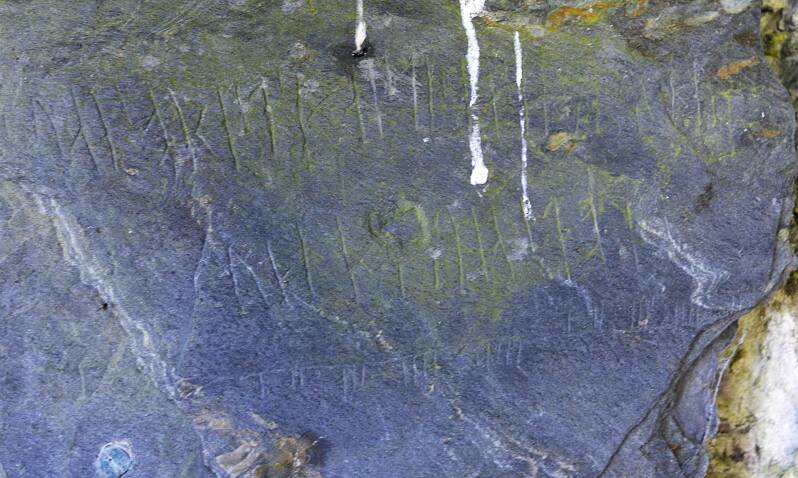
There are, as you can see above, in addition to the Maughold Stone Ogham inscription, two runic inscriptions, the upper one of which reads: ᚢᛆᚿ᛬ᛓᚱᛁᛌᛐ᛬ᚱᛆᛁᛌᛐᛁ᛬ᚦᛁᛌᛁᚱ᛬ᚱᚢᚿᚢᚱ - which can be transliterated as: uan:brist:raisti:þisir:runur which is easily translatable as: "Uan (Iain, John) the priest raised these runes". Whilst these inscriptions are commonly described as "Old Norse", and whilst haphazard attempts are generally made to standardise the language according to Old Icelandic orthography, and whilst these inscriptions are sometimes divided by their "east Norse" and "west Norse features", such categories are pretty inaccurate for describing the Norse language in Britain, in fact, that there are "Old East Norse" and "Old West Norse" variants of inscription and dedicational language in Scandianvia, has very little to do with the way in which people actually spoke. For example, the diphthong æi is often described as "Old East Norse", when actually in modern Nordic languages, æi occurs almost always in western Nordic languages, in Norway. In Britain, the attempts at trying to classify inscriptions as Old East Norse and Old West Norse do not work, because the actual Nordic languages spoken in Britain, the Isle of Man and Ireland were likely neither one nor the other, which is why I prefer the term "Anglo-Norse" for describing these languages, although, when it comes to the Isle of Man and the Western Isles, the term Western Norn is perhaps more appropriate, as using the term "Norn" here correctly implies the relationship between the Isle of Man, Hebrides and Northern Isles, where the Nordic languages there came to be known as "Norn". At least some of the Norse or Norse-like runic inscriptions in Cumbria could also be considered a part of this Western Norn language area. Note I discuss one of these Cumbrian Norse inscriptions in a recent article on a different website, the article being titled: C2: On the Pennington Norse Runestone in Cumbria & related topics, published on the 30/03/2026 , the link to which is: https://www.kielimatka-2-11.co.uk/c2-on-the-pennington-norse-runestone-in-cumbria-related-topics-published-on-the-30-03-2026 .
There are also many variations within this Western Norn language, which do not necessarily correspond to the so-called "Old East Norse" and "Old West Norse" dialects, which I think, in reality, did not actually exist as an important distinction in Nordic languages, at least, no more distinct than any of the other measurable dialectal differences. We will notice that in the inscription: ᚢᛆᚿ᛬ᛓᚱᛁᛌᛐ᛬ᚱᛆᛁᛌᛐᛁ᛬ᚦᛁᛌᛁᚱ᛬ᚱᚢᚿᚢᚱ/uan:brist:raisti:þisir:runur that the [ai] diphthong is used in raisti/ᚱᛆᛁᛌᛐᛁ, which is not typical of Western Norn as a whole, although because the Younger Futhark alphabet lacks the [e] sound, it is difficult to say whether or not the ai/ᛆᛁin raisti/ᚱᛆᛁᛌᛐᛁ represents [ai] or for example [ei] or [eː], although it is also possible that in these formulaic inscriptions the language was pronounced as written, so perhaps even though the more common vowel combination may have been [ei], in these formulaic examples the pronunciation could have been [ai].
The lower runic inscription on the Maughold Stone can be written in runes as: ᚢᚦᚭᚱᚴᚽᚿᛁᛆᛌᛐᛓᛘᛚ᛭, with the first letter either missing or damaged, this can be transliterated as: uþorkhniastbml- which, if the ᚠ was present, would be: ᚠᚢᚦᚭᚱᚴᚽᚿᛁᛆᛌᛐᛓᛘᛚ᛭ or fuþorkhniastbml which is the magical, formulaic reading of the Younger Futhark alphabet, the letters "Futhark" themselves being equivalent to the (ᚠ)ᚢᚦᚭᚱᚴ/(f)uþork part of this inscription on the Maughold Stone. In this sense, the second runic inscription on the Maughold Stone is akin to the Ogham inscription on the Maughold stone, both the aforementioned being magical, formulaic uses of writing the Runic and Ogham alphabets. This is to me extremely interesting, as it connects to the topic of the relationship between written magical formulae and vocalised language, and how the two interplay. Most would probably say that fuþork is a magical word simply because it is a "reading" of the first letters of the Younger Futhark alphabet, but I am inclined to think that there is more to it than this, that the letters being arranged and pronounced in this way has a meaning that goes beyond the ordering of the alphabet and that the word Futhark may have a meaning in and of itself. As I have said previously, the "higher", original language within runes was not in my opinion Norse, the runes were later used to write Norse in a formulaic way, but Norse language does not on its own explain nor quantify the more magical language inherent within the runes themselves, and their ordering. A similar thing can I think be said for the Ogham alphanet.
Thank you for reading this article, I hope that it was interesting. It is dedicated to the people and ancestors of the Isle of Man, and to Manannán Mac Lir.
Add comment
Comments