This article/blog post was published by Linden Alexander Pentecost on this website on the 1st of April 2026. Neither this nor the unrelated, different blog post I also published today on this website, are April Fools jokes in any sense, they both represent serious subjects. This article/blog post is unrelated to and separate from any and all of my other publications. No AI was used in this publication nor in any of my written works. The 5 photos in this article were also taken by myself, the author. This article was only published on this UK website, and was published in the UK, the author is also from the UK and lives in the UK. The photo descriptions also contain important information not in the main text, and the photos, like both the photo description in italics and main text, have also not been published before. Note I also discuss the wynn and k runes, and other runes, in the other article published today also in the context of unrelated carvings that bare similarities to these runes, but in this article I am discussing Anglic runes, where the K of the Norse Younger Futhark looks akin to the S of Anglic runes. This article on this page contains a total of 1217 words.
Urswick Church or Urswick Kirk in Cumbria is a special site, situated within a wider sacred landscape with several megalithic sites and other ancient and sacred sites. I have discussed some of these elsewhere, and have also discussed elsewhere the Anglic runic inscription located inside Urswick Kirk. These runes are located on what is known as the "Tunwini Cross". I recently visited this church, on the same day that I visited another church nearby which has a Norse runic inscription, I have discussed the Norse inscription already in my unrelated article on a different website, the article being titled: C2: On the Pennington Norse Runestone in Cumbria & related topics, published on the 30/03/2026, the link to which is: https://www.kielimatka-2-11.co.uk/c2-on-the-pennington-norse-runestone-in-cumbria-related-topics-published-on-the-30-03-2026 . Neither in this article on this page, nor in the aforementioned article, do I discuss the Tunwini Cross runic inscription, but I have elsewhere. In this article on this page I will instead discuss other interesting markings, symbolic language and other letters also at Urswick Kirk. These markings are explained in the photo descriptions above the photos below.
As well as discussing some likely apotropaic markings in this article/blog post, I also discuss what is most likely a mason's mark, and I also discuss a very fascinating gravestone with inscriptions upon it which look very akin to a runic inscription, and the aforementioned gravestone is not the already known about runic stone, the Tunwini Stone, located inside the church, although I find it very hard to believe that nobody would have noticed a second runic inscription at this site until now. Nevertheless I leave this open to debate and to further research.
Photo below: a selection of what may well be apotropaic markings on the left side at the entrance of Urswick Church. Towards the top of the image can be seen what may be two capital i's, lower down is what may be the capital letters TM, similar to those that occur at Lacy's Caves, as I have discussed elsewhere, although the top of the possible T is not really visible in the photo below, and it also looks as though the M marking is linked on the left side to the possible T.
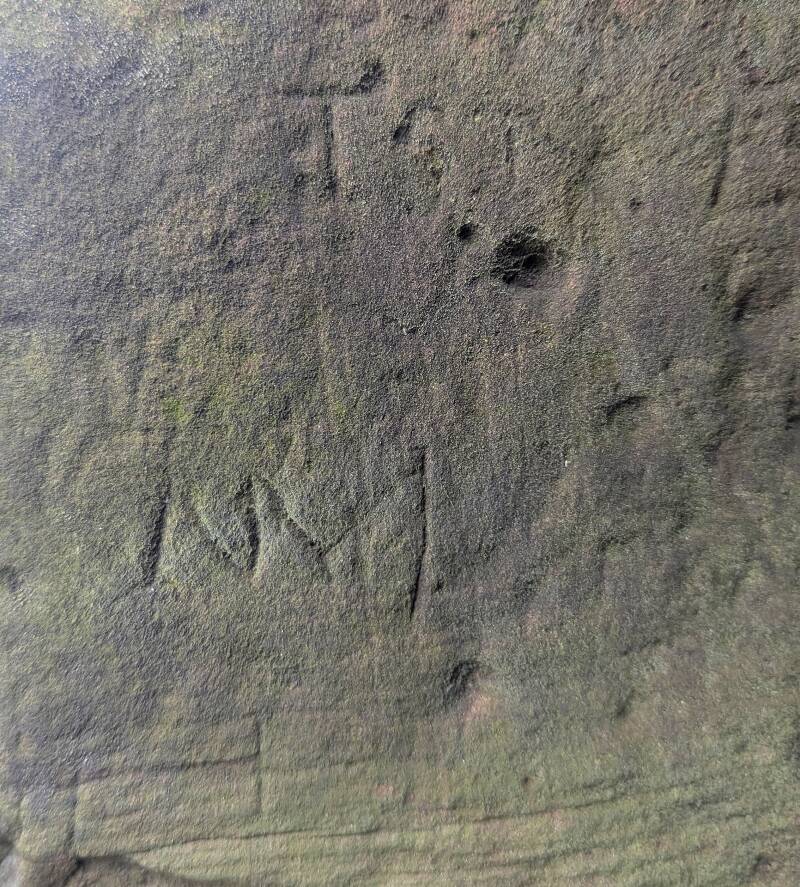
Photo below: what is likely a mason's mark on the font at Urswick church, below which was a damaged carving of what may be a mythological amphibian.
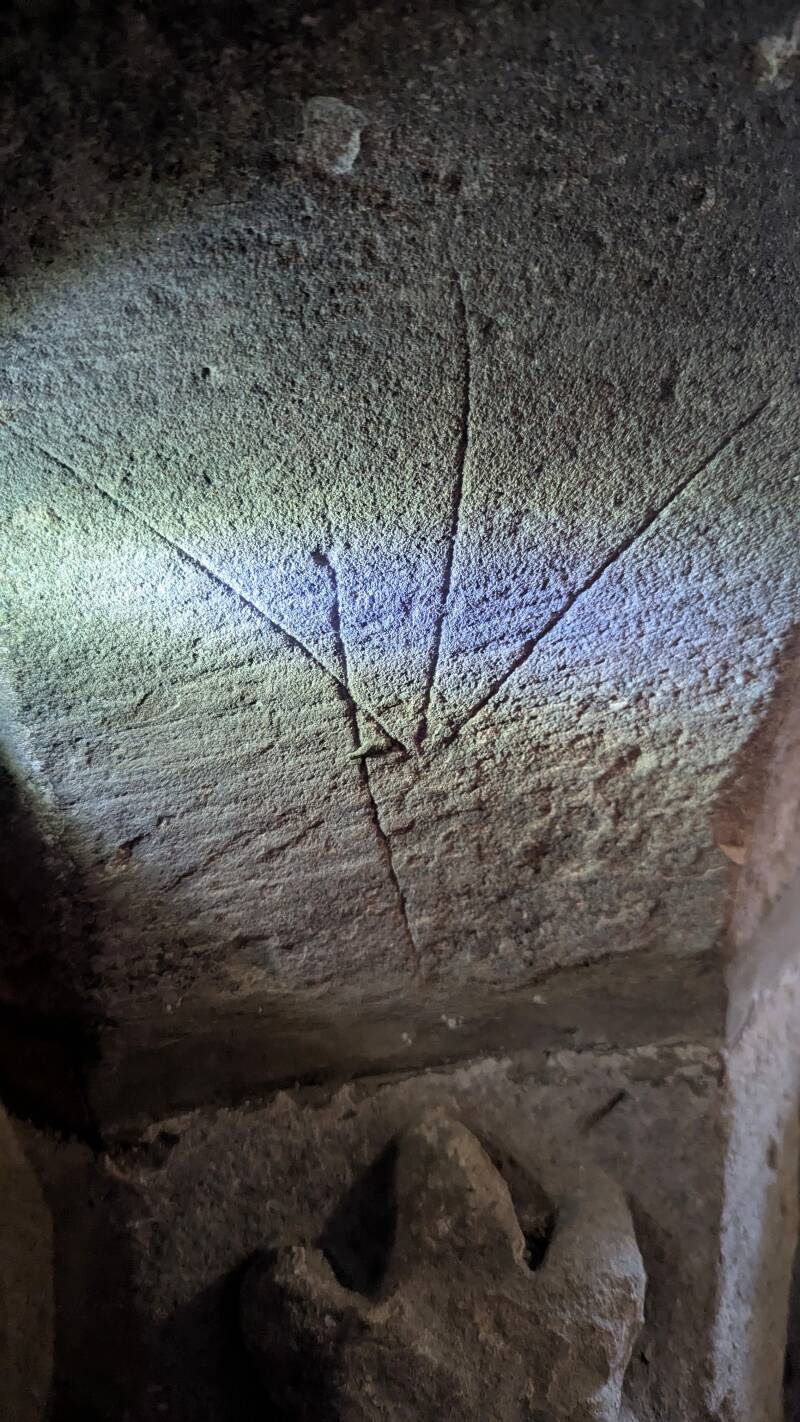
Photo below: other possible apotropaic markings on the left side of the entrance to the church, one of the symbols or letters also resembles a capital T again, I am unsure on the symbols above and to the right of the T.

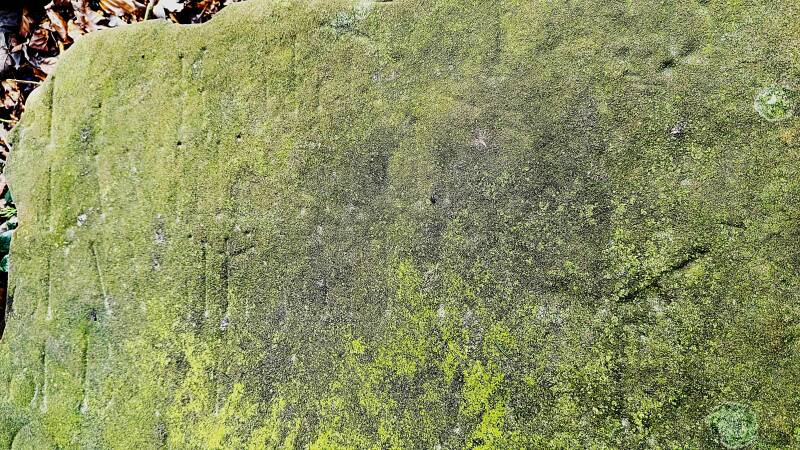
Photo below: part of a very curious set of markings on what seems to be a broken gravestone, no doubt one of early date. This gravestone is located just a bout two metres south of the most southeast corner of the church, at around the GPS coordinates: 54°09'29.8"N 3°07'17.4"W . Whilst I think it doubtful, and whilst the lines are so worn and difficult to work out, the vertical orientation of many of these marks, namely all those to the right side, and the way other marks come off them, are very rune-like. One of the symbols upper bottom right looks like a three-pronged T-rune merged with another rune, whilst some of the markings towards the top look a bit like K runes, but they are so worn that it is hard to tell where the lines actually intersect. If these are Anglic runes though, the K rune could in fact be an Anglic s rune, ᚴ, which looks more or less identical to the Norse k rune, ᚴ. Note also that what I describe as a three-pronged T rune, is a form of the Norse T-rune, although not that which I see most commonly in Norse inscriptions, but if the gravestone below represents a possible Anglic runestone, which might make more sense at this church specifically, then the three pronged Younger Futhark T-looking symbol, combined with a line to the left, could instead be the Anglic Ilcs rune, ᛉ, combined with a line to the left of it.

Photo below: another photo showing the same grave slab and inscription as is visible in the photo above, but the photo below shows this from a wider angle, and shows more of the vertical lines which are akin to those of runes. Towards the left side can be seen several circular shapes, of religious meaning. To the right of the fourth symbol down can be seen what looks like a P or a wynn rune. Considering that there already is a known Anglic runic inscription known from this site, namely the Tunwini Cross inscrition, inside the church now, it would perhaps be fitting if the below represented another example of a different Anglic inscription, with for example wynn ᚹ and ilcs, ᛉ visible. This is unlikely to be an Anglic inscription unnoticed until I noticed these markings, but many aspects to these marks are similar to runic inscriptions, another thing being the way in which there appears to be four clearly defined lines of script. The way that the possible Ilcs rune connects with a line on each side, is unusual though. I sent my friend Edward Hatfield a photo of these markings after noticing rune-like marks, but before writing this article, and he told me that they both "do" and "don't" look like runes, but that they do not look English (modern English).
I hope that this article was an interesting read, and I hope that it encourages further research into this site and its markings. As I have mentioned there is also a known about, confirmed runestone, not in the photos above, which is also well worth visiting. Please be respectful of this place. This article is dedicated to my grandad and to all that I love. May the Great Mystery bless all.
Add comment
Comments
Sir, I am reading your posts. I share your fascination with languages. Celtic, Salishan, Germanic, Finnic. Would you consider joining me for an online study group for some language you want to study? I have been searching for company to study Irish/Halkomelem/Inuktitut together. I am from Lviv, Ukraine