Written and published by Linden Alexander Pentecost on the 1st of April 2026. This article/blog is not any kind of April Fools joke or anything, it is about a serious subject matter. The unrelated blog post I wish to publish later today will also not be any kind of an April Fools joke.
This article/blog post on this page in front of you, is unrelated to and separate from any and all of my other publications. No AI was used in this publication nor in any of my written works. This article was published only on this UK website, this article was published in the UK, I, the author am from the UK and I live in the UK. The photos in this article were also taken by myself the author and have not been published before, the photos are important, alongside the main text, and the photo descriptions in italics above each photo, also contain important information not in the photos nor in the main text. Note I will publish another, unrelated blog post on this website later today. This article/blog post contains a total of 2386 words and 9 unique photos.
In the ongoing saga of apotropaic markings, symbolic language and other forms of written inscriptions - the markings I have discussed so far at the small cave near to Victoria Cave and those in Jubilee Cave are not all the carvings in these caves, and in this article/blog post I will discuss some other very interesting examples. Often with these carvings it is difficult to tell what relation some of the symbols bare to Latin and runic letters, and to other symbols, and there are some resemblances to both Latin and Runic letters, but primarily mainly to Latin. But some of the other symbols discussed in this article are not akin to known symbols. Furthermore it is sometimes difficult to distinguish natural markings from carvings, and also, it looks in some of these cases as though more recent markings have been added to earlier ones.
The first carving of several letters or symbols is located in Jubilee Cave, at the very end of the right-most passage when facing the cave entrances from outside. This right-most passage can only be accessed by a cross-cut from the middle passage, and the cross-cut is also an unstable and dangerous area, I have previously discussed this area in another blog post on this website and the carvings around there, there were also Neolithic burials in that part of the cave.
The first carving shown in this article however (and shown in several photos) is again, right at the end of the right-most passage and on the left side, as it gets very narrow towards the end. There is no doubt more further into this cave from the point in question which has not yet been excavated, I presume, but there must be "something" in this area or beyond this area, which necessitated the creation of the carvings on the left side.
These carvings appear like a series of symbols, some are very clearly symbols, the first "line", I am less sure about though, as the first line furthest left in the photos could be a natural marking. The group of symbols - when taking this first line into account, and reading from left to right, appears as a vertical line, then two vertical lines which may be a H-type letter, followed by a letter which very clearly looks like a capital E, followed by another vertical line, with a possible other line coming off the upper right of that line and going up, but the smaller attached line may again be natural, and then followed by a P-like symbol, which does look akin to the Christian Chi-Rho symbol, yet if this is a Chi-Rho symbol then the right two lines coming off the Chi- part of the symbol appear to be missing. Furthermore this symbol bares some similarity to the Anglo-Saxon rune wynn if as part of a combined rune, but this is speculative. I have nevertheless included several photos of this carving, which is necessary as certain angles will show certain lines or shapes that others do not, and vice versa. After these photos (each with descriptions above them) I will discuss with other photos some more carvings in Jubilee Cave and some more in the small cave close to Victoria Cave.
Photo below: the inscription discussed above, with the Chi-Rho-like symbol visible centre-image and slightly to the right, to the left of which can be seen a vertical line, with another small line coming off the top and to the right, making it look a little akin to a K rune, ᚴ, which I have seen as an apotropaic marking elsewhere, as I have with the letter K, this is discussed elsewhere. But note that the line might not completely connect with the vertical line. Note also that the Chi-Rho-like symbol is carved in a different way to the other symbols, and is seemingly in-part more "shallow". Note that to the left of the possible ᚴ-looking symbol is what appears to be a capital Latin E or a similar symbol, but I am not sure if all three horizontal lines of the capital E are carvings, although this does appear to be the case. To the left of this can be seen one of the lines that form part of the possible H-symbol.

Photo below: a different view of the same inscription, with again, most clearly, two vertical lines, possibly as part of a H-like symbol or H, followed by what looks like a capital E, followed by the ᚴ-like symbol and then followed by the Chi-Rho-like symbol, when reading left to right.

Photo below: another view of the same inscription as in the two photos above, with focus on the H and E like markings, followed again by the ᚴ-like symbol and followed by the Chi-Rho-like symbol.

Photo below: another view of the same inscription, with the first, standalone vertical line, possibly natural, more visible from this angle and with the light from this angle, which is again followed by the H-like symbol, which is looking less H-like in the photo below, and more like two vertical lines, followed by the E-like symbol, with the uppermost horizontal line looking exceptionally long in the photo below, followed by the ᚴ-like symbol and followed by the Chi-Rho-like symbol. Note that in the photo below it kind of looks as though the two upper lines of the ᚴ-like symbol are joined with a horizontal line at the top, but I do not think that this is part of the symbol - although, I am not sure. In the photo below the ᚴ-like symbol essentially looks like a variant form of wynn as well as the Chi-Rho looking like a variant form of wynn. Note that if we consider that W markings are found commonly, and that wynn represents W, this could be a symbolic link, but this is speculative.
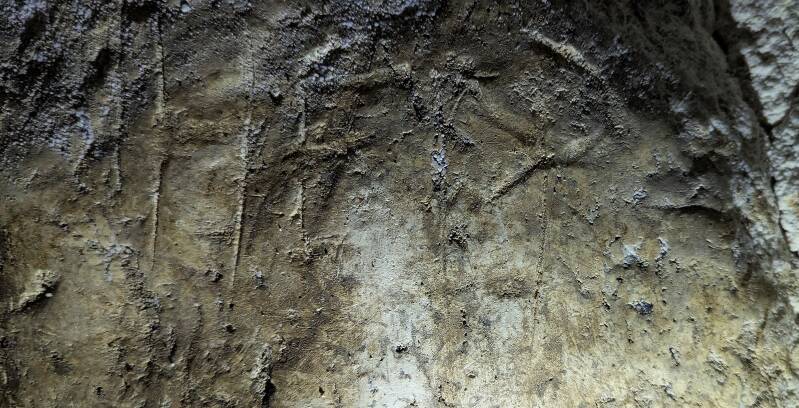
Photo below: another view of the same inscription, again with many of the same markings visible, and again with the ᚴ-like symbol appearing a bit more wynn-like, but this may again not be what this symbol means.

The second carving in Jubilee Cave that I want to discuss in this article is also located in the right-most passage, but not quite so far towards the end of the accessible area of the cave. Furthermore, the carving shown in the photo below is in the narrow area at the roof of the right-most passage and towards its end. In some senses the marking looks like graffiti, and one, by reading what the lines kind of look like, might read it as PAZ WOZ ER which looks a bit like a "was here" inscription. Yet I find this doubtful, as the carving is, at least in part, carefully cut, as though with a sharp knife, and furthermore, the position of this carving in the cave is pretty awkward, and I find it unlikely that someone would create a "woz here"/"was here" carving in such a place, especially given, that if this was the case, then the forms of the letters would also be extremely abstract and of unusual sizes. I discuss the details more in the photo description below.
Photo below: the inscription close to the ceiling in question, at the top can be seen what looks like a P, but which is also shaped more like a wynn-rune, followed by a capital A, when reading from left to right, and followed by a larger Z-like marking. If we go down the image slightly, we see an abstract W furthest left, which looks to be formed from an upside down smaller V imposed on a larger normally-positioned V, and then reading to the right, is a somewhat abstract looking O which resembles more a diamond symbol, followed by another larger Z-like symbol (why the large Z-symbols?), and then going to the bottom of the inscription, we can see what appears to be a Latin capital E, followed by a runic R or stylised capital Latin R. There are also what looks like two, possibly natural (or not?) vertical lines which intersect with the R and with the Z immediately above (not the top Z-symbol).
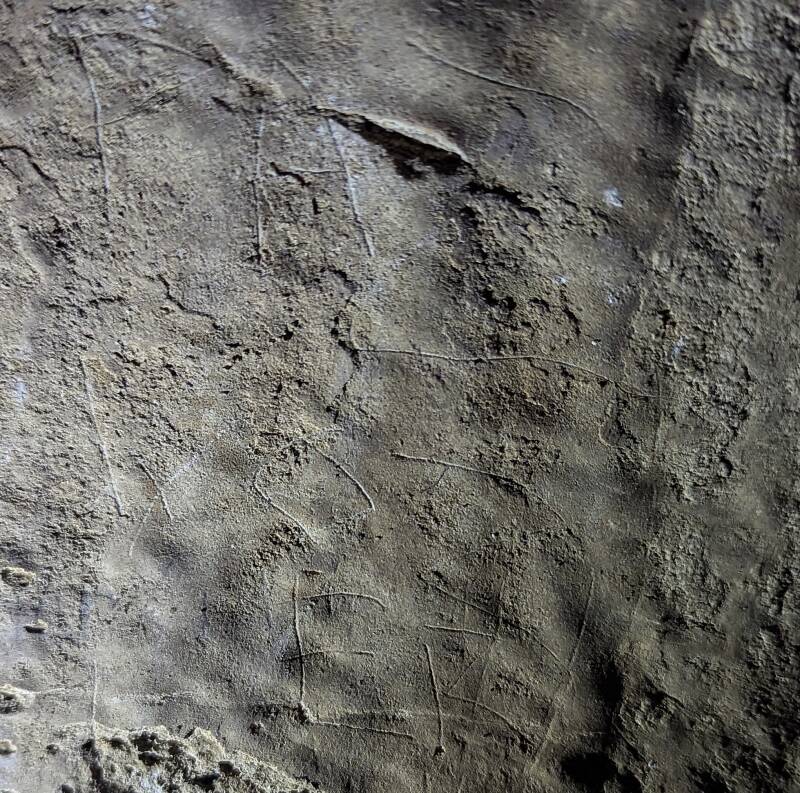
Photo below: another view of the symbolic inscription in the dangerous area of Jubilee Cave, I also discussed this carving (as well as other carvings) and included different, equally important, photos (of the carving below and others) of it, in my other blog post about this cave on this website, the link to which is: https://www.languages-of-linnunrata.co.uk/3056851_the-first-article-on-carvings-within-jubilee-cave-also-published-on-the-11-03-2026 , and the title of which is: The first article on carvings within Jubilee Cave, also published on the 11/03/2026 . As can be seen in the photo below, showing the carving from a new angle, the "500"-like marking doesn't look that much like a number 500 in the photo below either, and visible in the photo below is what appears to be another line, linking the "5"-like symbol to one of the very square-looking 0-like symbols and then back to the 5-like shape, or "not 5-like" shape. Below this can be seen the other markings, including the circle-like marking and a square-like marking to the left of it.

The fourth set of symbols or carving I would like to discuss and show is another within the small, narrow, but quite tall cave slightly to the north of Victoria Cave by about 15 metres, and slightly lower down the scree slope than the entrance to Victoria Cave is. The carving visible in the images discussed below is close to some of the VV like-markings or as Tom Lord later described them after seeing my photos specifically of those symbols - a possible set of "butterfly mark" apotropaic symbols. But these are only just visible in the upper left hand corner of the photo below, with the photos below focusing instead on the Latin letter or Rune-like markings shown only in the photos below, and discussed in more other details in the photo descriptions above each photo.
Photo below: as well as the possible butterfly marks in the upper left, the central and more right parts of the image below, show a confusing range of markings, the first of which resembles a Latin, or, even more closely, a runic R- symbol, and moving right, followed by another vertical line, interfacing with an upside down V-like symbol above it, to the right of which are more unclear markings alongside what are probably erosion marks, making it very hard to see. The markings in this area appear to be a vertical line, with a possible line coming off the bottom and going up to the right, which forms onto a larger "roof" of the possible symbol. In a sense the symbol looks like a capital D, but I am unsure. To the left is what appears to be a more horizontal line, perhaps on a more vertical line, and in the upper middle far right is what looks like a smaller possible W symbol, similar to the possible butterfly-markings in the upper left of the image.
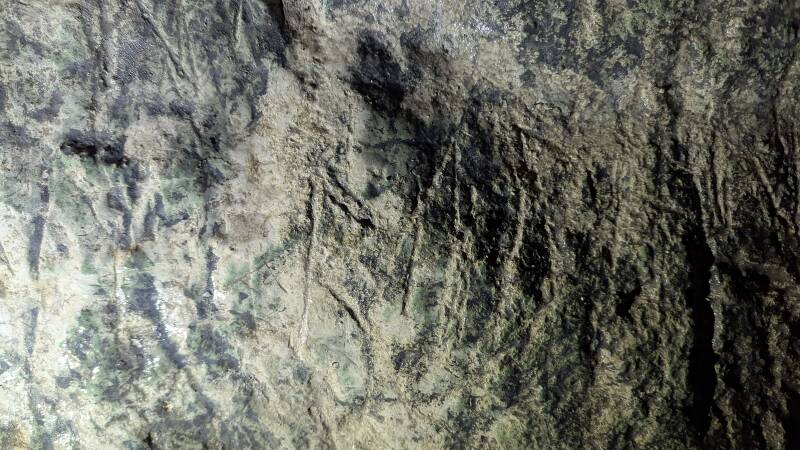
Photo below: another view of the same carving shown in the photo above, in the photo below, the vertical line immediately right of the Latin or Runic R, also seems to have a line coming off the lower right and going upwards and right, making this, combined with the vertical line, makes it appear also somewhat akin to a ᚴ rune. Note also the upside-down V shape seemingly superimposed onto this other ᚴ-like symbol, to the right of which again is another symbol, akin to an incomplete capital Latin D, or even to a wynn-rune with an extra line going from the bottom and up to the right, to the right of which is the possible vertical line symbol with an almost horizontal line across the centre, making it almost akin to an N rune, although it most definitely isn't an n rune, ᚾ, to the right of which is what could again be another W or butterfly apotropaic marking. Note also that the K-rune like symbol to the right of the R also could be part of an abstract H symbol, although this is again unlikely I think. Note that the K-like rune symbol may only appear thus because of a natural crack intersecting with the vertical line, but I am unsure.

I hope that this article was an interesting read. I would like to thank Tom Lord, an archaeologist who has done a lot of work on Victoria Cave, for explaining to me about the existence of these markings at the back of Jubilee Cave and for more generally putting me in touch with the subject of these markings existing in Yorkshire Caves. I hope that this article (and my others on these & related subjects) helps to encourage further research into these markings and to help ensure their protection. This article/blog post is dedicated to the ancient ancestors of the Malham upland areas, and to all who call it home there, and to all who simply love it there.
Add comment
Comments