This article was written and published by Linden Alexander Pentecost, and published on the 29th of March 2026. This article is unrelated to and separate from any and all of my other publications. No AI was used in this publication. This publication was published in the UK and on this UK website, I the author am also from the UK and am a resident of the UK. The photos were also taken by the author and have not been published before, the photo descriptions in italics also contain information not in the main text. Note that the discussions involving witches and labyrinths and Blå Jungfrun in this article are also unrelated to other things I have written recently which involve witches, or which are connected to witches, labyrinths and Blå Jungfrun. This article contains 2 photos and a total of 2525 words. I hope to publish more in the next few days, on this and on other websites. Note I also published an unrelated article on this website yesterday which pertains to a labyrinth carving. Note I also published other information about Blå Jungfrun in an unrelated Silly Linguistics article as well as other information in a recent PDF book. Note that the day after publishing this publication on this page, this was published on the 29th of March 2026 - on the day after publishing this publication on this page, I will publish an unrelated article about a Cumbrian runic inscription, which will be published on a differet website.
The island of Öland off the coast of Sweden, and in the Baltic Sea, is a truly fascinating island. The island is full of ancient, prehistoric sites, from forts built of drystone walling, to Norse ship burials, standing stones, barrow mounds, chambered cairns, dolmens, passage tombs and stone circles. Öland actually seems to be the easternmost extremity of the passage tomb building technique, with passage tombs being found in Iberia, Ireland, Wales, occasionally in Scotland, France, Germany, the Netherlands, Denmark, Southern Norway and Southern Sweden, with Öland seemingly as the easternmost point.
The landscapes of Öland are not typical to Sweden. In a sense, they resemble some of the more agricultural areas of southern mainland Sweden, but Öland is particularly characterised by its sedimentary rocks, and its flat, limestone landscape, some of which is limestone pavement akin to that in Yorkshire and Cumbria in England. This is known as the Alvar Öland also possesses many windmills, and the landscape is generally very beautiful. Clearly, this island was very important in prehistoric times, although its importance in the ancient world is poorly understood.
I sometimes ponder at just how the megalithic sites in the Germanic countries of Holland, Germany, Denmark and Sweden, are so rarely visited by megalith enthusiasts. These sites are without doubt some of the most impressive and beautiful in Europe, and they show a longevity and continuity of megalithic architecture. The archaeology of Öland goes back at least as far as the Mesolithic period, and it is interesting that the Mesolithic village at Alby for example, resembles some of the limestone landscape archaeological features in southern Cumbria.
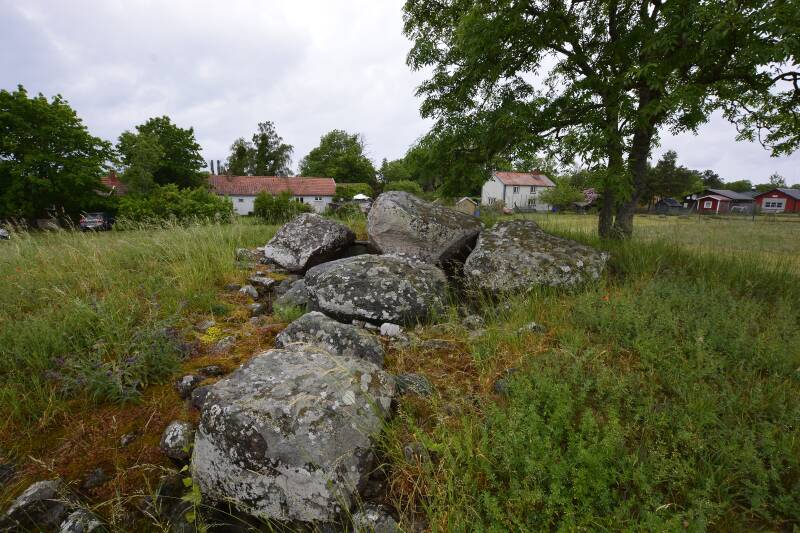
Photo below: the Mysinge Gånggrift 1 Passage Tomb, not to be confused with the Mysinge passage tombs 2 and 3, nor to be confused with the Mysinge Hög barrow cemetary. These are, as I mentioned, the most eastern passage tombs in the world, at least in terms of the typical definition of a passage tomb. The island of Gotland further out into the Baltic does not contain passage tombs, but does contain other types of megalithic site. The passage tomb shown in the photo below is a little different from those elsewhere in Southern Sweden, Denmark, Holland and Germany. In England the closest thing to these type of tombs that we have specifically are perhaps the Medway Megaliths, although these are not described as passage tombs as such, yet their design resembles them and has similarities to the passage tombs in Sweden, Denmark, Germany and Holland.
The island's Mesolithic history may I think connect in some way to the legends of witches, associated mainly with the island of Blå Jungfrun, a small, and very mysterious island to the west of Öland. I have described Blå Jungfrun elsewhere, but there is more to discuss here. The island was also called Blåkulla, which is believed to be a more sacred, and older name, which people even feared to speak, hence why the name Blå Jungfrun became more commonly known. Both names mean approximately "The Blue Virgin" or "The Blue Young Woman". This name is very mysterious to me, and seems to be naming the Goddess of the island rather than being a physical description of the island in any sense. The use of the word blå - "blue", also implies perhaps that this goddess had a blue, death-like appearance, as sometimes "blue" is used in this sense, particularly in older folklore. This might imply that the Blå Jungfrun goddess is associated in some way with death or with the world of the dead. This mythology is not I think Germanic per-se but belongs I think to much older cultural and linguistic threads of history, possibly connecting back to the Mesolithic time, of which there is evidence on Blå Jungfrun.
The labyrinth on Blå Jungfrun is known as Labyrinten, "The Labyrinth", clearly a more recent name, I am not sure if there were once older names. Other labyrinths on the nearby island of Gotland do have names, such as the Fröjet Trojaborg and the Folhammar Trojaborg. There is some speculation that these labyrinths are connected to the world of the dead. I also think that these labyrinth structures are likely connected to the famous "witch cultures" associated with various parts of Northern Europe, cultures which do not appear to be Norse, nor Sámi nor Finnic per-se, although these labyrinths and legends of witches are found in Sámi and Northern Finnic areas. Note that a person must NEVER take any stone from the island of Blå Jungfrun, as this will cause bad luck, as has been well documented.
Blå Jungfrun has a labyrinth, a famous labyrinth, and the island is very much associated with witchcraft, with Blåkulla also being a "place" in Swedish mythology, a mysterious island where witches gathered to fornicate with the "devil" or rather, fertility deity. Witches would often travel to this island using flight, and it is also important to note that Blåkulla was seen as both the physical island of Blå Jungfrun, and as a more ethereal island in another world that witches would travel to. The metaphysical or ethereal version of the island is described quite differently. Physically, the island is very rocky, and "mound-like" in shape, consisting largely of solid rock, and with some shrubby forested areas and sea cliffs. As well as the labyrinth there are other archaeological sites, including two caves, one of which may have been used for singing and rituals, with acoustic properties. These sites are likely Mesolithic in date.
The ethereal Blåkulla was on the other hand, described more like an endless meadow, in the centre of which is a large house, where the devil lives, or, to give an older explanation, where the left-hand-path fertility deity lives (this is my interpretation). This is a little akin to how other mysterious and floating islands are described in legends, which I have discussed in detail in other publications. This idea of Blå Jungfrun having a sort of endless meadow though, is uniquely interesting, and it reminds me of some the imagery invoked in the fictional book Inverted World by Christopher Priest, wherein is described the perception of a world that becomes dimensionally more "flat", the further one is behind the story's moving city, which moves on Wales. When the main character has gone a certain distance behind the city, the landscape becomes infinitely flat. I wonder if Christopher Priest was picking up on something about reality which pertains to how the particular worlds of the dead I have discussed in this article "behave" in terms of their dimensional nature when perceived by us. In many senses, the magic of certain witches is implied to be something that twists the physics of normal reality, but is this really a twisting of physics or just a different kind of physics not perceivable to us? Similarly, whilst certain witches and witch goddesses are associated with disease, is this disease, often connected with warts, also a kind of perversion or twisting of reality, into a place where the laws of physics are different? Or again, can it be argued that this "disease" element associated with witches, only seems like a twisting and perversion because we cannot properly perceive it, and because their "reality" is true alongside our own, more right-hand-path spiritualities?
Similarly, this idea of witches "flying" is not necessarily about physical flight, but is perhaps more a way that witches used to "bend" or rather, to see differently space and time, and so to move through them in a different way. I remember I once, when I was 23, had a potent dream in which I was with flying with a group of witches over a North Pennine English landscape, akin to Pendle Hill, known for its witches. In my dream, I was gathered with the witches, and then we all got onto our broomsticks. Some of them flew ahead of me, and I remember that they seemed to be flying along specific "lines" in the air, ley lines, or something akin to that, perhaps. I remember that flying the broomstick was strange, because there was no kind of engine or power source, rather, the broomstick "moved" when I observed where I was flying to. The more clearly that I could "see" the next crag over the next hill, the more quickly I moved there. I am not saying that this dream gives an accurate representation of the shamanic-like journeys associated with witchcraft on broomsticks, but nevertheless, the dream showed me a form of movement in time and space which our modern culture doens't really have a complete idea of - yet it bared a lot of similarity to the mythology surrounding how witches move, and also to the implications that the spiritual dimensions associated with some witches are very different from our own world, and in my dream, I was moving in one of these dimensions. The light was different. It was connected to this world, just as the mountains like Pendle Hill, and the island of Blå Jungfrun are connected to this reality, but I was not moving in this reality in my dream, even if I may have been able to see Pendle Hill in that other reality too.
The island of Holmengrå north of Kirkenes in Finnmark, Norway, also has a labyrinth, and there are other labyrinths slightly to the west and along the coastline before one reaches the Varanger Peninsula, or Varangerhalvøya. There are other labyrinths in Sápmi, including on the sacred mountain of Saana, these I have discussed elsewhere in one of my recently published PDF books. The presence of labyrinths along the north coast of Finnmark, also puts these Finnmark labyrinths into the context of the witches who reputedly lived in Finnmark in the past, and the Gandfinner, a people I also discussed in an unrelated recently published PDF book. The witches of Finnmark became particularly associated with Vadsø, itself a small, northern island. Which begs the question, are these labyrinths associated with some kind of Barents Sea, and Baltic Sea witch culture? It is also important to note that both Blå Jungfrun and Vadsø were seen as portal islands, places where some kind of underworld flowed through into our world. It is also important that in Finnish mythology, the realms of Tuonela and Pohjola are located in the "northernmost" parts of the World, and have to be accessed by water (akin to islands like Vadsø and Holmengrå). The goddess Luohi, a goddess of disease and of the world of the dead, is the ruler of Pohjola, and she herself is associated with witchcraft. Furthermore, Scandinavians in general, and Finns, often associated Northern Finland and Finnmark with witchcraft and sorcerers, and I do not believe that they were describing the Sámi or northern Finnic speakers, but were I think instead describing some other culture, a culture of witches. The presence of labyrinths around the White Sea is also interesting, and perhaps implies a connection with the "Bjarmians" who were once in this area. I have written about the Bjarmians and their language before, including in the article that the following link leads to: https://www.clwaideac-na-cuinne.co.uk/articles-focusing-on-etymologies-from-july-2025-onwards-pages-e1-to-e28/e1-new-interesting-etymologies-noticed-july-2025 .
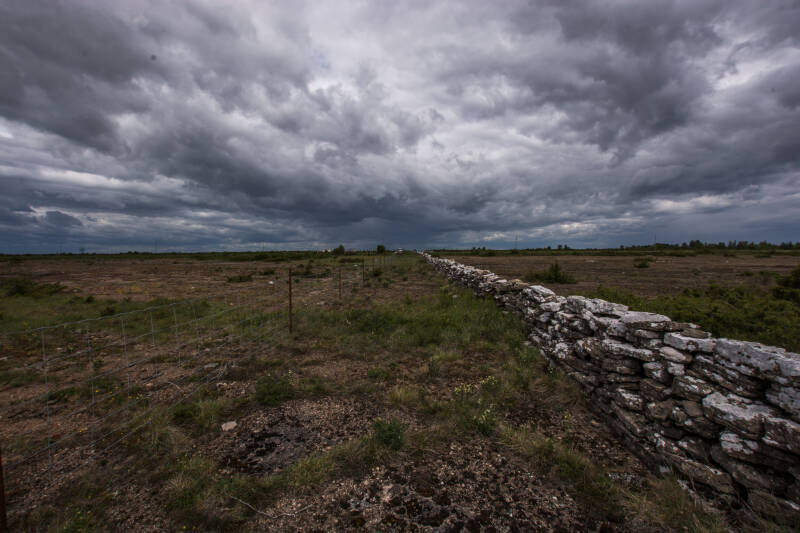
Photo below: an "alvar" landscape in central Öland, with stormy, thundery summer skies above. This image for me invokes both the beauty of Öland as an island, and also invokes the image of witches fying across this sky and to the island of Blå Jungfrun. Blå Jungfrun indeed possesses a lot of beauty, and something about these landscapes feels very ancient. In summer especially, one feels on Öland the same presence of the skies, sea and the flat but beautiful alvar nature, and this nature sings the same song, and is illumated by the same light, with the same horizons, as it was thousands of years ago. And one can feel this very strongly. The drystone wall going towards the horizon also may be very old, or in part very old, and the horizon of this flat landscape also makes me think a little of Blå Jungfrun, or rather how Blåkulla is described in the ethereal sense.
Öland is a fascinating place, and it and Blå Jungfrun open up a whole myriad of mysteries about the ancient Baltic, and Barents Sea coastlines. Blå Jungfrun and Öland, and all these sacred islands especially - also deserve great respect from us. A runic inscription on Öland mentions the word "draug", attesting to the power of the realms of the dead as they intersect with these lands. The island of Blå Jungfrun has repeatedly had stones returned to it, which visitors had taken from the island. The stones were returned because of the curse that people experienced having taken things from the sacred island of Blå Jungfrun. I never had the chance to visit Blå Jungfrun when I was in Öland, but ever since I heard about the island in around 2016, it has left a strong impression upon me. The island is obviously associated with dangerous curses and the very real intensity of the dimensions of the worlds of the dead - but it is also a part of the creation of the Great Mystery, I do not believe the island is bad or evil in any way. I discourage anyone to cause insult or disrespect of any kind to this island. And the island is also a beautiful and magical place - and I do love its magic.
I hope that this article was interesting. It is dedicated to the Blå Jungfrun.
Add comment
Comments