Written and published by Linden Alexander Pentecost on the 28th of March 2026, this article/blog post is unrelated to and separate from any and all of my other publications. No AI was used. This article/blog post was published in the UK on this UK website and I the author am also from the UK and am a resident of the UK. The two photos in this article were also taken by me and their descriptions above are also important. Note that yesterday I published an unrelated PDF-only book via a different website. This article/blog post on this page contains 1109 words.
The area around St Patrick's church at Heysham, Lancashire, represents an important archaeological site, spanning over ten thousand years. I have written much about it elsewhere, but in this article I want to discuss the possible symbolic carvings that can be found there. The known symbol, a labyrinth symbol, is found on the shoreline, a short distance from St Patrick's Church and the rock cut graves, and other features. This labyrinth is thought by some to be of more recent origin, and I myself really cannot comment on its age, but it is also possible that the carving is prehistoric, and labyrinth carvings in England are not that common. Note that I discussed labyrinths recently in an unrelated book (not in the book I published yesterday wherein I discuss other aspects to ancient symbols, related topics & many other things). Note that soon (I am not yet sure when) I will be publishing an unrelated blog post that looks more into labyrinths in general whilst discussing some islands of Sweden, which I also briefly mentioned in one of my recently published books.
The labyrinth symbol at Heysham is sadly, now, barely visible - which is just another symptom of how badly we treat our ancient carvings in Britain, i.e., one almost gets the impression that nobody "high up" cares about them. One of the things about Heysham is that archaeologists and historians are mainly focused on the Christian, or, presumed Christian aspects of this site, and the fact that people were using this site 14,000 years ago is barely discussed, or seen as being in connection with other archaeological features. Another friend of mine, Dawn Hilton, who is also interested in white witchcraft, is also fascinated by Heysham (Dawn is not the white witch, the discussion with whom I discuss in two recently published books, one of them yesterday).
I have focused on the "bird head carving" found here, thought to be Christian, but which looks more like a thunderbird, the rock cut graves, and other aspects to this site, and have published about this in many places, but Dawn has noticed how many of the rock formations at this site also resemble animistic spirit beings, with some of the rock formations appearing like serpents, one appearing like a large turtle, and another like the head of a raven. Some of the walls around these rock features, thought to be part of a garden, could also I think be much older, and mean that this crag in essence has a series of "steps" leading up to it, almost like the steps on a pyramid. Dawn also believes that the naming of the church as St Patrick's church is also in connection to the serpent-like rock formations visible below the old church and not far from the rock-cut graves.
I personally think that the rock cut graves would have been used for "sky burials" and not as permanent burial sites, and that the thunderbird carving may connect to the sea eagles in our physical world, that would pick at the bones and in part "carry" the peoples' souls to the sky world. The serpent-like rock formations almost beneath these rock-cut graves, may I think represent the idea of the serpent or wyrm "consuming" people and taking another part of their soul into the underworld. The turtle-shaped rock formation I think could represent the earth or the earth mother, the sacred mountain that rises from the primordial ocean. The raven-shaped rock formation could represent a trickster figure associated with death, similar in a sense to Odin (note that Odin has two ravens, and that I discussed Odin in a book published yesterday) and/or to the Raven figure in the mythology of the Pacific Northwest of the Americas. In a sense, the site could be thought of as a temple and sanctuary that honours the primordial gods, and which honours the spiritual self's journey of transformation. These are of course just my opinions and interpretation of this site. It was Dawn who pointed out to me the raven-like rock formation, the serpent-like rock formations, and the turtle-like rock formation.
Below are two photos, each with a description above it. The first photo shows the labyrinth on the shoreline, the second photo shows two other worn, possible carvings, which I think I photographed also on the shore and close to the labyrinth carving, if I am not wrong, but I cannot remember exactly where on the shore they are located.
Photo below: the labyrinth carving on the shore at Heysham, now barely visible sadly. Nevertheless the concentric circles of the labyrinth can still be seen quite clearly from this angle. The labyrinth in the photo below is outlined inside a black oval.
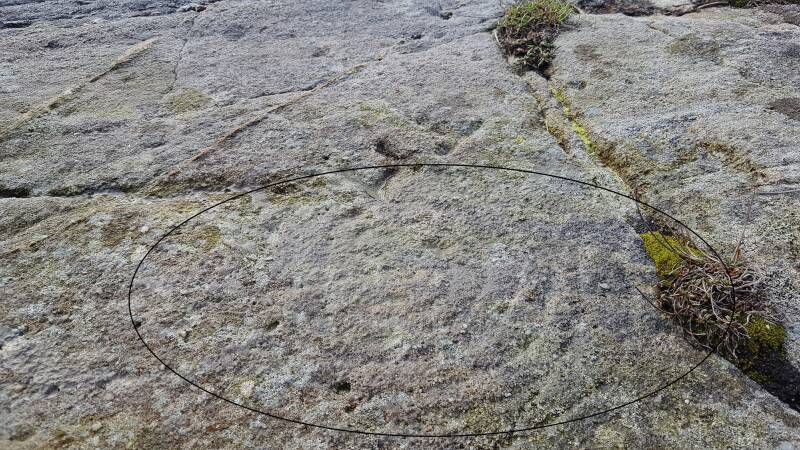
Photo below: four other possible carvings close to the labyrinth, which are outlines inside black ovals and a white oval for the one I am less certain of. The possible symbol furthest right resembles a sort of V mark, the middle symbol in a black oval looks like a triangle symbol (I have discussed others elsewhere recently), and the symbol outlined in a black circle and furthest left, looks akin to a sort of swirling vortex symbol, a little like the Hannunvaakuna symbol or even to a clover symbol (I also discuss more on the flower Pictish symbol in a part of a book I published yesterday). The possible symbol outlined in the white oval I am less sure of, but it could be a sort of fish-shaped symbol, which is not to say that it actually is representing a fish.

There is a lot more on the ancient history of Heysham which has not yet been discovered. The precise nature of this ancient site, or rather, series of ancient sites, remains a mystery. I hope that this article was an interesting read, it is dedicated to all that I love. Thanks for reading.
Add comment
Comments