Written and published by Linden Alexander Pentecost, this article/blog post was published early in the morning on the 11th of March 2026, after a different blog post was already published early this morning, and another on the 10th of March 2026. This article/blog post, like the other published on the 11/03/2026, was edited with important updated on the 12/03/2026. No AI was used in this publication nor in any of my written works. This article/blog post was published in the UK, only on this UK website, and I the author am from the UK and am a resident of the UK. This article/blog post on this page is unrelated to and separate from any and all of my other publications, including others I have published recently and before on other ancient carvings in Yorkshire caves & is unrelated to and separate from all other works, including those recent and longer ago which cover ancient writing in Scotland and elsewhere etc. I will also publish more unrelated different words with different examples of these symbols and more different information in the near-ish future. The 5 photos in this article have also not been published before, and all of the photos and the text in italics above them are very important as is the main text of this article. When editing this article/blog post I was originally going to include another photo of the carving that looks a bit like a "500" but I will include another photo in another publication. I will publish some more things in the next week, the first of which will be an article on my newest website (not the website you are currently on) which will be a new article with new information concerning language on the Barra Isles & the Pabbay Pictish stone and other topics. Note that I have briefly mentioned this stone in another blog post recently but in the article I am going to publish I will go into a lot of detail. Note that I also intend to publish more blog posts on this website concerning other Pictish stones, and have already written about them in several places on this blog. This article (the article on this page, not the aforementioned article to be published soon concerning the Barra Isles & Pappay Pictish stone & other topics) contains a total of 2146 words and 5 photos. All my publications are unique and this article/blog post on this page like all other contains that which has never been published before - I have also never discussed this site of Jubilee Cave nor its carvings ever before, in addition. The photos in this article were also taken by me, the author.
Jubilee Cave is another interesting cave not far from Victoria Cave, in which has been found evidence of Mesolithic, Neolithic and Romano-British period activity, with at least some Neolithic and Romano-British period human remains having been found there. The cave also contains a number of carvings, largely of unknown date and origin, many of which seem to be supernatural protection marks. One cannot help but to wonder what relationship there might be between these carvings and the Neolithic and Romano-British period burials. I initially thought that I perhaps would not publish about these carvings with giving exact reference to the cave, but due to the in some cases very-recent graffiti in this cave, which in some cases has confused potentially very-old carvings, I think it better to be open about the locations of these carvings, as this will help to let others become aware of them, and, hopefully, could set in motion some process that makes the public more generally aware of them, thereby hopefully discouraging any further graffiti in the cave. I think it is of importance to mark and to take note of precisely where these carvings are, and potentially - if this can be arranged with the relevant authorities, to place laminated paper signs around or outside the cave to help others to become aware of these markings. I hope that the caves do not ever have to be gated, but if, God forbid, any further damage occurs to these markings, this may be an option for the relevant authorities to consider.
Jubilee Cave consists primarily of three interconnected passages, the carvings, are to my knowledge, only present in two main areas, one of which is in a side passage (which is also in danger of collapsing), whilst other carvings exist towards the end of one of the passages. It seems that in the first area of carvings (which I discuss in this blog post), the carvings are located approximately above where one of the Neolithic burials seems to have taken place, and one cannot help but wonder, again, if there is some relationship between the two. This is not to necessarily say that the carvings are Neolithic, I am doubtful of this, but later indigenous peoples, into relatively modern times, could have been aware of the presence of burials in this cave, and to other aboriginal peoples having been there, perhaps even with some knowledge of continuity, in which case the markings may have been connected to the idea of keeping certain spirit beings inside the caves, and stopping them from coming out. The precise continuity of ritual activity is uncertain here, and it is noteworthy that Neolithic people made similar markings around some of their burial chambers, therefore we need not necessarily think of these markings as being to ward off an ancestral force that later people did not understand - I think it more likely that these markings belong to a continuity of more specific rituals and magical, symbolic phrasing. We know also that Neolithic people often had a rather alien relationship with their dead, compared to how people related to the dead in later cultures. And it is uncertain of course to what extent these more unusual Neolithic views might have continued into later times - but there is some evidence of this, as I have discussed elsewhere, particularly with regard to the type of magic associated with "witches" in the past few hundred years.
I am also curious as to why in certain instances there seems to be prehistoric activity in caves in parts of Northern England, during the Neolithic and Iron Age periods, and sometimes after, and sometimes before the Neolithic, yet there are instances where no Bronze Age activity is recorded (some caves in Northern England did have Bronze Age activity though). But the point is, why would some caves, like Jubilee Cave, seemingly have a gap between the Neolithic and Iron Ages? One explanation I have come across for this, is that during the Bronze Age, the changes which took place meant that some peoples would have abandoned these ancient sacred sites, with a kind of later "return" to these ancient sites taking place in the Iron Age. But, an alternative, albeit more controversial idea, would be, as something I have briefly gone into in other contexts elsewhere - the idea that the archaeological features we identify with the Neolithic and Bronze Ages don't necessarily represent just periods of time, but could represent different cultural groups that coexisted, but which came into, and out of the archaeological record at different times, for different reasons. There are a whole many levels to this, but one aspect is that the Neolithic peoples in this part of Yorkshire did not necessarily "become" or "become replaced by" Bronze Age peoples, instead, the peoples we identify with Neolithic culture may simply have taken a back step in some areas, and in with in some areas their primary cultural works seeming to phase out of the timeline and out of our perception in the archaeological record, only for them to later manifest at other periods. There are also other aspects to this, for example, if we consider that there have always been these distinct cultural strands in Ancient Britain, then using particular manifestations of culture to date certain sites, may not always work.
The same issue occurs for example with many of these ancient markings, including for example cross symbols and VV symbols, and also with for example Pictish carvings, even runes and Ogham and the like. Since often these things are assumed to be tied to certain periods, their presence is sometimes used to date sites to certain periods, but in some cases it is near impossible to date these things through scientific methods, so they, as manifestations of culture and symbolism are often dated upon where in the timeline we tend to imagine these manifestations of culture and symbolism coming from - something which in many cases is perhaps incorrect.
Below are photos showing different parts of the first section of carvings in Jubilee Cave, with descriptions above detailing further important information about the markings and other things visible in the photos. Some of the carvings appear multiple times in some of the photos but all the photos are important because not all angles capture all of the carvings and so photos from several angles are sometimes needed and have been included.
Photo below: some of the possible carvings in the connecting passage in Jubilee Cave. Towards the lower centre left of the image can be seen what looks like a VV mark, two upper parts of which appear to connect to other lines. Towards the centre right is a tall oval shape, which, on the right line forming the shape, seems to go down into a V shape, going up again next to the tall oval shape. Above this is what appears to be two squares with another marking to the left, these two squares and the marking immediately to the left may be the number 500, written in numerals, but I am not entirely sure.

Photo below: another view of the possible carving shown in the photo above, specifically showing the VV shape, drawn seemingly with two parallel lines in some areas, and with marks leading from the top of it. Part of the markings to the left are also visible, as is a part of the "500-like" carving above them, which in the photo below looks to have a sort of border above it.

Photo below: another view of the same carvings, in the photo below, the VV-like markings looks more like a natural marking, but a less-natural looking connecting marking, a little like an upside down U, seems to connect the VV-like marking to the tall-oval marking next to it, in a way not visible in how the tall oval marking connects to other lines in the other photos. Again a part of the possible inscription reading the number 500 is also partially visible above, with the bottom of the could-be 0's and the bottom of the coule be 5 plainly visible.
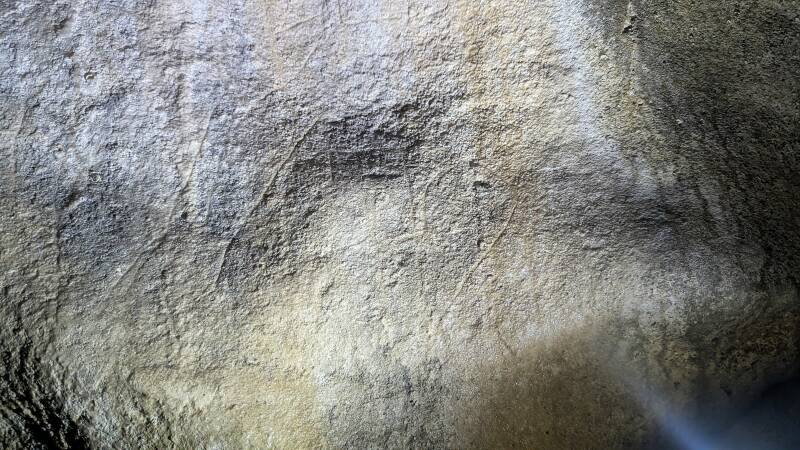
Photo below: various modern pieces of romantic love heart graffiti with what appears to be older marks, located in the same area but on a different area of wall-face to that shown in the photos above and in the photo below the photo below, the markings in the photo below, apart from the romantic love heart symbols and initials, seem to include a clear VV or W symbol towards the bottom of the rockface visible in the photo below, plus what may be another marking to the right of the VV marking.

Photo below: a self portrait I took, with myself looking towards the markings in this section and illuminating them with the torch, in part to show their scale and location, the backlighting also helps them to show up via their shadows. Note that this part of the cave is quite dangerous and there are multiple large pieces of stone which have slipped out of the roof and onto the floor, with other blocks in the ceiling that will eventually come down - subsequently I really shouldn't have been here without a helmet, although to be honest I do not think that anybody should linger in this passage for any length of time. This is one reason why I think the photos showing this part of the cave and these carvings are important.

I hope that this article was an interesting read, this article is dedicated to my grandad, a great admirer and adventurer of caves who sadly passed away very recently. I miss him greatly. This article is also dedicated to the ancient peoples for who Jubilee Cave served as ancient and sacred place for many, many thousands of years. I will be covering more examples of and information about the carvings in this cave in future publications, including with some of this being published on this website. Best wishes to all and thank you for reading this blog post/article.
Add comment
Comments