Written and published by Linden Alexander Pentecost on the 11th of November 2026. This article/blog post was updated on the 12th of March 2026, as was the other blog post published on this website on the 11th of March 2026 (published after the one on this page). The photos were also taken by me, Linden Alexander Pentecost, and have not been published before, this article/blog post in general has not been published before & is unrelated to and separate from any and all of my other publications. The photos are also important as are the areas of text in italics above each photo which contain information not in the main text. This article contains 3 photos and it contains 2029 words. No AI was used in this publication nor in any of my written works. This article was published in the UK, on this UK website and I the author am also from the UK and I live in the UK. 2 of the 3 photos show different views of the same site and their descriptions above each describe different aspects to this site and related interconnected things.
The Isle of Skye is one of the most widely visited of all the Hebridean Islands, and compared to other islands I have not discussed it that much. The Gaelic dialects of Skye are arguably the closest to what the standard written form of Scottish Gaelic represents, although Skye dialects of Gaelic do have their own unique features and pronunciations too. Often the dialects of Skye correspond to those of Wester Ros. In other senses, some of the Gaelic dialects of Skye corresponds to certain features of the North Argyll dialects, particularly those of Moidart, Eigg and Canna, although Skye Gaelic lacks the Argyll-dialect features and other specific features found in the Moidart, Eigg and Canna dialects, the connection between Skye Gaelic and those dialects nevertheless implies to me some ancient connection between the ancient people of Moidart, Canna and Eigg, and those of Skye.
Skye has a diverse number of archaeological sites, and has a high concentration of brochs, many of which are in a quite good condition. There are also brochs for example in many areas of Wester Ros, but there are not many brochs in Moidart nor in the Small Isles to my knowledge. Perhaps these commonalities in broch building between Skye and Wester Ros in a sense pertain to the similarities in the Gaelic dialects, whilst the similarities between Skye Gaelic and the Gaelic of Moidart and the Small Isles could correspond to other cultural and linguistic levels of prehistory, although the two are doubtless also interrelated.
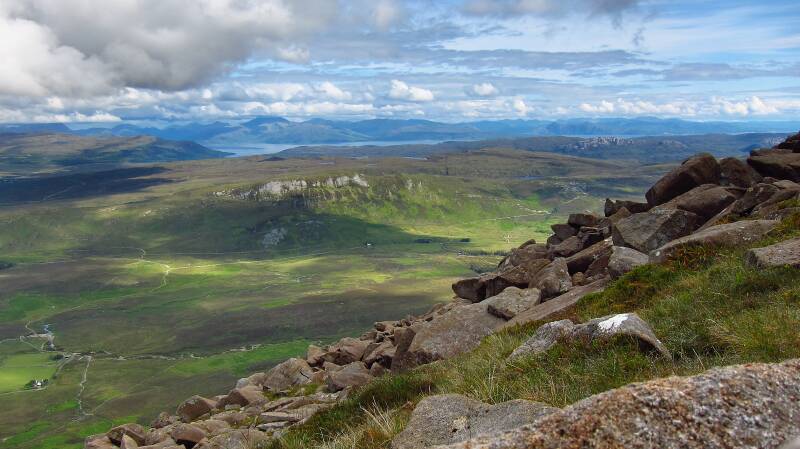
Photo below: a view from Beinn na Cailleach near Broadford on the Isle of Skye. Note the large rocks - some people believe that these have in places been arranged to form part of the cairn atop the mountain. Note the beautiful view and scenery from this sacred site, with landscapes of eastern Skye and the mainland visible, alongside part of the Sound of Skye.
A thing I came across recently was the mention of a mysterious tribe who lived on Skye in the past, known as the MacQuithens or as Clann Ic Cuithein. The etymology of this root cuithein is also interesting, especially as it bares some similarity to the word ciuthach and to the sgith- root in Gaelic Sgitheanach - “Skye”, and to the name of the goddess Scáthach associated with Skye, and to other words. If this tribe were in some way connected to the ciuthaich then it is interesting that the ciuthaich are often associated with the sea and with sea caves, and that Clann Ic Cuithein are associated with a sea arch on Skye known as Eaglais Bhreugach or the “False Church”, something that may be similar to a Sámi sieidi in function. This site, Eaglais Bhreugach, is associated with a kind of ritual known as a taghairm. This word is usually associated with a horrific supposed ritual which I believe has tainted and mislead scholars into misidentifying what a taghairm originally was, and we also have to consider the possibility of Christian propaganda in terms of how the idea of the taghairn was described. Nevertheless, the taghairn associated with Eaglais Bhreugach on Skye was not sinister, and apparently involved taking the seer by the feet and arms, and carrying them to a boundary stream, and (gently) bumping them against the bank, until sea creatures came from the sea to answer the question of the divination. According to The Gaelic Otherworld by John Gregorson Campbell, this was likely the form of the taghairm performed on Eastern Skye by the MacQuithens, at Eaglais Bhreugach.
This method of divination is of great interest, especially as it involves some connection with the sea, and of sea creatures in some way answering the request for divination, although how precisely the sea creatures conveyed the divination is not specified anywhere to my knowledge. This could I think connect with the ciuthaich and with the Mesolithic coastal ancestors of Scotland, who often built shell middens, and perhaps with many of the probable (in my opinion) non-Indo-European Gaelic words for sea creatures in Gaelic. It is also somewhat curious for me personally, because about 7 years ago, a woman I know told me that she had a dream about me, in which she saw me meditating, whilst naked. The fact I was naked in this dream is not really relevant, unless, on a higher level this dream represented that I was consulting a female sea goddess in some way, but the idea of meditating in a rockpool and staring into the water, into the realm of the sea, is somewhat akin to the idea of consulting small sea creatures in a coastal environment as a form of divination. After my friend told me about this dream, I did, when on an isolated bit of Islay’s Coastline, and hidden from view at all angles, meditate naked whilst sat in a rockpool. It was a special experience, although for obvious reasons I was very conscious of the tide, and doing this kind of meditation could potentially be really dangerous if someone performs it alone and without another person watching to check on the tide and waves. Freak waves are also a potential danger when spending time around rockpools off Scotland’s coasts.
It is also interesting I think how the MacQuithens of Skye are described only in vague terms, but are often described as being unpopular or disliked in some way, which I think could be an indication that this tribe belonged to earlier groups of indigenous people, possibly connecting to ancient localised forms of the Gaelic language and of previous languages, and may have been disliked by some other Gaels as they were not in a sense Gaels, and could have belonged to earlier cultures who for example did not see tribal and land divisions in the same way. Similar peoples, as I have discussed elsewhere, may have lived on the Small Isles until relatively recently, and the aforementioned peoples on the Small Isles and on Ardnamurchan were massacred by the bigger clans, so again we see this dislike of these smaller, more mysterious clans, by the later larger, entirely Gaelic-speaking clans.
Photo below: the Dùn Beag broch near Struan on the Isle of Skye, note the impressive masonry, which in some instances comes to resemble polygonal masonry, although no brochs seem to have true polygonal masonry. The Nuraghe structures in Sardinia also contain what is almost polygonal masonry.
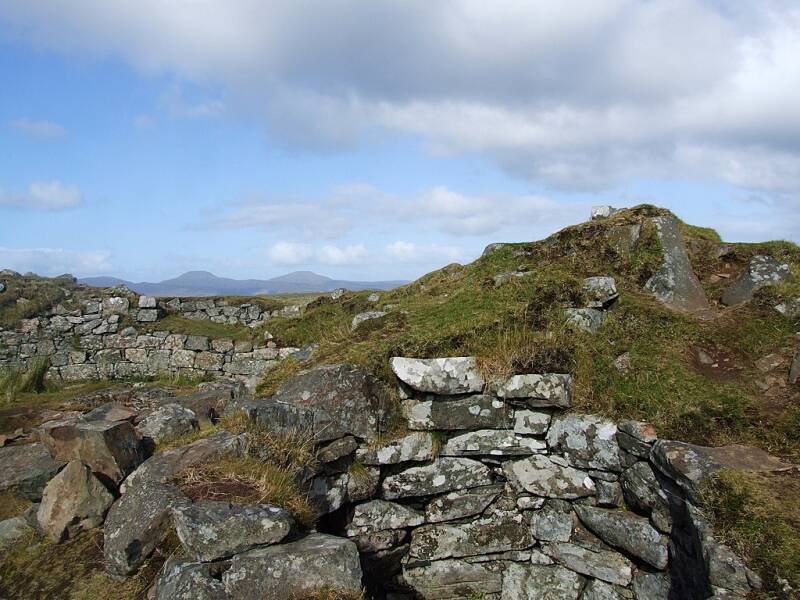
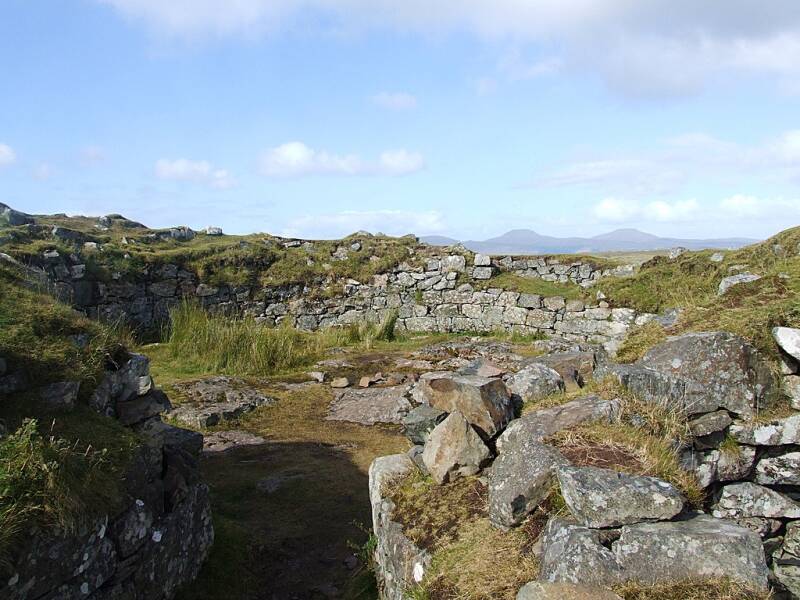
Photo below: a different view of the Dùn Beag broch near Struan on Skye, the walls are actually a fair bit higher when seen from outside the broch, whereas from the view shown below, the walls appear much lower. Mountains can be seen in the distance. The broch is not located far from the islands of Wiay and Tarner, and these islands must have been known and important to the builders of Dùn Beag, and the islands would also likely be prime locations to look for evidence of the ancestors to the broch builders. The etymology of Wiay is also interesting and is likely related to the island name of Fuiay (Fuidheigh) in the Outer Hebrides.
Another curious aspect to Skye’s ancient peoples and animistic beliefs concerns the mountain of Beinn na Cailleach close to Broadford. There are two mountains of Skye which bare this name, but here I will focus on the Beinn na Cailleach close to Broadford. I have climbed this mountain once, when I was 19, but at the time I did not know about the significance of the cairn on the mountain’s summit, nor about the mountain’s spiritual associations in Gaelic oral history. The name Beinn na Cailleach means “Mountain of the Hag”, often in reference to a witch or a supernatural female figure of some kind. The goddess Scáthach is also associated with Skye, and the Isle of Eigg is associated with giant warrior women, to name some other examples that I have discussed elsewhere in detail. We see similar associations surrounding Beinn na Cailleach near Broadford, with some accounts connecting the mountain with a Norwegian princess called Saucy Mary, a legend which appears to connect the goddess of the mountain to a (pre?)-Norse Scandinavian connection, with the name “Saucy Mary” perhaps connecting the goddess of the mountain to fertility, and indeed the mountain does in many ways resemble a giant woman’s breast. Another legend about the Cailleach associated with the mountain, talks of a giant woman in the days of Fingal. The giant cairn upon the mountain reminds me somewhat of Maeve’s Tomb in County Sligo, Ireland, also associated with an important goddess. I do not think that this cairn on Beinn na Cailleach has been excavated - and I am glad for this.
These Cailleach goddess figures in Gaelic oral history do I think also connect to the earliest ancestors, and to this idea of goddess worship, even sea goddess worship (for example the Cailleach Bheur), and consider also the dream in which a friend saw me meditating naked in a rockpool (possibly) to commune with one of these goddesses, others of which I have met several times in my own dreams. I also think it possible that these “Sea Cailleach” goddesses relate to the shell middens, and to the culture of the ciuthaich, ancient fish traps, ancient cave sites in the Hebrides, and so forth (and to the Eaglais Bhreugach on Skye). They also I think relate to polyandry, and the cultures described in ancient Scotland who were connected with matriarchy and with polyandry. I remember many years ago coming across a fascinating website too, in which a theory was put forth regarding one of the oldest Gaelic goddesses being depicted as a one-eyed, tentacled goddess, who appeared somewhat akin to a vulva and eye with tentacles. I have discussed many other aspects to this elsewhere, but it makes sense to me, even though I cannot remember what the website was called, and have never been able to locate it since. I also feel that the Isle of Skye in particular has an association with powerful female figures (like Eigg, in all fairness), and in my own life I have come to associate both Eigg and Skye with polyandry (and polyamory in general) for various reasons, which I will describe elsewhere at some point in terms of their symbolism and meaning. Polyamory, when I was around 23, seemed to contradict with the Gaelic spiritual values, but actually I feel like the Gaelic attitude towards God and creation also embraces the possibility of polyandry and polyamory - this is at least my personal opinion. I have written about other aspects of this in other publications, including with some of this information published elsewhere on this blog.
I hope that this article/blog post was an interesting read, it is dedicated to the ancestors of Scotland and to all I love.
Add comment
Comments