This article/blog post was written and published by Linden Alexander Pentecost, and was published on the 16th of March 2026. This article/blog post is unrelated to and separate from any and all of my other publications. The photo was also taken by myself the author and the photo description above it in italics contains important information not in the main text, this article/blog post also covers many things not implied in the title. No AI was used in this nor in any of my written publications. This article/blog post was published in the UK and I the author am from the UK and am a UK resident. Nothing in this article, nor the photo, have been published before. This article contains 2404 words. This article/blog post was published just before midnight on the 16th of March 2026. Some of the main text continues after the photo description and photo. I will publish another, unrelated article/blog post on this website tomorrow. Note that I also published another unrelated blog post on this website earlier this evening (also on the 16/03/2026) God bless all.
I am not very familiar with County Durham, and have only been there a handful of times perhaps. In some other publications I have talked about when I visited Worm Hill near Washington & about the Lambton Worm, in what is also historically County Durham. Worm Hill is quite well known in the folklore of northeast England, due to the story of the Lambton Worm (not the same as the Stockburn Worm), the Lambton Worm being arguably more well known. There is also a famous song about the Lambton Worm, which has had a strange, if mystifying connection to my family. My grandad had a friend who he went caving and mine exploring with in the past, and this friend was apparently obsessed with the Lambton Worm Song, and would sing it over and over again, as they explored caves and mines. When I was 18, I heard about this, and started to do the same thing, for whatever reason, on my own mine exploring trips. I remember one memorable early Spring day walking up the Coniston Old Man in Cumbria with a friend, and singing the Lambton Worm song as we explored the various slate mines and the misty mountain outside.
The mythology around these things fascinates me a lot and I have written about it a lot elsewhere. Worm Hill near Washington is also I think a sacred mound, there is a spring there behind it, which no-doubt connects to this idea associating worms/wyrms with springs and with the flow of energy from the earthly "mound". Note that worm/wyrm does not mean like an earthworm, a physical animal, nor is the ancient Anglic idea of the "wyrm" or "worm" describing a reptile or serpent, a "wyrm" or "worm" seems to be some divine being which is in many senses worm-like or serpent-like, but which is not necessarily either. I discuss them a little and other aspects to this in the other blog post published on this website earlier today.
Recently, a few weeks ago, I met somebody from County Durham. After us only speaking for a few minutes, I somehow found myself singing "The Blaydon Races" to her, and a bunch of other people who probably had as little idea what was going on as I did. The person from County Durham didn't even know the song, but she asked me to sing. I wonder if I should instead have sung the Lambton Worm song, probably not though, although it would have been kind of fun to see people's reactions.
Also, I think I have some problems with identifying the Durham accent and dialects. The person I met did not speak the traditional Durham dialect, which is similar to that of Northumberland in many respects, nevertheless her Durham accent contained sounds and intonations historically found in Durham, but which are not really found in the "Geordie" accents to the north. She said to me something about my accent being strange, and so I said to her jokingly and flirtatiously "says you, you've got a German thing going on with your accent, but you also sound Welsh" or something along those lines, to which she loudly laughed and explained she was from County Durham. I don't normally make such statements to people about accents, but when you vibe with someone, and they're already teasing you in some ways, I think it's sometimes okay to tease them back.
I did not meet this person in County Durham, I met her in North Lancashire, but when I did visit County Durham in 2021, and visited Worm Hill, and the Sockburn Region, I did meet a farmer, from the upland, more western parts of County Durham, and I was also convinced that his accent was Welsh. This is pretty interesting, this suggestion that some of the prosodic patterns and intonations historically in County Durham resemble those prosodic and intonation patterns in parts of Wales, and also, Germany. I do apologise to those people of Durham for misinterpreting their accent as being kind of German-like and Welsh-like, but there is no offence intended here, I think the Welsh "sound" in some Durham dialect speakers could pertain to very ancient linguistic influences, whilst the gentler similarities to German prosody and phoneme structure, which I at least, think I have heard, could pertain to the common Germanic and pre-Germanic language features shared with speakers of some Germanic languages across the North Sea.
When I was in County Durham in 2021, I was also involved in looking for springs, and I went to a sulphur spring (a spring which gushes forth water with a higher amount of sulphur than average). This was located in Croft-on-Tees, a place that Charles Lutwidge Dodgson (Lewis Carroll) was familiar with, and I remember hearing it suggested that the sulphur spring in question might have been visited by him, although I think that his connection to the sulphur well specifically is probably just an idea or theory. These sulphur wells are interesting places, and as I have mentioned elsewhere, occur with names containing the *urd- element in certain parts of Scotland, something which can be compared to the Old Icelandic word Uðr, which was another name for the god Odin or Óðinn. I have discussed elsewhere on whether there could be some connection here between the names *urd-, Uðr, sulphur springs, sulphur being linked to the underworld, and the story of how Óðinn put his eye into the well of Mímisbrunnr to see into the otherworld. I wonder if Lewis Carroll did the same thing, not literally with his eye, but, in terms of gazing into the otherworldly watery realms around Croft-on-Tees, especially considering that his poem, The Jabberwocky, may have, some think, been inspired by the legend of the Sockburn Worm. The film of, The Jabberwocky, with Michael Palin and others, is also bizarre and fun, if disturbing at times.
The Sockburn Worm seems to be described quite similarly to how the Lambton Worm is. Wyrms are known in northwest England too, but County Durham seems to have quite a concentration of these names, seemingly implying that the people of these gentle, often flat, fertile landscapes, intersected by slow rivers that cut into sedimentary rocks, may have encountered several of these "wyrms" in their collective mythological past. How one interprets their meaning, is another thing entirely. In terms of their physical manifestations, they seem to connect to the rivers, ancient mounds, and history of creation within County Durham. Both the Lambton Worm and the Sockburn Worm are portrayed negatively. And well, if the tales are to be believed, they imply that these wyrm "beings" had a hold over the land and over the people, from their mounds and other places. And yes there probably was I think an element of this that was seen as scary and even as otherworldly, even back in pagan times, even before any kind of organised "religion" in the sense we understand now. But it is also likely that these "wyrms" became seen as negative only due to the suppression of the more natural feminine and masculine qualities in nature, and to the general dissociation and misunderstandings which occurred between genders, and between people in general and the land. I believe one thing the stories of these wyrms teach us - is that creation is neither male nor female, but can exist on a level of what seems like chaos, but which is harmony. The Aboriginal Australian histories about the Rainbow Serpent are some of the best ways of conveying this idea of "wyrms" as being neither male nor female. And whereas in Australia they are accredited with having formed the land, as being connected to water springs, among other things, we also seem to have exactly the same idea in northeast England, and elsewhere, only that in most of our legends about them, they are being killed by knights. And I think that this aspect needs to be considered also in terms of the pagan beliefs being suppressed, whether by Christians or by other, earlier forms of organised religion. I think we should find more positive ways to relate to these "wyrms" in the landscape, even if from a purely academic perspective.
There are of course many other ancient legends, and ancient sites in County Durham. One of which, known as The Castles, a kind of monument made of huge drystone walls, in a sense akin to a dun, is one particularly interesting monument - which I have never been to. But I have watched the Timeteam episode about it, and enjoyed it. This monument is certainly unusual. There are a few examples of drystone fort-like structures found in Northern England, but The Castles is most definitely prehistoric. The rarity of such sites, and indeed the uniqueness of The Castles, makes me wonder whether or not such sites are representative of a kind of relationship between certain parts of Northern England, and some of the Iron Age peoples in Scotland. This is certainly not impossible. The souterrain-like tunnel located on Winter Hill in Lancashire, which I have discussed elsewhere, is another example of a slightly different form of potentially Iron Age masonry, which is also found for example in some parts of Scotland (but not always where the brochs and dun's are), and also in Cornwall and in parts of France for instance. Again, the north of England remains somewhat of an enigma in which exactly it stood in terms of its historic linguistic and cultural groups.
When I spoke to the lady I met from Durham recently, it was quite bizarre and random, but special, I think. The pub we were in was so busy that I invited her if she wished to sit down in another room where it was less noisy. We did. The conversation was bizarre, fun and felt sort of exciting and romantic - to me at least. I noticed some flowers in a vase, or rather, jar of water on the table. I lifted them up, in part out of curiosity, in part because I wished to give her a flower. As soon as I lifted the flowers, I saw that the stalks were covered in mould. But before I could do anything, she grabbed the flowers, smiling and said "are these for me?" This person is also not the witch I met recently, who's ideas about Pictish flower symbols are interesting, and who I briefly mentioned in something published on a different website yesterday, but I will write more about what she said, including about "decay" as a concept, elsewhere.
Back to the conversation with the person from County Duham: "Yes" I said, "But, erm", I said, trying to point out the mould on the stalks, "but, they're covered in mould, I think they have mould." She was then like "What? They're plastic aren't they?" as she pulled off the mould I was pointing to with her hands, as she checked what it was. I laughed, and said something like "you've got mould on your hands". We laughed, and she then used a mixture of my wine and her beer to wash her hands, as the mould wine/beer was then poured into another glass (not for anyone to drink, but to get rid of). A while later we left the building, she went to where she was staying, we hugged and said goodbye. Meeting this person touched my spirit and I will never forget them. I still feel somewhat sad that they were only in my life for two chaotic and fun hours at a pub, but what will be will be, as they say.
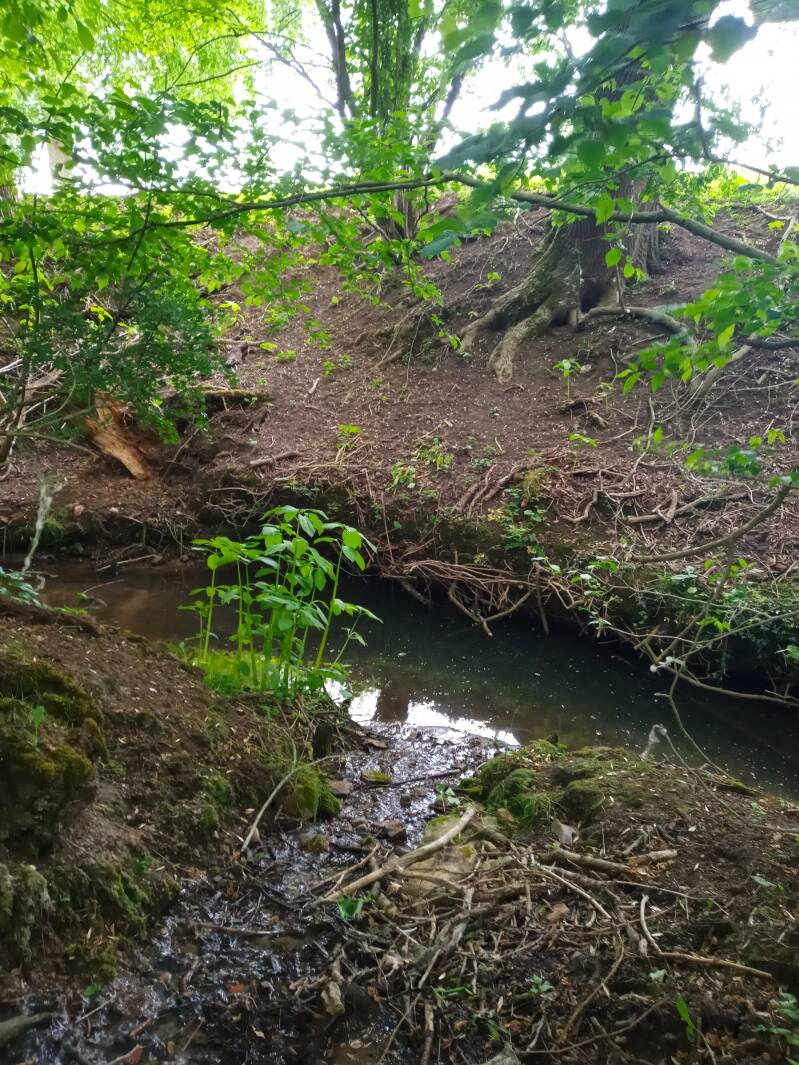
Photo below: the stream, into which flows the sulphur discharge from the sulphur well close to Croft-on-Tees, one can almost imagine a wyrm sliding through this water, although to me, these little forested areas are also romantic and mystical. The landscapes of northeastern England are quite different to those of northwestern England where I live, and there is a subtle difference in the magic of the landscape. The sulphur in the water centre image is not that visible in the photo below, but it has the appearance of a whitish grey substance, kind of like mould, and mystical. The mythological associations of sulphur are also very interesting. In many senses, the northeast of England also feels like the southeast of England to me, the types of streams, the way the water appears, the sea cliffs and the meadows, and sedimentary rock deposits. But, the northeast indeed holds its own mysteries.
I hope that this article/blog post was an interesting read. My friend Brendan Riley, a singer, comedian and polyglot, and linguist, is far more knowledgeable about the language and dialects of northeastern England than I am. He has also published a great dictionary. I have an interest for the northeast and a love for it - and for its people though, and I hope that this blog post/article can add to the saga of romance, history and language in northeastern England. Much love to everyone. This article is dedicated to all I love, especially to romance, to mythology, and to the ancestral guardians of County Durham.
Add comment
Comments