This article/blog post was written and published by Linden Alexander Pentecost, and the two photos showing different aspects of the Eagle Stone symbols were also taken by Linden Alexander Pentecost. This article/blog post was published on the 17th of March 2026, and close to midnight on this day (the 17/03/2026), note that I published two unrelated blog posts yesterday on this website and published an unrelated article on a different website the day before in part concerning the Pabbay Pictish stone (an unrelated Pictish stone to that discussed on this page/in this blog post on this page). This article/blog post in front of you is unrelated to and separate from any and all of my other publications, no AI was used, this article/blog post was published on this UK website, and I the author am a resident of the UK and am from the UK. The photo descriptions contain information not in the main text, and no part of this article, including the photos and text, has been published before. This article/blog post contains 1288 words. Note thattomorrow (aka on the 18th of March 2026) I will publish an unrelated PDF book via yet another website (via one of my oldest websites, not via the website you are currently on). The content in the upcoming PDF-only book will be unrelated to and separate from any of my online or other content including in other books. Note also that this article on this page is not the article in which I discuss what a witch I met told me about Pictish symbol meanings, in relation to the Pabbay Stone (I also did not discuss what the witch said in my article already published about the Pabbay Stone, nor is this witch the same person I mentioned as being from Co. Durham. What the witch said about the Pabbay Stone I will publish in a publication in the next week or so (also it will not be published in the PDF book being published tomorrow (on the 18th of March), but will be likely published in a different PDF-only book to be published around the 20th of March 2026).
I was going to write about something different on this blog today, and was also going to discuss a differen Pictish stone next, not the Strathpeffer Eagle Symbol Stone (I published a few days ago something with info about and an image of a drawing of the Pabbay Stone, another Pictish symbol stone), and have published about other Pictish stones recently.
However, I decided to discuss the Eagle Stone, the Eagle Stone in Strathpeffer in Easter Ros is also a very beautiful Pictish symbol stone, although the symbols upon it are not always that easy to make out. Before I go on to discuss this stone, I would like to discuss the name Strathpeffer itself, The first element, strath- is likely from Scottish Gaelic srath - "a wide and flat" valley", but the word is also related to Welsh word ystrad and to the Cornish word stras. The root word can be called Indo-European, but it is no more connected to Brythonic than to Goidelic. The second element, -peffer, may well be related to the Welsh word pefr meaning "shining", although this word may well be of non-Indo-European origin, and its presence in Welsh and in the place-name Strathpeffer could be due to a pre-Indo-European influence, rather than it having come from a Brythonic language. It is also possible that the [f] was always pronounced in the "Pictish" form, whereas the Welsh form pefr pronounces the f as a [v].
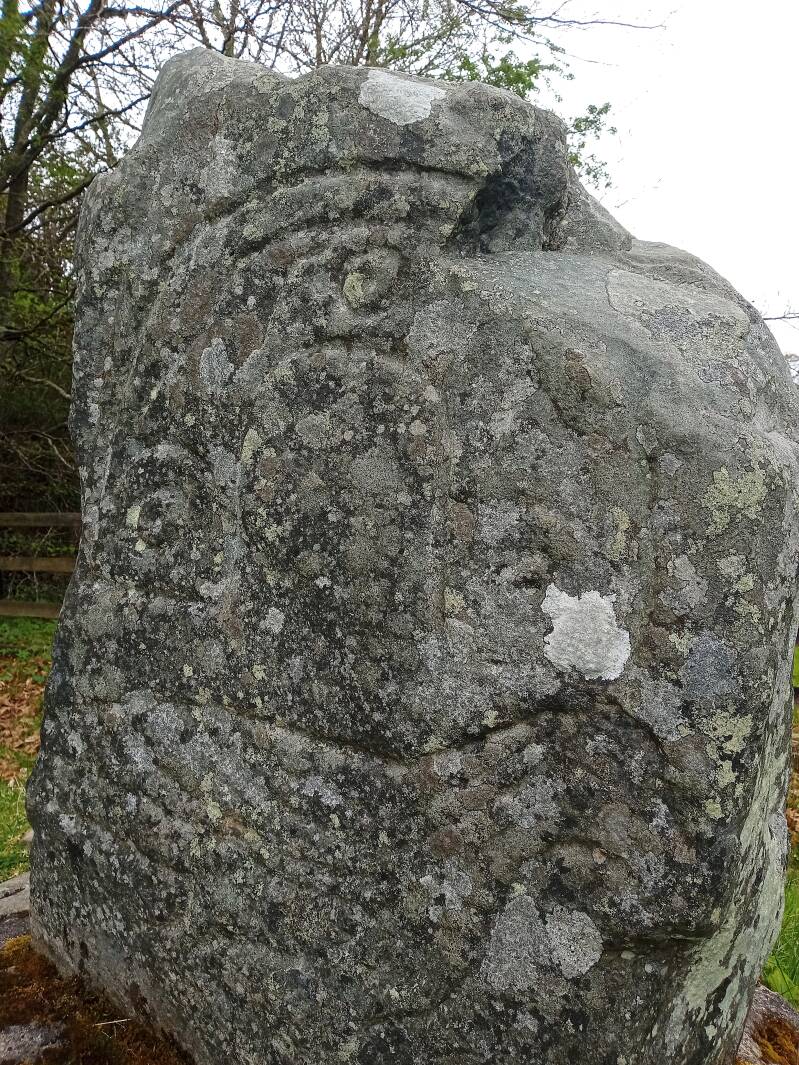
The Strathpeffer Eagle Pictish Symbol Stone, is so named because one of the symbols upon it seems to be of an eagle. The fact that the eagle is not the uppermost symbol on the stone is curious, as it suggests the eagle in Pictish symbolic language differed in its usage to how possible totemic animal symbols are added to the upper parts of other Pictish symbol stone 'inscriptions'. The eagle may of course be totemic in a sense, but I feel personally that it relates specifically to the "land", tribe and indigenous people of Strathpeffer, in a way that is perhaps more specific. Above the eagle symbol is a kind of archway symbol, somewhat akin to a horseshoe. If it does represent a horseshoe then it is interesting how the horseshoe in England in later times was placed behind walls to protect a place from negative influences. Although the symbol on the Eagle Stone could instead represent an archway, firmament, or something other.
In Gaelic, the stone is referred to as Clach an Tiompain, meaning "The Sounding Stone", which implies a reference to this concept of stones vibrating, making sound or even speaking, which is another curious connection to language, possibly. The Brahan Seer, or Coinneach Odhair, predicted that if the Eagle Stone fell three times, then the valley would flood. It seems to have already fallen twice, but has now been set in concrete.
Photo below: a close-up of the eagle's head and neck as symbolised on the Strathpeffer Eagle Pictish Symbol Stone, note that the eye, beak and what appears to be neck feathers are visible.

Photo below: the whole of the Eagle Stone/Clach an Tiompain, with the eagle visible, as well as the horseshoe- or arch-like symbol above it, the arch-like symbol also has three circles upon it, at the upper, lower left and lower right points, and these circles connect with other outer circular and more curved lines on the arch-like symbol. Sadly, as can be seen, the right side of the stone has been damaged. The eagle symbol is undamaged, thankfully, but I fear that erosion processes in the future might damage this symbol, and the arch-like symbol, further.
Easter Ros is also interesting in terms of its Gaelic dialects, as well as in terms of its other linguistic influences, in for example the "Pictish" place-names and Pictish symbolic language on stones. It is likely I think that the indigenous people of Easter Ros who created the Eagle Stone would have been of a different tribal affiliation to those in the heart of "Pictland" to the east of what is now Inverness. The use of the eagle symbol in this way also, to my knowledge, is not found elsewhere in the world of Pictish symbolic language, which may indicate in some way a difference between how the users of this language in general used the symbols, and how those in Easter Ros used them. If the name Strathpeffer does indeed contain an etymological relation to Welsh pefr, why exactly this valley would be referred to as the "Shining Valley" is a mystery to me. It could be that the local form *pefr, *pefer had a somewhat different meaning to Welsh pefr which we do not yet know about, but I find it tempting to associate eagles with "shining" qualities (e.g. their feathers and their reflection of light as they fly), and the general association between "shining beings" and the celestial realms, so I am wondering if perhaps the eagle symbol could represent something celestial on earth, something of symbolic meaning, that might pertain to the idea of "Pictish" *pefr/*pefer in some way, but this is more speculative, but I hope it is interesting to me.
I hope that this article was an interesting read, it is dedicated to the eagle, to the people of Strathpeffer and to the ancestors of that valley. Thank you everyone for reading.
Add comment
Comments