This article/blog post was written and published by Linden Alexander Pentecost on the 19th of March 2026, published very early in the day on the 19/03/2026. Note that yesterday I published an unrelated PDF book via one of my other websites, and published another blog post on this website you are on the day before that, and later today I will publish something else, before publishing a different, unrelated PDF book via another website tomorrow. (The PDF book being published tomorrow is also unrelated to the PDF-book I published yesterday, and all the aforementioned publications are unrelated to each other). This publication on this page is unrelated to and separate from any and all of my other publications, including those wherein the Borrowdale Yews, yews and symbols are discussed. No AI was used in this nor in any of my publications. This article/blog post was published only on this UK website, it was published in the UK and the author, I, live in the UK and am from the UK. Three of the four photos in this article (also never published before) were taken by me, the author, the third of the four photos (in the order that they appear) was taken on my camera, of me, at the Borrowdale Yews, and was included with their permission. Above the photos are photo descriptions containing information not in the main text, just as the photos contain information not in the main text. This article/blog post contains a total of 1922 words. This is also not the publication where I discuss what a witch said about Pictish and other symbols (which will be in my next PDF book).
The Borrowdale Yews are, as the name suggests, yew trees, but of ancient age. I will discuss the mysterious symbol at this site further down this page. These yew trees could be between 1-2000 years old, or perhaps even older, as yews are not easy to date, especially when the innermost sections of the tree tend to die, leaving the living tissue more on the outside. The Borrowdale Yews are thus very special, and are, as the name also suggests, located in Borrowdale, towards the bottom of Borrowdale to be specific, and close to the village of Seatoller.
These trees most definately would have been alive during the times when Norse-like, and perhaps Celtic-like or pre-Celtic languages were still spoken in Cumbria. They have witnessed and absorbed the essence of the creation around them, and no doubt they remember, the times when other cultures existed in Cumbria.
The yews themselves seem to be built on, or as part of a complex of cairn-like structures and megalithic stones. The megalithic stones on the site are scattered and difficult to interpret, no doubt the fact that the site is on quite a steep slope has also meant that some of these megaliths would have moved in the past few thousands of years.
I noticed these megaliths many years ago, and the cairn-like material of rocks, which look to have been taken from the nearby river, from which the yew trees seem to grow. Some of the rocks in these cairns also contain many pieces of quartz, and pieces of rock containing large amounts of iron. I personally think that the yew trees were probably planted on these cairns, or within them, deliberately, and that the yew trees in a sense serve as guardians to the underworld, with yew trees being potent symbols connected to the underworld in later, attested British traditions.
Hence why for example yew trees are often planted in churchyards, the yew trees, on a symbolic level, resemble upside down trees, and so connect to the idea of the underworld being an upside down, or mirror version of this world. The branches of yew trees appear like tentacles, stretching up from the underworld. In later traditions they were believed to protect churches from evil, whilst in earlier traditions I also think that they could have served as symbolic "gateways" into the underworld, especially given the way that ancient yew trees become often hollow, with their own inner caves.
The presence of quartz rocks and of rocks high in iron content at the site is also interesting, the quartz rocks being found here is not unusual at certain ancient sites, and may relate to the idea of clarity, of spiritual communication with the ancestors and gods, as well as to how quartz functions in electrical contexts and how this might relate to the spiritual "flow" of energy, and to the paths used by the ancestors, within the ethereal levels of the land and sky. The iron could have been placed there as symbolic of the blood of the earth, or it could have been placed there as a protective barrier to "stop" the beings of the underworld coming into this world, in much the same way that people would carry iron objects in Scotland and Ireland, or place them at the entrances to sacred sites, in order to protect themselves from dangerous spiritual influences. Of course, iron is not effective defense against all negative spiritual influences, and in other cases silver was more effective, amongst other things.
Other researchers, independently of me, came to believe that this site was also a prehistoric cairn of some kind, although I can nolonger find the publication in which this is discussed. I came to my own conclusions separately in around 2016 about the ancient features of this site, and was not aware of the (I think) earlier publication by others, also suggesting that this is an ancient site.
Another of the curious features about this site, which I only noticed relatively recently when looking through photo I took in 2016, is the presence of some very interesting symbolic markings on one of the megaliths, right next to one of the ancient yew trees. One of these is very clear, and appears more recent, but regardless of how recent it is, it may well be an ancient of a witch-mark, supernatural protection symbol or other magical symbol (witch-mark not meaning in the sense of "warts" or "spirit marks" on witches' bodies, but in terms of spiritual protection marks to ward away witchcraft). The symbol in question appears to be a form of VV-mark or W-mark, with another V-like shape of a wider angle placed upon it, and a J-like symbol placed across the centre. Below this marking are what appear like two, much older VV markings.These markings are shown in detail in two of the photos in this article/blog post.
Regardless of how old these different markings are, the fact that they are placed upon this possible sacred site is I think significant. Going back to what I said earlier about this site being a possible burial cairn, and what I said about yew trees, quartz and iron - could these markings, like the yew trees and iron possibly, be there to protect this ancient site, or even to stop the underworld spirits from being able to come out of it? Or, could they instead represent a form of symbolic communication with gods and ancestors? The precise meaning will likely depend somewhat on the age of these markings, although the ritual principles and symbolic language may be in continuity from when this ancient site was first created.
It is of course, also possible that these markings represent later graffiti, and it is even possible that the clearest of the three symbols was done relatively recently. It is hard to say, but the symbols are nevertheless interesting, and their symbolic placement by this sacred site implies to me that they are not just later graffiti markings, especially considering the amount of careful effort which has gone into them.
On another interesting note about language, there is a "wad" (graphite mine) in Borrowdale, now abandoned and full of dangerous shafts. The word "wad" is interesting, and I wonder if there is any connection between this word "wad", Old English wecg - "wedge, mass of metal" and Finnish vaski - "copper" for example.
Photo below: a close-up of the symbolic markings, on one of the megaliths next to the Borrowdale Yews, showing the clear, more recent-looking symbol, consisting of a W-shape, a wide-angled V-shape and a J-shape, all laid upon one another; and below this can be seen what appears to be two older, more degraded VV symbols, one of which is below and lightly to the right of the bottom of the larger, clearer symbol, and which is only partially visible in the photo below; the other VV symbol is below and slightly to the left of the bottom of the larger, clearer symbol.
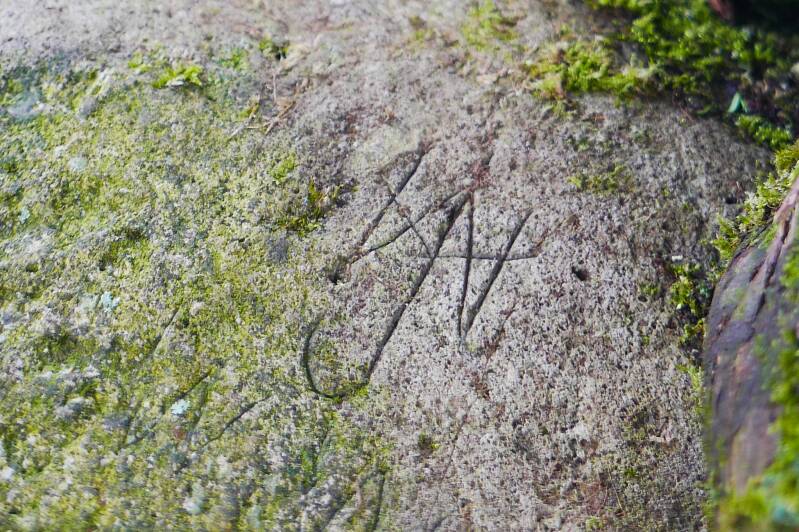
Photo below: a wider view of the stone upon which the carvings are, the carvings can also be seen at the lower part of this image, and the image above is based on an edited, zoomed in and sharper version of the image below, the image above showing the carvings in detail, whereas the image below better shows their placement. Note also the close proximity to the yew tree which is visible in the photo below, with the ancient yew tree having seemingly grown over the stone somewhat.
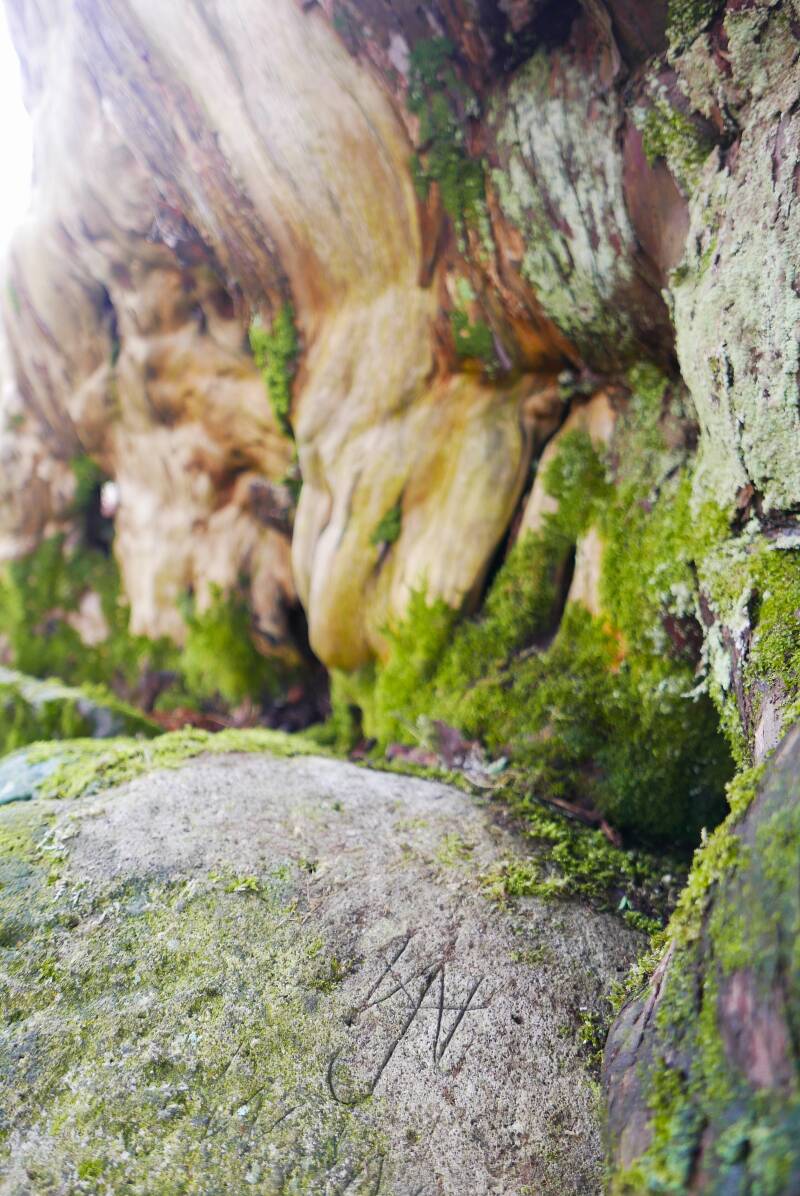
Photo below: a photo of myself, taken by a family member on my camera and included with their permission, as I am sat beneath one of the Borrowdale Yews and "meditating". Personally I am of the belief that these trees are rather like wise, ancient people, in a different form. Being in their company feels like spending time with living, breathing ancient gods, who just experience time and space a lot differently from me. You can see some of the cairn-material on the ground near the Borrowdale Yew behind me, whilst another of the Borrowdale Yews, the ghostly-white one, which has large hollow areas in its centre, is visible behind the first tree to the right. The aforementioned ghostly-white coloured tree is also the tree by which the carvings on the megalith are located, if my memory serves me correctly.
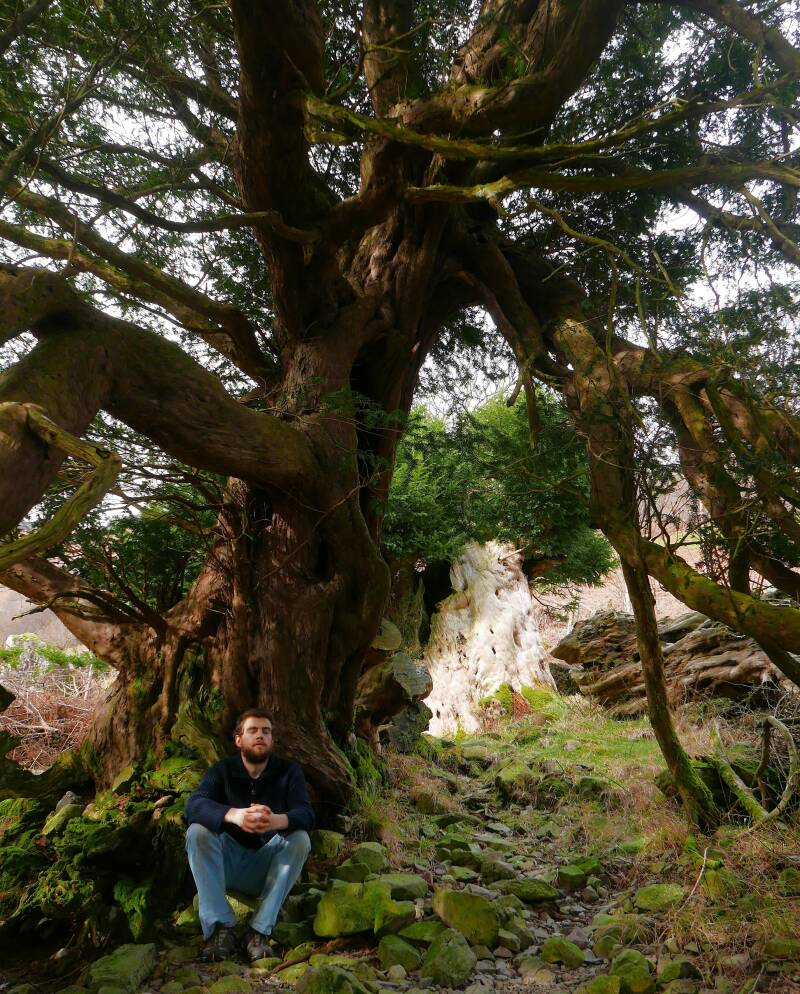
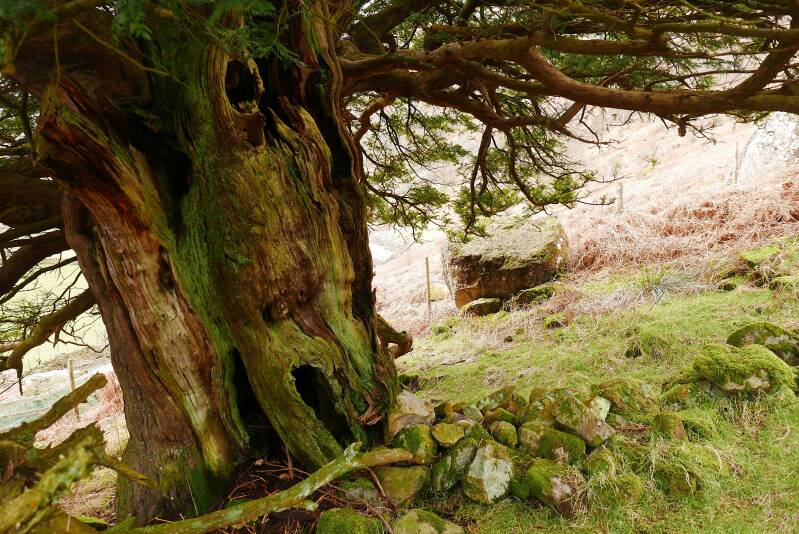
Photo below: another of the Borrowdale Yews, this one has many beautiful hollow cavities with various "cave" entrances within it, but it does not look quite as ancient as the ghostly-white Borrowdale Yew visible in the background in the picture above. The yew in the picture below does have some very beautiful colours in its wood. In a sense, the holed nature of these ancient trees makes them appear in a sense like ancient bone or fungus, the shapes and "holes" and "cavities" are similar. Also visible in the photo below is some more cairn rocks around the base of the tree, and a megalithic rock in the background and to the right of the tree.
I hope that this article/blog post was interesting, and I would be very grateful to find out if anybody has any further information about the carvings at the Borrowdale Yews. This article is dedicated to the Borrowdale Yews and to those connected to this site in the ancient past and more recently. Note that I also discussed aspects of these yews elsewhere, and have discussed other aspects of yew trees in general in other publications, including this year, in one of which I discussed a dream in which I met a friend in the hollow spaces inside some other yew tree. Thanks for reading.
Add comment
Comments