This article/blog post was written and published by Linden Alexander Pentecost, published on the 22nd of January 2026, this article/blog post was published in the UK and only on this UK-based website, www.languages-of-linnunrata.co.uk . I the author am from the UK and live in the UK. This article/blog post contains completely separate content from, and is unrelated to, any and all of my other publications. No AI was used in the writing of this nor in the writing of any of my publications. This article/blog post contains 3567 words. Included in this article/blog post are four photos I took showing different parts of Castell Dinas Brân, these photos were taken by me and have not been published elsewhere, they, and the photo descriptions above them are relevant to this article, which covers previously undiscussed topics, not just pertaining to Castell Dinas Brân and to its giants, other giants and related topics - a big focus of this article/blog post being also concerned with my own spirituality and realisations in connection to Wales as a whole, and to this castle, hence the "mystical feelings of Wales" part of the title, which also discusses my cat, Welsh dragons, magic, celestial gods, spiritual protection, Welsh music, among many other things in this article/blog post which I have not already mentioned nor related in this paragraph nor in the title. I have published a huge amount more about Wales, Welsh, other languages in Wales, Welsh history and mythology, fictional stories about Wales, and Welsh giants and related topics across many other publications unrelated to that on this page, I have also talked about the Berwyn Mountains elsewhere a little, including in poems.
For a very long time, I have sighted the castle, Castell Dinas Brân, when travelling into North Wales from the east. The castle is located on a prominent hill above Llangollen in North Wales. I had gone past this castle so many times, or rather, seen it at a distance from the road, atop its hill in the Berwyn Mountains, a mountain range that is geologically and archaeologically distinct from the mountains of Snowdonia or Eryri to the west. The sight of Castell Dinas Brân alone had long given me the feeling that the castle oozed with legend, importance and magic. It may not be the most intact castle in Wales, but often I think that intact castles fail to remind us of, and fail to invoke within our hearts, the legendary past in the same way. I am glad that Castell Dinas Brân has not been rebuilt, because in its current form, like a skeletal sacred site atop a steep hill, it reminds us, sticks out as something that would not make sense in our current time and world, and does not belong to it. It is this ability for it to stick out, to obtain and embody the mythological, that enables it to speak so powerfully of legend and of ancient times. Were the castle rebuilt, it would not I think do this so potently.
When in Wales, during the autumn of 2023, I felt it was time to finally take a walk up to the castle. We had some lunch in Llangollen in a wee café beside the river. I gazed at the impressive stone bridge, and observed the torrent of peaty-coloured water rushing through its path at the base of the valley. We then found the path that headed upwards towards Castell Dinas Brân, which began as a steep slope, past fields and through small patches of woodland. From the side where we approached the hill, the path was grassy, but steep, meandering its way upwards. I did not know at the time, that the castle was connected to the legendary giant, Gogmagog, who's name is connected to the Biblical figures of Gog and Magog, although, according to Manley Pope, the name Gogmagog may be from the earlier Welsh Gawr Madoc, gawr being a mutated form and variant of Welsh cawr - "giant", and Madoc being an earlier form and spelling of the Welsh name Madog, which seems to be of uncertain origin. One cannot help but notice the similarity between Madog/Madoc and the Biblical name Magog, itself being derived from Hebrew גּוֹג, gog, again of uncertain origin. One can see a potential similarity here with the Welsh name Gogarth, to describe the "Great Orme" in North Wales, and to several other root words, including that which gives Welsh ogof - "cave".
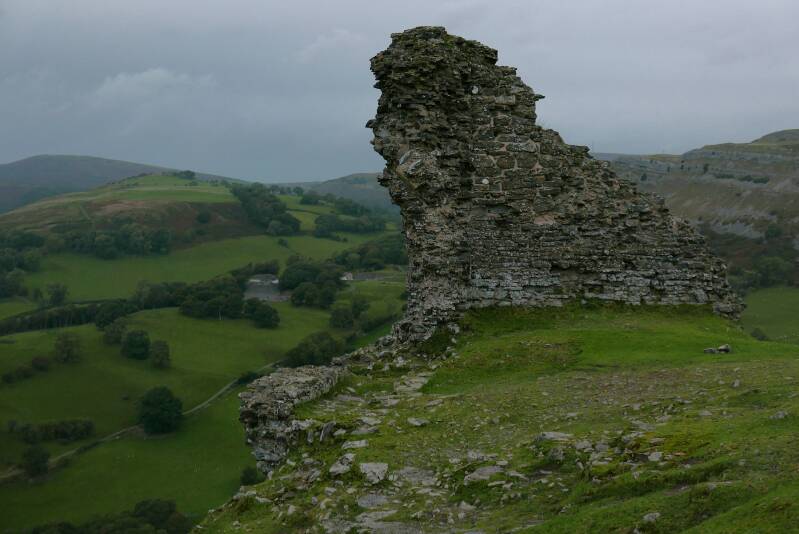
Photo below: a view of one of the remaining walls of Castell Dinas Brân, with the green, September valley below, and limestone rock formations visible on the hillside in the distance, behind and to the right of the castle at the right of the image.
Castell Dinas Brân is, naturally, associated with the divine Welsh figure of the mythical world, Bran the Blessed, who is himself sometimes thought of as a giant, although, like the Welsh god or divine figure Idris, Brân takes the role of a divine, protector giant hero, rather akin to how I poetically described the "St Bees Giant" in a different blog post some days ago. Although the association with Brân is not completely understood, with some saying that the name Castell Dinas Brân relates to brân in the sense of meaning "raven" and not the personal name - the fact that the castle's name literally means "Castle (of) the fortress (of) Bran" does seem to imply Brân in this context refers to a divine figure, although I have been unable to find any original references to the known tales regarding Bran the Blessed at the castle, other than that in an original romance about the site, called Fouke le Fitz Waryn, the giant Gogmagog is killed at the castle, and as the giant is dying, he tells the tale of a King Bran who had built the castle to defeat Gogmagog, but had presumably failed to do so. However, this does show that Gogmagog is not entirely a negative figure and seems to express some kind of honour towards Bran in his last moments. In London, Gogmagog was also considered a "guardian" of the city, and not as an entirely negative figure. There are, in addition, other legends of giants associated with the Berwyn Mountains, but I will have to discuss these in another publication, although there is much discussion of different giants and giant-related topics in this publication on this page, too.
In Fouke le Fitz Waryn, Gogmagog is seemingly described as mace-wielding giant, this is at least from what I understand of the original romance via secondary sources. This is curious, because it means that Castell Dinas Brân is both associated with a divine, protector giant figure, Bran the Blessed, and with another giant, Gogmagog, which carries the more "wildman" and "caveman" attributes of giant figures. Are the two in some way deeply connected, and is this legend in some way about the connection between this castle and both the harmonious, protective, and chaotic, dangerous, aspects to giants? Does the legend in some way represent how these two aspects have "split" into different attributes, akin to the "angels" and "fallen angels", and akin to how the urSkeks in the film "The Dark Crystal" split into the Skeksis and urRu? On a slightly different note, when I see imagery of the urSkeks in art, I have to say - I have a distinct feeling that some of our ancestral spirits present in Europe do appear very much like them, although I have not seen them with my own eyes.
Anyway, According to what I understand from the book Literary Culture in the Medieval Welsh Marches Networks, Places, Politics, by Matthew Siôn Lampitt, on page 96 it seems implied that the Fouke le Fitz Waryn also gives further details about the castle, where King William discovers the already-ruined castle, with the knowledge that Gogmagog had already been killed here, and it is also implied that, rather like a vampire or draug, some kind of spiritual presence appears to occupy the body of Gogmagog and to be able to leave it (later on I describe a dream where I saw a vampire-like being). This is very akin to how the bodily spirit of giants is described elsewhere, and which I have described different examples of in detail - namely that a giant's body, after death, still contains a spirit, or aspect of the original giant's spiritual self, which, like a vampire or draug, can leave the body. Compare for example the way in which Mímir's Head in Norse mythology can still "speak" after death, due to its bodily spirit, and the way in which in Finnish mythology, the wizard and giant Vipunen can still "come back to life" in some way in his decaying, buried body, despite that he has already been dead for a long time by the time that Väinämöinen asks him for three magic runes. As I discuss in other articles and publications, including in other blog posts recently, this idea of a bodily spirit remaining attached to the body is a very ancient thing, but it does contradict with more conventional spiritual wisdom and may confuse the spirit, and we can only assume that ancient people and ancestors had a knowledge of this which did not involve confusing or fragmenting the spirit - although in general this spiritual pathway is probably, likely intended for the "gods" and not for humans nor animals, at least not for modern humans, but our Bronze Age, Neolithic and earlier ancestors did have a higher knowledge of this and their own concepts on how the spirit was intended to safely journey. Gogmagog is also associated with stormy weather, like many other giants.
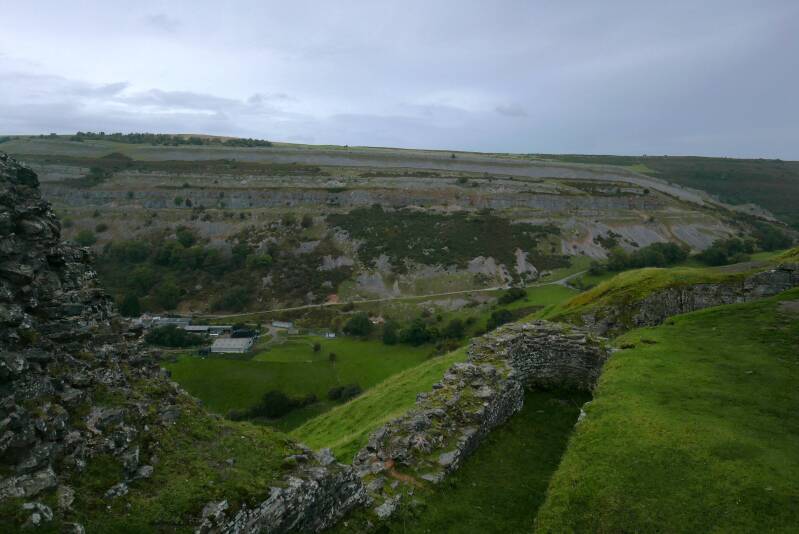
Photo below: another, different view of Castell Dinas Brân, and the limestone formations on a hill opposite. Note the way that the hill upon which Castell Dinas Brân is situated is both "near" the other mountains and yet apart from them. I feel that this image also invokes a feeling of ancient guardians and of magic.
In Fouke le Fitz Waryn it is also implied that Gogmagog told Payn the Knight, just before Gogmagog died, that there are treasures buried at Castell Dinas Brân, including idols of swans, peacocks, horses and a huge ox made of gold, but the giant Gogmagog does not reveal their locations. This is interesting, given the connection between giants and treasure, and given that there was activity on the site of Castell Dinas Brân going back at least as far as the Iron Age, implying that these "giant" legends of the site are perhaps associated with its deeper prehistory in some way, although, as I have discussed with many other examples elsewhere, castles themselves are frequently said to have been built, and occupied by giants. Another thing I'd like to mention in this paragraph is that a Welsh friend of mine said that she has felt an eerie "vibe" at the castle, and wondered if this may have been the ghost of a woman, although I also wonder if it was an aspect of Gogmagog's spirit. What I would also like to mention in this paragraph is that, when I visited the castle, something slightly amusing happened, where I met a lady and we watched a couple flying their drone around the castle, and we found it kind of cute how they were with their drone.
Photo: a mystical, haunting view of Castell Dinas Brân, with dense clouds, and the sun shining through, the dark walls of the castle reaching towards the heavens.

Again in terms of Y Gogarth, there was also, reputedly found, a 64-pound hammer stone at the Great Orme Copper Mines, a large, Bronze Age copper mining site. I have not mentioned this before either when discussing The Great Orme, because I don't know where this report of a 64-pound hammer comes from, and, I asked someone working at the Great Orme Copper Mine (the tourist attraction part) some years ago, and they told me that they also had no idea where this report comes from. But who knows, I will nevertheless not be believing this story unless I find the original reference to the find. Just to give some idea, most adults could perhaps wield a Bronze Age hammer weighing around 20 pounds - not one which weighs 64 pounds. And furthermore, if giants were involved with the Bronze Age copper mines on Great Orme, which I think is entirely possible, they wouldn't have been doing much in the underground sections, some of which are so small that only a very small person could mine in them. A Welsh friend once told me, that he felt as though these Bronze Age miners at Great Orme were, at least in part, quite a hostile presence towards other indigenous groups in North Wales at the time, and I for one am pretty certain that the cultures doing this Bronze Age mining were not the same as those living further inland. I have discussed many other aspects to this elsewhere.
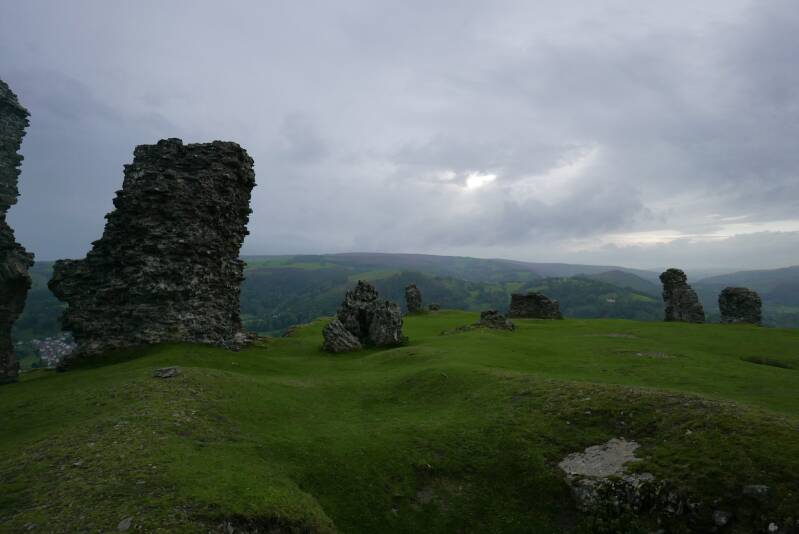
Photo below: vast cloudy skies, with light leaking through, above the beautiful ruin of Castell Dinas Brân, broken and ruined, yet perfect and complete in a spiritual and mystical sense. The remaining walls of the castle when seen in this photo, do remind me of a stone circle atop a hill.
I feel and know in my spirit that Castell Dinas Brân will come into my life again, and that there is more for me to learn and say about my own feelings regarding the place, and that I will visit it again. This future journey will be more about my own spirit and the romance of the castle I think though. It is a place that, when I eventually walked up to it, became set in stone at a pivotal point in my life, as though my coming to the castle was preordained, set in time. What I will mention of this other aspect of the castle's significance is that I was a bit worried about my cat at the time when I visited, and yes, I have mentioned my cats in other blog posts and articles and other publications, including the blog post I published before this one. But this particular element is very relevant to this blog post too. I was not too worried about my cat when I visited the castle - but in the back of my mind I was a little. And I remember going to a small shop in Llangollen and buying my cat a small fluffy effigy of Y Ddraig Goch, or "The Red Dragon", the symbol of Wales, and its protector, which appears on the Welsh flag. I got this for my cat as a kind of guardian for him. During this day, time was indeed twisting back towards me, as though a significant part of my life was changing, and month and a bit later, my cat passed away. This castle had been in my mind all of my life, and my cat had been in my life since I became an adult at 18. When I eventually walked to the castle, I was returning to myself on a deep spiritual level, and, like at the end of any cycle, there is often a return and also a loss, in this case, my cat passing away not too long after. And, as someone wise once said - I will paraphrase, time and life in the realm of spirit, are about cycles of returning, knowing ourselves again, and connecting back to our core. I feel that Castell Dinas Brân is such a place that somehow connects to my core, and I know that, as I return to myself ever more, at some point, I will return there.
Before my cat passed away, I remember one night listening to music with my cat, just after my visit to Castell Dinas Brân. It was a playlist of Welsh folk music, which is very different to that of Ireland by and large, but there are similarities. I have not heard as much Welsh folk music as I have Irish and Scottish, and I remember when listening to this playlist, how beautiful I thought it was, how it seemed to remind me of a yet unclaimed and unknown part of my self. I remember my cat sleeping close to me, the music clearly to his approval. When I say, a "yet unclaimed part of myself", what I mean by this is that, although a lot of my published writing and work, and life in general, has concerned Wales, there are also things I feel about Wales, which I feel connect to me, and which I feel elevate magic and consciousness to a realisation so pure, eternal, gentle, eternal.
I had a less pleasant experience too on that visit to Wales when I finally went to Castell Dinas Brân. |I was staying in an old house near Llanfair-ym-Mluallt or "Builth Wells", a place I will discuss more about in the future. When in this house, I had a nightmare, in which I met a terrifying-looking ancient human, akin to a vampire like those depicted in Stephen King's miniseries Rose Red. It stared at me as I was dreaming and I was scared. But I knew that, in dreams, fear is the worst thing to let overwhelm one's senses, and rather than avoiding the darkness around me in my dream, I instead dove into it. I fell, further and further, as though passing through portal after portal into deeper and darker macrocosmic dream realities, breaking through barriers of time with noticeable thuds. I was not running from my fear, but in a strange way, I was allowing it to be there, and allowing myself to feel it fully, to become smaller, to be deminished, but deep inside, I knew that this was the way out, and I increased in speed, falling faster, and faster, feeling energy build, and build and build, my embrace of the fear became concentrated into an inner light, and suddenly, at great speed, I broke through the deepest barrier, and my energy burst from me like a 360 degree boom and wave of luminocity. The vampire in my dream was blown away from my vision, washed away by a whirlwind of stars. If you have ever seen the Harry Potter film in which Harry uses a petronus charm to ward away evil, what happened in my dream was in many ways akin to how this charm is used in Harry Potter.
If you have ever heard the Welsh song, Ar Hyd y Nos, and if you understand the words in your heart and spirit, then perhaps you can also feel or are aware of the presence of starry angels, beings that we might feel on a starry night in the mountains of North Wales, watching over us. Unlike the Welsh folk music I mentioned earlier, which was in reference to instrumental music, including the use of harps, Ar Hyd y Nos is an example of something else, the folk music of Welsh choral singing. As I have written about elsewhere, I feel a particular connection to the Welsh goddess Arianrhod, who is also associated with the celestial realms. But in a more general way, I feel that these figures are in a sense, the deep gentle spirits who helped to craft and sing the music of Welsh creation. Despite our knowledge of gods and spirit beings in Wales, those which I mentioned in the previous sentence, are to me, some of the most mysterious and beautiful of all. I feel that the "charm" I performed in my dream, is of a magic and truth deeply akin to theirs, and that songs like Ar Hyd y Nos are, in a sense, about those celestial beings, and about the Creator, within who's heart all true things are without beginning and without end.
I saw this quote once, something like, if a person creates only one beautiful work, that is enough. I have written a huge amount of stuff, and this article/blog post on this page is tiny in comparison, but somehow, writing this has felt significant. If I had to choose one piece of my writing to share to someone, only one piece, then perhaps I would choose this publication on this page, not because it speaks to my ability as a writer, but because this piece of writing means a lot to me, and encompasses a lot of things that I feel are personally important to me - which I am about.
I hope that this blog post was an interesting read and that it may be inspiring. It is written in honour of my cat, who I know is always there, in spirit, and will always be there, including when I eventually leave this world as an old man. This article is also dedicated to the magic of Wales, to its ancestors, and to the giant beings and mythological dragons, and celestial angels of light, that, throughout all my life, I have always felt guarding and watching down upon me, across the beautiful skies and mountains of ancient Cymru. Thank you for reading this article, and may the Great Spirit bless all.
Add comment
Comments