Written and published by Linden Alexander Pentecost, published on the 21st of January 2026. Note that I published another unrelated blog post/article on this website earlier today. This blog post/article is separate from and unrelated to any and all of my other publications. This article was published in the UK, on this UK-based website, and I the author live in the UK and am from the UK. The photo in this article showing the Gulf of Finland at sunset was also taken by me and has not been published before. This article/blog post contains 1084 words. The main written content of the article begins beneath the photo description below and below the photo beneath that. The photo description and photo are also important as well as the main text.
Photo below: the Gulf of Finland as seen from a ferry between Tallinn and Helsinki. Whilst the photo does not show the sea in Russia close to where Votic is spoken, it does show a part of the same Gulf of Finland seascape and sky. I describe aspects to this seascape later in the article, and the photo below is relevant to that section too. Note the beautiful red colours on the sea, and the beacon, which makes me think of the god Saarevaht.
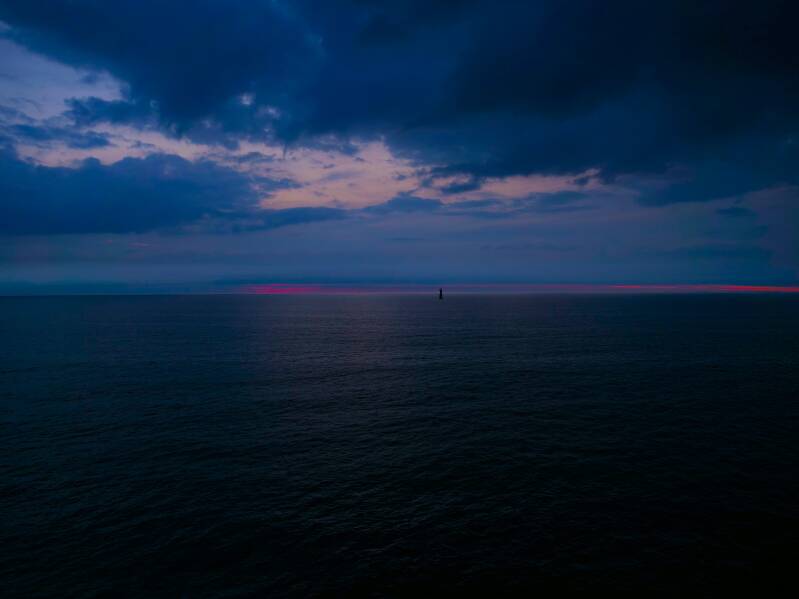
The Gulf of Finland is lies between the coastlines of Southern Finland, Northern Estonia and a part of Russia in the east of the gulf. This region is quite linguistically diverse, with southern Finland possessing dialects of Finnish, Finland Swedish, as well as more historic "broader" forms of Norse spoken in Southern Finland, which I would argue are not Swedish.
The Northern coast of Estonia is where Standard North Estonian, Eesti Keel originates and is spoken, as well as the northeastern coastal Estonian dialects, known as Kirderannikumurre, whilst many of the Estonian islands in the gulf of Finland historically had their own Nordic languages, referred to, I think erroneously, as "Estonian Swedish", which, like in the case of "Finland Swedish", has a lot to do with the past political ties with Sweden, rather than these Nordic languages actually being Swedish. If you listen to some examples of so-called "Estonian Swedish" you may indeed notice that the phonology and prosody of Estonian Norse is very unlike that of Swedish.
On the now-Russian coastlines of the Gulf of Finland, two other languages are spoken, and were historically spoken much more widely, namely Ingrian and Votic. Like Finnish, Standard North Estonian and the Kirderannikumurre, Ingrian and Votic are Finnic languages. A distinguishing feature of Votic is that where most Finnic languages have an initial [k], Votic often changes this to a [tʃ], written in Votic as č, c or tš depending on the writer - as Votic has no spelling system that is universally accepted. For example, the word for "language" may be written as ceeli, tšeeli or čeeli in Votic, compare Finnish: kieli and Standard North Estonian keel. The Votic language is referred to in Votic as Vaďďa Čeeli.
I would like to discuss some of my favourite Votic words, for example karjõ - "flock", itäpõhjõ - "northeast", from itä - "east" and põhjõ - "north" or "bottom" luku - "rhyme", "spell" or "incantation", jõči - "river", jürü - "thunder", laivõ - "ship", lasku - "sunset" or "ebb", with the implication of something gently rising and falling. These words generally have equivalents in other Finnic languages, although the meanings differ.
Votic is a highly endangered language, and out of all the Finnic languages, I feel that it receives the least attention from linguists. What is more, is that the Gulf of Finland seems to have an important mythological presence, and the linguistic diversity around the Gulf of Finland, including that of Finnic languages, would seem to suggest that this area was in some way very important in the formation of Finnic languages.
Although I have never been to what is now Russia and to the areas where Votic is still spoken, I have crossed the gulf of Finland from Helsinki to Tallinn, and back, and have felt the magical quality of the seascape, which seemed to stretch out endlessly, as though the horizons of sea and sky were connecting to a far greater, mythological, Finnic world of sky, water and magic. I remember watching the sea from the ferry, and sending a prayer to one of my cats who had passed away the previous year, to the male cat I had, because in that seascape, when the skies were open and vast, and evening clouds were merging with the broad sunset, I felt very close to him, and to the other cat. The male cat had accompanied me, often physically, as I have researched languages, cultures and spirituality, and mentally and in spirit he has travelled with me to wherever I go. The year that I got him was the first year that I went to Finland, and I know in my heart that my love for him is somehow connected to this magical reality of Finnic gods, ancestor spirits, and of the Great Spirit, which I have felt since around the same time I got him.
One of the Estonian gods which I have discussed elsewhere is known as Saarevaht meaning "island guard", and he is associated with the Gulf of Finland. I do not know if Votic speakers have some kind of equivalent, and in fact, I know next to nothing about their spiritual beliefs, and how much they correspond to those of other Finnic-speaking cultures. The traditional pagan beliefs of Estonia and Finland for example, whilst interconnected on many levels, are fundamentally very different to each other in terms of their mythological worldview, heroes and gods etc. I do like Saarevaht, who is generally described as an man who keeps to himself, who is connected to small islands, and to the lighthouses upon those islands, making him a guardian who protects those travelling by water. I like the story of this spirit being, the way that he likes solitude and serves as a silent guardian, these type of mythological figures are some of my favourites. I feel a connection with him in some way.
I hope that this blog post/article was an interesting read. Thank you. This article is written in honour of Saarevaht and is also dedicated to my cat. Which is also a nice rhyme.
Add comment
Comments