Written and published by Linden Alexander Pentecost on the 29th of June 2026, this article was published only on this website and is unrelated to and separate from any and all of my other publications. Note that later today I will publish an unrelated article on a different website connected to more about the witches of Tiree, not to be confused with my many other publications concerning Tiree recently or about aspects of Tiree. No AI was used in this article/blog post on this page nor in any of my written works, this article/blog post was published in the UK on this UK website, I the author am also from the UK and live in the UK. The photo in this post was also produced by me as a tonemapped image from 3 other images back in 2014. This article/blog post contains 1003 words. Note that I published an unrelated article also about other aspects of Cornish, published a few days ago and on a different website. The main article begins below the photo and photo description below.
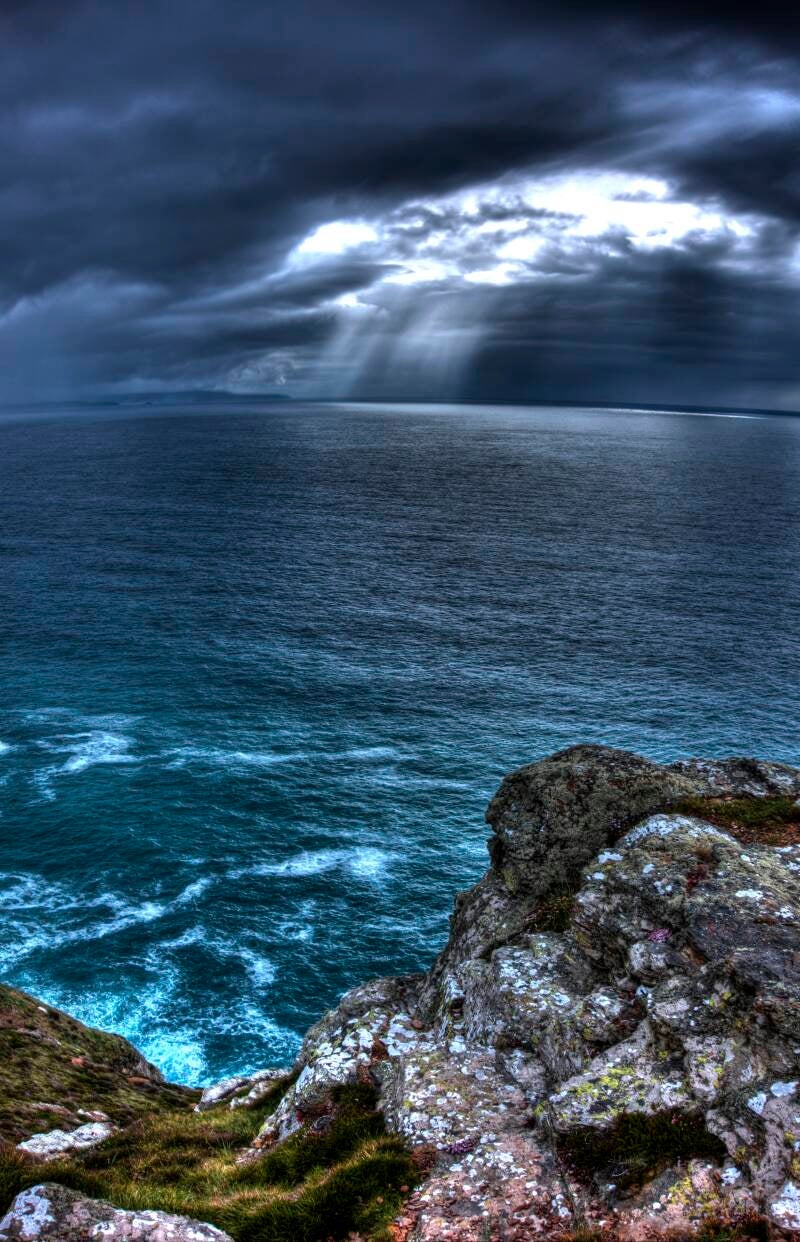
Photo above, a tonemapped image I made back in 2014 showing the wild and beautiful seas of western Cornwall as seen from atop the cliffs, for me this image invokes the witches of Cornwall and their connection to the sea and to wild weather, and their places among the coastal fringe, this photo is also representative of the "late" Cornish language which was still used by fishermen on the sea after it had become mainly extinct on the land. Note that the coastlines of Cornwall are extremely dangerous and great care must be taken.
When it comes to the spelling of Cornish, I personally have just come to the realisation that I would rather just spell the language as it has been represented by speakers of Cornish across time, rather than using systems that always compromise on these things and which sometimes try to merge “late” and “earlier” Cornish together in a way that simply doesn't work and isn't accurate to how the language is attested.
One thing I have pondered in the past day or so, to quite a large extent, is the thera- and era- verb forms in “late” Cornish, which are used as locational, present continuous forms of the verb “to be”. For example therama or thera ve - “I am”, thesta - “thou art”, thera nye - “we are”, thera why - “you lot are”. And also the era forms which are used in the locational present continuous as interrogative forms of “to be”. For example era ve - “I am”, era nye - “we are” and ero why - “you lot are”.
What I find curious here is the way in which these thera- and era- forms bare some resemblances to the way in the words “there” and “are” are used in English. For example therama might be said to be roughly equivalent to the English “there am I”. For example therama clappya - “I am speaking”, compare on English “there am I speaking”. Similarly the second person singular form thesta can be thought of as similar to in English “there is thou”, or in Cumbrian dialect: thëar ista.
Similarly, if the thera- Cornish form is related to English “there”, then it can also be thought of as having some indirect similarities to the Danish usage of der and also the Shaetlan usage of der.
The era- Cornish forms have a similar usage to how the word “are” is used in English, and also for example er, ir, jär, jer etc in North Germanic languages, ir in Shaetlan etc. Notice again that just as with some Germanic languages, the -r form is missing from the second person singular forms in the Cornish usage of era and thera, which are esta and thesta. Compare for example the way in which the Gutnish Nordic language has the form
Forms such as therama and thesta are thought to come from older yth esov vy and yth esos jy etc. But I would argue that the “late” Cornish forms do not come from the earlier forms and instead represent a parallel development, in which an equivalent of the Germanic or pre-Germanic forms *þer- “there” and *ir- “is, are” are used, the latter acting as a copula in an arguably similar and possibly pre-Indo-European way in which Goidelic languages use is as a copula.
Lastly in this post I would like to comment briefly on the witch traditions of Cornwall. As I have stated elsewhere there is no way of reconstructing the Cornish mythological landscape into some "Proto-Celtic" pantheon, the evidence in Cornwall rather seems to suggest that witches, giants, saints, and forms of nature spirits, ancestral spirits, and hero figures, are likely most closely representative of Cornwall's indigenous spiritual traditions. The witches of Cornwall are it seems especially connected to the westernmost parts of the county, in particular to the area around Zennor, perhaps implying a connection between these witches and older "non-Celtic" cultures surviving in the west, hence perhaps also why western Cornish, so called "late" Cornish in my opinion contains greater numbers of non-Celtic influences. I have applied this similar theory with regard to witches elsewhere and have published about this extensively, including recently with regards to Mull and other places for example, and later today I will publish an unrelated article on a different website concerning more about the witches on Tiree & connected topics, not to be confused with my many other publications pertaining to Tiree recently. Note that I also very recently wrote an article on a different website concerning Cornish, the link to which is: https://www.kielimatka-2-11.co.uk/newly-discussed-cornish-vocabulary-and-etymologies-published-on-the-26-06-2026 .
I hope that this article/blog post on this page (unrelated to that linked to at the end of the previous paragraph) was an interesting read - it is dedicated to the witches of Cornwall and to the people of Cornwall.
Add comment
Comments