Written and published by Linden Alexander Pentecost, also published on the 5th of July 2026 after another blog post or article, unrelated to this one, was also published on this website today a short time ago. This blog post is also now complete and published. No AI was used and this article is published in the UK; the photos were also taken by me, the author. This article contains 4 photos and 1667 words.
The mountain of Snowdon, or in Welsh Yr Wyddfa, is kind of famous for its Snowdon Mountain Railway, known in Welsh as Rheilffordd yr Wyddfa. This railway is a piece of history as well as a working railway, and the only public rack and pinion railway in Britain. It runs around four a half miles from Llanberis at the lower end of the railway, where there is a station, sidings and engine shed, before then ascending towards the summit of the mountain, passing through several stations, many of which nolonger serve as actual public stations. The first station is known as Waterfall Hault, which is close to a waterfall on the Afon Hwch river and where tourists once alighted to visit the waterfall. This first section of the line is quite steep in places, and between Llanberis station and Waterfall Hault, the railway rises over two viaducts, with relatively steep gradients on the areas of track between the two viaducts and just after the upper viaduct, next to the waterfall. At Waterfall Hault the railway track has a much shallower gradient, and this shallow gradient continues as the track turns left into a long, straight section.
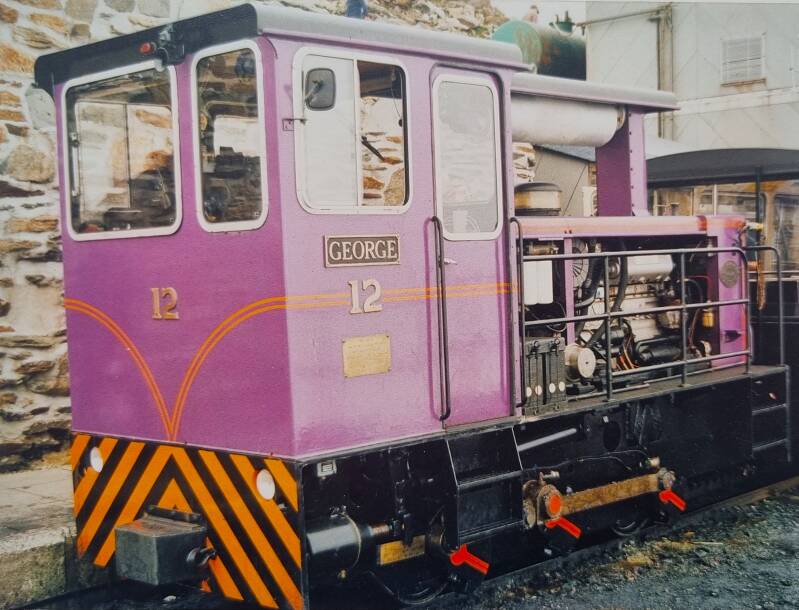
Photo below: Diesel no. 12 George with its violet-purple livery, the heart-like lines on the back are orange, whilst the buffer beam visible has black and orange chevrons, the locomotive was at the summit station when this photo was taken.
This straight section gradually becomes steeper again, before turning, going over a bridge, and rising quite steeply towards the next station, which is Hebron Station, also no-longer a public station on the route. A ruined chapel lies closeby, as well as some unusual stone features, resembling megaliths - although I do not suspect an ancient origin. After Hebron the gradient rises again, quite gently, going along and slowly up the left side of a vast valley, filled with grasses, bracken, and in the summer, wild flowers. It's a beautiful valley. Just above Hebron Station there is an unusual section of skeletal track combined into a bridge that runs over a stream. The track goes towards the left again, becoming steeper, going over another bridge, through a cutting, and towards the Halfway Station, also no-longer used as a public station. A water tank is located here for the steam trains to drink from, when ascending or descending.
After the Halfway Station, the railway rises steeply, in a sloping ledge on the right side of the mountainside, not Snowdon itself yet, before turning left again, and continuing to rise steeply as it heads up into the Valley of the Rocks, or Rocky Valley, a vast area of rock outcrops and boulders, where the railway turns right, and goes parallel to the main rock formations, reaching the station of Rocky Valley, which is sometimes used as a public stop, when the track ahead is covered in snow, or when the wind conditions are too bad.
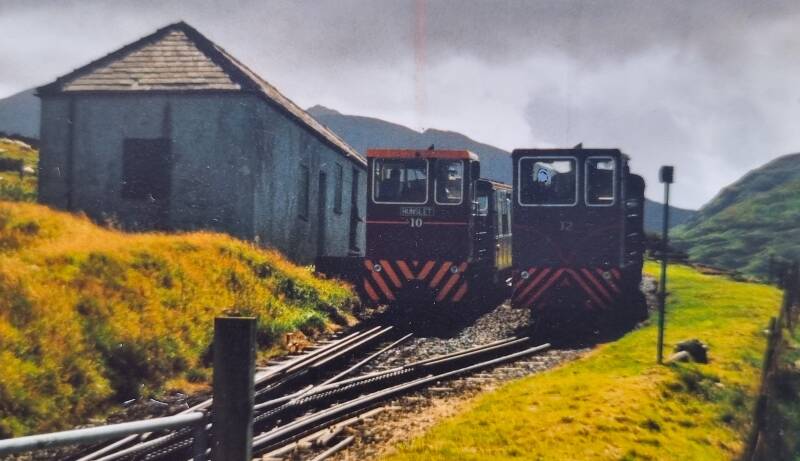
Photo below: diesels no. 10 Yeti, left, with a barely visible maroon livery and with more visible down-turned orange and black chevrons on its back buffer beam, to the left, and George no. 12 to the left, with its purple livery and orange-black upturned chevrons on the back buffer beam, to the right, this photo was taken from just below Hebron Station.
After Rocky Valley, the railway rises steeply, meandering slightly, and on the left side there opens up a 2,000 foot drop into the Llanberis Pass which lies far below. The track rises and meanders steeply, keeping some distance from the large drop, before finally becoming a shallower gradient as it reaches Clogwyn Station. Like at Hebron Station and at the Halfway Station, the railway at Clogwyn station switches to a double track, for a short distance, before returning to being a single track above the station. This is so that trains can pass when needed.
After this point the railway remains on a shallow gradient for a short distance, before turning and rising very steeply, over a bridge and up an embankment, with the footpath and the 2,000 foot drop on the left side, and a steep rocky slope, opening up on the right side. From here the railway is built on a sloping ledge cut into the side of Snowdon itself, and with the mountain on the left, the railway track and ledge skirt around the side of the mountain towards the right, until a point is reached where above the railway is a steep slope and some cliffs, and below the railway are cliffs, leading down towards a deep valley of rocks and boulders, dwarfed by the huge cliffs, with the lake of Llyn Du'r Arddu and is sandy, braided stream systems lying at the base, close to which are old copper mines. According to legend, it was once possible to travel from these mines to the Snowdon Brittania Mines on the other side of the mountain. These legends seem to be more connected to the Otherworld than to purely physical movement, another such legend for example tells of a tunnel from Furness Abbey in Cumbria going a long distance elsewhere, whilst a similar legend exists about the slate mines on either side of the Coniston Old Man connecting up. Note that all the aforementioned mines are dangerous, with those copper mines on Snowdon being exceptionally dangerous. I have discussed aspects to these topics elsewhere in different details.
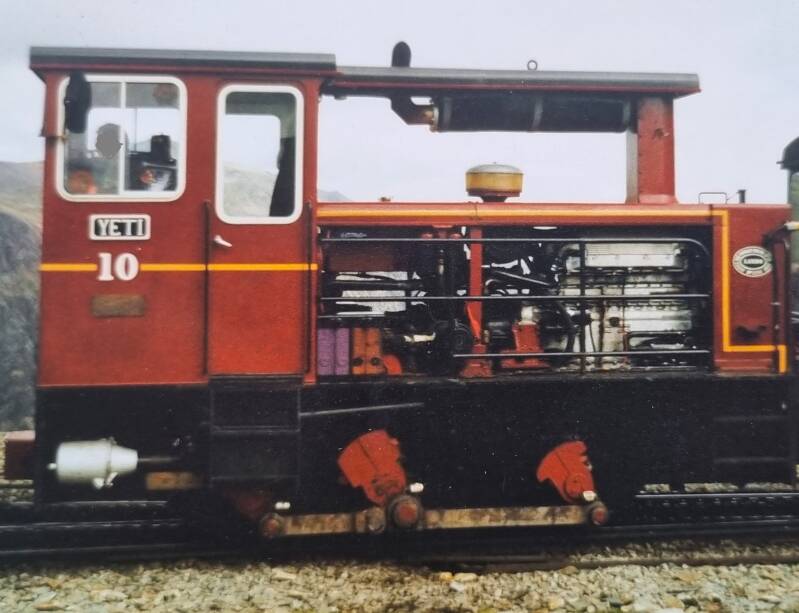
Photo below: Diesel no. 10 Yeti just above Clogwyn Station, with maroon livery and orange line, the buffer beam at the time was the same as that shown in the photo above, with orange-yellow and black downturned chevrons, not visible in the photo below.
The railway line then gradually turns towards the left, as it goes beyond these cliffs, and skirts the ridge of Snowdon itself, making some snakey movements but being generally in a straight direction as it goes towards the summit station. Some of these sections are also very steep.
The railway has four diesel locomotives, known as Ninian, Yeti, Peris and George. Ninian is named after the Welsh saint, who was also known in the Old North. Peris is named after Llyn Peris, one of the lakes in the valley of Llanberis, Peris was also the name of a saint, who has an extremely interesting history, and the name Peris also bares a similarity to Parys on Anglesey, and also to the names Ker-Is and Paris. Peris may I think have originally been a local deity or guardian spirit associated with Nant Peris and later with Llanberis which is also contains a form of the name Peris after soft mutation.
The two slightly older diesel locomotives, Ninian and Yeti, are both slightly different, but both are generally slightly "wider" looking than the slightly younger diesels, Peris and George. When all four diesels originally arrived, they were painted green, with their crank axles and buffer beams painted with white and red chevrons, with the buffer beams having multiple symmetrical chevrons between white and red, with in some cases the white chevrons being wider. After some years, Yeti and George, which are locomotive numbers 10 and 12 respectively, had their red and white chevrons replaced with black and yellow chevrons, with George having largely yellow crank axles and Yeti having largely black crank axles.
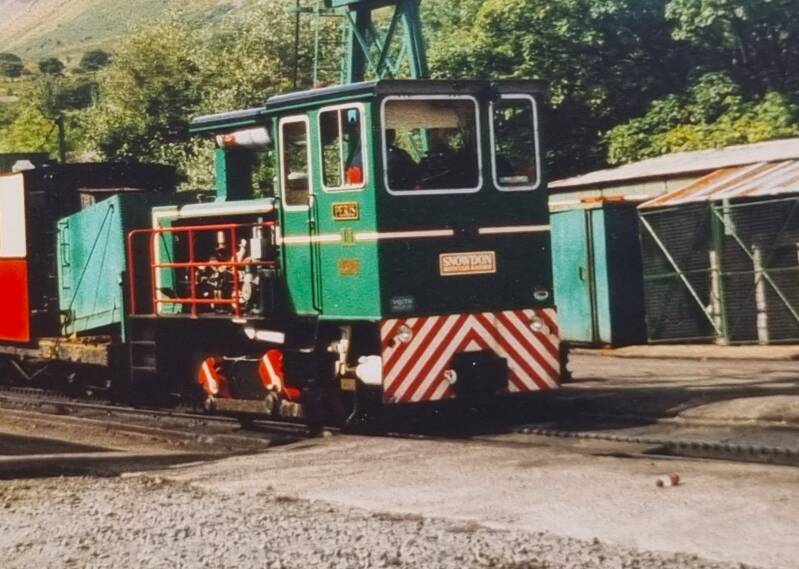
Photo below: Diesel no. 11, Peris, at Llanberis station, during the same time period that the photos above in this article were taken, here showing Peris' green livery and red and white painting on its buffer beams, crank axles, railings and line markings, also with upturned chevrons as with locomotive no. 12 George. Peris is coupled to the railway's supply train in the photo below.
After this time, the locomotives generally became more colourful for a while. Peris retained a variation of the original colour combination, with a green livery, and red and white chevrons. Ninian retained a variant of this livery to some extent, with the chevrons on the crank axles being red and white, but replaced the chevrons on the buffer beams with green and red chevrons.
Yeti, around this time, went a maroon colour, and Yeti's chevrons became black and light grey, almost white; whilst George went a dark violet or purple colour, with its thinner chevrons being pained orange and black. The following year, Yeti's livery changed slightly in that the chevrons on the buffer beams became black and light orange-yellow, the year after which, the trains began to develop new livery patters. George retained its orange and black chevrons, but largely became dark green. Yeti also became dark green, but its crank axles and buffer beams were painted completely red, with no chevrons. Ninian remained largely the same, and so did Peris, except that Peris' chevrons became cream and red coloured rather than white and red, with the cream lines being broader. George later replaced its black and orange chevrons with black and red chevrons.
After this time, the diesels retained cream and red colours in some of their paintwork, including on their crank axles, but their chevrons all became painted black and yellow again, which lasted for some years until the present black-red colouration took form on these locomotives.
Personally, I associate these locomotives with their more individual liveries, which in my opinion were a lot more interesting, and which I think "invoked" the pure spirits of the locomotives that little bit more. I hope that this article was a good read.
Add comment
Comments