Written and published by Linden Alexander Pentecost on the 11th of July 2026. This article/blog post is unrelated to and separate from any and all of my other publications. The photo was also taken by myself. No AI was used in this nor in any of my written works, this article is published in the UK. This article contains a total of 664 words.
I myself have never spoken any Gaelic in Oban, as I have not yet met any Gaelic speakers there. I have however spoken Swedish with Swedes in Oban on three separate occasions. I even met a French lady there once, and the last time I was there, I met an American lady and some Dutch people, and some westcountry people who were laughing at a cyclist's bike seat and how painful it looked to sit on.
Gaelic is of course the main historical and indigenous language of the Oban area, and researchers such as Àdhamh Ó Broin have done research into the specific dialectal features found around Oban. The survey of the Gaelic dialects of Scotland has no informants from Oban itself, but has several informants from nearby, one of whom comes from the Outer shores of Loch Feochan, a sea loch a short distance south of Oban. This speaker is registered as informant number 60 in the Survey of the Gaelic Dialects of Scotland, and I will be discussing their speech here in brief, after the photo description and photo below.
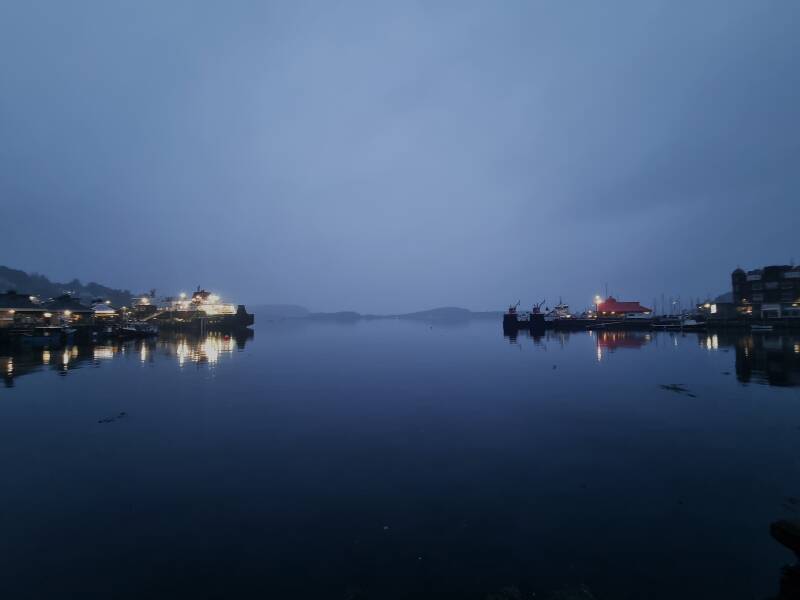
Photo below: a typical summer's day in Oban. The mist is indeed atmospheric and this image invokes the indigenous landscape and Gaelic dialect of the area, I think.
One of the curious features about this dialect seems to be the tendency to add an extra suffix, ending in [gʰ] onto the ends of certain words ending in a vowel. For example coire - corrie, or kettle, becomes coireagʰ in this dialect, whilst mise - “I” in the emphatic sense, becomes miseagʰ. The word eala - duck, similarly becomes ȷalagʰ in this dialect. Note that the dotless j at the beginning of ȷalagʰ is pronounced like the English 'y' in 'yes'.
This suffix relates to -adh, -eadh suffixes which are also frequently pronounced [gʰ] in this dialect, e.g. fiodh - "timber" is fiʊgʰ in this dialect, but this is not the case in every word, with fiadh - "deer" becoming fiø in this dialect.
The broad velarised L in this dialect often has a w sound after the L, but this varies upon the word, and is also common in medial positions. Examples of this occurring initially can be seen in the words lwø̀ran - "claw", lwajir - "strong" and lwai - "hand", the standard Gaelic forms of which are: ladhran, làidir and làmh.
Some medial examples of this sound, in this dialect, can be seen in the words er cʊ̀lw - "behind", dalwam - "a poem", and jalwag - "a thorn", the standard Gaelic forms of which are: air cùlaibh, dàn and dealg.
This dialect also contains some quite unusual diphthongs, which can differ significantly from those in surrounding dialects. Glottal stops are also not particularly common in this dialect, but they do occur in certain words it seems. As can be seen, the slender d in this dialect becomes what is essentially the English j sound, hence it is written as j in the word lwajir - "strong", for example, this word also lacks the long vowel most commonly found in this word in other dialects.
I hope that this blog post was an interesting read. All words marked in bold are spelled based partially upon the given phonetics of this dialect as recorded as the speech of informant no. 60 in the Survey of the Gaelic dialects of Scotland, edited by Cathair Ó Dochartaigh. This article/blog post is dedicated to the Gaels of the Oban area, and to their ancestors.
Add comment
Comments