Written and published by Linden Alexander Pentecost, published early in the morning on the 4th of August 2026. This article/blog post is unrelated to and separate from any and all of my other publications, no AI was used in this nor in any of m my writings, and this blog post, like this website and my other websites, is published in the UK. I, the author, also took the photo of the North Sea coast shown in this blog post. This blog post contains 2233 words. Neither the article as a whole nor the photo have been published before or elsewhere.
I have heard it commented before that Dr Who is "scientific" and is not religious or spiritual, but, Dr Who is actually full of spiritual, ancient esoteric, and religious themes if you know how to recognise them and to read them. Part of the classic series' points of deception, whether deliberate or not, seems to be in that very spiritual and esoteric themes are under the guise of science fiction, in other words, Dr Who can in some ways be thought of as an esoteric, spiritual journey, framed in terms of "modern science" and therefore bypassing the audience's awareness of the more deeply spiritual themes, by reflecting science fiction on the surface.
With no Dr Who do these spiritual and esoteric themes become more profound than with the series' involving the 7th doctor, acted by Sylvester McCoy. The episodes/series with the 7th Doctor focus greatly upon the fight between good and evil, and in some way or other, often involve the Dr deliberately downplaying his intelligence and knowledge about a situation in order to allow evil to feel convinced it has won, thereby undoing itself and destroying itself in the process.
The 7th Doctor's esoteric nature is expressed in the number 7 itself, as well as in the repeated use of "question mark symbolism", with question marks of course resembling the number 7. I feel that the use of this "question mark" theme pertains to the idea that what is uncertain, what is not said, is often more potent than that which is known and said, and another thing about the 7th Doctor and his plans, is that usually his enemies, and even his assistant Ace, have no idea what the Dr's plan is, and so this question mark serves as a reminder: "what will he do next?"
Without doubt, for me, one of the most potent and intriguing stories from the classic Dr Who series, is "The Curse of Fenric", staring the 7th Dr and Ace. This is a story that connects the northeast coast of England, Dracula, to the Cold War, arguably, to the ancient interactions between Vikings/Norsemen and Russians, to Viking lineages, to Viking curses, disease, and to Ragnarok, to the theme of "drauger", the theme of runes, language, acting as a key to something far more ancient and advanced, and to the battle between good and evil.
The most potent characters in "The Curse of Fenric" are arguably the haemovores, a kind of vampire that results from becoming infected by the "Curse of Fenric". But these are no ordinary vampires, whilst they connect to the story of Dracula in a sense, and to more "normal" vampires in that way, haemovores are essentially a re-telling of the Norse concept of the drauger, under the guise of science fiction.
The Curse of Fenric is visually potent with this drauger symbolism. We see these undead, vampire-like beings emerging from the misty sea, parts of their skulls and spinal cords visible, their faces and bodies covered in octopus-like suckers, their skin a blueish purple. We see one scene when these haemovores are walking through a misty graveyard, past the graves of their own ancestors, baring the Norse name Sundvig - the idea being that these haemovores are in part able to become such due to this "curse" being passed down the lines of Norse descendants on this part of the northeast coast of England. The scenes showing the haemovores coming out of the sea, with mist in the air, and walking through the graveyard, strongly, for me, invoke the spirit and feel of drauger, which are dangerous beings, albeit not in my opinion evil.
In the series, we see two young adult cockney women turn into haemovores, and apart from becoming very pale, and developing long claws, and being unable to feel the cold, it would seem, they look more or less human. But the appearance of the other haemovores show us that over time, these women would have gradually transformed, over hundreds of years, into less-human looking haemovores, likely they would eventually become covered in suckers, their bones would become partially exposed, until eventually becoming humanoid shapes of tentacles, suckers and teeth. Thus is the "curse" of Fenric.
We learn that this appearance is not accidental, and that this advanced haemovore form is essentially a potential future for humanity, if the oceans were to become poisoned by the evil of Fenric (a green, poisenous substance), then humans would eventually evolve into haemovores, from a land of chemical waste and slime. We also meet "The Ancient One", who wants to help to create this future so that his haemovores and his race live. The ancient one is aso known as Ingiger. I wonder if there is a connection between this name and the Old Icelandic word gýgr - a kind of giant. Note that I also discuss aspects of this word in my unrelated article published yesterday (but which is not quite yet completed), the link to which is: https://www.runic-serpent-777.co.uk/on-gaelic-other-languages-around-the-scottish-seas-publ-on-the-03-08-2026
Like the drauger of Norse mythology, the haemovores are not bad or evil themselves per-se, rather their behaviour seems to be motivated by their own trauma and survival. And in a strange way, the haemovores, and their evolution from being for example, pale females with long claws, to becoming Cthulhonic drauger-like beings, has a certain intriguing beauty. There could be an interesting twist made for a future Dr Who story, wherein a more positive take is given to the idea of this curse, and it being ritually "passed on" in some way, akin to how many modern vampire films depict them and their "curse" in a more positive, sacred light, in their own way. Although this is not to say that these things are positive in a spiritual sense.
I do not know whether or not there are any legends concerning drauger-like beings known among the Pomors, Vienan Karelians, Sámis or Nenets of the White Sea region of Russia. Note that in another blog post recently on a different website I discussed the languages of this area, the link to which is: https://www.runic-serpent-777.co.uk/3303529_on-russian-grammar-the-pomor-dialects-languages-of-the-white-sea-publ-on-the-02-08-2026 .
Given that there are Russian characters in the Curse of Fenric story, and given the way in which the Russians in the story seem to be repeating a voyage that Vikings made long ago, and by design, I do wonder if this connects back to the actual links between the Norse, the Rus and modern Russia, and the Bjarmians etc. So many things about the Curse of Fenric story feel like more than just fiction, even if the exact characters etc are obviously fictional. In the following article linked to, I discuss something of the ghosts or draug-like light apparitions connected to historic Russian settlement on an island off the coast of Norway, the themes and vibes seem again similar: https://www.clwaideac-na-cuinne.co.uk/articles-on-travel-and-language-r1-to-r25/r1-exploring-around-kvaloeya-and-sommaroeya-in-troms-and-their-linguistic-history-mysteries
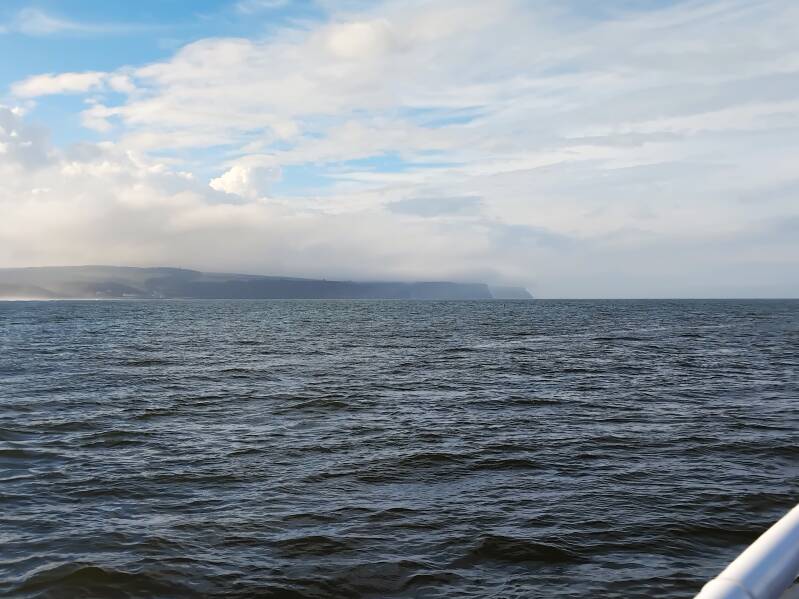
Photo below: the North Sea Coast, looking north of Whitby, the place associated with Dracula (I have also discussed other aspects to Whitby elsewhere), the photo below I think invokes something of the themes in The Curse of Fenric, its imagery, the mist, the sea cliffs rising above the sea that was once used as a passage for Vikings. Furthermore, when I was last there, I saw the Northern Lights, something also connected I think to the themes discussed in this article.
One of the most fascinating ideas in the Curse of Fenric also connects to my own ideas about runes, in a sense, that they represent some higher form of language, beyond just their reading in Norse. In the Curse of Fenric, Ace implies that one of the runic inscriptions is some kind of logic diagram for a computer. There is definitely an implication in the story that the runes are a code for something more ancient and "beyond" human language, representing I think another kind of language. Furthermore, the physical, green poison associated with Fenric's curse is similar in a sense to the Norse concept of the eitr, a yeasty, fungus-like primordial substance that was important in the creation of the universe, according to Icelandic tradition. The root behind eitr is also connected to the concept of serpent venom or wyrm venom, or juice, and it is noteworthy that Ingiger or The Ancient One in the story, is also known as "The Great Serpent". Note that I am not publishing this blog post on my "runic serpent 777" website, and all of my websites have content and discussions connected to serpents and to their symbolism.
Another curious thing about the Curse of Fenric, is the way in which one army commander seems far more capable at holding off the evil than any of the others do, even though if in the end he becomes possessed by Fenric. The nature of this evil seems to be one of lacking faith, with Fenric depicted as mindless and evil, again, the "Wolves of Fenric", including the haemovores and The Ancient One/Ingiger/The Great Serpent (the oldest haemovore), are not evil, and this is visible in the story, their vampiric, sometimes lusty behaviour driven by their circumstances, and again I think there is potential to depict them positively, and for them to find meaning on their own.
Of course we can also talk about the similarities between the name Fenric, and of course Norse Fenrir and Fenrisúlfur, the connections between these and Fenric would be a discussion in and of themselves, but they are one of the more obvious connections which I have chosen not to discuss here. Could there also be some, vague link to the Danish word Fanden - "Devil", even if through associated etymologies? Compare also the name "Fendahl", a Dr Who entity included in a series with the fourth Dr, Tom Baker. Could this word "Fendahl" connect to Danish Fanden in some way? The Fendahl is something I wish to discuss in a future publication.
Another thing I noticed about Dr Who recently, during the "Trial of a Time Lord" episodes with the 6th Doctor, Colin Baker, was a brief reference to polyandry, when Peri, the Dr's beautiful American assistant, becomes captured by a future tribe of humans, lead by a lady who sounds very posh, but who carries the vibes of Boudica, in my opinion. When this tribal leader lady presents the possibility of many husbands to Peri, Peri seems to gasp, outwardly shocked, but with a positive, excited twinkle in her eye perhaps, and says "husbands? Plural?" This shows the way in which Dr Who, even back in the day, subtly and positively introduced mind-opening concepts. Sadly I feel that in recent years the show has come across in such a way as to seem (in my opinion) like it is "forcing" generally positive ideas on its audiences, and I feel that that sense of it feeling "forced" and "preachy", even if the things being preached are positive, has meant that the stories have suffered. Traditionally such things were introduced in Dr Who more through suggestion, creating intrigue within the viewer's minds, like with the example of Peri discovering the idea of many husbands for example. A few episodes later, Peri becomes shaved bald in preparation for having an alien's mind transformed to her brain, not the most pleasant circumstance, and thankfully this turns out to be just a fabrication. However, I think Peri, with a bald head, but with dark eyebrows and eyeliner does look very beautiful, and I think this is another example of Dr Who demonstrating non-conventional idea, or in this case, look and expression of beauty. I just wish that the circumstances of her baldness had been more positive, for example if she was consensually undergoing a transfer of some aspect of mind or spirit to hers in a way which would be beautiful and positive in a strange, alien way, but in reality of course this was not the point of that particular story; nevertheless, the aforementioned is how I might have written it with a more positive point and strange, but positive outcome.
The 7th Doctor's episodes also incorporate other mystical themes too, and, like the Fendahl for example, similar mystical concepts can be found in Dr Who in general, when one interprets them as archetypes and entities and not as "aliens" as they are depicted within Dr Who. And I will discuss more on these, and on Dr Who's symbolism, in the future, this article being my first publication dedicated to this subject specifically as a standalone work.
I hope this article was an interesting read. It is dedicated to the actors and writers of the Dr Who stories discussed; and to all those I love.
Add comment
Comments