Written and published by Linden Alexander Pentecost on the 29th of July 2026, this blog post is completely separate from and unrelated to any and all of my other publications, including to those all separate publications, both those published recently and much longer ago, which discuss these topics, including sometimes Utrøst. The photo in this article was also taken by myself, the author, and has not been published before; the photo description also contains information not in the main text. No AI was used in this article, and this article was published in the UK. This article/blog post contains 870 words.
One of the themes in the story “The Cormorants of Utrøst” or Skarvene fra Utrøst in Norwegian, is that when the main character is lost at sea, three cormorants come down to this boat and help to guide him and his boat to Utrøst.
A somewhat similar thing happens in a tale about Tìr nan Òg as recorded in Tom Muir's book Scottish Folk Tales of Coast and Sea. In the story in question, titled Tìr nan Òg and beginning on page 118, a man called Aodh is fishing close to Oronsay and is then swept out to sea and into a storm. A group of oystercatchers then fly over him and their presence seems to calm the storm immediately around them, as he is guided to Tìr nan Òg.
I personally believe that we can connect these tales of birds guiding people to Undying Lands with the idea of “The Straight Road” in Tolkien's legendarium. In these aforementioned stories regarding Utrøst and Oronsay it seems to be implied that the seabirds are in a sense able to show people and/or to help them to find “The Straight Road” from our physical seas and to these islands, at least in certain circumstances.
In some versions of the Utrøst legend it is even stated that in order to get back to Utrøst, a person must keep/follow the course of the cormorant as it goes out to sea.
The cormorant in this sense can also be seen as related to the idea of a divine water bird in Uralic mythologies, who lands upon the divine waters of creation. In this sense the cormorants and oystercatchers can perhaps be seen, in some ways, as a western Atlantic-based equivalent of this idea, in which these seabirds are showing people the way back to divine realms, that connect to but go beyond the waters of the skies and seas.
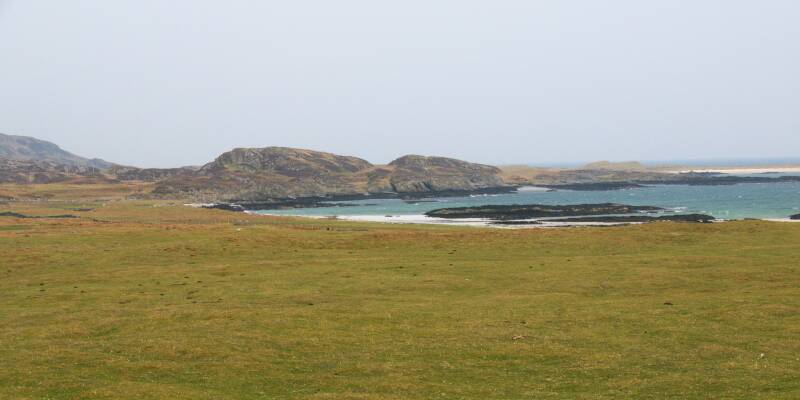
Photo below: the coastlines of Oronsay, taken from near to the prehistoric shell middens. The coastlines of this island are indeed extremely mysterious and for me invoke feelings of incredibly ancient cultures, their presence is something I can still feel loudly on this now lonely island.
Note that recently on my newest website (not the website you are on but a very new website titled: www.runic-serpent-777.co.uk) I discuss other divine bird figures in an unrelated blog post, including in relation to the mystical island of Буян, Buyan in Russian traditions, the link to the recent unrelated blog post is: https://www.runic-serpent-777.co.uk/3297247_on-russian-folk-beliefs-including-the-zhar-ptica-firebird-related-topics-publ-on-the-28-07-2026
Note also recently I published another unrelated article (and unrelated to the aforementioned article in the previous paragraph) with other new important information on floating islands, flotoyggjar in Faroese, and related topics, the link to this other article (on yet another website, recent but not as recent as that linked to in the previous paragraph), the link to the flotoyggjar article is: https://www.kielimatka-2-11.co.uk/on-flotoyggjar-valinor-rocabarraigh-the-green-isle-publ-on-the-26-07-2026
Another fascinating thing about this story about the man who goes to Tìr nan Òg from Oronsay, is that his boat is described in the story as having a wooden frame and being covered with skin, essentially a prehistoric boat akin to what the Fin-folk on Orkney seem to have used, and in a sense akin to how the boat of a ciuthach is described in one story.
If this is factual and is not embellishment by Tom Muir, which I don't think it would be, then it also seems to imply a connection between the boat and the Fin-folk, and with a prehistoric Scotland, these same connections exist elsewhere in different ways as I have discussed elsewhere.
What is also of note is that Oronsay has a number of large, prehistoric shell middens from the Mesolithic period, which I have also discussed elsewhere. Could the cultures who constructed these also relate to this story?
A difference between the two stories I mention here is that whilst visits to Tìr nan Òg often seem to mean that time passes much faster on earth in relation to there, this does not appear to be the case with Utrøst. Note also that in this article I use the term "Undying Lands" to refer to both of these places, which I feel is accurate, even if originally this term was used specifically for the islands west of Middle Earth in Tolkien's writings.
I hope that this article was an interesting read. It is dedicated to the ancient spirits of Utrøst and of Tìr nan Òg, and to the ancient peoples of western Scotland and western Norway.
Add comment
Comments