Written and published by Linden Alexander Pentecost. This blog post was published on the 24th of August 2026, after two other unrelated blog posts were also published on this website's blog earlier today. No AI was used in this publication and it was published in the UK. This publication is unrelated to and separate from any and all of my other publications, I, the author also took the photo in this blog post. This blog post contains 739 words.
Cumbria has a rather large number of stories about, and reports of, giants, as I have discussed in detail elsewhere. One piece of information that I only found yesterday however, and which I find extremely interesting, can be found in the book NORTH-COUNTRY FOLKLORE by Jessica Lofthouse. On page 131, she writes: The historian Collingwood wrote of crane men, tall hunters who stalked the fells between Coniston and the Duddon, before the days of recorded history,...
Whilst Jessica Lofthouse does not to my knowledge provide an exact reference, I think she is talking of the historian and antiquarian William Gershom Collingwood. On page 131 of Jessica Lofthouse's book, she goes on to describe, how these "Crane Men" left their marks around Beacon Fell, White Borran, Blawith Knott, Raisthwaite and Heathwaite. She also says that their graves are marked on maps between Tottlebank (near Greenodd) and Woodland. I do not know if what is being referred to here are the Giant's Graves marked on modern Cumbrian maps, such as that near Blawith Knott, but it seems that Jessica is implying the existence of some of these other "giant graves" which I have been unable to locate. One historian from Millom also told me how even now they came across graves of unusual size. Jessica Lofthouse also implies that the people of Furness believed that these were indeed inhabited by larger than normal humans, and some excavations in Cumbria also imply, or state this (with regard to giant graves elsewhere in Cumbria).
I had always felt that the landscapes around the Duddon were deeply connected to these ancestors, and the implication that they were known in folklore as "Crane Men" is indeed fascinating. Presumably they were named such due to them being tall, like cranes, but I suppose it is also possible that they were connected with cranes, or waterbirds in some way? But this is perhaps less likely. Could the "crane men" being reported, possibly be folkloric memory of these Celtic, or pre-Celtic speaking "giants" who inhabited west Cumbria in ancient times? Or is it possible that a facet of their culture survived in some independent way into contemporary historic times? That they are described as hunters and of stalking fells, might also be implying to some degree that these "Crane Men" did this as an ordinary part of their culture and homeland, and not as other hunters would go into the fells only sometimes. Could this be implying that the Crane Men were thought of as an indigenous group?
Photo below: a section of one of the "megalithic" drystone walls, located on the side of the steep road between the Duddon Valley and Broughton Mills. This whole area is filled with significant stones, cairns and other features that look suspiciously like they are part of a sacred landscape associated with giants.
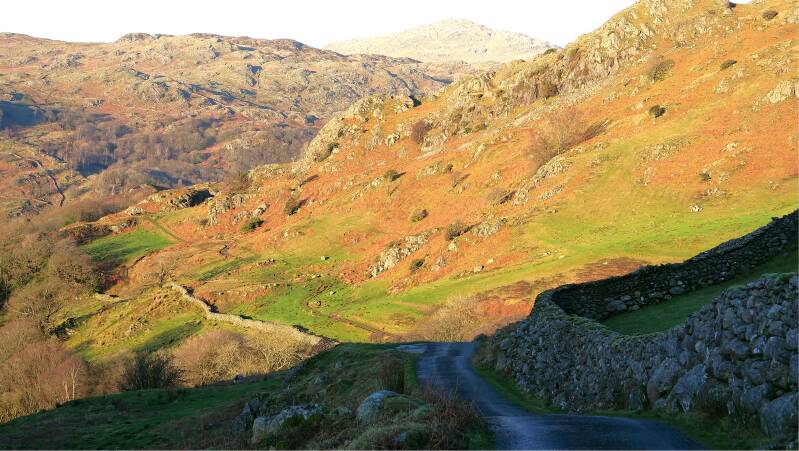
Another thing with regards to giants around the Duddon Valley, is the presence of numerous drystone walls of very large size. Whilst drystone walls are common in Northern England, there are plenty of examples, a fair few of which I have discussed elsewhere, where more ancient wall systems or megalith arrangements become incorporated into later drystone walls. Some of those however, just above the Duddon Valley, on the road from the Duddon Valley to Broughton Mills and Dunnerdale, are of exceptionally huge size - at least at their bases. Could these drystone walls made for massive rocks, especially at their bases, be indicative of a more direct continuity between megalith builders and drystone walls, and could this relate to the "Crane Men" connected to these very hills?
I hope this blog post was interesting, it is dedicated to the Crane Men, and to all who love the Duddon Valley and Coniston - may you all be safe if hiking or exploring in those areas.
Add comment
Comments