Written and published by Linden Alexander Pentecost, published early in the morning, UK time, on the 2nd of September, 2026. This blog post is unrelated to and separate from any and all of my other publications, and has completely different content from any of them, even though it connects in many ways to things I have published elsewhere. No AI was used, and this article/blog post is published in the UK, and I the author live in the UK and am from the UK. I also took the photo in this article/blog post, like the blog post the photo has also not been published before, but some different angles of the carving in question have been elsewhere. This blog post contains 1324 words. Another completely unrelated blog post will be published shortly after this one on this website, and then another after that, two on the 2nd of September 2026, and one in a few days, of which this blog post in front of you is the second. I also published an unrelated article/blog post on this website yesterday. I have discussed a lot of other topics about ancient writing elsewhere, particularly in relation to the Orkney Islands but also more generally, this is all published across my publications (not in the article/blog post in front of you here)
This blog post is a follow up and update from my extensive work already this year and before on apotropaic markings in caves, and related topics. I published many valid and I think important things about these subjects already this year and before, but in some cases I became overwhelmed when trying to understand these subjects, and so rather than overworking my mind to try and comprehend them, for now, I want to update a change in what I am saying about some of these sites. This does not exclude any of my earlier comments and earlier photos, which are I think relevant and important, I want merely to state my general re-framing of my current understanding of these particular sites numbered below, as an update to my earlier publications on them:
1. Sandstone caves in Cumbria - most markings can be explained as pick marks, a few examples are more clearly W or M markings, another does resemble a serpent carving, some of the orifices and other shapes could be carvings of unknown age, as I have discussed elsewhere, but I suspect that even if Lacy's Caves is old, that the carvings may not be so old, but some of them may nevertheless be apotropaic.
2. Dunald Mill Cave, Lancashire - this very dangerous cave does I think have at least one example of a W marking or set of markings, and another marking of some kind, even if graffiti, near the entrance.
3. Jubilee Cave, North Yorkshire - this site certainly does have apotropaic markings, what I discussed and photographed, all in publications (mostly in other blog posts on this website) - I certainly found some markings and photographed them in this cave, some might be apotropaic, others graffiti, both are important for understanding historical context, language, and these caves generally.
4. Cave just to north of Victoria Cave, Yorkshire - the "butterfly markings" in this cave are I think more likely natural marks where certain layers of rock have eroded, but some of the W-like markings and possible the possible letters beginning with an R, are likely I think graffiti, perhaps some are apotropaic.
5. Victoria Cave - two unusual symbols, possibly modern, but with elements of ancient design, are found on the walls to the left, near the entrance, the upper one consisting of two connected circles is not accessible, and the cave is dangerous. I think that the other carvings or markings within the cave are again natural markings and graffiti, but somebody may prove this wrong. Nevertheless my previous publications on this site are important, some of which are on this website, and the markings, whatever they are, are important parts of the cave's history, regardless of what period they come from.
Most, but not all, of the above sites, are to at least some degree discussed in other blog posts on this site. I have discussed & published about the rest and, more on them generally, in publications beyond this website. This blog post/article continues beneath the photo description and photo below. All of my previous work in relation to the sites discussed above, is nevertheless important and does reveal much historic detail as well as important concepts and photos of these sites and markings.
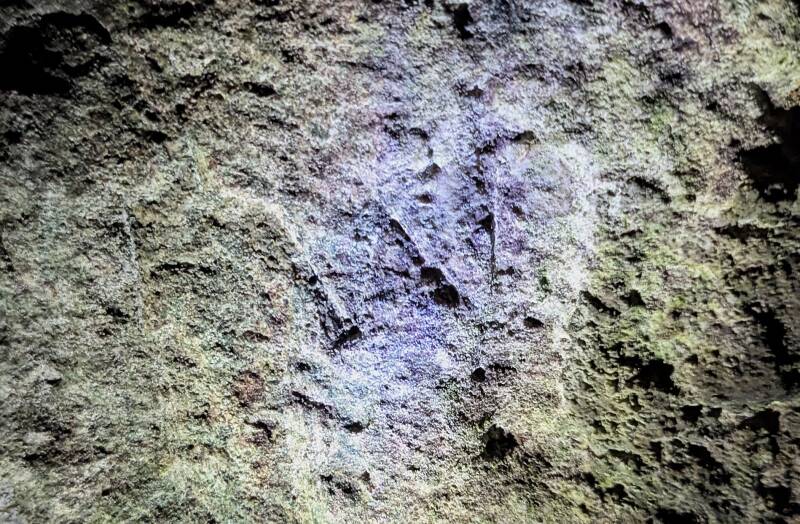
Photo below: another photo of one of the carvings at Dunald Mill cave, other photos of this carving I have published elsewhere, with different lightning and from different angles. The photo below is useful for showing the clear lines of the W shape, which may only be a part of this carving. Note that Dunald Mill Cave is very dangerous, with many unsuspecting drops. Note how in the photo below the lines are clearly distinct from the natural lines in the rock.
When conducting this research, I became, in a sense, almost too obsessed with trying to understand whether or not the carvings in these above locations were authentic, apotropaic markings, of which I am sure some of them are; but in doing so I think I became distracted from the bigger picture, and what I hope to do now is to visit some new sites, to look at them and their geology from a new standpoint, and to look at their markings in relation to that understanding. Work already on these markings and caves, and my own other work there, in a sense distracted me from seeing the bigger picture, hence why I have not progressed this subject much for several months. Note that I have discussed a lot of other examples from outside and within Northern England which I have not mentioned here, as those are the ones I am confident about. Nevertheless my publications on those mentioned here is valid and shares important data and comments.
There are also so many aspects to this I have not discussed, such as apotropaic markings, resembling runes, in form, found in sites in France, and across central Europe. I have only discussed a few of these possible ancient examples before, and hope still to write a Silly Linguistics article on some of these examples elsewhere in Europe. There is just an awful lot to process for a human being when it comes to this subject, and with so little work being done on it in the UK, apart from myself, and of course a few others, it is currently very difficult to make interpretations on what I have noticed and found, with regard to this subject. Creswell Crags is another place which possesses these markings in Northern England, and there are also other caves in North Yorkshire containing them, which I have not yet visited. My other comments on markings elsewhere, runes, Pictish markings, markings in Orkney, Ireland, across Europe etc, I am more sure about. I also want to note that Kings Cave on the Isle of Arran seems to contain Pictish, Ogham, and so far unresearched apotropaic-looking markings.
In terms of my future plans for this website in general, I intend to continue with blog posts for now (and another unrelated one will be published shortly after this one), and to create some more longer articles to be available on the website's top panel. I will be publishing more on apotropaic markings in the future, possibly yet more on this website.
I hope that this article/blog post was an interesting read, it is dedicated to all cavers, in wishing them to return home from caves and mines safely, and it is dedicated to the spiritual beings and ancient people connected to ancient caves.
Add comment
Comments