This very long blog post was also published on the 12th of November 2026 by Linden Alexander Pentecost, most of the content (but not the first section nor the last section, both of which are extensive) of this blog post is actually blog posts I published for another website, but which I then took off that website to republish here - none of said blog publications were web-crawled by the British library. The first topic discussed aka Tiree and Coll Gaelic also contains different information and examples from those very numerous other publications I have written on these dialects. The last section of this blog posts discusses entropy in language and related topics. No AI was used in this publication and this publication is unrelated to and separate from any and all of my other publications. All photos and the art included were also taken by me, the author. Note that beneath some of the individual "what were" blog posts I say "thanks for reading this blog" etc, but for this blog post as in where the old posts have been republished along with new content, I give a similar message right at the end in reference to the blog post (the whole blog post) on this page. This blog post contains a whopping 21,175 words and 9 photos, one of which is of a piece of art I did. This blog post is also unrelated to the other blog post I published on this site earlier today, which is about something more specific and is not in this blog post but which has a tiny bit of crossover in topics with the much larger content and subject range of this blog post in front of you on this page. Like all articles blog posts this was published in the UK.
Updates were added to this blog post on the 16th of November 2026
Yet more on the Gaelic dialects of Tiree and Coll
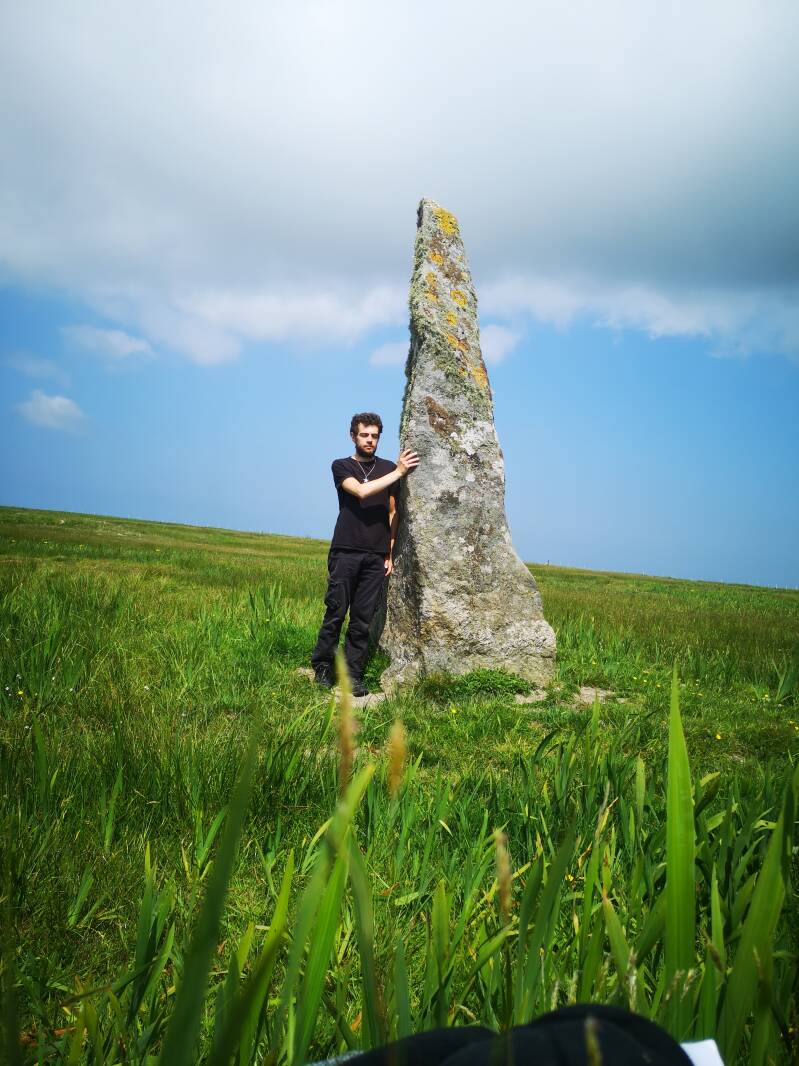
This main section begins beneath the photo and photo description above it - of a previously barely-described (by me) Tiree standing stone.
Photo below: a self portrait showing the Balinoe Standing stone, next to myself, the author of this blog post. This standing stone felt very grounding and positive to me, and I love the way in which it catches the beautiful light of the sun as it caresses the stone with warmth, as the sun makes its daily cycle. This stone felt extremely "grounding" for me, whereas Tiree's energy is in many ways not very grounding at all, and can be described as highly entropic in Kozyrevian terms. The shape of the standing stone is almost like that of a steep pyramid, and its energy is somewhat scary I think, but not in a bad way, just in a very imposing way. I found the stone very comforting and I loved its presence in the otherwise empty and flat landscape. I wonder if, as with some of the other stones I have discussed on Tiree - if this stone in a sense grounds the island's chaotic energy, and the more that I have learned about Kozyrevian time energy the more that I understand why these stones on Tiree might be very important for stabalising that energy, but I still think that more conscious effort needs to be done in empathic relation towards the land on Tiree, to help to stabalise its energy. Note that Tiree is also discussed further down this article, with an image of the Dun Mor Broch at Vaul also included.
Tiree and Coll are the two most northwestern of the inhabited islands of the Inner Hebrides, and are located somewhat southeast of Barra, and to the north and west of Mull, with Tiree being the more westerly of the two islands.
The Gaelic dialects of Tiree and Coll can be considered as members of the larger Argyll Gaelic subgroup, and I think that the Gaelic dialects of the two islands, sharing certain features in common, including unique features, could in a sense be classed as their own subgroup of Argyll Gaelic. On the other hand, the dialects of these two islands also share specific and more general similarities to other Argyll Gaelic dialects, making it difficult to classify them.
Both dialects are critically endangered, with Tiree Gaelic having more speakers. The exact number of speakers of the native dialects of these islands is unknown, even if census data can give an idea about the number of Gaelic speakers in general.
From my own experience, there are still a fair number of Gaelic speakers on Tiree who speak forms of Tiree Gaelic, but I have only spoken to a few of them, and have only on occasion heard Gaelic spoken on Tiree in a public context; which is not to say that it does not happen, just that perhaps one is less likely to hear the native dialect spoken publicly than one is likely to hear Lewis Gaelic spoken on Lewis, for example. Tiree has a population of around 700, whereas the Isle of Coll only has a population of around 180, and the native Coll Gaelic likely has very few speakers now.
The situation on these islands in terms of the continuation of the local Gaelic culture, and the ability for locals to continue living on the islands, is also being threatened at present. This is in part due to property being bought by outsiders, often forcing locals out of the housing market; and also due to continued issues with ferry connections. One individual from Tiree, whose family is from the island, told me that he fears the current situation will result in a second “Highland Clearance”.
Tiree also has an incredibly rich folklore, a wealth of prehistoric archaeological sites, and natural landscapes that are beautiful beyond belief, and it is understandable that so many people visit the island.
No matter how much Gaelic might be taught through adult courses and the like in the future, the Tiree Gaelic dialect, and the indigenous culture of the Gaels on this island, are I think endangered. The folklore, language and nature of this island are deeply connected, and I believe that the loss of one of these things will render the others forever incomplete, and I really hope that that does not happen.
On some features of Tiree Gaelic
Tiree Gaelic shares many features with other Argyll Gaelic dialects, albeit, not with all of them, but it shares common features found across Argyll. How these features occur differs though from place to place. For example, Tiree Gaelic possesses glottal stops and glottalisation, but not necessarily in the same positions, nor in the same words, as where these things occur across Argyll Gaelic dialects.
Another common feature is that the future verbal suffix, -idh, tends to be pronounced as though -ich, and is written here as -ich. Another feature is that words such as ceòl - “music” and beò - “alive”, tend to be pronounced with two vowels (specifically as [eo]. I write these words in the dialectal orthography representation here as cëòl and bëò.
The slender d is often, but not always, pronounced [dz], a feature that occurs in many other parts of Argyll. Examples include:
A particularly interesting feature of Tiree Gaelic is that the slender r, when not in initial position, may sometimes become a vowel or semivowel, or may occasionally become [z] or a variant of [s]. Examples of the slender r becoming a vowel or semivowel are found in the Tiree forms of standard spelling: cuirm - “a feast”, muir - “sea”, morair - “lord”, Màiri - “Mairi”.
Examples of the slender [r] becoming a [z] or [r] can be seen in Tiree Gaelic forms of the words famhair - “a giant”, and màthair - “mother”, which in Tiree Gaelic I write as foʼɲai̯ʴ and màʔaiz, with the first word containing glottalisation and a mysterious [ɲ]-sound, like the Spanish ñ, and the word ending in a slight “r” at the end, similar to the English “r”, which is neither rolled nor trilled; and with the word for “mother” containing a glottal stop, and with the final slender r having become a [z] sound.
Coll Gaelic and Tiree Gaelic
The Gaelic dialect of Coll shares many similarities with that of Tiree, including similar changes to the slender r, although these changes seem to occur differently, at least to some degree, in the two areas. However, it is likely that such variations also exist in different parts of Tiree (and Coll), and I am aware that Tiree Gaelic has variations between the eastern and western parts of the island.
Note that my use of this dialectal spelling is not supposed to be a replacement of the standard spelling; I just feel that as soon as Gaelic pronunciation is explained in terms of written form and separately as pronunciation in the IPA, it automatically separates the two things. By using these spelling variations on the other hand I am trying to express the two as one concept and element, and express the etymological and spoken forms as a single interconnected unit.
On a mysterious site in Coll
I have never actually been to Coll, but one place on Coll that really draws me is the Clach na Ban-Righ or “Stone of the Queen”, a large stone which is balanced upon three smaller stones. This may be a glacial erratic, although these kinds of sites of rocks, balanced in this way, are sometimes identified as structures made by ancestral peoples, sometimes called “propped stones”. Several possible examples have been identified on the Isle of Lewis (see note 1), but they are found in many other places, the sacred mountain of Vottovaara in Karelia, Russia, being a place where many are found.
According to A Journal of A Tour to the Hebrides with Samuel Johnson by James Boswell, the Clach na Ban-Righ was thrown by a giant to his mistress, who then threw it back at him, implying that the stone had significance in the animistic context of the landscape.
From CKY to Greenlandic, part one on "getting to know Indigenous American languages"
I have had a love for Indigenous American languages for a long time. Some people are just mainly drawn to the cultures and places they are most familiar with in life. Many in the UK, are I feel drawn to Asia, not only because one can stay in Thailand for example, cheaply by UK standards, but also I feel there is a "general thing" in peoples' consciousness right now, where southeast Asia especially does draw people - including on a spiritual level, being a region of temples and Buddhism for example, although foreigners likely only rarely look at the more indigenous beliefs. I also haven't ever met a single UK person who learned one of the languages spoken there, but for me personally, I am more drawn to the Americas than to southeast Asia, and to the land, cultures and spirituality, and languages, there.
From my experience, people in the UK know far less about the Americas than about southeast Asia. On that level, like Siberia, the Americas in general always invoke in me a feeling of magic and hidden wisdom. I would say that probably most of the American films we see in the UK, do not focus on the indigenous people, nor indigenous aspects to the landscapes. Nevertheless, these things underlie everything in any American film that allows one to see anything of landscapes or culture. Even in an American TV series like say, CKY, Native Americans might not be the focus, but we are constantly seeing bits of the landscapes and nature around West Chester, Pennsylvania.
For me personally, when I feel the slightest love for a place, even when seen through TV and being able to "feel" something of its vibe in my consciousness - I wish to know how to call it, how to relate to it. I ask, "what did the indigenous people of that place call a 'river'? What is its true name? What about that mountain there, what did they call that? It feels mysterious, what is in its ancient name?"
This is really what got me interested in Native American languages; but it was also being able to glimpse and to feel something of their immense wisdom, initially through certain films, books etc. I felt that their languages must also be wise to reflect them, that their languages must possess an understanding of their lands, so vast, ancient, complex, different, from anything in Europe. And I am not wrong.
Like many perhaps, my initial interest went kind of towards Algonquian languages. They are widely spoken, well, some of them are. The Mohican language for example, an Algonquian language, is spoken in the film Last of the Mohicans, a film that carries with it a powerful emotional truth, and within it, one gets to feel the energy of those vast northern forests, to hear the language, and to understand the kind of wisdom and love that those Mohicans shared with that landscape.
And so at first, it was languages like Cree and Ojibwe that I became aware of. These languages are known for possessing extremely long words, and for being highly polysynthetic, as are the Eskimo-Aleut languages in the Arctic Americas, in many places spoken directly north of where Algonquian languages are spoken.
But I never learned an Algonquian language beyond a few phrases, words and pronouns. I honestly find them exceedingly difficult, exceedingly. Cheyenne for example, a language with words that can be, well, enormously long, and which contain "voiceless vowels", so when learning this language with the help of an audio CD, I was reading the words in the book, and seeing how their spoken realisation almost "floated over" certain vowels, making it very hard, for a person who speaks English as their first language, to understand how such consonants, and vowels, and voiceless vowels, could be made sense of in my mind as one word, with its complex inherent meanings. Cheyenne is I think perhaps particularly difficult in this sense.
Many "western" films and books do of course, by their very nature, give us vast views into a more western landscape, one of arid canyons, pine forests atop mountains, and deserts, dotted with sky-islands or mesa-type mountains. These areas are found in many parts of the Americas, but we often associate them with the southwest of what is now the USA.
Many indigenous peoples have lived here, with the Pueblo Peoples, like the Hopi in Zuni, in many cases being the most ancient to have inhabited these landscapes. In western films, we perhaps more often hear languages like one of the Apache languages though, and the related Navajo language was another of those first Native American languages, which I tried to study. And in the case of Navajo, I was more successful.
I cannot speak Navajo, but there have been times when I have been known, and been able to read or understand many parts, in certain specific contexts. Even though Navajo is also very difficult, being polysynthetic, tonal, and having a vastly complex and diverse verbal system, my process of learning it was nevertheless easier, and felt in a sense more connected, for me personally.
Another of these first Native American languages I got learning, was Greenlandic. With learning Greenlandic, I was more successful than with any of the other Indigenous American languages that lie north of the equator. Greenlandic is, difficult. But it also felt more profoundly connected to my, European world - not simply because of Greenlandic having close ties to Denmark and to the Norse, but for the greater reason of how the Norse interacted with Greenlanders in the past, and how actually the same also happened in the other direction.
I once spoke to a Greenlander for example, who had distant ancestral relatives who had been buried in Scotland. They had been whalers, whaling close to the Hebrides, and had tragically drowned. This is part of what may be a more "long-term" interaction, with people coming to Britain from the west. I have discussed other aspects of this elsewhere in a great deal of detail - but one theory about later sightings of "Finfolk, and two examples of their canoes, are connected by many to Greenland, and to indigenous canoes used by the Kalaallit, Greenlanders. I do not personally think that these Fin-folk were Greenlanders in such a strict sense, but rather that this "Finfolk" could have also been linked to Greenland, for example, just as certain legends imply that they were in Iceland too.
I also went to Iceland, and Iceland is not that far from Greenland; and again, there were some influences from Greenland into Iceland. Perhaps at some point I should search for Eskimo-Aleut cognates for some of the more obscure words in Goidelic and in Nordic languages.
I hope that this was interesting and will quite soon publish part two. This post is dedicated to all Native Americas.
A journey in Nordic languages, and on some Icelandic giants & connected topics
My journey into Nordic languages, began with the realisation that Nordic languages were importantly connected to Scotland. I was already learning and speaking Gaelic, and had originally no interest in Germanic languages, until this realisation about Norse in Scotland. I then learned a little about Norn, Icelandic, and Faroese, and found that Norwegian also particularly appealed to me, and felt somehow "right", whilst I found Swedish to have a beautiful written elegance, and to be beautiful in music; somehow holy. Icelandic and Faroese felt fascinating, connected to the Goidelic-world and to English, and to the Norse language in Britain, in profound ways. In photos of Iceland, with captions in Icelandic, I saw a part of the same linguistic universe that I felt in relation to say the Orkney Islands and their wild seas, and the Outer Hebrides with their green fields going down to the Ocean.
The first Nordic-speaking country I had visited was Iceland. I spoke enough of the language to use it, by memory around noun-cases was kind of vague and did not cover anything like all of them. The vibe of Iceland felt to me connected to Western Scotland, and to Greenland (see my blog post before this one on this website regarding Greenland & Scotland). I liked Iceland, it felt romantic, but it was in many respects the vibe of Iceland, something present there, and in Scotland, rather than it being that Iceland was more beautiful than other places I had been to. It was however uniquely beautiful.
By the time I was on Barra, in September when I was 18, I was speaking Danish and listening to Danish chav music, or had been earlier when I was 18, so I had interacted with all the main official Nordic languages today: Icelandic, Faroese, Norwegian, Swedish and Danish. I was also pretty familiar with Norn (the Norse languages spoken in Scotland), and with Old Norse. But I was also aware of some of the minority North-Germanic languages, such as Elfdalian, spoken in a part of Dalarna in Southern Sweden; Trøndersk, spoken in Trøndelag in central Norway; Jämtlandic, spoken in central Sweden, the Salten dialect of Norwegian, spoken around the Saltfjorden in Northern Norway, and I was also aware of Bondska, the Nordic language spoken on the shores of the Baltic, and in the river valleys, in Northern Sweden.
With Bondska, I initially learned that year only of the Skellefteå, Burträsk and Kalix Bondska languages, particularly as I had gone through Kalix only a few months before going to Barra, having had no idea at the time that Bondska was a language. When in Norway and Sweden around a month and a half before going to Barra, I also did not know much about Northern Norwegian dialects, having only been briefly introduced to them by someone I met in Nordland.
Icelandic, or Íslenska, originally spelled as Ízlenska, is a language of often softer consonants, voiced dental fricatives, like the "th" in English "this" and "thing", gutteral g and k sounds, like the Scottish Gaelic broad gh and ch, and also possessing pre-aspiration (the h sound before certain word medial consonants), which is also found in Gaelic. Icelandic can however have a noticeably rolled r. These things to me demonstrate the quality of Icelandic, which in many ways, gentle, calming, yet its use of certain intonations can make it also sound very powerful, thundering; whilst to me, when a woman says certain things in Icelandic with certain kinds of tone, it can sound sexy. I feel it as a language of vast valleys on summer nights, when the sun never fully sets, and when the volcanic mountains, with lush green lower slopes, gently seem to flow, to the sounds of a waterfall, and of nesting birds. Icelandic also makes me think of flat landscapes of dried lava flows, covered in moss, the warmth of the sun, and cliffs in the distance, towering like giants, and reminding me of the vibe invoked in the 1950s film version of Jules Verne's Journey to the Centre of the Earth, in which Icelandic is also spoken.
There is a specific reason why I think of the giant, namely that I stayed in a place in Iceland, in view of a mountain known as the Lómagnúpur. This mountain, the Lómagnúpur, is mentioned in Njálls Saga, wherein Flosi Þorgeirson sleeps at Lómagnúpur mountain. In a dream, Flosi Þorgeirson encounters a giant, coming out of the mountain of Lómagnúpur, and prophecising the deaths of some of his men. In modern times, although perhaps with some older origin, the mountain giant, in Icelandic: Bergrisi, associated especially with the mountain giant of Lómagnúpur, is also one of Iceland's "four guardian Landvættir" (Land Wights). The bergrisi , or in particular the bergrisi of Lómagnupur is one of these four guardians, and is thought of as the guardian of the southern part of Iceland, with the idea that the bergrisi at Lómagnúpur watches south towards the sea, guarding Iceland. Between Lómagnúpur and the sea are rivers and lava fields, I stayed in one of these areas once. It was quite alarming to know that the eruption at Eyjafjallajökull relatively recently, had caused a large river entering the sea on the south coast to basically change its course, although I do not remember precisely where this river was in relation to Lómagnúpur.
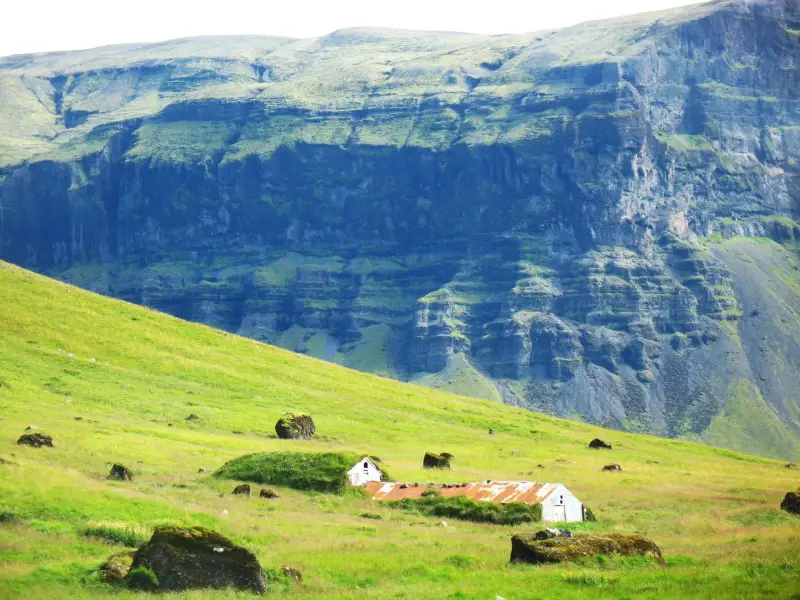
Photo below: some cliffs in Southern Iceland, if I remember rightly, pretty close to Lómagnúpur and as a part of the same system of south-facing cliffs, close to the outflow of the Vatnajökull Glacier. Indeed the landscape below makes one think of giants and of beings connected to the rocks and mountains. The grassy slope in the foreground shows something of Iceland's beautiful summer colours.
The other three guardian Landvættir of Iceland, are the Dreki - "dragon" in the east, the Gammur - a kind of eagle, or a griffin, guards the north of Iceland, whilst the Bull, the Griðungur, guards the west of Iceland. I do not really know anything about these other specific Landvættir, but I know about the legends of worms/wyrms in parts of Iceland, though these are not necessarily "dragons" in the sense our modern culture may understand. I do not yet know much about the other three guardian Landvættir.
"Giants" in Norse tradition can be known by different names, are are not necessarily the same types of beings. One of the most common Icelandic terms is jötunn - often thought to mean something like "eater", but in the name bergrisi we see the word risi being used. Not all of these groups of giants were the same. The term tröll - "troll", can also be applied to "giants", but I do not believe that tröll meant originally a specific type of being, although it may well sometimes describe specific groups of beings, and this can sometimes include "giants".
I have discussed more on the etymology of the word "troll" elsewhere, but here I will discuss different things, for example, that we can see another aspect to the word's meaning and etymology in the Icelandic word trylla - which means "to enchant", but also "to thrill", "to fascinate" or "to delight". In a sense, perhaps something like the "lure of polyamory" can be considered as connected to "troll magic". Just as witches are often associated with polyamorous-type frolicking with horned fertility entities, often simply called "The Devil" in later folklore. Even if polyamorous fornications are not to my knowledge explicitly mentioned in the folklore stories I know like this - I feel it is certainly implied. Whilst polyamory was not the norm in the Norse period, I personally believe that those referred to as tröll in Iceland likely have some connection to pre-Norse peoples, and when they were "physically" in this World, perhaps they did practice a more open form of sexuality. Certainly it does seem implied that female tröll would take Icelandic men as their husbands, which implies a certain promiscuousness, but not polyamory directly.
In Iceland, one of the older terms for "witchcraft" is tröllskapur. This indicates how the word "troll" was not only thought of in terms of being a specific type of being, but rather with a form of magic and enchantment, associated with certain groups of beings, but something which ordinary people could also tap into. This is not to say however that the original meaning of tröllskapur. described something quite akin to how we use the word "witchcraft" today.
In the Pite Bondska language of Northern Sweden, people use the term trölla to refer to beings that in many senses more akin to elves, and this seems to be a specific example of applying the creators, or original holders of this "troll magic", to a specific group of beings.
Another interesting word in Pite Bondska, which sadly I cannot remember at this current time, is a word that means something like a "spook", but more generally it refers to something that is just out of place, in an eerie way. One of my Pite Bondska-speaking friends, told me that when she was younger, her dad talked about such things.
Personally, I do not consider myself a Norse pagan in the traditional sense, because I just don't really identify with the idea of calling myself that, nor do I necessarily feel it is totally me to connect with the main Norse gods. But trolls, and giants, do I think represent earlier undercurrents of spirituality, and I feel that I do more profoundly connect to them. Like several other writers on Norse paganism have implied, to work with gods and goddesses can be communal, ritual, a system that makes sense and is ideal for our current linguistic and mythological reality.
But not all of us fit into that spectrum. And, like several other writers of Norse paganism have implied, working with giants and trolls, and beings that might come under those categories, can be much more personal. These beings, it would seem are innumerable. And unlike the main Norse gods perhaps, it is often necessarily to find them, and to feel them properly, by going to the edge of our realm, where their realm feels most close.
I have personally experienced this in Norway and on the Isle of Tiree for example, although these similar and likely I think connected beings were known generally as a foidhneir or as a ciuthach on Tiree. But, I do feel that perhaps both the Norse and the Gaels were referring to connected groups of ancient ancestors, by different names. I have also written a lot elsewhere about how these mythological and linguistic currents between say Tiree and Iceland might relate to cultures that are technically "pre-Norse" and more to do with the "giants", and "trolls" and "Finns" than being to do with the Vikings themselves.
The other thing about connecting to "giants" and "trolls" spiritually, as other writers have implied also, and also from my experience, it feels in many ways more personal. Whereas Baldr and Thor are main gods associated with the power over certain elements in this linguistic reality, giants are numerous, guardians, connected to particular mountains, caves and places. So if you work with one of them, it is not really akin to worship or a worldview, it's more like a friendship or mutual understanding. You can "feel" it when you're in their area, even see it, because it can feel as though your eyes glitch out or are unable to completely process certain rock formations or features, almost like you just can't quite focus on them for some reason. It feels like trying to look at something five dimensional, with eyes that can only see something that is three dimensional, and there is a certain feeling of sensory overload from the eyes, and an innate feeling that there is something "right there" that you just can't directly look at.
This is of course, just my experience of it, and furthermore, such places are often dangerous, and if you believe in these things like I do, then you'll understand that what I refer to as these beings, can be dangerous and deserve our respect. Pagan writers on these topics likewise may explain how these forces are all unique, and how they contain within them the full spectrum of friendly or unfriendly towards people, just as people display these spectrums of attitudes towards nature. Generally, being cautious, self aware, knowing when to turn back, and most of all: empathy, are all important things here.
I hope that this blog post was good to read, thank you! It is dedicated to the beings and ancestors herein mentioned, and to empathy for all.
More on flotoyggjar around the Faroe Islands, & older Danish texts
This publication discusses aspects to the flotoyggjar I have not discussed before, which includes having not discussed these aspects in other recent publications about them, with this publication on this page being entirely separate from my other publications about them. I have written numerous other things recently regarding these flotoyggjar and have discussed much more on these topics before that, the other recent publications (unrelated to and separate from the one on this page, and with other examples and information) are: my article: On flotoyggjar, Valinor, Rocabarraigh & The Green Isle, publ. on the 26/07/2026, published on www.kielimatka-2-11.co.uk , my unrelated blog post: Cormorants and oystercatchers as guides to Undying Lands, publ. on the 29/07/2026 published on www.languages-of-linnunrata.co.uk and my unrelated blog post: On Russian folk beliefs, including the Жар-птица/Firebird, & related topics, publ. on the 28/07/2026, published as a different blog post on the website you are currently on (www.runic-serpent-777.co.uk). I have published many other recent thing with discussions on tsunamis and ancient flood, and related aspects to this, plus much more in the past on these islands and connected topics.
The extracts in this blog post are taken from the book Føroysk tjóðminni og ævintýr by Jakob Jakobsen, a book written mainly in the Faroese Language, but with certain parts using Danish text. In the chapter of this book Fyribrigdi í natúruni is the section Flotoyggjar 5 - J. C. Svabo um flotoyggjarnar, where is given an account account about "floating islands" written in late 18th Century Danish, in a work titled: Indberetninger fra en Reise i Færøe 1781 og 1782 1. by Hefte. J. Chr. Svabo, (Jens Christian Svabo, a Faroese linguist and recorder of Faroese cultural knowledge, who often wrote in Danish. In this blog post I also discuss other things and important information not found in old Danish texts.
I have not translated this whole section in 18th Century Danish about the floating islands, but have translated certain parts of it that I feel are particularly relevant, beginning with the following below where Svabo refers to the work of another author Lucas Jacobsøn Debes, and what he says in his own book: Færøa reserata:
Fra S. 19 til 22 er denne Forfatter fast i den Troe, at hvis "de ikke ere Iisbjerge fra Grønland, saa ere de Djevelens Spøgerie og Forkoglerie, hvilken i sig selv er en tusindfold Konstner.
- from page 19 to page 22, this author is firm in the belief, that if "they are not icebergs from Greenland, then they are the Devil's haunting and witchcraft, who in himself is a thousandfold/powerful Artist/creator".
This bit of Danish text uses many archaic words and spellings, for example the spelling of M. Danish isbjerg - "iceberg" as Iisbjerge (in the plural), the use of the term Spøgerie for "haunting", as well as the use of Forkoglerie for "witchcraft". You will also notice that the spelling has something more of a "German" feel, with some nouns ending in -ie and all nouns beginning with a capital. You will also notice the lack of the letter å, which was commonly represented in the past, and is here as aa. The plural form of at være - "to be" is ere in the present tense form, whereas er is used in the singular. The phrase which describes the Devil as en tusindfold Konstner is essentially describing him as a being of a thousand ways of demonstrating their art, a kind of polymath, in this case with the implication that this art is used to deceive people in multiple ways. Note some of this archaic use of language here no doubt comes from that Svabo is in part quoting from the earlier writer Lucas Jacobsøn Debes. As well as Iisbjerge the texts given on this page contain other examples of double vowels not found in Modern Danish spelling, such as seet given below, which in a sense make the spelling a little more German- or Dutch-like in other ways.
The next part reads as, in archaic but slightly less-archaic Danish in the written language of Svabo:
Han beretter videre, at Svinøen har været en Flyd-Øe. Jeg vil legge til, at det samme berettes om Store-Dimon, ja vel flere af de færøeske Øer - "he further tells, that Svínoy used to be a Float(ing)-Island. I will also add, that the same is said about Stóra Dímun, (and I suppose) more of the Faroe(se) Islands".
Another part further down which I would like to translate and discuss is the following, where more reference is given to Lucas Jacobsøn Debes' works:
Man igjentager den Fortælning, som L. Debes sigter til, at der fra Kalsøen og Viderøen skal have været for mindre end 20 Aar siden seet en Flyd-Øe, den største Deel af Dagen. Denne berettes at have havt 2 Fjelde, et paa Syd- og et paa Nord-Enden, hvoraf det sydligere var mørkere, og troedes derfor at være begroet med Lyng. At den for Resten skulde være græs groet til Toppen, og have store rindende Aaer; det har alle færøeske Flyd-Øer til fælles med denne. Ligeledes beretter man endnu, skjønt længere hen i Tiden, at have seet slige Flyd-Øer fra Mygenes og Suder øen
- people repeat the telling, which L. Debes refers to, that from Kalsoy and Viðoy there has (must have) been seen, since less than 20 years ago, a float(ing) island, for most of the day. This is said to have had two mountains, one in the south, and one on the north end, of which the southerly one was darker, and was thought therefore to be covered in heather. And that incidentally there was supposed to be grass grown to the top, and have big flowing streams, this all Faroese floating-islands have in common with this (one). In the same way people still tell, although further (back) in time, to have seen such floating-islands from Mykines and the Suðuroy.
Note that the translations of the Danish I give in this blog post are intended to be readable easily in English but also to preserve Danish nuances of meaning, I put elements of the translation into brackets when the information in brackets is not direct translation word for word but the general implied meaning in English. There are other parts of this longer Danish text which I will translate and publish about in the future, in this blog post I have only translated, and only discuss, certain sections of it.
What is particularly interesting here about the connection with Mykines, one of the Faroe Islands, is that also in the book Føroysk tjóðminni og ævintýr is the section: Flotoyggjar 3 - Mykines, wherein it is described (in Faroese and not in Danish) how Mykines was also said to have once been a floating island or flotoyggj. I find this, and the description in Danish of floating islands having been seen from Mykines, interesting in particular, in that Mykines is one of the Faroe Islands with evidence in the soil of a pre-Norse population. As I discussed in another, unrelated blog-post recently, and in other places recently with different examples, about a connection between other such islands and certain ancient peoples, this may also be the case here - that there is some kind of implied connection between these flotoyggjar and ancient, pre-Norse peoples in the Faroe Islands, in a similar vein to how "floating islands" are sometimes associated with the Fin-men in the Shetland Isles. The pre-Norse people of the Faroe Islands are often more associated with the Papar however; although the exact identity of the Papar, as I have stated elsewhere, is a mystery.
It is also curious here how the flotoyggjar are described as having large streams or rivers. I find it very difficult to believe that these things sighted were just mirages, and I also think that Lucas Jacobsøn Debes' implication that they are the work of the Devil, is also an unfair judgement, when these islands are very clearly linked to their own magical ancestors and qualities which have nothing to do with the Christian idea of the Devil, although I suppose that Lucas Jacobsøn Debes was implying in a general way that anything that seems phantom-like, or not fitting into the physical laws of our World, must be the work of the Devil, which is also an unfair and in my opinion, completely wrong assumption.
I have read a fair bit of the section Flotoyggjar 3 - Mykines - the parts I can understand, which is a fair bit of it, but I will not provide a translation for this in this blog post, although I will translate bits of it and publish them in the future. I wish also to translate something in Jakob Jakobsen's book about the easternmost of the Faroe Islands, Fugloy - "bird island", having also once been a flottoyggj, and the relevant part of the book also connect the island (as a flotoyggj) with the Faroese trøll, magical beings in the Faroe Islands translated generally, and etymologically meaning "troll", although the Faroese trøll - "trolls" are unique and not the same as all other uses of this root word throughout Germanic speaking cultures. This does again imply another example of a connection between these flotoyggjar and magical ancestral demigods and spirit beings, although in this instance they are connected to the Faroese trøll and not to Finns for instance.
Often in Scotland for example, general reference to the "Norse" and what I call "pre-Norse" aspects to Scotland's history, archaeology and language, are generally explored through the standard method of studying the Icelandic sagas and historic written sources, often written with a bias. These things can tell us a lot of course, especially in terms of Iceland, but also in the the more contemporary and simultaneously ancient Icelandic folklore which is not recorded in the sagas. But the Faroe Islands and their folklore, and language, are arguably the closest living Nordic-speaking culture to Scotland, and the Faroe Island and Scotland have many linguistic and historic ties. And honestly, in my personal belief, if you are a Scottish person looking to connect to Norse history and to how the Norse and Goidelic (and other ancient) cultures interact, I would personally say that the Faroe Islands and Faroese language can tell and instruct much about these things which are less commonly explored, and which I wish to go still deeper into - at least in my opinion.
*Note that the "floating islands" described in these publications are not the same as the physical floating islands, like those historically found on Derwent Water in Cumbria for example, which are formed of vegetation and soil, and which float. The mythological, phantom floating islands that I discuss are much larger, and a much vaster and different topic - which is not to say that physical floating islands are not also fascinating in their own way
This blog post is dedicated to the mysterious trøll of the Faroese flotoyggjar, and to all who call the Faroe Islands home, in spirit and in physicality.
On an Elf site in Southern Iceland, & related topics
The Sámi people of northern Europe have historically known certain sacred sites, in the singular these are known in Northern Sámi as sieidi. These sites are often stones, sometimes propped stones that appear to have been altered, unusual rock formations, and boulders, that were used as sacred offering sites, and associated with spiritual powers. Whilst I do not understand much about which deities were honoured at these Sámi sites, and to what extent they are associated with more localised spirit guardians, I know less. One example is known in Northern Sámi as Áhkánjárstábba, sometimes called Stalloen - "The Stallo" in Norwegian, or also called Kjerringnesstabben, named after an old woman, possibly a witch in this context. This place-name and site is unusual perhaps among Sámi seidi sites as being especially associated with the stallo-witch-troll archetypes, but such names are I think more common in Norse (and/or pre-Norse culture), where unusual rock formations are very often associated with trolls, for example the Trollsteinen - "The Troll Stone" near Ballangen in Nordland, and the Trolltunga - "troll tongue" in Ullensvang in Western Norway.
Whilst these sites are not sieidi sites, I do feel that at the very deepest levels of Norse or pre-Norse spirituality, we find a form of animism that also recognises these usual rock formations as sacred, but in Norse tradition (perhaps coming from pre-Norse tradition), they are perhaps most often associated with trolls. Again whilst these sites are not necessarily sieidi sites from a Sámi cultural and religious context, the trolls of Norway serve a similar role as sacred named areas of land, as primordial giants, forces and spirit beings that inhabit and helped to create the landscapes of the North.
I find it strange how many commonly regard Norse mythology as something always associated with the Aesir Gods, with Viking ship burial sites, mounds and Viking/Norse wooden temples, yet rock formations named after trolls, for example, tend to discarded as folklore and seen only in the context of stories about trolls, and not in the context of ancient animistic beliefs that might well have existed around these sites for thousands of years before the Vikings.
Sites associated with trolls are found throughout the Norse world, yet I feel on a deep level that they identify not spirits or beings in the purely archetypal category of being associated with giant things, mountains and nature, but that they also share some connection to more animistic belief systems that, I feel, connect to the ancient pre-Norse peoples of the North.
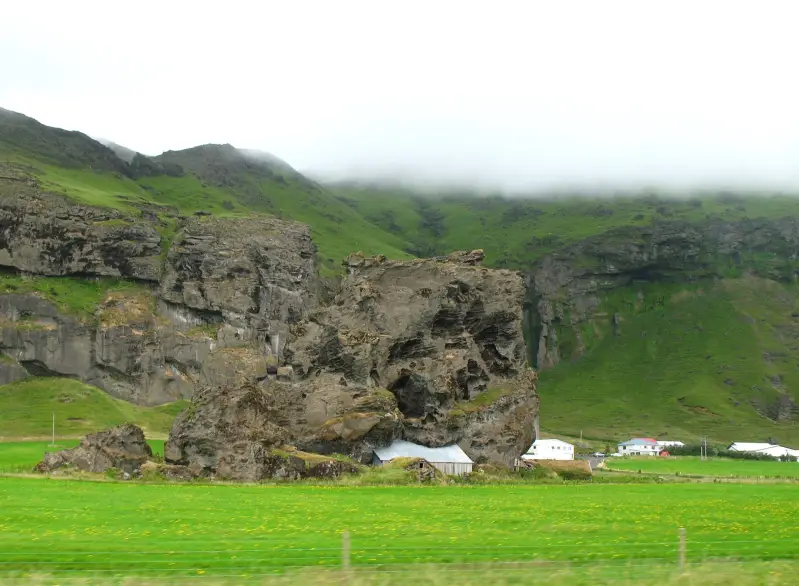
Photo below: the Drangurinn huldufólk dwelling or thin-place, located in Southern Iceland, the Drangurinn itself being the massive rock formation in the centre of the image, although it is somewhat camouflaged against the cliffs behind. Note the barn-like structure built into one of the caves in the rock formation. As can be seen, the rock formation is of unusual appearance, and of impressive size. I have discussed other caves in Iceland elsewhere.
Iceland also has many sites associated with what we would call trolls, elves and beings of the faerie realm. The word "elf" is somewhat hard to try and explain. In Icelandic, an elf is known as álfur. I have gone into the etymology of this word in much detail elsewhere, and have given examples, nevertheless, the name still confuses me, as do the illusive beings that bear the name. In Norse tradition, the elves are associated with the ancestors, and with the dead, but I do not think that they necessarily were thought of as the souls of the passed, not in the strictest sense, even though they are connected to them. The Norse gods, the main, most known gods, also share what seems often to be a close connection with elves. The term "elf" seems sometimes used as a name for divine beings, and not always in a more particular sense. These beings are often associated with light and with spiritual power, whilst the huldufólk in Iceland refers to otherworldly humans that might, for example, perhaps be called "elves" in other areas, but it seems that Icelandic tradition generally applies álfur to divine spirit beings more in the sense of mythological or primordial time.
Nevertheless, I do not really understand the application of the word álfur in a complete sense. For example in Iceland there are places that bare the name of álfakirkja - "elf church", rock formations that are associated with elves, by name, although the name in this context may be referring to the sacred kind of entities connected to these places, and to that they are sacred places to them, and does not necessarily mean that "elf" in this context was not being applied to the huldufólk. The fact that these rock formations are sometimes considered as "elf churches", does to me seem to imply that they were sacred animistic sites, connected to the elves in some way, and perhaps not of the same spiritual system and trajectory that gives us the Icelandic sagas, and the more typically Viking understanding of Gods and the Norse World - but this is speculative, perhaps goddesses like Freyr were honoured at these elf churches, but again, this is speculation - these sites remain very mysterious, and we ought to respect them.
One example of what one might term an álfakirkja, which I have visited, or rather, been past in a car, is known as Drangurinn, located close to Drangshlíð, close to the southern coast of Iceland. From what I understand of the stories of this place however, it seems that this was more a dwelling of the elves or huldufólk. I cannot find many original sources (in Icelandic) regarding the legends of this site, but I do feel in some way that it having perhaps been specifically a dwelling of the Hidden Folk/huldufólk that the place and mythology does give the "vibe" of it being a sacred site, associated with a pre-Norse indigenous people who lived there, and again there are some compelling similarities between the huldufólk and the Good People of Goidelic tradition, for example, and with earlier groups in Iceland having likely been linked to the Gaels, this is interesting. An Icelandic source about this site, is the article Drangurinn í Drangshlíð on the Sagnir af Suðurlandi website. Icelandic sources I have noticed, tend to associate this site with huldufólk and not to my knowledge with álfar. The huldufólk are described as having helped farm animals and as friendly with Icelanders in our realm, and were also respected by the Icelanders in our realm.
This blog post is written in honour of the álfar, huldufólk, tröll and of the primary Norse gods, and to all who I love.
On the soul, the elf sun, and Fenrir & on having multiple husbands.
On spirit and soul, do we misunderstand both?
I think that maybe, languages really have confused our understanding of spirituality - not the fault of languages themselves, but due to the complex interplay of change and illusion that has permeated our reality and history.
Nowadays we may use the terms "spirit" and "soul" in the same way, but they were not originally understood as being the same thing. The word "spirit" is connected to Latin spirare - "to breath", which may incidentally be related to a Germanic word meaning "to fart" or "blow". So the "spirit" is connected to air, to the ether, to wind, just as in the Bible, God is connected to whirlwinds, and to the breath of life. In Finnish mythology the God Ilmari whose name derives from ilma - "air", may have been the original Finnish creator god, and similarly connects the spirit with the concept of a single divine creator or creative entity of life.
The word "soul" has a different meaning. I personally believe we can learn something about this word by looking quite widely. For example, the English word "soil" is similar, as is the Spanish word sol - "sun", and Norwegian sol - "sun". There is also a connection I think to Uralic and several other words for "eye", e.g. Finnish silmä - "eye", and Scottish Gaelic sùil - "eye". There are also similar sounding terms connected to water and to salt. For example English "swell", English "salt", and Scottish Gaelic sàl - "saltwater", and many other examples. There are also similar words referring to frost or dew, for example Quechua sulla - "dew", and Northern Sámi suoldni - "dew", "mist" or "frost".
I think that by looking at connections in words, it is possible, perhaps, to peel back the later layers of our linguistic, spiritual reality, and to see things for what they might originally have meant.
In this case, perhaps the "soul" is something connected to soil, the divine earth, and also to the sun, to holy celestial light. It is perhaps also linked to the eye, the eye connecting in some way to this earth, and light, and water - "soul" also I think connects fundamentally to water, as movement, as flow, just as sunlight has waves, so does water. And that the "soul" is also connected to dew, and to mist, to the celestial waters in the air.
We can think then of the "spirit" as being the thing that gives us our individual time on earth, and our divine god-self, whilst the "soul" is more like the essence of our time its halo, the storm and flow of solar, or water energy, around the blue light shining from the black hole at the centre. This, ironically (or not) also connects to "farts". The anus is like the black hole, and in this case a word for "fart" might be related to the word for "spirit".
The concepts of "spirit" and "soul" are of course linked, but they are different descriptions, describing different facets, reflections or aspects of the divine self. These words that are possibly connected to "soul" are not all describing the "soul". The point is, I believe, that at one time, all of these words were describing the same thing, and now we all have different "parts" of facets of the understanding of what the original thing is. So rather than thinking of the "soul" in terms of something purely defined through our language and concepts, perhaps what we understand as the "soul", what the ancient Finns understood as connected to the "eye", what others associated with the solar energy, with salt, and water, are actually describing a spiritual reality that is all of these things at once.
I realise that in terms of etymology many of these words are not supposed to be related through our current understanding of languages and their historic reality, but nevertheless I think that these words share a connection that is beyond our cultural linguistic reality.
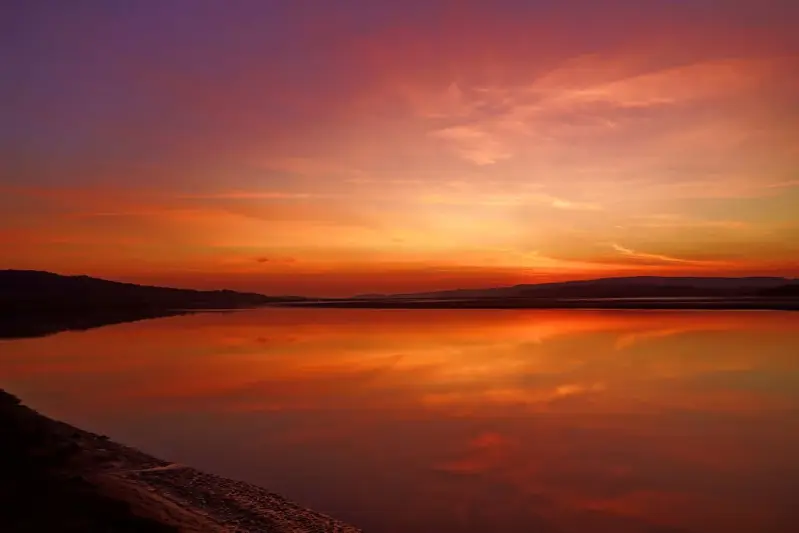
Photo below: a photo I took when in Cumbria in 2013, I think that the photo below, showing a winter sunset reflecting upon the water, is special, also is also a beautiful representation I think of "soul" energy, something full of colour, full of flow, depth, glow, reflection, bright with heavenly life, in the waters of the estuary and in the waters of the sky.
Elven aspects of the Norse linguistic reality
In our modern reality, we may think of languages as systems of direct equivalence, like numbers written in a different ways, but which are of equivalent meaning. But this is not quite true.
There are I think overreaching, sacred patterns in language. But as it describes with the Tower of Babel in the Bible, the languages were confused. Things were split, reflected into shattered pieces, each a facet of their original form, and humans experiencing time and reality from this perspective of having particular pieces, not connected to the whole.
This is why I think, the word for "sun" in one language, like sol in Norwegian, and say grian, the Scottish Gaelic word for "sun", and aurinko - the Finnish word for sun, are not necessarily describing, nor containing the essence of the same thing. Each word is a vibration, a larger note of the whole music. Even though these three words all describe the "sun", they are all in a sense unique notes, and sequences of the sun's music, and its different essences.
In Icelandic, there is a beautiful word, a kenning, for describing and perhaps invoking the meaning of the sun, within the "elven" aspects of the Norse reality and linguistic worldview. This word is álfröðull, from Old Icelandic álfr - "elf", and röðull - "glory", "halo" or "sun". In a sense, we can think of the more common Old Icelandic word sól - "sun", as describing, invoking the sun, in terms of its "soul" energy, which functions like waves in water and in light.
Whereas the word álfröðull is describing the "sun" and invoking its aspects in an Elven linguistic reality, invoking it as connected to the elves, beings of light, and of it in terms of a halo, perhaps connecting more to its light and life giving qualities, both of which, light and life, are strongly connected to the Elves in Germanic traditions.
Cthulhonic aspects of the Norse linguistic worldview
Other aspects of Norse language and mysticism are even more mind-opening, and much harder to understand. Recently it was mentioned to me about a thing with a certain name, beginning with Fen-, existing on one of the Hebridean Islands. An entity perhaps? In Norse mythology, there is Fenrir or Fenrisúlfrinn - "the Fenris Wolf", a giant, a being of chaos, and one of the offspring of Loki. This being is wrapped in chains, to then be released at Ragnarök, the end of this cycle of creation.
I also wrote elsewhere recently about a Dr Who story from the 80s, called The Curse of Fenrick. In the context of this story, Fenrick, who's name seems to be a combination of "Fenrir" and "Richard" or "Dick", is a cosmic evil, a giant force, who's curse causes humans to haemovores, draug-like, Cthulhonic vampire entities that live in the sea, at first appearing pale and vampiric, before transforming into beings of octopus-like bodies with suckers, and bones and teeth that extend from their once human forms, now unrecognisable. This "curse" is also connected in the story to a form of green poison, like the yeast-like eitr substance in Norse mythology, which gives rise to the first giants. So we see how, like in Norse mythology, this Dr Who story connects the idea of a primordial oozy substance, to "giants" and beings of chaos.
Another Dr Who story with the Fourth Dr, Tom Baker, shows us an entity with a similar sounding name, the Fendahl. This entity, like the haemovores, is also a kind of vampire, but in this case a vampire of psychic energy. It requires a main adult human to merge with, and that human becomes its host, whilst it turns other humans into Fendahleens, worm-like creatures with mouths full of tentacles - and let me tell you, the scene when one first appears is worth watching. When you first see it, my gosh. You'll either giggle and be amused, or just think "what in the name of God".
So, looking at the Norse mythology, and how this mythology and root word has passed into Dr Who episodes, we are looking perhaps at a concept of an entity of being which is a giant, chaotic, which mutates, sucks psychic energy, turns people into hosts, and which is associated with the chaotic, dangerous, but also life giving eitr substance, which is also connected to yeast.
In terms of etymology, the etymologies of Fenrir and Fenrisúlfr and of this *fen- root, are poorly understood, but both words may be connected to the English word "fen", which again implies something primordial, and boggy, and often linked to things like decay and of primordial substance. I also think that the Danish word fanden - "the Devil" may be connected, and also possibly the English word "find", in the sense of this entity, or whatever it is, being connected in some way to the desire to find out.
I do not think that this entity is evil. But I think that it represents a part of our spirituality which has long been suppressed and left in the dark. In Norse mythology, the substance eitr is both live-giving, crucial to the formation of reality - as well as being highly dangerous. It is the same substance said to be spat from dragons or serpents, or wyrms, if you like. We can see how these things all connect, and how this substance is both mythologically, and within our conscious, important to creation, but is simultaneously dangerous without coherence.
This leads us back to the idea that the "giants" or "ancient ones" are returning to Earth. In The Curse of Fenric, the lead haemavore is called "The Ancient One" or Ingiger, the latter name perhaps being connected to Old Norse gýgr to describe a giantess. This energy is I think neither masculine nor feminine, it transcends boundaries, and it upsets the coherent system of reality that the Norse gods for example, or what our current linguistic worldview - hold in check. Indeed, on one level, it seems that these archetypes are inherently alien. Yet at the same time, they feel inherently connected to us in terms of an ancient World, an ancient time. Whether the archetypes being discussed here are truly "bad" for humans, even if not inherently evil, is an unknown. Personally, I think that by their very nature, these archetypes are not coherent with our current linguistic worldview and reality, but that doesn't mean that they are bad for us.
The "Old Gods", twin-flames, and women with multiple husbands
Similarly, a person I know said that things like polyamory or multiple husbands don't fit into our reality, nor into our linguistic worldview and understanding of creation. The idea of multiple husbands also contradicts the worldwide spiritual understanding, in our linguistic reality, of the concept of twin-flame love, and the divine connection shared only between two people - which is so special precisely because it is only between two people. On the other hand, does the confusion of our languages mean that we are only seeing one version of romantic and spiritual truth?
I believe in twin-flames, as a concept of divine love between two people, that they share in a non-physical way with the whole of creation, from their hearts. But this truth does not necessarily make anther possibility false, just as the Norse could call the "sun" sól or álfröðull. The truth of one thing, one reality, and pathway, does not exclude the existence of another truth, as another aspect of that greater cosmic force.
I think a spiritual journey can be about understanding the inherent truth and coherence of these things, when seen as what they truly are. How something can be both one thing, and another, if they are fundamentally of the same essence.
Personally, I think that when polyamory, for example, a woman with multiple husbands, comes from a situation and twin-flame love where it is just her and her one husband - that polyamory can begin from twin-flame love, and then simultaneously that third energy can grow and transform to include other people, when the time is right for both of the original persons.
In this sense, twin-flames and polyamory are not incompatible. Just as the idea of gods of order, like Odin and Thor, do not necessarily contradict the Old Gods, the giants, full of creative power and chaos.
I remember reading in several places, with regard to Norse paganism, how the giants do not really understand the idea of love, or intimacy, like romance and twin flames, like humans do. And that in a sense, those forces wish to learn that from us, to learn it from our spirituality, where the twin-flame is the highest named expression of romantic love. But at the same time, I have seen it written, that the giants can help us, to incorporate and embody their energies within ourselves. And how their energies are very polyamorous, and free.
But also - "free", the true meaning of freedom, is not to be able to do and have whatever we want. True freedom is to be able to have what we most truly want. And so the question of polyamory's potential sacredness within our spiritual worldview, will always ultimately, come back to, and stem from, our truest nature and our deepest values and needs. I believe that polyamory may often be negative if it contradicts with what we most truly need to feel loved, for example a twin-flame connection. But this is not to say that that contradiction will always be present.
Will we re-define the whole concept of twin-flames and open a new, more interconnected paradigm of their spiritual essence?
I hope this blog post was an interesting read:) It is dedicated to the Great Spirit, present within all things. May The Great Spirit bless you all.
More on the Draug, on understanding what they are, & within Norse spirituality,
The Draug is a mysterious figure from the folk beliefs of Iceland, Northern Norway, and to an extent, other parts of the Nordic world. The draugs from Iceland, in Icelandic: draugar, are different from those in Norway. In Modern Icelandic, draugur is a word meaning "ghost". In Icelandic tradition however, draugar encompass their own unique nature within the context of Icelandic tradition, in which they are often quite different from our understanding of the word "ghost", and what a ghost is in our linguistic reality.
In Old Icelandic, the form of the word: draugr encompassed something akin to a ghost, but also something more "undead" and physical, and yet at the same time possessing attributes that made it non-physical, or possessing a different kind of physicality. Like vampires in a sense, the draugr is neither living nor dead, neither physical nor non-physical. The name might be related to Old Saxon gidrog - "delusion", which I think might tell us that the draugr could encompass this idea of being a "delusion" as well, at least in the sense of being something that doesn't fit, doesn't quite have coherence within the linguistic reality we live - which is not to say that this sense of "delusion" means that draugar do not exist. I am sure that they do exist, in some form. In West Germanic languages in general, a related root may be that which appears as trügen - "to be deceptive", and Dutch bedriegen - "to deceive".
If these West Germanic forms do indeed teach us more about the Draug, then then would also seem to imply that the underlying meaning encompasses beings that are undead, with immense strength that is neither wholly physical nor non-physical, and that they are in some way connected to delusion and deception, not necessarily as a deliberate evil, but perhaps in that, by their very nature, they are delusions in our world, yet simultaneously real; that they are deceptions and connected to the deception of our spiritual being, yet at the same time, this may be inherent within their nature. It may also be that they relate to Germanic words for "dream", such as Icelandic draumur and Norwegian draum or drøm, which would again imply a connection between the draug and beings that are illusory, yet also the dreamworld is spiritual, and in my view, real, but sometimes deceptive. I am personally not sure how convinced I am on the direct connection between the words "dream" and Draug though.
The coastal people of Northern Norway have their own form of draug, which is connected to what is known in Kven as meriraukka, although raukka in standard Finnish means something more like a "poor wretched person". Also related is Northern Sámi rávga. In the Sámi languages, this word refers specifically to the ghost of a drowned person in the sea. A form of this root is also found in the eastern Kildin Sámi language, as роа̄ввк, rååvvk, the Kildin Sámi form meaning either a "phantom" or "vision".
In some Danish literature, we see how strange sea beings can be referred to as søtrold - "sea troll". In Hans Edege's book, Det gamle Grønlands nye Perlustration, the Kraken is described, then the Draug is described as a søe-trold og spøgelse - "sea-troll and spectre", and is described as having no particular form, but that it can show itself in one form or another.
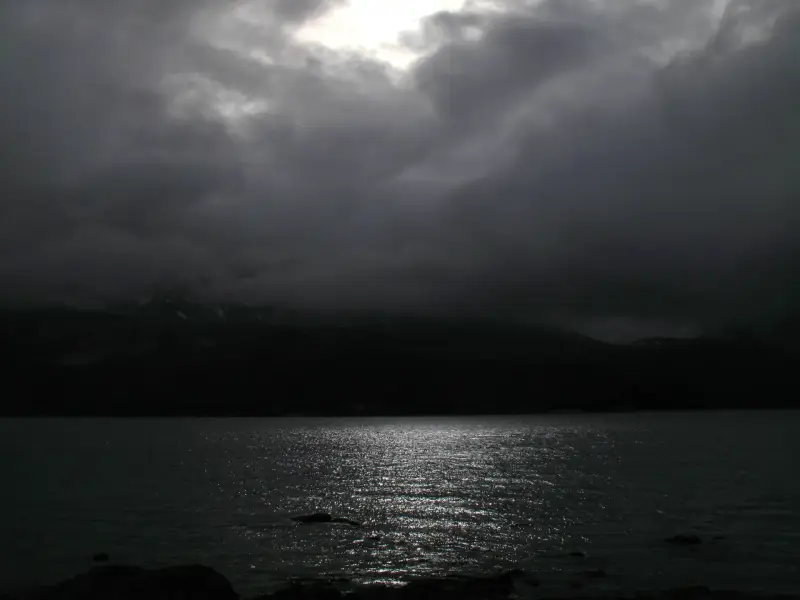
Photo below: the dramatic Skjomenfjord in Northern Norway, close to Narvik, the photo was taken in July 2011. Whilst I know of no specific Draug stories found in relation to the Skjomenfjord or in relation to the Narvik area specifically, the Skjomenfjord is well within the territory of the Northern Norwegian Draugs, and I in a sense felt their presence when beside the Fjords and beneath dramatic skies, as I think are well demonstrated in the contrasting light, darkness, deep dark fjord, glittering surface waters and dark snowy mountains, and grey stormy skies, in the photo below, all of which are akin I think to the energy of the Draug. I bless anybody who goes near the Skjomenfjord and ask that they may come to no harm from these forces, and apply this also to the rest of Northern Norway.
Drauger in Spirituality
It is curious how the draug, in the modern Icelandic sense, is a ghost or phantom, but in Norse mythological time, it is an undead being, attributed to immense powers. This perhaps implies, like with the idea of the "soul", that we nolonger readily understand what a Draug fully is. Another curious fact is presented in the article: The Draug by Simon Hughes, on the Norwegian Folktale Website, wherein it is described that a foam-type matter, when found, was thought to be the Draug's vomit. Does this perhaps connect with what I wrote about the eitr in my other, separate blog post published on this site today (on the 28/08/2026). As I have discussed elsewhere, the "haemovores" from that Dr Who series are also I think of the Draug-archetype.
As I have discussed elsewhere - drauger have come into my dreams. In my most recent draug dream, I was leaving a harbour in a boat, going under a bridge at the harbour's narrow entrance. I saw a large seal sat on the stonework above the entrance. As soon as my boat left the harbour, the seal splashed into the water, and followed me, as I headed out to slightly larger waves. Draugs in Norwegian tradition can take the form of seals, and the bloatedness of this seal was akin to how Icelandic Draugs are sometimes described as appearing bloated.
In another dream, I was surrounded by some Draugs, and chanting an Icelandic magical spell, in a croaky, almost whispered voice, which was keeping the Draugs at bay.
In other dreams, I have had more positive interactions with them. In another dream, I was on a misty beach in the Lofoten Islands, in Northern Norway, at least, that's what it looked like. There were mountainous cliffs behind me and around the bay. From the misty water came walking corpses, long dead, some of them in Viking armour. Their eyes glowed with a blue light, and they telepathically or, through speaking "thanked me". I do not know why.
It's kind of ironic, or not, that Draugs are connected to dreams, and that they have entered my dreams. And weirdly, as archetypes of the mind, or of mythology and real spiritual interactions, they fascinate me. Two of the dreams I have mentioned here were somewhat frightening. But the third one I mentioned was not. I have also had many other dreams of Draugs.
If my dreams taught me a more positive thing about them, then it's that perhaps we can help them in some way. Perhaps by remembering the sea, and remembering its danger, and having empathy for those who are lost to it. As some of my dreams demonstrate though, this is not to say that sometimes it isn't necessary to exorcise such beings from our reality. But generally I do not think that it is, Draugs can help people, according to folklore, and can "warn". I do not think they are inherently evil, nor that they deserve to be defined as such.
In a wider sense, we can see how the Norwegian sea drauger and the idea of Draugs taking the shapes of seals - relates to the wider Norse-Gaelic and pre-Norse-Gaelic traditions about seals being connected to the ancestors, of people transforming into seals, and of the Finfolk and Fin-men, and the Finns, Kvens and Samis in Northern Norway, and their magic. And there is far more to this I think than the Draug as a negative entity, they are much more than that.
Draugs are also connected with disease, and again talking of Finnic traditions, it is interesting how Louhi, the Finnish witch goddess, birthed the nine diseases after coupling with Iku-Turso, a Cthulhonic entity, in some ways similar to the Kraken. Draugs are I think fundamentally connected to these other entities in some way, with the similarities again implying that there is far more to Draugs than is obvious.
I have a request for my fellow Norse pagans: have some empathy for the Draugs. There is far more to them that what it seems.
I hope that this blog post was an interesting read. It is dedicated to the Draugs, and as a wish for all people to be protected, and safe, when on the sea.
The Languages of the Caribbean & a different look at Arawak/Lokono
Arawakan languages are a large and diverse family of languages spoken in South America, and to some extent in Central America. I have a real passion for South American Indigenous Languages, and whilst I am pretty familiar with those of the Andes, and to some extent others, but there are so many indigenous languages in South America, and my knowledge is naturally limited. There are entire language families that I know virtually nothing about, and in some cases, neither does anyone else. When I heard back in 2018 I think, about the destruction of linguistic and anthropological data after a fire at a museum in Brazil, I felt pretty devastated. At the time I wanted to create some kind of online community for gathering, openly sharing, discussing and working on indigenous South American languages. Such communities exist, but they tend to be hidden behind the veils and to be more privately academic. Which is why I conceived of that idea - because there just isn't enough passion and interest in South American languages in general, data and information about them has been allowed to die, disappear, and this is not only a tragedy, but is also an outright loud insult to those indigenous people of South America who contribute a plethora of knowledge, wisdom and information about a large region of our planet.
Of course there are other reasons, for one, it is difficult to get to parts of South America to do research. But another part of the problem is that the information on these languages is sometimes collected, but not used or made widely available. Even when taking tribal privacy into consideration, I think that the lack of publicly available information on many of these languages does make the situation worse rather than better.
If I was going to live for a thousand years, then I would be able to make a huge difference with this. Generally, people tend to live to around 100, but that's still enough time to make a significant effort towards change in these subjects. I am unlikely to ever live in South America, but I can still do a lot with the resources, intellect (if it can be called that?), and research abilities that I do possess.
The Arawakan languages are divided into northern and southern branches. The northern branch is spoken in parts of the Caribbean, Venezuela, Columbia, Northern Brazil, Guiana, Suriname and French Guiana. The southern branch is spoken in parts of south central Brazil, western Brazil, and in parts of Peru, Bolivia, and to a limited extent in parts of Argentina and Paraguay. Having done quite a lot of research on these and on Andean languages, I feel that Arawakan languages do in many respects provide a cultural and linguistic "corridor" between the Caribbean/Atlantic Ocean, and the Andes. Out of the indigenous language families in South America, the Arawakan languages cover one of the largest geographical ranges.
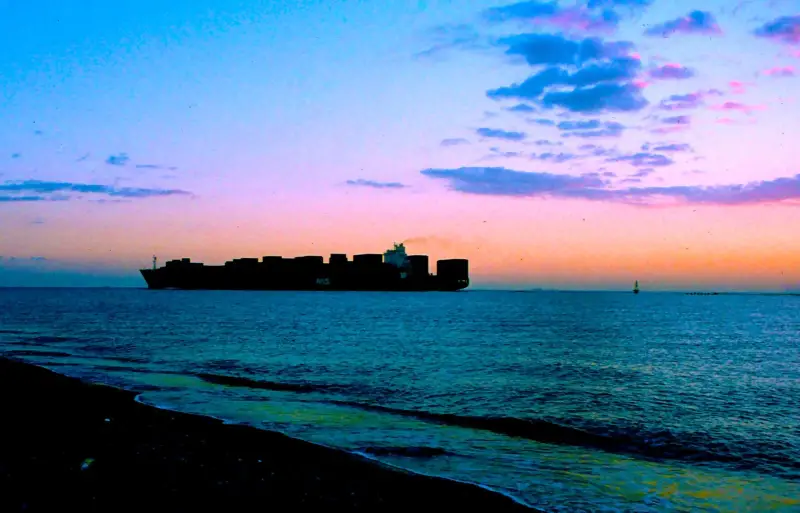
Photo below: The Caribbean Sea, taken some years ago on a beach at sunrise, with a ship (obviously) in view. In Arawak the word for "sea" is bara and the word for "sun" is hadali. I do not know the word for "sunset", but I believe that the image below gives a feel and impression for the kinds of seascapes witnessed and and seen by speakers of Arawak, and invokes the nature of this language and of its inherent sacred reality.
The family is named after the Arawak language, also called Lokono. Arawak or Lokono is a member of the Ta-Arawakan or Caribbean Arawakan grouping of Arawakan languages, some other members of which are Wayuu and Taíno. The Taíno language is famous for having once been the primary indigenous language (bot not the only indigenous language) of the Caribbean Islands. Efforts to revive different dialects of the Taíno language are underway. I do not know precisely how similar Taíno and Arawak are, and Taíno in many senses seems to have fewer phonemes than Arawak, even if some publications tend to give a more simplified definition of Arawak's phonology - although it does also vary from dialect to dialect. I have also heard it implied that Arawak is perhaps the "closest" language to the Taíno language of the Caribbean Islands. The Taíno people in the Caribbean Islands also did not die out, but rather integrated into the Afro-Caribbean communities on these islands. There is also a controversial idea existing within the "Tartaria theory" community, that Afro-Caribbeans are the indigenous people of the Caribbean. Whilst I think there might be something to this theory, I dislike the way in which this theory is sometimes used to imply that Native Americans are not indigenous to the Americas, which is an utterly absurd idea. I can accept the possibility though that there could have been black people in parts of the Americas in ancient times, alongside larger populations that we now refer to as Native Americans. Obviously, this theory is also used sometimes to imply that the Slave Trade didn't happen, which is obviously not true - it did happen. But, that doesn't necessarily mean that all black slaves were from Africa. As I white person I don't really feel it's appropriate to theorise about this much more here. But essentially, I do think it is possible that black people could represent some of the indigenous populations outside of Africa, it being also possible for example that not all, but some of the ancient peoples in ancient Britain could have been black.
It is perhaps possible that there are deeper connections between Afro-Caribbeans and speakers of Arawakan and Cariban languages, which might predate European colonialism in the Americas. But, I don't know. What's interesting to note is that some of these Afro-Caribbean communities ended up speaking the Garifuna Language, rather than speaking so-called "creole" languages (I don't think the word "creole" really fully conveys the status of these languages are their own unique parts of the Germanic and Romance language "continuums"). The Garifuna language is related to the Kalinago language, which is another indigenous Arawakan language, that was spoken in parts of the Caribbean, as well as Taíno. The Garifuna language is technically also an Arawakan language, but it does contain more links or loanwords to European languages, and contains a significant amount of vocabulary from Cariban languages. The Caribs who were present in the Caribbean left a lot of words, but ended up speaking Kalinago. The original Cariban language spoken by these people, may have been close to the Carib or Kalina language of Venezuela. The Cariban languages are a whole other language family, and are not Arawakan languages, but Cariban languages are to a great extent spoken in proximity to northern Arawakan languages. There have been some attempts to connect the Cariban languages to the Je language family, but fundamentally the two language families are just so different from each other, in my opinion.
Arawak or Lokono does have masculine and feminine genders, but these do not work the same way as they do in Indo-European languages. Gender is visible in pronouns though for example, the pronouns in Arawak having standalone emphatic forms, end-point forms, and prefixed forms. For example the first, second and third prefixes are d- or da- for "I", b- or bu- for "you singular", l-, lo- or lu- for "he", and t-, to- or tu- for "she"
Out of the indigenous American languages, Arawak is perhaps not the most difficult for an English speaker. The language has some really beautiful ways of expressing concepts, as well as what appears to be fascinating inherent sound symbolism. The language has some wonderful ways of expressing concepts and meaning. For example the verb aiyuyuto means "to water" (1), which itself seems related to the word yuyuokili - which means "mist", pertaining, perhaps to the way in which moisture brings the life giving substance. Another interesting connection between different Arawak words, is the way in which a word for "wisdom" and "cleverness" is derived from the word for "a song", "a song" being ienihi in Arawak, which is related to ienikoto - "to make wise", and ieniko - "wisdom" or "cleverness". The language also contains some examples of reduplication, for example in the word uwadawada - "fins", I have mentioned other examples elsewhere. The word uwadawada also seems to contain sound symbolism or sacred root language similarly represented in Quechua as wayt'ay - "to swim", in English "water" and "wet", and in Finnish vesi - "water". There are a great many such similarities in Arawak, and I have discussed others extensively elsewhere. Another example which I have not published about before (from what I remember) is Arawak seme - "to be good" or "to be delicate", and seme/semehe - "good spirit", which can be compared to Quechua samay - "breath, spirit", to Finnish sumu - "fog" and perhaps English "same", if there is a higher spiritual teaching of this root, then I think it perhaps relates to the spirit, to breath, to cloud, and to "oneness". Words relating to "time" and "life" also contain an interesting symbolism in Arawak, for example Arawak haika - "peace", and Arawak ika or ikka - "a certain time" or "there was once", compare also Arawak kokke and kakü - "life" or "to live". This shows a similarity to Finnish ikä - "an age", iki - "eternally", aika - "time", and to Japanese ikiru - "to live", iki - "breathing", and also iki - "life" or "alive". Another interesting word is kalekku, a word referring to the spirit of quartz, or to white stones or pebbles used by a medicine man. This word kalekku bares a similarity to Quechua khallki - "cobblestone", and to for example certain words in unrelated, far distant language families, which I have discussed examples of elsewhere.
According to what I understand of source (1), the author indicates that each phoneme in Arawak contains a certain sound symbolism. I have discussed other aspects of this elsewhere, but for example, the author of source (1) explains that the l (L not i) sound is connected to willingness, movement and masculinity. The author of source (1) also connects the sound k(a) is connected to the act of appearing and being present, similarly ka/ga means "there is". Perhaps the symbolism of this sound is also connected to the "time words" in the previous paragraph. The sound f is on the other hand, associated with "aspiration" and a "lightness", and this can also be seen in the most fundamental sense in the Arawak word fa - "will" or "future".
I hope that this blog post was a fun read. The Arawak words in bold were all originally learned or sourced from the book: The Arawak Language of Guiana by C. H. DE GOEJE; the definitions and explanations in this article I have learned, but are to some extent based upon those in the aforementioned source, as well as the word definitions more fundamentally having been backed up by other sources. The comments on the specific sound symbolism of k and f are also only in the aforementioned source, to my knowledge (as well as me having discussed and published about other aspects to this elsewhere).
More thoughts on the Vikings in the Hebrides, and the Finns, Danes/Goill, collective spirits & other topics
For me there is something a bit odd about the traditionally given history of the Hebrides. The mainstream narrative has largely been that people spoke Pictish, a P-Celtic language akin to Welsh's ancestor language. Then, invasions happened from Ireland, replacing the Pictish language with a form of Middle Irish, then, the Vikings came, and influenced the names and language in the Hebrides and more generally the Gaelic language.
It is simple and also boring. There are also alternatives to it. One thing that has always awed me about the Gaelic language is just how indigenous it is and how connected it is to the landscape and folklore. How could so many unique words, sounds and pagan stories have arrived into Gaelic - if it itself was already used by Christians when Goidelic supposedly came to Scotland?
One could argue that this folklore is of Norse origin. But no it isn't. There are some crossovers with Norse but they could have originated from any time period. Others may argue that these stories and indigenous elements are originally Pictish and come from the P-Celtic speaking Britons. Except there isn't a single piece of evidence for that either. There doesn't actually seem to be any evidence of a Brythonic or P-Celtic “British” language having ever been spoken in the Hebrides.
So, in some way perhaps these indigenous, pagan elements passed into the Gaelic language or are connected to Gaelic in some way within an earlier, localised indigenous time frame.
One such possibility is that Gaelic has been spoken in Scotland for far longer than previously thought. I believe that this is true to a large extent, but that this original “Gaelic” language may not have fitted together quite as Gaelic does today.
It is also likely that if Gaelic was spoken earlier in time in Scotland, then it would have interacted with or interfaced with other indigenous languages as well.
So when it comes to the interactions between Norse and Gaelic, how do we know that some of the linguistic connections and similarities between the two do not relate to interactions between earlier languages- which then shared a continuity with later peoples, like the Gaels and Vikings?
I would also like to bring up the “Finns” here. Whilst the Vikings are accredited as being the most fearsome warriors of old world Europe, as master sailors and navigators, the Vikings themselves also stand in the shadow of the other cultures who preceded them and who were around them.
One of these peoples or groups of peoples or ancestors can be referred to as the Finns. In many ways, the Finns can be thought of as the magical peoples who sailed the seas, who could transform into fish or sea animals, who may have influenced the earliest facets of Scottish language and mythology long before the Vikings existed. The Finns are doubtless connected deeply to the mythology surrounding selkies and undersea kingdoms, people with magical abilities who were especially known in the Shetland and Orkney islands - although precise accounts of them differ. The Finns in this context are distinct from the Finnish identity and from Finnish people today, but are I think connected in some way.
We praise the Vikings as fearless warriors, and yet the Vikings feared the Finns and their magic. The form of Norse magic, seiðr, may have been more connected to the Sámi and Finns, and to the pre-Norse world, than to the Norse themselves, and the knowledge of seiðr, even among the Norse gods, may have come from the Finns or from their ancestors.
We talk about the Vikings being fierce and powerful seamen, yet the Finns in Scottish mythology were sailors and seamen described with truly magical abilities. They could travel huge distances using just a few oar strokes, and in Shetland they were the only people who had the ability to ride the njuggle, a waterhorse-like being.
I mean, in terms of examples of how important and powerful these Finns were perceived as can be seen in how people generally feared water horse type beings. The Vikings likely also feared these beings or were wary of them. But the Finns? They rode such beings.
Furthermore, the Vikings, but also later Europeans, feared the Finns, especially for their magic. In later years this became a specific worry about taking Finnish men on board boats, for the fear that the Finnish person might cast a spell and change the weather. Similar legends exist regarding some of the Scottish witches, and I think it can be surmised that the two are connected in some way.
Yet there is suggestion even within the Gaelic language of possible deep similarities between certain Finnish and Gaelic words. One such example that I discussed in an unrelated, different recent article also pertaining to Tiree Gaelic and Tiree's witches (one of many unrelated Tiree-related articles this year published by me), is the Tiree Gaelic word tais - meaning "moist or warm", which can be seen as similar to the Proto-Uralic (Finnish-related) root: *kačV - "warmth" (1) and to an Afro-Asiatic root word discussed in the other publication. Note that I have discussed other aspects of the aforementioned topics elsewhere, and many more of these particular cognate examples within Gaelic.
There have been finds on Tiree which are considered Norse, but it can also be said that what is identified as Norse may have older connections to these islands. For example, a "Viking" brooch was found on Tiree, which from what I understand, is intricately designed, having somewhat "serpentine-like" forms which are common in Norse artwork, but which also go back into more ancient times. There is also evidence of Norse or Viking settlement on Tiree, although again, it is not known whether or not the people living on these settlements were mainly newcomers, of if they were mostly people indigenous to these islands who had (re)connected culturally with Scandinavia. When the Vikings came, they would have brought with them new laws, cultural and trade systems as well as a new "naming" system for these things, but to what extent these differed from certain cultural systems and languages already in situ on the islands, is debatable.
The "Finns" as I describe them here do not necessarily connect to the backgrounds of all these indigenous cultures. If the Vikings had pre-Norse ancestors, already speaking a language connected to Norse, in situ in these islands, then, as I have discussed elsewhere, I do wonder if the Gaelic word gall was sometimes applied to these people, in much the same way that several of the broch and dun structures are connected to these people; sometimes translated as "Danes" in the English language, albeit not necessarily in the sense of Norse or Danish people, but perhaps in reference to something much older, which I have discussed elsewhere in relation to language and mythology etc, including in terms of influences in Argyll Gaelic dialects. I also recently discussed in an unrelated article (in which I also discuss yet other things about Tiree Gaelic and other dialects, different from other articles mentioned here, and still one of many discussing these things) how the Gaels of St Kilda may have interacted with "other" populations, and it is perhaps not surprising then that I discovered since then the place-names Laimhrig nam Gall on Hirta and Gob A' Ghaill on Soay which may attest to the presence of "others" in the westernmost parts of St Kilda; and I am not convinced that the goill/"Galls" being referred to here were Norse, rather than earlier peoples, however, I need to find a person who can confirm that gall in the sense of "people from another culture" is the implied meaning in these St Kilda names, before this can be confirmed.
Some of the most unusual magical traditions in the Hebrides invite us to a different spiritual way of thinking, which is in many senses quite profoundly different from our notions of later Celtic religion and spirituality. One thing I would like to discuss briefly are "snail beads" or cnaipein seilcheig in Gaelic. The sacredness and sacred connotations of snails and seashells, and also cthulhonic deities in the Hebrides are something I have discussed a lot elsewhere, including shell middens. There are also shell middens, ancient shell middens, on Tiree for example. These were made by the earliest indigenous cultures on these islands. The snail-beads or cnaipein seilcheig relate to these structures and to this widely previously discussed (by me) aspect of "merging", in my opinion, as cnaipein seilcheig are said to be sacred stones, apparently formed when four or five individual snails come together and "form" themselves into a mass, which then forms a sacred stone, that people used for protection. I am not sure however whether or not the implication on page 221 of The Gaelic Otherworld - John Cregorson Campbell's Superstitions of the Highlands and Islands of Scotland and Witchcraft and Second Sight in the Highlands and Islands, edited by Ronald Black - is that these snails come together to "create" a stone, as in something separate from their bodies, or if the snails themselves form into the stone itself. Either way, there is an implication here of a kind of intimate interaction between multiple snails, which is kind of polyamorous in its implications, and which also implies a merging of energy and soul into a sacred object.
I do wonder if this "coming together" of snails is connected to shell middens in some way, and to those ancient peoples; and if this idea of snails coming together to form an individual mass, an individual sacred being that then becomes a stone being, pertains to these ancient peoples. In a sense, this idea I have discussed in detail elsewhere (including in relation to Tiree) about the polyandrous Attecotti in ancient Scotland, and to this idea of "collective deities" I have also discussed many places elsewhere, may also pertain to this idea of snails coming together, and this also asks us to question how these ancient peoples viewed the concept of the "individual" versus a "collective" spiritual being. A similar concept is in a sense expressed in some Paleolithic, Mesolithic, Neolithic and Bronze Age burial traditions. The concept and magic behind the cnaipein seilcheig certainly seems to imply that there was a concept in the ancient Hebrides - a concept of snails, more Cthulhonic-like beings at least, having the ability to "merge" themselves, or at least aspects of themselves, into a collective energy or being.
A similar idea - which I have also discussed a lot elsewhere, can be seen in how the Cladh Hàlainn mummies found on South Uist were made from parts of multiple individuals made into just two mummies, with one mummy having a jaw bone from a different human than the rest of its skull came from, for example. Note that in my other blog post published on this website on the 12th of July 2026 I also discuss in detail another aspect to this concept in terms of Finnish and Goidelic terms for "one eyed".
I hope that this blog post was a fun read and awakens curiosity in others - it is dedicated to the people of Tiree. Source (1) refers to that the Proto-Uralic form *kačV - "warmth" was reconstructed by Sergei Starostin and can be viewed on the starling.rinet.ru linguistics website.
Photo below: Dùn Mór Bhalla or anglicised as "Dun Mor Vaul", literally meaning the "big dun of Vaul", is the most intact of Tiree's broch and dun structures. The name Bhalla/ Vaul is related to the Old Norse word hváll, referring to a kind of hill, although it is also possible that this word and place-name is "pre-Norse" rather than being Norse per-se. The interactions between the Iron Age broch builders and the later Norse is also not well understood, although there are many indications of a kind of continuity between the two cultures, at least in certain areas. My experience here at this broch was quite mystical, especially as a raven seemed to be following me around and "calling" to me whilst in this area. Ravens are associated with Odin, but also are important figures in the belief systems of the northwest Pacific Native Americans, for example. Not far from this site is the "Ringing Stone", which I have published about elsewhere.
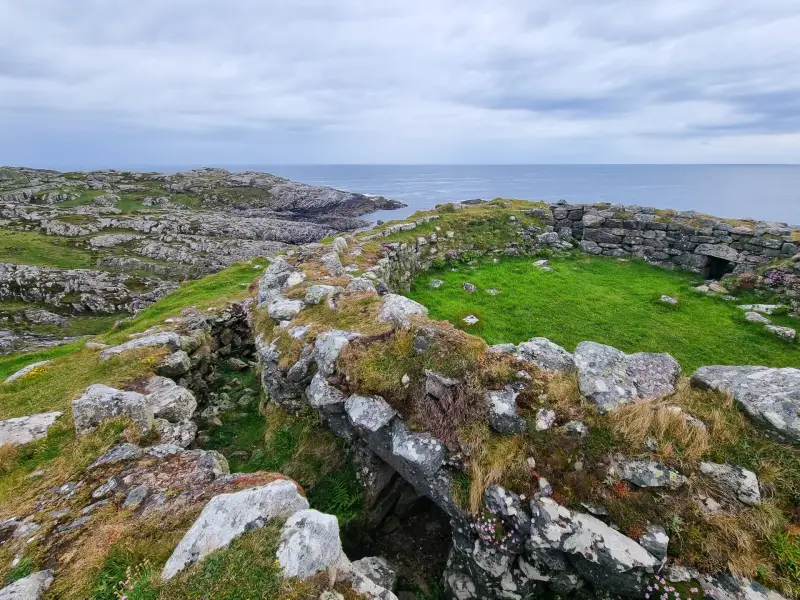
The Lake District - and its often fabricated history
If you go to the town of Bowness on Lake Windermere in Cumbria, you will be walking into what can be described as a modern tourist park. Bowness is the Cumbrian equivalent of Vegas (no, they are not that similar though). Most people who come to Cumbria will have heard of Beatrix Potter, the writer who created stories about animals. Wordsworth was a famous poet, also known today as connected to the Lake Windermere area. And by and large, that's about as deep, and as thorough as the history goes. But - if you are interested in history, you will no doubt come across things like "Cumbria was a Viking land", and "The Vikings came to Cumbria and gave us most of our names". If you look further back you will find things like "Cumbria was originally Welsh-speaking, and this language was called Cumbric".
Do you want to know the problem with this picture? Not only is most of the subject of the Lake District's history overwhelmed by Beatrix Potter and by English-language frameworks, stories and artwork, most of which is often disconnected from our indigenous history - but furthermore, the actual history, what I just wrote about the Vikings and the Welsh - well, that isn't really accurate either, in a lot of ways. Which is frustrating and irritating for anyone who wants to try to connect to the indigenous history in Cumbria.
So, you go to Lake Windermere. The most famous bits of imaginative creative work, by Beatrix Potter, were entirely fictional stories, made up. If you look into the folklore of Lake Windermere you will hear about little beings called Tizzie-Whizies. They also, were made up. You might hear legends of beings called dregpikes, said to live in Cumbrian lakes. These, again, seem to have been made up, fabricated. The reports of a so-called being called "Bownessie" in Lake Windermere, appearing around 2010-2011 - seem to be entirely made up. And I know this personally, because I know someone who's mates apparently created the hoax using various floating objects in the lake. This is embarrassing, especially as I have seen "Bownessie" mentioned in actual paranormal literature. Making stuff up in this way only confuses and misrepresents an already difficult subject.
Photo below: Lake Windermere on an autumn day, taken from near Bowness. Bowness. Bowness is supposedly a Viking name, but actually, we can only be sure that it's a Germanic name, because the roots "bow" and "ness" are found in Norse and in Old English. The name Windermere, well, Windermere is supposedly named after a Viking called Vinandr. Such a personal name does exist, but again the chieftain in question may not have been a Viking in the strictest, Norse sense. Again, the underlying root words in the name are found outside of North-Germanic, Norse languages. Often the supposition that such names are Norse is based upon the presence of the masculine genitive ending here as -ar, also found in Cumbria as -er. However, it is perfectly possible I think that speakers of more "classical" Germanic in Cumbria could have shared this genitive -ar/-er with Scandinavian "Old Norse" languages, without their own language needing to be "Norse" in the strictest sense. This genitive usage could also for example have been a part of a formulaic naming system rather than being the normal genitive used in speech. How exactly this -r developed in Norse is itself a bit of a mystery, and I am inclined to think that -r or some kind of -r like sound may have existed as a suffix in pre-Germanic times, rather than simply evolving from an older -s or -z. -r stem nouns are also found throughout "Indo-European", and Etruscan for example uses -r as a plural suffix. Certain North-Caucasian languages also use forms of the "r"
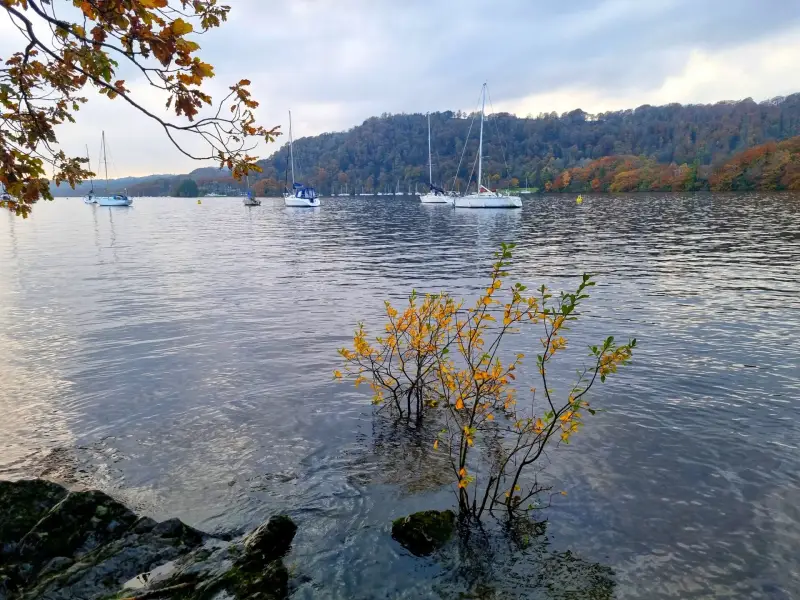
Back to the Vikings. Is there any real evidence of Viking burials, Viking ships, of Vikings - in Cumbria? Actually, not really. Okay, a lot of the place-names in the Lake District have a clear connection to Norse. But are they strictly Norse or Viking? I don't think so. There isn't enough evidence so say objectively that these people were "Vikings" or "Norsemen". Connected to them, yes. But if we look at a lot of the place-names that are supposedly Viking in origin, many of them actually can be equally explained as coming from a form of Old English or Old Anglic. The fact that the place-names share certain similarities to Norse, for example the frequency of the word "Fell", are again, not objective evidence of Viking presence in the strictest sense. Personally I feel that they indicate that the historic Germanic "language(s)" in Cumbria, in many ways paralleled Norse more closely, but were not necessarily "Norse" in the strictest sense. Note also that "fell", Norw. fjell etc may well be equivalent to German Fels - "rock" and Felsen - "rock", with this etymology and that of fjell possibly being, at least in-part, pre-Indo-European. Compare also Proto-Central-Chadic *fyalan - "bank" (1). Many "Norse" words, like "thwaite" could instead be pre-Indo-European substrate words, ultimately. When words like "Rigg" are used as evidence of the "Vikings" - no. "Rigg" can just as easily be explained as a Northern dialectal variant of English "ridge". And what about the runestones?
Yes, Cumbria has examples of both "Norse" and "Anglic" runic inscriptions. But we have to keep in mind that such inscriptions were formulaic, and there is nothing to suggest, no evidence at all, that the language of these prestige, high-culture runic inscriptions was the same language that people actually spoke. In terms of ship burials in Cumbria, an archaeologist called Steve Dickinson has implied that Ivarr the Boneless is buried at a ship burial in North Cumbria. But this is not confirmed and I personally am at least sceptical at the moment. Whilst there is some evidence of Vikings in Cumbria, with a few Viking grave sites found, with no ship burials or Viking ships so far found, these few Viking-style burials seem to represent isolated individuals possessing or at least being connected to "Viking culture". These graves do not in any way indicate that Cumbria ever had a "Viking population" in the strictest sense. The "Viking Crosses" and "Hogback Stones", also used as evidence for "Vikings", could quite easily be born from indigenous traditions and motifs in Northern England and around the Irish Sea, connected in their iconography to the mythologies, spirituality and storytelling of the Vikings, yet by no means are they necessarily Viking in origin. Carvings, such as that of the so-called "Loki" stone, found at Kirkby Stephen, are interesting. But is this Loki? To say that the stone is Loki sure makes it easy to fit Cumbria's ancient history into a Viking narrative. The only trouble is, that we have no evidence whatsoever that the entity depicted is Loki. The fact that the entity seems bound may well indicate some kind of crossover with Loki, but that is not objective nor empirical evidence that the entity depicted can simply be said to be a "depiction of Loki". I mean, we really have no idea do we? Although I have some thoughts. The Cumwhitton "Viking" burials for example, could equally be representative of a common Germanic "Viking-like" elite society, connected to both Norse and Anglic society, in the same regard to how this central "Viking-like" link can be seen in how the Anglo-Saxons were also expert seamen, with their own boats, not too dissimilar to Norse vessels. From this perspective the Cumwhitton "Viking" burials may represent Germanic royal groups who were connected to the Norse, but who may also have been in Britain long before the Vikings, and who may have been equally connected to the Angles.
The idea that Cumbria is "Viking" seems to be at least to a large degree, to do with a historic re-set and re-imagining of information, rather than being definitive. The "Norse" elements were picked and chosen, whilst other words, Celtic, or pre-Celtic or pre-Germanic, get ignored. The focus is on the Vikings. From the 19th century til the present, the word "Viking" excites us. It gives us a sense of superiority, a connection to these violent, warlike men. And I am really sorry to say this and to burst the bubble, but a fair amount of this, and these headlines around Vikings, seem to be an utter fabrication. Like Beatrix Potter's stories and like Bownessie, our Viking past is to a large degree made up, fabricated, an illusion, like an AI-generated simulation that makes our relationship with Cumbria one of incoherent, misplaced history, one of fantasy writing, and no real visible indigenous connection. The factual information is lost in the illusion. You walk through Bowness, and see the tourists, all visiting this place, The Lake District, presented to them. Tourists also visit the Scottish Highlands, North Wales, Cornwall, where they encounter local history, literature and mythology and language. The difference with Cumbria is that most of this "reality" that tourists encounter is either based upon fiction, or is in part, or in full - a fabrication.
It has taken me 20 or so years to understand what is going on here, but, this is the reality. The Lake District is a re-set land, a land where indigenous tradition and our connection to the ancestors has been almost entirely displaced by a more "safe", typically English, "acceptable" history, planted by writers of fiction, by made up stories, and by misinterpretations of our past.
I am also fed up with how we take this entire history of the Lake District, an entire history for thousands of years, then we stamp the word "Viking" on it, and, well, that's that. The idea of the "Vikings" feeds into our damaged collective past. There are genuine historical connects to Vikings in England, of course, absolutely. But I do not think that the picture is quite as simple as it seems. I think we also like the idea of the Vikings because they represent power. Yes, they are genuinely connected to us Brits, but so are so many other cultures, like the Angles or Welsh, who get virtually no interest whatsoever, despite that the Angles and Welsh were equally capable, and equally powerful and amazing cultures. I feel our modern Anglocentric culture also worships the Vikings, in the same way it worships reels on our phone screens - it gives us dopamine, makes us feel "connected" to something, but is to a large degree a spiritual and mental trap, playing at our own minds and at our lack of known indigenous history, in Cumbria at least, and replacing it with a fake, but attractive mask.
So, let's stop treating Cumbria like some English, outdoor casino complex and adventure park, let's peel back the layers, and see what's really there. I have been doing this for a long time, but doing a lot of publication and work is not equivalent to knowing the absolute objective truth. For that, we are going to have to work together to dismantle the illusions and to look objectively at what we see, without presumption. But the illusion has already broken, and things are changing - slowly.
(1): Central Chadic Vocabulary was reconstructed by Alexander Militarev and Olga Stolbova and can be found on the starlingdb.org website.
Storms, and more on time and the Hannunvaakuna - and command keys
This year has been a strange year, and I am certainly not the only one to feel this. The cycles of time seem altered, and off, this year. My Hopi friend and his people have had issues with a lack of rain during planting season. In the UK, the trees have been in a strange perpetual state of "almost-autumn" since July - or at least, some of the trees have. Some of the trees that were bearing berries in July - others of that same species are bearing berries now, towards the end of October. What the f?
This year has been all about delays, delayed time. For me it has felt as if plans and energy have been in a very entropic and unpredictable state, almost like, some of us, like me, have made important decisions and actions, yet the results of those actions seem delayed as far as the physical world goes. So, maybe it's the right time to discuss spiritual command keys, again. "Key" here being akin to a word, syllable, or phrase. Our ancestors all over the World, understood the relationships between spoken language, symbolic language, magic and truth.
The past few days, at the time of writing this, have been a little unusual. This included having a dream, with three things from the dream also happening in reality the next day. This also coincided just before the arrival of two storms this weekend, which hit the UK. Like other storms over the past years, these storms have been given names. I can't remember their names, nor do I really care, I don't really pay attention to the news or to how the British media classifies and names things. But, the storms are real, and whatever their true names might be - they come at a strange time. I am actually writing this blog post as the storms are still among us here.
I have a feeling that this weekend, this storm, represents a portal or turning point for the "delayed" energy that has stunted momentum, both in individuals, and in nature, since around May time this year. Last night was also particularly unusual. I met a friend in West Cumbria. Going to a pub near Whitehaven and then observing the sea (from a safe distance), was not really what we planned. It was one of those nights where staying in was the most obvious and logical thing to do, but instinct drew us out. Perhaps feeling the excitement of some kind of change, and longing to witness it.
We ended up driving around until late (my friend was driving and doesn't drink), with two others, as we - I'm not sure, allowed ourselves to feel the shift, and to ritually recognise it. As I write this, it feels as though the "slack" energy over the past many, many months, has suddenly flipped, and now forces are pushing in, flooding our collective and individual realities. What we tried to hold back out of convenience and habit can nolonger be held back. Similarly, what we are holding onto that we can't truly sustain will also be ripped from us. On some deep, instinctive level, I recognise this period as significant.
Photo below: some art I did recently of another Hannunvaakuna symbol, different to those I have created and published elsewhere, the one below being created on black paper, and made with gold, silver and copper coloured pens, and with other differences also present. This is also the first time I have published an image of the Hannunvaakuna from this re-orientated position, giving it more of a diamond-like shape in some respects.
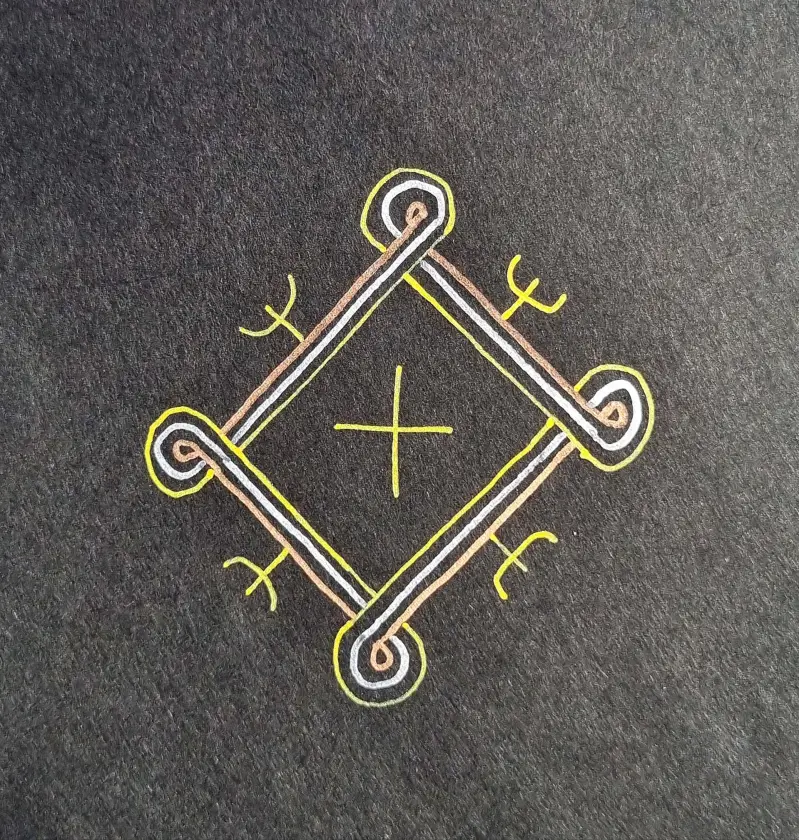
Such times do not happen all too often, and they are sacred, periods when changes in direction can be achieved. I remember being at a particular place in Finland in September 2024, and this German guy told me that he felt that things in our world, and in our collective direction and beliefs might seem like they are going one direction, but that this is not the case. Our human society seems to be forever making everything more convenient, more infinite choices, more possibility, etc. But this is becoming very boring for a lot of people. I mean, take New Age spirituality for example. It's basically, often, a way of "feeling" spiritual, and appearing spiritual, but without actually doing anything to help anyone. The indigenous peoples did not have a thing called "spirituality", because their entire existence was interwoven into the spirituality of life itself - everything to them, even the mundane things, were spiritual. The idea of doing yoga courses to "ascend as a master" and to become "enlightened", would seem, to most indigenous peoples, to be a selfish, ego-centred path which in many ways is the exact opposite of what spirituality means to them. Indigenous people also understand that simply talking about love and light, without using one's willpower, is pretty useless, and likely to just create a confusion and sense of meaninglessness around the word "love".
That's not to say that "enlightenment" is not real, on some levels. But we have to dissect the meaning of the word in English (it has nothing to do with the New Age idea of enlightenment), and to examine the Vedic texts, to see how the New Age and Vedic concepts aren't even the same thing. That's another thing about New Age spirituality, it has a habit of stealing indigenous viewpoints, implementing them into a capitalist view on life, which views spirituality as "soul contracts" and "levels of awareness", whilst also completely misunderstanding what they mean. There are people who make a lot of money out of being yoga teachers, and some of them present it in such a way as to imply that they really do grasp it and that they have all the truths, and have the authority and trustworthiness to dictate the paths of other people. I haven't met a single one of them who spoke Sanskrit though, or, who for that matter was even deeply interested in Vedic mysticism. It is a bit of an inconvenient paradox that sometimes New Age "spirituality" is actually just stolen, misunderstood indigenous traditions, transformed into another form of capitalism and psychological control.
But anyway, no niin, maybe the storm that is raging outside will herald the start of a period when people start to look beyond these deceptions just a little bit more. Which brings us again to the Hannunvaakuna symbol, a symbol which I have discussed and published about elsewhere in detail - including recently. Apple's "command key" is based upon the "looped square" symbol, which the Hannunvaakuna is a specific imprint of, the closest form to the Finnish Hannunvaakuna being found among Native American tribes, including the Yuchi, who I have also discussed recently elsewhere. As a protection symbol, among other things, the Hannunvaakuna is also a kind of "command key" or "master key". I have published elsewhere about why this is, but, in brief, this symbol is something truly special. It is not widely known about, nor recognised across the World. As I have also discussed elsewhere, the symbol bears many similarities to the Auryn symbol, in the Neverending Story, which I discussed in the unrelated blog post on this website, previous to this one. The Hannunvaakuna symbol is, I think, connected to time in some way. If Apple's use of the looped square symbol is seen as a corruption and overlay of the original meaning, then perhaps the Hannunvaakuna symbol in its original sense can be thought of a kind of "command key" that connects a person's consciousness directly to the Creator, to the source of time and creation, allowing us to interface with it, and to make decisions.
That's another thing about New Age spirituality: its focus on timing, on "divine timing" and the like. Whereas I am more inclined to believe that time itself bends and alters itself around truth and consciousness, so when something feels like divine timing, it's not because it's the right "time", but rather because a command key, a feeling, or realisation, enables us to interface with time and with reality in a command key-type way, not out of ego or power, but through self-realisation, through seeing and feeling, and knowing our truest needs and loving purpose as a spirit. So, I would highly recommend bearing or using this symbol if you feel that you truly understand its gravity, power, and innermost meanings.
I hope that this blog post was an interesting read. May you all have a good day (evening, in the UK).
Semantic bleaching, Kozyrevian time, and the collapse of language
Have you ever watched a TV advert, and noticed how companies use certain words, as though like-symbols, detached from their original objective meanings. For example, when I was in Sweden, passing through the depressingly beautiful Stockholm Arlanda airport, I saw an advert, which said bli rewarded med points. This is the kind of thing that might literally send a linguistic purist into a rage. It means, of course “Become/be rewarded with points”. Not only are the words rewarded and points obviously English, and are not even adapted to Swedish grammar nor phonology - these two words also function essentially like symbols, metaphors - metaphors for particular abstract concepts used in Western commercialism.
Another example is New Age spiritualism. Now, I love spirituality. Do I find the New Age stuff slightly irritating sometimes, and find often that I end up disagreeing with it? Yes.
Take for example the way in which the New Age spiritual movement sometimes uses the word “love”. If we look at indigenous perspectives, “love” as a feeling and understanding is known, but the different forms of these “love” feelings are not disconnected from, nor are they always exchangeable with, the actual actions and choices required to maintain real balance, harmony and healthy joy. So when New Age spirituality uses the word “love”, whilst it relates to real processes and feelings, and is ideal in a general sense - when we too often use “love” as a metaphor it can entirely lose its meaning.
Take also for example the word “positivity”. Again this word often gets used in New Age spirituality like a metaphor or symbol, which helps to form a coherent-ish “idea” of spirituality, but is often detached from what “positivity” really means in terms of action and affect. Yes, there absolutely is truth in the idea that “love” and “positivity” are good things - what I am saying however is that they are often used as metaphors in the context of how we imagine spirituality and human consciousness, and how we “imagine” these things are often very different from how they actually function. And this absolutely, I would argue, has to do with materialism and commercialisation.
Think for example, how closely the New Age concepts of “enlightenment” and “soul contracts”, are abstract, but perfectly mirror the capitalist ideas of “ego power” and “business contracts”, even if New Age spirituality may often frame its own concepts as being anti-capitalist and anti-ego.
Think also of the way in which New Age spirituality (and also psychology, arguably) present an entirely misunderstood version of what the word “ego” originally meant. “Ego” comes from Latin ego - meaning “I”. Thus the word relates to “I”, the “self”, but also on a more philosophical level, it relates to: who we function as, according to our own choices. According to this more balanced understanding, the ego is neither good nor bad - and I would personally argue that the point, from a spiritual perspective, is to have one’s “ego”, one’s sense of “I”, mirror divine love and kindness, and be a part of it.
Now, by contrast, the New Age spiritual community talks about things like “killing the ego”, which, in many ways would actually mean “giving up” one’s free will, individuality and spiritual purpose. New Age spirituality also, often, blames pretty much anything on the “ego” and talks about destroying it, even though, rather paradoxically, the whole New Age interpretations of “englightenment” and “being ascended” are essentially functions, reflections of the very same “ego” sense of “I” that New Age spirituality also claims it tries to destroy.
The paradoxes in the English language, and, to a degree, in other Indo-European languages, are absolutely everywhere. And, in many respects, I think it might in some ways pertain to why our world and modern society seems so utterly fucked.
Let’s take a dive now into one of the most bizarre and interesting films, and the book that preceded it, - both of which some of you might have encountered. You might remember the film because of the “ shiny, glittering flying dog thing”, which is in fact Falkor, the Luck Dragon, or Glücksdrache in the original German. I am referring to the book, The Neverending Story, by German author Michael Ende, originally titled in German as Die Unendliche Geschichte, and to the subsequent 80s film of the same English title.
The story and film - I will discuss them as one entity, are often seen as for younger audiences, and as being imaginative, fantasy-based. But, The Neverending Story is, in my opinion, also one of the most profoundly symbolic works of fiction I have ever come across, and furthermore, the magic of this book, the very structure of its narratives, internal cosmology and themes - are deeply connected to language. And as an extension of that, the story’s themes are very connected to meaning.
In the book, which ironically (or not) is also about a book, called The Neverending Story, a lad called Bastian runs from some bullies, he finds the mysterious book, with the “Auryn” symbol on the front cover, and skips school to read. As he enters the book, he finds himself in the world of Fantastica, or Fantasia, which is being destroyed by a mysterious force called “The Nothing”, or das Nichts in the original German. “The Nothing” grows stronger in the world of Fantasia, when people in the human world stop reading, stop hoping, and stop dreaming. And when a thing dies in Fantasia and is consumed by the Nothing, it becomes a lie in the human reality.
If we think of how profoundly this relates to the “semantic bleaching” in our modern World - we can I think relate the concept of “The Nothing” to how words like “love”, “community” and “success” can be semantically bleached, and disconnected, to the extent that they can indeed become lies. Also for example, “science” and “religion” described, in their etymological roots, different aspects of what were originally interconnected subjects. Now, however, these words, in a sense, “lie” about, or act as symbols for concepts that they are not always truly representative of. And it is kind of curious how this process of semantic bleaching and “lying”, seems in many ways tied into the different ways in which humans have been controlled and manipulated, whether by religion, racism, immoral use of science , into this current, highly unbalanced, and in many ways “fake-feeling” reality.
There is actually a particularly disturbing part of the film where Atreyu (the main character within the world of Fantasia) asks Gmork (the Fenrir-like, wolf servant of “The Nothing) why Gmork is trying to help “The Nothing”. And Gmork’s reply is: “Because people who have no hopes are easy to control; and whoever has the control... has the power.” (The quote just given was created for The Neverending Story film, Wolfgang Petersen, and German screenwriter Herman Weige, based on Michael Ende’s original book).
For a child, this quote might not hold a lot of gravity. But, the gravity of how this quote absolutely does relate to our modern World, and to what is happening within it, is both striking and disturbing. What I am attempting to argue, is that another dimension to this process is implied in The Neverending Story to be connected to the loss of meaning, and a lack of reading, and that this might in a sense be a metaphor for the “semantic bleaching” we can observe in the English language for example, and to how for example “New Age” vocabulary reflects the same kind of semantic dissonance, and helps to provide an environment perfect for lying and deception - that in many respects modern capitalism and other modern “control” systems also embody.
The Neverending Story also discusses time, a lot, particularly an understanding of time that would be far more familiar to Native Americans and to Aboriginal Australians, and, which also arguably, matches the principles of Kozyrevian time theory. Within the context of Kozyrevian time theory, “meaning”, or, more simply, “organisation” and “consciousness” are products of “time energy”. A lack of “time energy”, and thus a lack of meaning, a lack of consciousness or organisation, are by contrast “entropic” processes. In this context, a “lack of meaning” in the human world equates to higher entropy and to decay within the human world.
At a linguistic level, I wonder if increased semantic bleaching does essentially, to some degree, turn English into a more “entropic” language of metaphor and description, which becomes gradually more disconnected from our true nature and actions, and which in turn facilitates more lying and roleplaying, and eventually a much “flatter”, more “meaningless” reality. Would it be a stretch to say that perhaps many TV adverts present and transform language into this exact thing I am describing?
In The Neverending Story, Fantasia does succumb to “The Nothing”, but it does not completely disappear, instead, its narrative becomes “condensed” into a single grain of sand, a process which happens when Bastian gives The Childlike Empress the new name of “Moonchild” (again, with the profound linguistic themes in this book, with the Finnish concept of syntysanat - “origin words”, nicely representing this concept). In a strange way, this process of Fantasia becoming “condensed” is very akin to how our linguistic world is becoming “condensed” into digital formats, whilst languages themselves, and indigenous ways of thinking, are dying out. Bastian then recreates Fantasia “from” the grain of sand and brings everything back into existence with the help of his own willpower.
Whether we interpret this as using digitally stored information to recreate a better world, or if we interpret it as humans moving onto some “other” form of more electrical, mind-to-mind symbolic communication, as our own languages collapse into metaphors and seeds, or grains of sand - the parallels are extremely interesting. And I do get the impression that in some ways, The Neverending Story, as a linguistic narrative - is telling us about our World, and its linguistic narratives.
In many respects, The Nothing is also not truly evil. And in some ways, this vagueness, semantic bleaching and entropy, can be, under the right circumstances, beautifully creative in its own right. The “vagueness” of love, and its use as a metaphor and concept, is in a sense ideal for a more polyamorous, intermixed idea of “love” for example. In a sense polyamory can be naturally entropic, when not done safely, it also makes things like disease more common, and can lead to emotional “bleaching”, and, one would presume, large levels of semantic bleaching, where different connections and possibilities become defined by symbols like “love” and “joy, and “freedom”. English, modern English, is ideal for this, and I think this has a place in our reality
But, without there also being other forms of communication or use of language that define meaning more specifically, alongside using this more “entropic English” - the entropic processes and “lack of meaning” become inherently very negative, and outright dangerous. All languages possess entropy to different degrees, in different areas, but in languages like English, there does I think seem to be a rise in the general entropy. Consider for example the findings of the publication: The rising entropy of English in the attention economy, by Charlie Pilgrim, Weisi Guo and Thomas T Hills. If you are interested in how the ideas in this article relate specifically to the entropy of English in commercial contexts, I would highly recommend the aforementioned article.
In a more “futuristic” world, I do wonder if this entropy within English could be counteracted by for example, a greater, more specific use of symbols and metaphors (as is currently visible in the use of emojis and fossilised phrases or quotes).
Our current obsession with AI and electrical, metal things, opens up the possibility for language to become electrical “signals” using silica. Or, perhaps humans could communicate through being somehow integrated with mycelium networks in a healthy way that would not be overwhelmed by entropy or complete decay, causing our language to become more akin to how fungi communicate. Or, another possibility is that future humans could communicate using something like polarised light, akin to how cephalopods communicate. These possibilities are speculative, but they are I think possible, and many facets of human society do “seem” to be moving in that direction, even if currently in a rather unhealthy way. Although the aforementioned direction is not one that I personally trust or which I choose.
I hope that this blog post (all of this page not what were original blog posts separetely republished on this page along with other content) was a fascinating read, thanks for reading :)
Add comment
Comments