Written and published by Linden Alexander Pentecost on the 16th of November 2026. The 8 photos in this article, of some of the mines discussed, are located between different areas of text. This blog post is unrelated to and separate from any and all of my other publications. The photos were also taken by me, the author, when I was 19. This blog post does not encourage people to explore abandoned mines and people must know the risks and absolutely know what they are doing before entering such sites. I discourage against this. This blog post contains a total of 2338 words. No AI was used in this publication. Note that this and other blog posts on this website and unrelated to recent blog edits on my Runic Serpent 777 website.
I have been down many a Scottish limestone mine. But I will begin with a slightly different note. Once, my grandad was in Southern Scotland, exploring an abandoned limestone mine (limestone mine, not quarry) in Southern Scotland with his friend. He climbed out of the entrance with his friend, and my grandad met his wife on the surface. But then, the posh owner of the local estate was there. And he was furious. He was saying "This is private land. I don't care what you do, you are not going down that mine!" My gran then said in a high pitched, informative, but indifferent tone: "he's already been down". My grandad was confused as to why my gran had said this, but anyway, the posh man became angrier. Apparently he said to my grandad's friend "How would you like it if I came and walked all over your garden?" To which my grandad's friend replied, in a happy Lancashire accent: "you can come into my garden any time you like. I'll make you a cup of tea and some scones", or something along those lines, which the posh man found more infuriating.
Limestone mines are interesting places. Whereas limestone occurs commonly in outcrops across parts of England, particularly in North Yorkshire and parts of Cumbria for example, when one goes northward towards the Solway Basin, the limestone tends to appear more commonly in "beds" which, rather than outcropping significantly on the surface, tend to slope downwards at an angle, and to form "bands" or "veins" of limestone between other sedimentary rock layers.
Photo below: an isolated set of narrow gauge points within the Harelawhill Limestone Mine, the points were likely used on the incline but are now isolated, slightly out of place and abandoned to the mine's entropic processes.
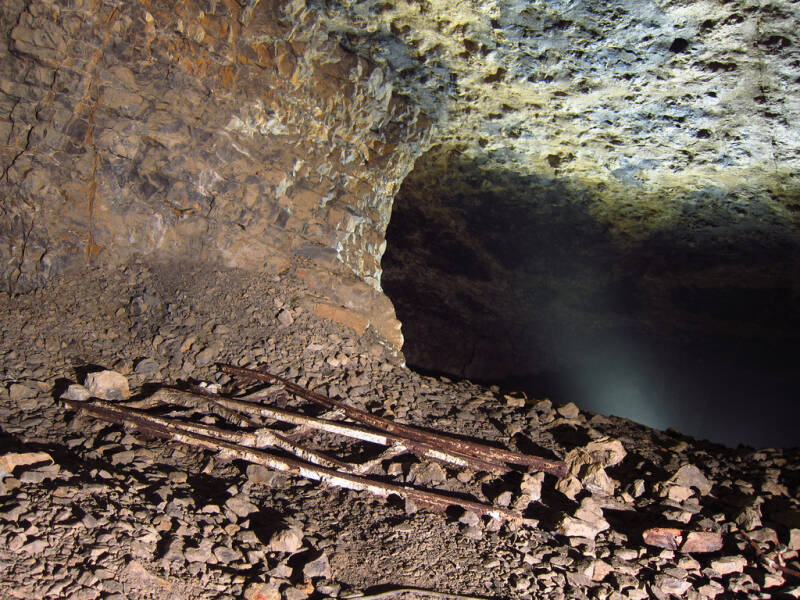
Photo below: one of the upper workings in the Harelawhill Limestone Mine, with the chamber up ahead illuminated by daylight. Note the "pillar and stall" style of workings and the connection to another daylit chamber in the distance.
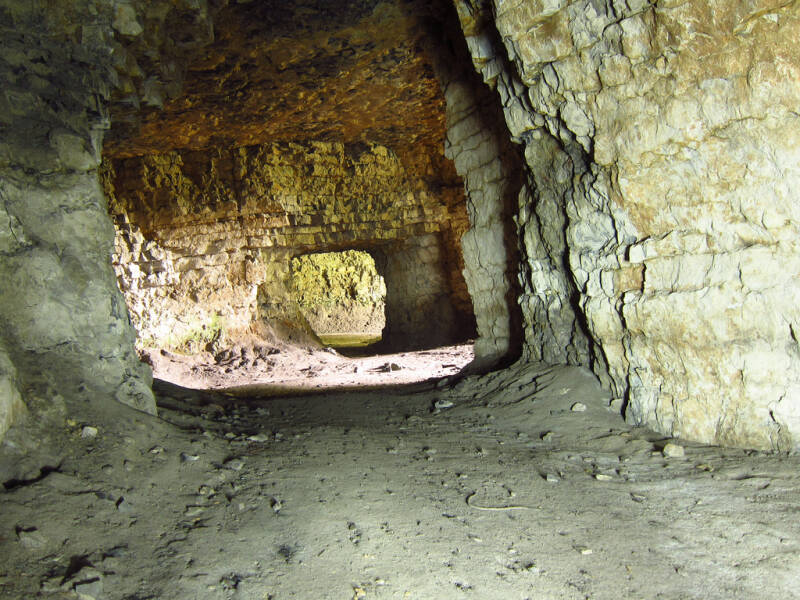
Photo below: a side gallery (left) and the incline descending (centre right), a shot front-lit, backlit from down the incline and lit with the help of my dad additionally in the passage to the left. This photo shows somewhat the "gradient" of the workings, as well as showing how little rail track is present within. I am not sure of the nature of the apparatus to the right.
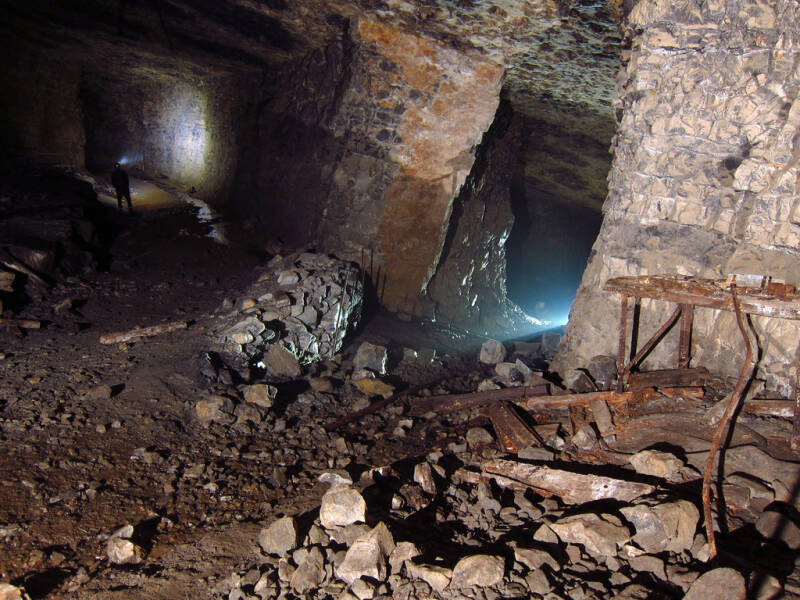
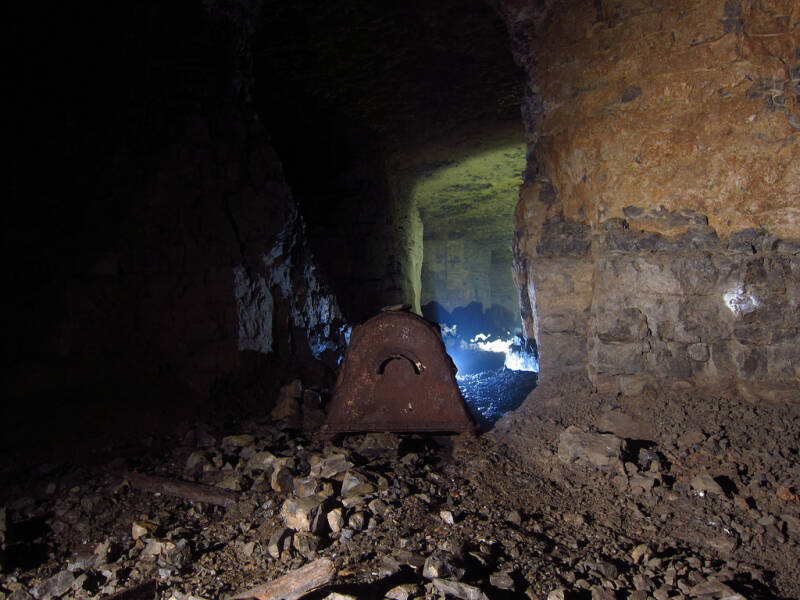
Photo below: the upper part of a tipper wagon, upturned, at, what was, if I remember rightly, the bottom of the incline. Note the difference in the limestone rock half way up the wall on the right, the shot is also backlit and part of the incline tunnel behind is illuminated too.
That's why in parts of Southern Scotland you have many limestone mines, or limestane mines as some mine explorers from Glasgow called them. These places have a rather strange atmosphere. The walls often look much the same colour, they are often very white, and stand out to torches, but they don't reflect much, and can make these mines look kind of flat, and dull, but in a sense that adds to their mysteriousness which I cannot quite explain. These mines can often be described as "pillar and stall" mines, where the seam or vein exists on a predictable flatness or relatively shallow slope, and where areas of the material are worked out, with pillars left at regularly intervals to hold up the roof. Sometimes these mines can be quite disorientating because of how similar the pillars, and tunnels between them, appear. This is why Cults Limestone Mine in Fife for example has random bits of tape and string leading from place to place, plus lots of arrows - these things being present to prevent people from getting lost.
Cults is quite a vast limestone mine, in Fife, but it is not my favourite. The location in the forest is nice, but the mine does feel a little bit dark and oppressive to me, probably in part because I spent a night camping in there and drinking buckfast with two Scottish Urbexers, who kindly showed me around, but the Buckfast didn't make me feel especially full of joy the next morning. Even imagining it now makes me able to "taste" the sickly taste of Buckfast through some cursed, quantum memory, connected to that mine. There was another limestone mine in Fife (I think) that we were chased out of by a farmer in a vehicle (he wasn't driving the tractor out of the mine itself). Going further south, I know of Middleton Limestone Mine in Midlothnian, near Edinburgh (not to be confused with the Middleton Limestone Mine in Derbyshire), and there is also Barjarg limestone mine in Dumfriesshire - I have never been, but it looks grim. I'm sure it's beautiful but from photos I have seen it just looks unstable as f*ck and very wet. Harelawhill Limestone Mine is also located in Dumfries and Galloway, and not so far from Carlisle. Harelawhill limestone mine, I visited back in 2012, a while ago. The mine had a strange smell of sewage, but it was impressive and really interesting to see. Because of the way that the limestone vein is angled at a slope, outcropping near the surface, as one goes further down the slope of the natural rock, one gets to the bottom, where the lower chambers are wet. Within the mine can also be seen an upturned, upper part of a narrow gauge tipper wagon, as well as a narrow gauge railway axle.
Photo below: a self timer shot, with me on the right (aged 19) when I visited the mine, with the upturned tipper wagon top in front of me at the bottom of the incline, and with a narrow gauge railway axle in the foreground. I lit this image from three places, including using a flashgun in my hand.
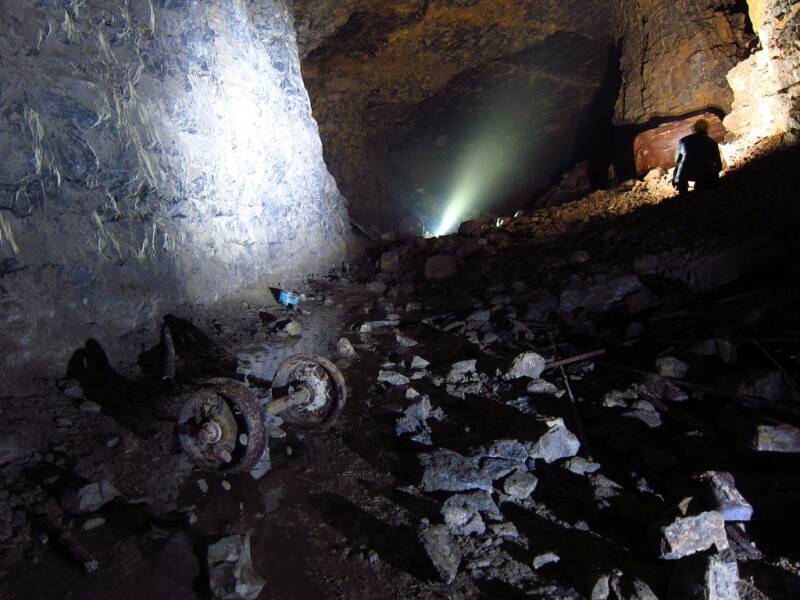
There are the remains of an inclined railway system within the mine, but now only some of the rollers, cables, and bits of the railway track, including some points, remain, from what I remember. There are some limestone mines in Southern Scotland which are far less known, and one location, I forget its name, is a very mysterious, narrow, low-roofed limestone mine located close to a waterfall. This one is so low that a person cannot really stand up in it, and the walls are so smooth, and there is some idea that the mine could be very old. Which leads back into this topic of, are some these generally "later" limestone mines, like Harelawhill, not like the more likely ancient waterfall mine - are some of these mines like Harelawhill perhaps somewhat older than is generally accepted, and is it possible that earlier mining operations at such sites might not have been mentioned as it was not considered relevant to the running of the mine and to its finances, etc? I do wonder, because certainly some of the limestone mines in Scotland are more "ancient" feeling. There was another limestone mine I visited in Scotland, which I do not know the name of, but it was quite spacious underground, yet very out of place. The entrance was more or less buried, and in an area of forest, and the tiny open quarry area was so low key, that it looked little different to how a Roman quarry would look.
Anyway, back to Harelawhill. The place-names in that part of Scotland felt very Anglic, and I remember, once we escaped the toilet atmosphere of the mine, we drove north, through beautiful autumn forests, eventually arriving at the beautiful, but not very "Scottish"-feeling city of Edinburgh.
That night, as I walked around the dockyards taking Urbex-type photos, I was briefly stopped by the police, as apparently I was in Edinburgh's illegal (not legal or official) zone for where prostitutes are, illegally picked up. I had no idea, I was just walking along, staring at lights and finding atmosphere in the mist. Anyway, I then went back to where I was staying - alone.
In terms of etymology, the "law" part of the name Harelawhill, is Anglic, and refers to a mound or even to a sacred mound site in Anglic tradition. The name Barjarg is also interesting, and would be spelled in Standard Scottish Gaelic spelling as bàrr dearg meaning literally "red summit", although I am doubtful that the Gaelic language in this part of Scotland was ever the same exact language as what we know of Scottish Gaelic in the modern, primarily Argyll and Highland sense.
Personally, I have only ever really explored limestone mines in Scotland, and one in Norway, but examples are found in England, including the Middleton Limestone Mine in Derbyshire, and the extensive limestone mines around Bath in the southwest of England. There are also some limestone mines in Wales, such as the large limestone caverns drained by the Milwr Tunnel. Outside of Britain, limestone mines are found in many parts of France, where, in Paris for example, they interface with the much more esoteric and mysterious underworld of catacombs and railway lines, beneath Paris. The French mine photographer, Hugo Clément, known on Flickr as Esprit de sel, has beautifully photographed a wide number of limestone mines beneath Paris, and elsewhere in France. His photos of the Paris limestone mines often give the impression of zones and areas that are somewhere between being mines, and being Cthulhonic occult sites and catacombs tied into Paris' esoteric Christian underworld, and perhaps, perhaps, tying into even earlier cultures and mythological themes. I wonder what kinds of myths are associated with these places, exactly, and if any give indication of being of more ancient origin, or being indicative that some of these mining sites beneath Paris might be pre-Christian. The underground mines in Paris are thought to have begun in around the 11th century, but Roman limestone open quarrying certainly took place in Paris, and the Parisii Gauls may have done some stone quarrying. I have heard unsubstantiated rumours also, connecting some of the catacombs and mines beneath Paris to the idea of druidic sacred chambers and later French occult meetings.
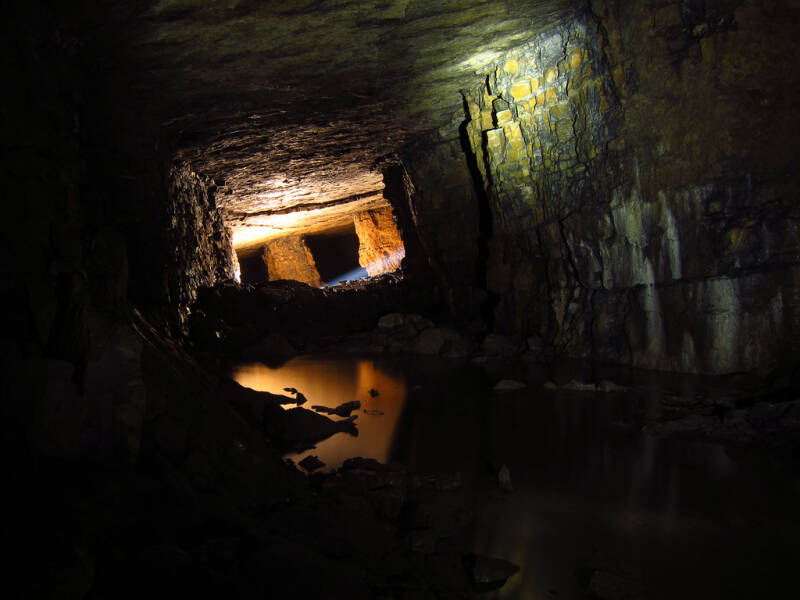
Photo below: one of the tunnels in the Middleton Limestone Mine in Midlothian, with early morning daylight shining into the tunnel up ahead, and reflected on the water below.
The idea that some mines are more ancient or may have served a different purpose is common in Tartaria Theory circles. A lot of the time these ideas seem like wishful thinking, but certainly there are some examples of limestone, and particularly of sandstone mines in the UK, which also resemble underground temples, resonance chambers, with there being I think a possibility that some are truly very ancient in origin. I have written about examples of this elsewhere. In terms of Hugo Clément's photography, I really like his album on Flickr, titled: Chaillot, Paris XVIeme. His pictures of this quarry network demonstrate the blending of limestone mine structures into the realms of Tartaria-style stonework, and with some of the tunnels in that album having incredibly smooth walls, almost out of place for a limestone mine.
Photo below: a beautifully preserved narrow gauge rail wagon, or "hutch" in Mid Central Scots, without its rails, and lying close to the water table in the mine. I do not know if this wagon is still there, but it is a beautiful example of industrial archaeology. This particular form of a "hutch" was common in Scotland at mining sites.
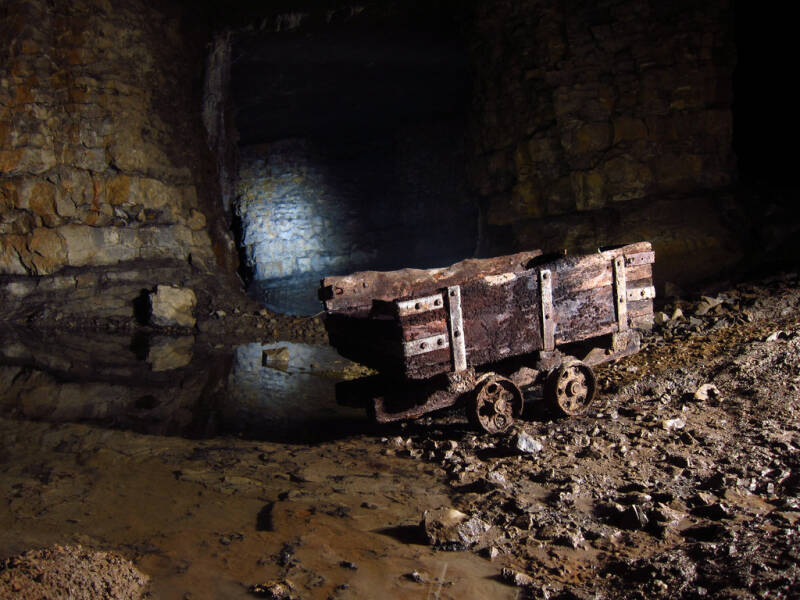
Photo below: a beautiful beam of light in Middleton Limestone Mine in Great Lothian, shining across the cavernous passage, and behind the pillar, from an entranceway to the left. I love the way that the light here illuminates the wall of the tunnel, this was indeed quite special, and felt like something magical to witness and to find in this industrial, slightly eerie mine. I remember when I first saw this beam of light in the distance it felt extremely holy and sentient, meaningful.
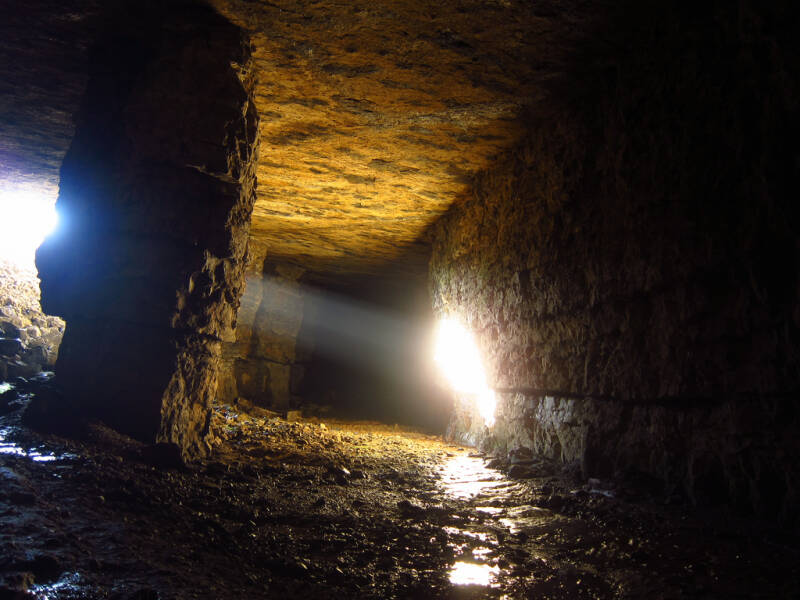
On the way back from Edinburgh on that trip, I visited the Middleton Limestone Mine in Midlothian. An opencast quarry is connected to this site, and the underground limestone mines connects into one of the open quarries. The open quarry was closed when I visited, and I remember going into the limestone mine through one entrance to the quarry, and coming out in a different one. This site is private and the underground workings were pretty unstable in places, probably not helped by more recent quarrywork. But the mine was very atmospheric. I visited there quite early in the morning, or, well, mid to late morning, one October day, and in certain areas the light shining into the mine from the east created beautiful beams of light. There was also an abandoned mine wagon, partially submerged. Just like in Harelawhill, due to the "slope" of the limestone vein, the lower parts of Middleton Mine in Midlothian were flooded. These mine wagons are generally referred to as "hutches" in Scotland.
I hope this blog post was a fascinating read :)
Add comment
Comments