Written & published by Linden Alexander Pentecost, & published after an unrelated blog post connected to different mines and history was published on this website earlier this morning in the UK. I also took the 7 photos in this article/blog post on this page (unrelated to the eight photos in the unrelated mine article published earlier). I originally published the photos of Flickr around 10 years ago before losing the originals and re-downloading them when I deleted my Flickr, I nevertheless took them and own the copyright. No AI was used in this publication and this publication is unrelated to and separate from any and all of my other publications. Note that the mines discussed in this blog post are extremely dangerous and whilst I discuss them for historic reasons and research reasons with important photos, on no account should they be entered. This blog post contains a total of 1983 words.
When it comes to mines and to the mines of what is now Cumbria, (part of which used to be Lancashire), people might think of Greenside Lead Mine in Glenridding, or of Honister Slate Mine, or of the incredibly dangerous Coniston Copper Mines, or of Little Langdale Slate Mine, also known as Cathedral Quarry, which is definitely not a low-key place and is very touristy. But the coasts of Cumbria, and what was North Lancashire, were more known for their very large coal and Iron Ore (specifically haematite) mines. The coal mines are closed, they are either flooded, collapsed, or closed by the coal authority. Florence Mine in west Cumbria is now flooded and closed to a large degree.
The Furness Peninsula was another area big on haematite mining, but again, the deep mines are all flooded, and in-part collapsed, and most of their entrances are completely closed. There are a few exceptions though, although I don't know about now. I visited at least ten years ago and the mine was in a bad state of collapse then. But one exception used to be Daylight Hole near Lindal in Furness, a very dangerous mine. Daylight Hole. When I visited anyway, the workings had partially survived, as parts of them were very shallow and drained. Mining has been taking place on the Furness Peninsula since at least the Middle Ages, and it is quite likely that haematite was mined much earlier, whether for iron smelting or for ochre in even more ancient times. Newer workings also obscured or destroyed older workings, but there are a number of sites which I think prehistoric iron mining might have taken place, whilst other outcrop sites show some evidence of working, but again this is all assumed to be medieval or later.
Daylight Hole is essentially a pit, representing one of these "bubble" or "globular" like formations of haematite within the limestone rock. These iron mines did not possess neat chambers or stopes like most other mines do, neither do they possess "pipes" like graphite or diamond mines do, instead their working areas were uneven "globular" areas of iron, hence why within these mines, some cavities or areas of iron ore were relatively small, whilst others were large enough to form big cavers. Daylight Hole was a surviving cavern, the entrance being at the bottom of the nearby pit. Part of the cavern is flooded to a significant depth, and the chamber is highly unstable and dangerous. Towards the back of the chamber there is also a higher entrance through which daylight leaks. The tunnels we explored next to this chamber are also highly dangerous. The floor (the parts that are not flooded) of the chamber is littered with massive boulders that have fallen from the ceiling, and entering the tunnels to the left was extremely dangerous, as a significant roof fall would likely have caused the water to rise and the passages to submerge. This mine is really not safe and on no account should anyone enter it. Nevertheless, I did take photos and I feel my description of this mine is useful. Several 19th century mine wagons are within these tunnels, which were in part preserved by local conservationists. The tunnels also show incredibly beautiful colours.
Photo below: one of the tunnels within the Daylight Hole Haematite Mine, with beautiful colours on the walls, more diverse than the strong maroon red of the iron, and which is also the colour of the mud which coats nearly everything in this mine. Note also the very narrow gauge 19th century narrow gauge rail track in the image.
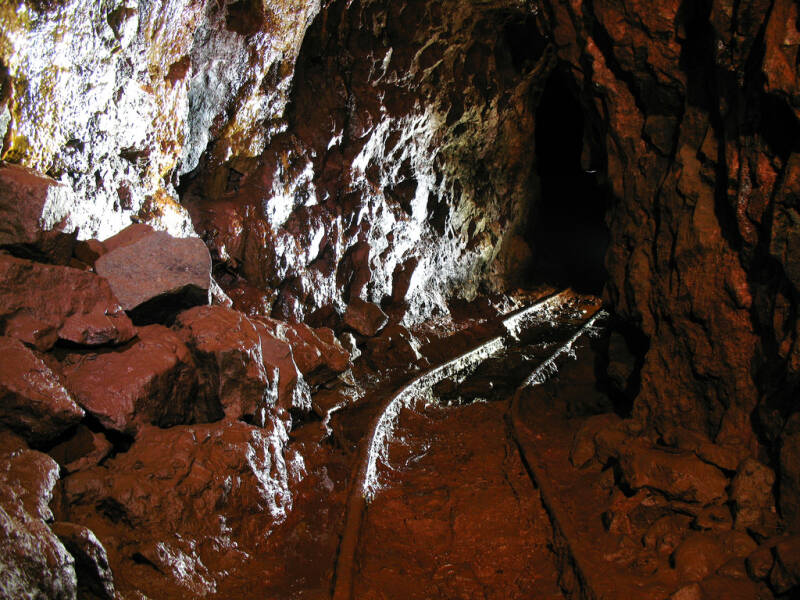
Photo below: one of the mine carts in one of the tunnels in the Daylight Hole mine, note the older style of the wheels and the unusual "squareness" of this wagon, even when compared to other mine wagons in the 1800s.
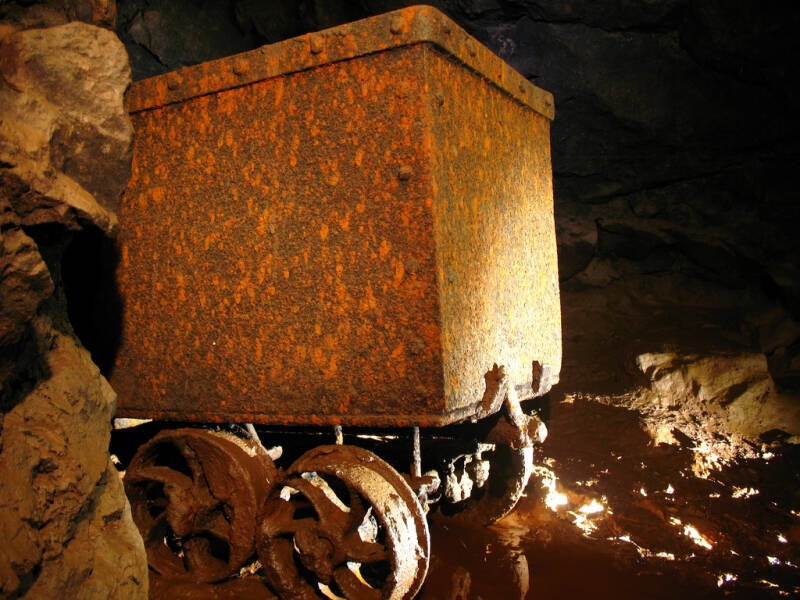
Photo below: two of the mine wagos in the Daylight Hole Haematite mine, which unlike in the photo above are not lit from the side.
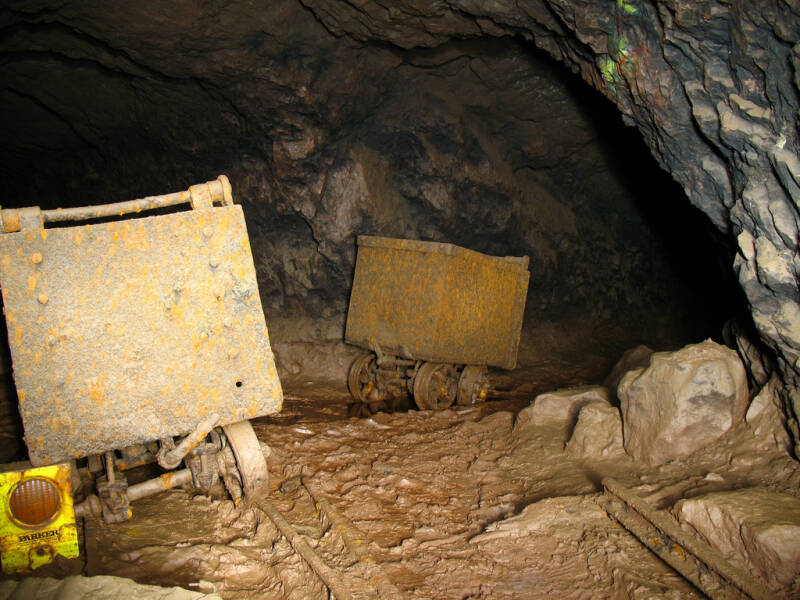
Photo below: another section of passage in the Daylight Hole Iron Mine, looking at the shape of this tunnel I suspect it was driven along what was a natural, possibly haematite-filled cavity in the limestone. Note again the beautiful colours on this image, lit from the front using a long exposure and lightpainting, and note again the narrow, narrow gauge railway, with strongly angular changes in direction where the tunnel and railway track turn.
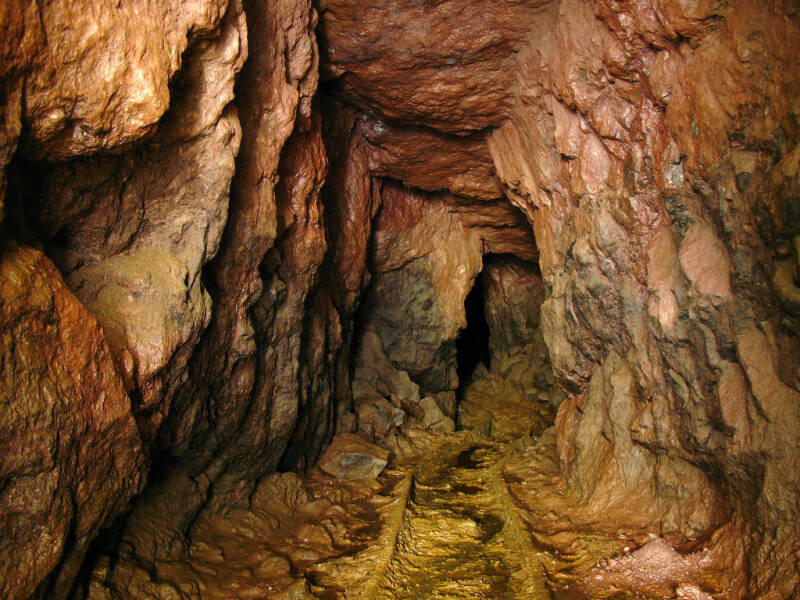
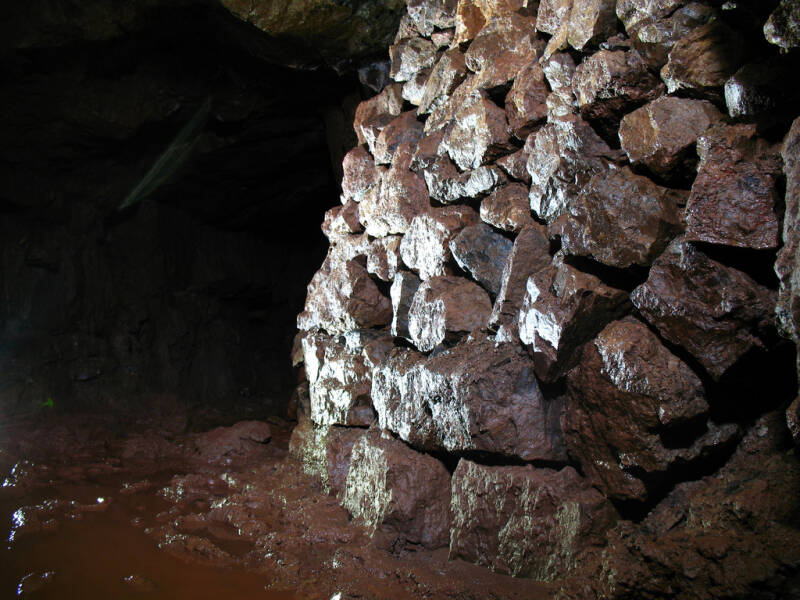
Photo below: a side lit and somewhat backlit drystone wall structure within one of the tunnels at Daylight Hole, presumably put in place by the miners for stability.
Very few of the haematite mines in what was North Lancashire are accessible. There is I think another which can be entered through a shaft of some kind, but again I am unsure if either of these mines are still accessible. Near Arnside, there is a small iron mine at White Creek, with two short, accessible passages. There is also the Red Rake Mine at Silverdale nearby, an old iron mine, now inaccessible. There are several other very small mines in that area, and some larger, and there are also a few on the north side of the Kent Estuary. Some of those mines are old, many undated, but others were worked more recently in the style of 18th and 19th century mine adits. One such example is shown in the two photos below, the one in the photos below is actually a widened natural cave stream, I visited this place 15 years ago. The tunnel in question is a main drainage level for the mines above it, and my grandad told me that when he once visited this mine tunnel, there was a beautiful formation of clays at the end of the tunnel. Because this mine drainage level followed a natural cave, the water flowing into that cave continued to flow, so apparently, at the end of the tunnel, there is a flow of water, kind of like a waterfall, and there are multicoloured bands of clay there, clay which was been washed into the natural cave cavity and which has been in part washed away by the water. I think the place sounds utterly beautiful, and the "colours" will result from the mineralisation in these cavities, including iron and copper. The mine level is located close to Warton Crag and actually goes underneath it, but I will not give away its location. It is however known as "Deep Level" from what I remember, and is on private land, so please, do not try to visit! The colours in what I did explore of this long drainage level are extremely beautiful and unique, and to my knowledge the photos below of this Deep Level drainage level beneath Warton Crag are the only ones that (when I publish this blog post) that will or have ever existed online.
Photo below: a partially backlit shot of the Deep Level under Warton Crag, with beautiful colours in the walls, and with the tunnel clearly rather wet. You can also see how the tunnel curves according to where the natural cave used to be, before being transformed. Parts of the old cave walls are, if my memory serves me correctly, still visible. The photo below also shows one area of packed stones of unknown use.
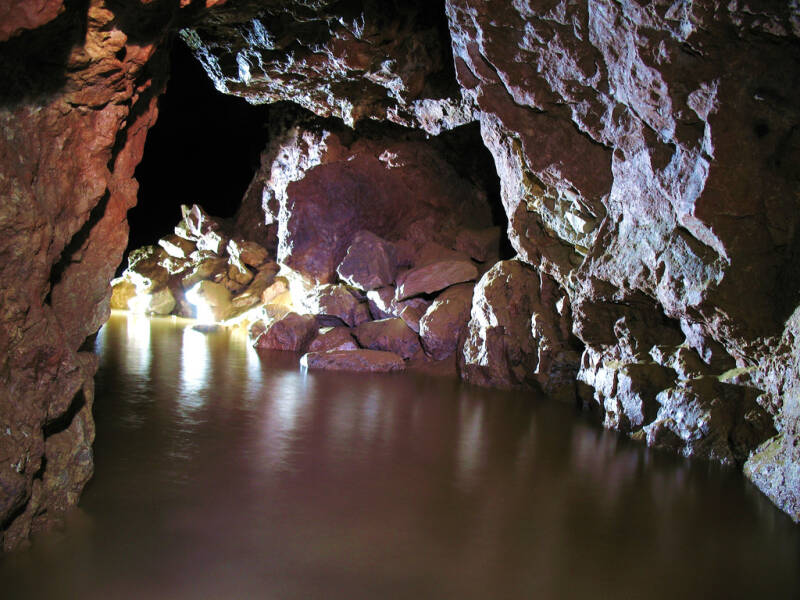
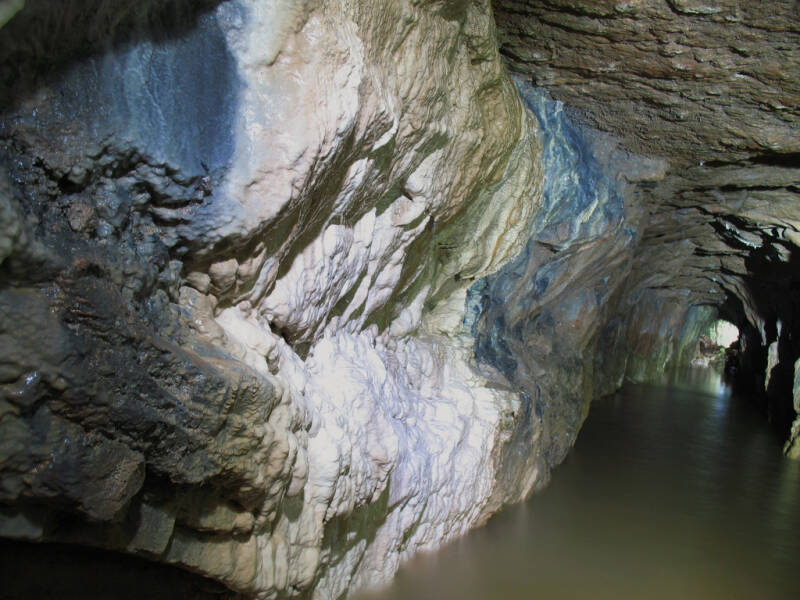
Photo below: beautiful flowstone, on what looks to be a part of the natural cave wall, in the Deep Level adit discussed above, with the entrance visible in the background.
I hope that this article/blog post was an interesting read, and also helps to give a useful historical record on these largely unknown and rarely visited sites, which are, quite likely, nolonger accessible. Eric Holland did a lot of research on the Furness and Morecambe Bay Iron Mines, and he was also a friend of my grandad's. My grandad was knowledgeable about the mines around Morecambe Bay, but he was more familiar with mines in Lancashire and parts of Yorkshire. Daylight Hole was also definitely not my grandad's favourite mine, although he liked the Deep Level under Warton Crag. I think his least favourite mine in the Morecambe Bay area was just south of Bardsea near Ulverston, and not far from Birkrigg Stone Circle, an area and place I have written about elsewhere. The mine in question is called Seawood Copper Mine, and is I think now collapsed, but lead in as a dangerous, liable-to-tidal-flooding tunnel from the shore. He described the mine as low, muddy, and when he got to the mine shaft which connected to the surface further inland, it was full of old rubbish and really very unpleasant. What is more pleasant however is Chapel Island across the water from there, where my grandad once camped and fished, this island can be walked to, with a guide and when conditions are right - the quicksands are highly treacherous and the tide washing over them happens extremely fast. When I visited the area a few years ago I witnessed how the tide on Morecambe Bay turned a dry, metre deep creek into a metre deep torrent of fast and dangerous water within about a minute, and about a minute later, the entire sandbank on either side of the creek was completely underwater and overrun with dangerous currents. Luckily I was up the shore and a safe distance away. I share these things about Seacove Copper Mine and Chapel Island because they are also historically and practically relevant, and like the other mines discussed it is likely that Seacove Mine is now inaccessible, not that I would ever wish to enter it. Note that I also discussed another of my grandad's mining adventures on the other blog post I published on this website early this morning in the UK (it is still night here).
My grandad has sadly passed away, as I have alluded to elsewhere. I had a dream about him pretty recently though. I dreamed of a large mine headgear, and buildings around it, workshops full of machinary. I went down some steps to a door at the base of the headgear, and I entered into a large workshop, with windows and tools and lathes situated on tables beside the windows. My grandad was sat on a chair, and quietly twiddling with some clockwork or other small-scale mine machinery, as he often did. It was nice to see him in the dream, in a workshop, illuminated by heavenly light. I miss him dearly but I know his spirit is in a holy place (the mine workshop not being where he is, but a place where I met him in my dream, where my consciousness was able to momentary be with his).
I hope that this blog post was a good read, thank you for reading :) May all miners and mine explorers be protected.
Add comment
Comments