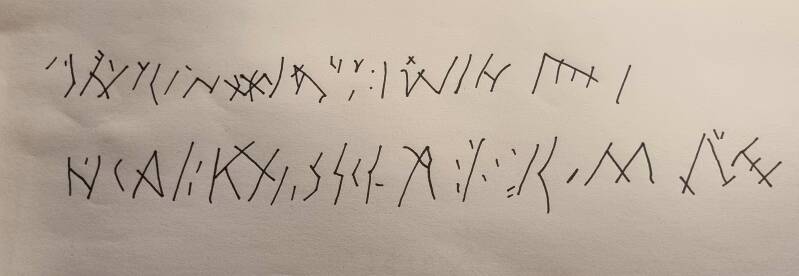
This blog post was written and published by Linden Alexander Pentecost, and was published early on a windy, cold UK morning, on the morning of the 20th of November 2026. This publication is unrelated to and separate from any and all of my other publications, it was published in the UK, no AI was used, and the photo in this blog post, showing a drawing I did of the Sitovo inscription, was taken by me, the author, and the inscription was drawn by me, but was drawn accurately from studying multiple photos and old drawings of this inscription. This blog post contains a total of 2193 words. Note I have discussed other ancient examples of writing in the Balkans in unrelated publications, and some of those topics connect to the topics discussed in this blog post on this page, but the information is different.
As I have discussed across a lot of publications, there exists in Europe, and other parts of the World, examples of similar forms of symbolic or written inscription, some of which may be classed as "proto-writing", which predate known alphabets by sometimes enormous lengths of time. I am very sceptical that all the alphabets in Western Europe come from Phoenician via Latin. Given the large number of ancient symbols and signs, often in inscription-like format, across ancient Europe, I think it far more likely that our alphabets developed independently, in-part influenced by each other, but ultimately drawing from ancient threads of proto-writing, written and other symbolic letters or forms. Sometimes the title "proto-writing" may in part be accurate, as for example, the Sitovo Inscription shown below, and many other examples, show both individual symbols and also what appear to be combined symbols, with the way in which these symbols are combined, and given extra lines etc, arguably having some meaning which is not directly a case of each symbol possessing a different sound. Of course, the same could be said about any hypothetical proto-writing system, however, there are commonalities. In my opinion there are many subsets of these ancient inscriptions and symbols which are not the palaeolithic pictographic and symbolic "letters" others have compiled, nor are they in my opinion merely a case of parallel evolution, they instead, rather, seem to represent variants of a symbol, or systems of early writing containing many of the same shapes, forms and ways of interlocking lines and symbols. I have found examples of this across Europe and some examples in the Americas and elsewhere. There are many sub-sets of this, and we are speaking perhaps of commonalities in an underlying geometric language and system of interlocking and associating the symbols, and this, and potentially several of these "systems" seem reflected throughout many ancient inscriptions, and there are too many similarities I think for this to be just about common geometry or parallel evolution - they imply I think something highly specific, a specific understanding perhaps of geometry and language and how to apply this geometry and many common symbols to a physical medium. Many sub-sets and other internal systems arguably exist as a part of this, and I am not implying they are "one" thing by any means. Another specific example I noticed today for example is a similarity between the inscription in the La Pasiega cave in Spain, which is dated to being between 18,000 years old and around 64,000 years old - so a fair time difference. But we have to keep in mind that time did not necessarily "flow" forward or behave as a linear construct - in the ancient past, in the same way that it does now.
I noticed that the upper left part of the La Pasiega Inscription, with several dome-like shapes upon a line, reminds me of an obscure and possibly now inaccessible inscription within the Wemyss Caves in Fife, which I have also discussed in detail in my Silly Linguistics article, titled: The Pictish symbolic language carvings, Norse rune & other mysterious inscriptions of the Wemyss Caves in Fife, Scotland – part one of the Pictish language. I have still yet to continue that article series but would like to perhaps look next at some caves on Arran, but anyway, in the aforementioned article I provide a drawing of an inscription in the Wemyss Caves which has geometric and perhaps deeper similarities to the La Pasiega Inscription. This, and my other work in general has lead me to think that so-called Ogham, rune inscriptions and other inscriptions, like Pictish symbols, do not neatly fit into particular time periods or cultures, rather, they connect in other ways, many symbols are missed or ignored simply for not fitting the standard timelines for the later alphabetic models, and these sites show continuity of common and more localised ancient symbols, connecting them to far outside of their respective cultural areas. For example I think it entirely possible, as I have discussed elsewhere, that certain twig-runes, Ogham and Pictish and other inscriptions may be far, far older, than the local cultural time periods that they are assigned to. See also my recent article on one of my other websites: https://www.clwaideac-na-cuinne.co.uk/articles-on-other-languages-l1-to-l30/l3-more-on-linguistic-similarities-between-europe-and-se-usa-publ-on-the-27-09-2026 .
Yet another recent example I have noticed was when reading an article, titled: Palaeolithic carvings rediscovered in Spain, on the bradshawfoundationnews website. Within the article in question is an image of an ancient piece of art depicting a horse. This image is the first of three in the aforementioned article, and is titled: Palaeolithic depiction of a horse at Cova de la Font Major, a cave in Spain. But, written onto the horse or somehow in connection with it are what appear to be two large M-like markings, which I would argue may be yet another example of these M or VV symbols existing in ancient contexts. I have discussed many others elsewhere.
Some of these have been picked up on by others, and sometimes, when occurring in the Americas for example, they are interpreted as runic, as Old Irish, or as Hebrew, but whilst geometric and symbolic, and perhaps deeper similarities exist, these interpretations always try to fit the inscriptions into preexisting known alphabets, which does not work fundamentally - rather than trying to understand the underlying geometric language and how that pertains to individual sounds and words.
The Sitovo inscription from Bulgaria is a very interesting example, and unlike most examples in England, and the twig-runes on Orkney, the Sitovo inscription is both obvious, visually important, and clearly defies any attempt to interpret it through any known alphabet. But as I will go on to discuss later in this blog post, there is an aspect to this that may connect to early Slavic alphabets, and to the so-called Bosnian pyramids.
Photo below: the Sitovo Inscription, located in a cave in a small cave in Bulgaria. There is speculation that this inscription is thousands of years old, and, from my own research and seeing the patterns, I would not be remotely described if the inscription was incredibly ancient. Some of the characters for example the upside down double, interlocking V symbols towards the right of the lower line, and also the two interlocking V's or W symbol on the upper line. Note also the most right but one symbol on the upper line, which resembles symbols in Iberian, Mound Builder Culture, Scottish Neolithic and other symbols in so-called Proto-writing, or writing. The Sitovo inscription below also shows examples of characters where precise lines and interconnections may be very important, as is the case with some so-called twig-runes, Proto-Ogham, and other examples, including those discussed in my publications about the Yuchi and Cherokee scripts, and elsewhere. Some of the symbols do resemble letters of the Cyrillic alphabet, but this is not by any means true for the inscription as a whole.
The presence of the Sitovo Inscription in Bulgaria, in the Balkens, connects it to a much larger concentration of ancient writing in the Balkans region. Whilst the Balkans, apart from Romania - tends to lack of a lot of the megalithic architecture found in other parts of Europe, it was certainly an important, and very central area in ancient times. The Vinča culture is the most known culture associated with this ancient writing, in various forms, although there are many, many, many other examples, including some which I have discussed previously, which are located in Romania. One of these is not considered Vinča and shows some similarities to the Sitovo inscription, and is also long like the Sitovo inscription. One example in Romania I am referring to is that of the Menhir near Fundul Pesterii Standing Stone, a photo of the inscription there can be viewed on the page for this archaeological site on the megalithic portal website.
Perhaps the most famous of the Vinča Symbol examples, although sometimes considered their own entity - are those on the Tartaria Tablets. One of these tablets shows symbolic or literal written language written around four corners of a circle, divided into four sections by a cross. This bares a remarkable similarity in form to an example of "twig-runes" found in Orkney, on an object, and to other examples of earlier circular writing divided into four quarters, for example, the Ogham alphabet was sometimes written, and for example, in the Book Of Ogham, In Lebor Ogaim, the four aicme of the Ogham alphabet are written as four distinct sets of symbols/groups of lines, each aicme being displayed in a vertical formation from the centre of a circle, with the lines coming out like a cross, and with the letters being written upon a circle. This example shows again this same four quartered writing form as is found on one of the Tartaria tablets and on one of the Orkney "twig-rune" examples, and on several others. In one of the four quarters of the Tartaria Tablet in question there is also a symbol looking like an Ogham word. There are also many other similarities between the Balkans and Celtic or extra-Celtic and pre-Celtic cultures, which I have discussed elsewhere, for example similarities between artistic styles of the Mesolithic Balkan Iron Gates culture, and motifs in Celtic art.
The Vinča culture was also one of the earliest cultures in Europe to make extensive use of mining, something which I presume, was in one way or another, connected to ancient mining in the Caucasus Mountains too, and perhaps even to pre-Celtic mining in some way or other.
Many of you have heard of the "Bosnian Pyramids", not far from the city of Sarajevo in Bosnia. Whilst mainstream researchers say that these structures are simply natural hills, my personal insight into them is that, whilst there is plenty of evidence showing that they behave like hills and ca be geologically interpreted as hills, some of their terrace or step-like rock structures do appear strange to me, and not natural, and furthermore, there are tunnels within these pyramids, possessing symbol markings, often the exact same as those I have seen elsewhere in ancient examples of inscriptions from across Europe. This alone I think is a strong implication that these Bosnian Pyramid sites are in part connected to ancient peoples and ancient civilisation as we understand the word, and that this also adds credence the possibility that the caves within the pyramid structures are also not natural.
When researching this early this morning I came across a rather deep rabbit hole - that of a theory which interprets many of these ancient inscriptions from the Balkans (most of them I haven't mentioned) as being in some form of early Macedonian or Slavic. I do not personally believe that this is the case, it seems too unrealistic to me, but I think that on some level phonetic values and symbolic, onomatopoeic-like sacred syllable values or formulaic structures might possess some kind of coherence, with regard to modern Slavic languages and these ancient inscriptions. This might also help to explain why some have interpreted the so-called "Noric Celtic" inscriptions as being both Celtic and Slavic, perhaps because classical Celtic languages also correspond to symbolic, vibrational, sacred or spoken phonetic or formulaic values of these ancient scripts - which leads back onto the topic of just how "Indo-European" the older forms of Gaulish and Lepontic writing are, a topic I have discussed elsewhere and which will someday go back to.
There is far, far more to this subject which I want to discuss and research, including this whole Ancient Macedonian rabbit hole, the Maykop Slab possible Proto-writing example of the Caucasus Mountains, connections to the Hungarian Rovas and ancient Uralic, and much, much more. In future publications I will also go into more detail about the things I discussed in the previous paragraph to this, and what I have written here should be enough to imply I think that the things I have discussed in this paragraph here, like the Caucasus Mountains, also connect to this larger range of topics.
I hope that this blog post was an interesting read. May the Great Spirit take care of you all.
Add comment
Comments