Written and published by Linden Alexander Pentecost on the 23rd of November 2026, published early in the morning and after I edited an unrelated article on a different website with extensive new content. This article was published in the UK and no AI was involved in writing this, this article/blog post contains three images, the first is one I took and edited, the second is an AI image which I prompted showing an attractive witch woman, and which I also extensively edited with symbols relevant to the topics in this article, the third image is of a drawing I made of some ancient writing, which before this publication I had not drawn and photographed, and which is unrelated to the Sitovo Inscription drawing in another recent blog post on this website. This blog post/article is unrelated to and separate from any and all of my other publications, and it contains 6101 words. Note that I am leaving the UK tomorrow (the UK is where I live) - but I will be leaving the UK for a while starting tomorrow, and this blog post is being published in the UK and will be the last thing I publish until I return home. This written work contains some references to adult erotic written themes (but no erotic image themes), and because of the written themes this blog post publication should not be read by those under the age of 18. This publication also discusses themes connected to sleep paralysis, which some may find uncomfortable to read. This publication on this page is unrelated to and separate from, and contains different content and information from, any and all of my other publications, and no AI was used in its writing nor publication, with one human-prompted, human edited AI image included in the three images. Note that many unique, but connected, and many previously not discussed things are written about in this long human-written blog post/article. This blog post/article was written and published early in the morning in the UK, with the other unrelated article I completed earlier today having been completed even earlier this morning.
Witches are an interesting topic. One of my own observations is just how the modern sense of the word "witch" differs immensely from what our ancestors in Britain were describing just a few hundred years ago. Witchcraft and the title "witch" have been re-imagined in modern times to help women claim back their inherent spirituality, and to also show that witchcraft is something that can be practised by men, too. I am, in a sense, a male witch, although I have only practised symbolic protection and gentle candle-magic, and honestly I have no intention of doing other spells, although the idea of meeting some of the witches today in Lancashire and being able to offer something to a solstice ceremony or something like that - does appeal to me, and I think I would really love that.
I am very much drawn to this, but the modern interpretation of "witch" and "witchcraft" can also be misleading. The magic I have partaken in, and that which those I know partake in, is white magic, it is protection based, supernatural defence-based and uses simplistic tools like candles to help relax and achieve inner insight (obviously it has to be done in a place where the candle is not going to set light to something), but I haven't done candle magic since I was 19 anyway, so.
Photo below: part of the interior of the Bryn Cellu Ddu passage tomb on Anglesey, North Wales. I have published some different photos of this passage tomb elsewhere, and earlier today I mentioned a different tomb on Anglesey when editing an article on a different website. Bryn Celli Ddu - as can be seen in the image below, invokes a certain underwordly atmosphere. You can see on the right people have left seashells as offerings. As I have said elsewhere, this is in a sense a continuation of the animistic rituals associated with the ancient peoples who once used this site. Also linking with my unrelated article on a different website which I edited earlier this morning - at the end of the passage visible below is a very unusual stone said to have acoustic properties. In many ways the prehistoric archaeology at these tombs, and modern practices, are both perhaps best described as animistic and as witchcraft-related, with shamanic-elements, although I do not apply the word "shamanism" to cultures outside of Siberia, it is just that sometimes it can be a useful word to employ, to give more substance or comparison to what I am describing. Note how in the photo below the light walls on the walls of the passage, and these tombs, or rather, temples, were subliminal places of both dark and light.
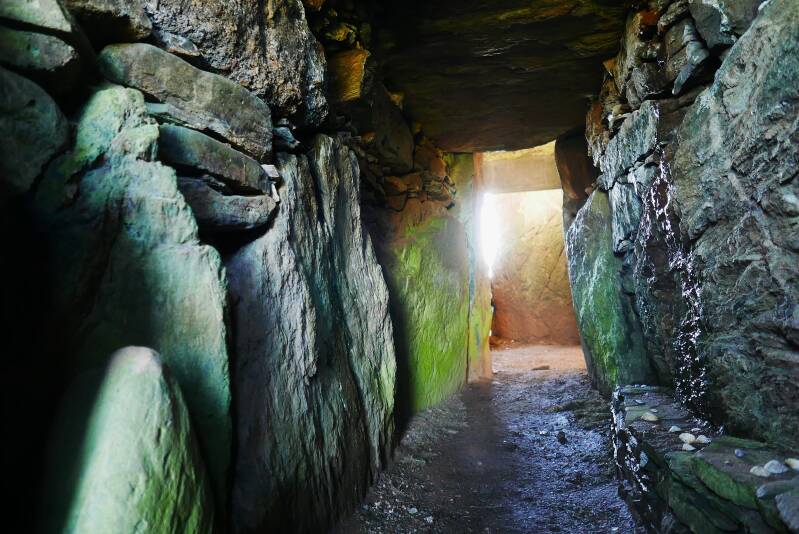
It is easy and tempting to assume that all "witchcraft", as I have previously postulated for the most part, is due to Christian leaders imposing control and trying to get rid of the last vestiges of indigenous spiritual tradition, for example in West Lancashire or on the coast of Finnmark in Northern Norway. And this is certainly true, and those who were put to death were all innocent, and it was an absolute atrocity that those female, and male witches, were put to death.
Without detracting from that previous statement, it is also true that when our ancestors described "witches", not in terms of the women and men who were wrongly punished, but in terms of "witches" as a phenomena, they were also sometimes describing something in many ways unlike our modern idea of a witch. Wise, indigenous women existed in Lancashire, who were called witches, not so long ago. But we have to understand that when the word "witch" was being used, a lot of the time, it was not describing women at all, but was describing something altogether non-human. The English language, rather confusingly, uses the word "witch", a word connected to wisdom, for both wise women, and, presumably, it was then later applied to the supernatural beings that some witches were likely aware of. These supernatural beings in our folklore are, a lot of the time, called "witches", but there is really very little difference between them, a succubus, a vampire and a "mare", as in the spirit associated with "nightmares".
The Welsh language on the other hand draws a clear distinction, where for example Swyngwraig refers to a female sorceress who does good, whilst gwrach refers to a supernatural female entity, associated with immense and dangerous power, and with themes of airborne disease, decay and rot, often also with vampiric tendencies. In other words a gwrach is not "human", it's not a woman, a female practitioner of magic, but something else entirely, although arguably women and men could become these entities after dying of old age, or in some way become consumed by and merge with them.
A famous example of a gwrach in Welsh folklore is Yr Hen Wrach, a giant, 7 foot tall undead-looking goddess figure with long black hair, who was said to breathe disease towards people, whenever she emerged from the bog of Cors Fochno close to Aberystwyth. I have written about her a fair bit elsewhere, but will also note here that there is evidence of ancient flooded landscapes in this area (which I have also discussed elsewhere), and I now think it entirely possible that Yr Hen Wrach could be some kind of deity associated with, and connected to, these ancient lands. The gwrach in question was said to have disappeared when the Cors Fochno bog was drained, which I think is curious because it almost implies that the gwrach needed dampness, mist, the same kind of environment where disease can spread - in order to physically manifest.
I do not think that these beings are evil, because at least, when I see the cosmos and creation, I understand that being a parasitic spirit, like a gwrach, vampire or succubus, does not automatically make such beings evil, when, in some stories, their interactions with humans are entirely consensual. It could also be argued for example that humans can behave in a parasitic way towards nature. As I have postulated elsewhere, the "magic" known to a gwrach seems to have been essentially the same magic that caused people to become vampires, draugs, or to turn into dragons. It seems to enable an expression of the soul and spirit to continue existing indefinitely in a kind of semi-physical state which can "manifest" during certain conditions, hence why lake serpents, vampires and the like, have an incoherent relationship with the physical world, sometimes behaving as though physical, and other times behaving as though non-physical. These beings seem to "trap" their soul energy or time energy and maintain it through consensual ritual gifts of fruit or tobacco etc, or in the case of succubi and vampires, through more harmful means, yet despite being able to create a strong physical influence on our reality under certain conditions, they seem highly vulnerable to aspects of our physical realm, in a way that humans and living things are not. The mythology implies that they are immensely physically strong, yet it seems that ultimately their powers in the physical realm are actually extremely limited, hence why they are so easily defeated by things like salt, holy water (carrying a frequency that is destructive to them), or the symbol of the cross. They are implied to be powerful beings within their own "rules", when they are moving through and interacting with reality in their own, mysterious ways, yet they seem highly vulnerable to things in the physical, human world, which are not vulnerabilities to us humans at all. In some ways, the things historically used to push away these beings are very mundane. Another example, discussed elsewhere on this website, is the way that these beings seem to become utterly confused and powerless when when presented with something like grains of sand, which they feel compelled to count, or when presented with for example a flower-shaped apotropaic marking, its geometric shape and lack of straight lines seeming to confuse these beings and stop them in their tracks. I am not suggesting that anyone try to attack these beings if they appear in nightmares etc, but if they are unfriendly, one should always protect themselves with the traditional deterrents. There is also the aspect that even friendly "dream entities" can be lying and presenting themselves under a guise of love and light when they are not that at all, ultimately our gut instincts enable us to tell the difference, and we must listen carefully.
Another curious account of a Welsh witch, is that of Elena Ddu, a women said to have transformed into a gwrach after death, where, after 30 years, she would rise from a lake, appearing pale and undead-looking, and had also grown large leathery wings - again implying some kind of transformation upon becoming a gwrach with the wings arguably being akin to those of a succubus, or those of a dragon. In fact, I would argue that in many respects, Western European folklore seems to imply that a dragon or serpent is very often a final, mutated form of what was a human, who turned into a gwrach, draug or vampire, before later mutating further to become a serpent or wyrm, or dragon. Again, we view dragons and serpents in our modern culture too often from the literal perspective of them having anything to do with reptiles, but they do not, I think. So perhaps we might postulate that the Dragon of Martonmere near Blackpool, and the Serpent of Hawes Water near Silverdale, may originally have been undead, witch or goddess figures, who, over thousands of years, mutated and transformed. Again, these beings are not evil, they are dangerous, and they are connected to the Undead, but they can also be healers, guides and teachers.
In Romanian folklore, a Balaur is a multi-headed dragon which is an evolved, further developed form of one of the undead, and in Bulgarian folklore, a transformed undead would become a Zmaj, a "Storm Dragon". There is a curious and strong association between these beings and storms, both in the Balkans but also in Scotland as I have discussed extensively. In Romani, the Solomonari are dragon-riding storm sorcerers, whilst Stirigoi witch sorcerers in Romanian folklore brought hail and winds - this in in addition to Stirigoi turning into dragons sometimes, along with other undead beings in Romanian folklore. Again we can see immense similarities here with flying vampires and with witches flying on broomsticks. It seems that the transformation from a Stirigoi into a Balaur was permanent, something which, in my opinion has slightly erotic, transformative undertones that I feel instinctively connect to the idea of consensual bondage in adult erotica. The same can be said for the way in which these spirit beings are said to "ride" men and women, which is not itself sexual, but is symbolic of it. Furthermore, despite sleep paralysis often being scary, and generally it is not sexual, sometimes it is sexual, and people do report positive, transcending, erotic experiences with these "undead" witch spirits or vampire spirits. This is not to say that I think anyone should wish for sleep paralysis - it is scary, what I am explaining is the fact that many of these experiences are scary, and are not generally erotic - this does not mean that people do not have erotic experiences as well, many of which are loving, transcending, euphoric and spiritual. Whether that is truly a good thing or a bad thing, who knows? I myself have never had such a dream, when I have occasionally encountered these beings in dreams, I have found them very scary, but not evil. In one such dream, such a gwrach essentially "dragged me" around the country lanes of North Lancashire for what seemed like a long time, before showing me a particular place. I will not say where, but the place I saw is linked to witch mythology, and despite the dream being scary, I felt that this being was "showing" me a place, and was actually teaching me and revealing something to me, despite the fear that I felt. I have had many other dreams in which I have encountered draugs and zombies, which I have described elsewhere.
Fascinatingly, in Hungary, the spirit medicine person known as the Táltos is said to begin as an adult person but with extra teeth or fingers, something which connects to the subject of ancient giants - as to many of the themes in this blog post. It is fascinating that this figure is also said to transform into a fiery wheel, not dissimilar to an ophan spirit wheel perhaps or to how Manannán Mac Lir is said to transform into a wheel, and how God in the Bible is said to have a chariot. In Hungary there is also the Szépasszony, which literally means "The Fair Lady" - rather than being a medicine person, this fair lady is a little akin to the gwrach, and she is associated with steppe plains and with sudden whirlwinds that appear out of nowhere. Also in Hungarian mythology, the Ördög "devil" figure is associated with steppe plains, just as, as I have discussed elsewhere, a devil figure is associated with an enormous, flat plain at the mythical place of Blåkulla, connected to the real island of Blå Jungfrun off the coast of Sweden. It is also fascinating how some of these figures are associated with roads, and particularly with crossroads, and I think this in some way pertains to the same reason that these beings seemingly "need" to travel along straight lines, with roads also, like plains or steppes, being "in-between", "transitional" spaces in a sense. The way in which these beings fly also seems to relate to this, I had a dream in which I experienced this, which I have described elsewhere, but it seems that in folklore witches did not "fly" in the traditional sense, but rather used what we call ley-lines to collapse the distance between places, which, from what I have read regarding various accounts, seems to have depended on how well they could "envision" the destination. It is implied in folklore that these beings moved magically, but again, only on ley lines, and arguably unable to make turns or corners with much sense of free will. My own dream of a gwrach which I discuss in the paragraph above this, also included roads, again, which further connects to this idea of ley lines, straight lines and liminal spaces. There is also actual folklore which urges people to not walk in the centre of roads at night - of course there are real reasons to not walk in roads at night due to the danger of vehicles, but British folklore also cautions against walking in the centre of a road at night so as to not be "ridden" by one of these undead beings. Another interesting point is that the term "Carlin" or "Carling" found in Cumbria and in parts of Scotland Scotland, the word related to Old Norse Kerling - "Old Woman" - is in a sense a Northern form of the gwrach, and in a lot of place-names it is unclear whether a "witch" or "Old Woman" is being referred to, but, if many of the names are referring to witches/gwrach-type entities, then that would be extremely interesting. Just as giants in Cumbria are connected a lot to the Eden Valley and Howgills area, there are also a few "Carling" place-names in these areas, like Carling Knott near Loweswater, and Carlingill "Gwrach Steep Valley" in the Howgills. Another place-name in the Howgills, Thursgill near Sedbergh, references a "Thurse", another giant-type entity connected to these others in my opinion. It is also noteworthy that these topics connect to those of tentacled beings, Jenny Greenteeth etc, discussed in other unrelated blog posts on this site, and in my other publications published elsewhere. Note that "Carling" can also simply mean an elderly woman in Northern English dialects and in Scots, and so "Fishcarling Head" near Beetham for example is more likely a place-name referring to old fishermen's wives, not to gwrach-like beings and goddesses.
There is also an obvious erotic theme in a lot of these stories, whether manifesting as a wyrm, "swallowing" and incorporating consenting men and women who choose that destiny, or whether it is in how vampires appear in erotica; or in how artwork of "demon women" and the like, frequently shows beautiful adult women, with serpent-like tails and horns, and similarity to how "devils" are often said to have horns. Whilst later European folklore usually has a male knight saving women from a serpent or wyrm, some of the mythology does to me imply that women and men were "drawn" to these beings, and consensually chose to partake in their magic and to merge with them - not that I think this is a good thing. As I have commented elsewhere, the links between mythological "serpents" and sexuality are very noticeable, and as I have mentioned elsewhere, I once had a girlfriend, when I was about 23 and she was 31, and she explained to me that if, when healthy, she started to grow horns, develop spiky scales, and for her torso or belly area to transform into a segmented, worm or serpent-like shining form, then she would still feel beautiful.
The person in question and I also used to discuss polyamory sometimes, and there are historic accounts of witches, that clearly imply both adult female and adult male witches partaking in "communal" or "group" relationships and orgies, involving bisexual activity, with each other and also with the horned, hoofed, male, humanoid fertility "devils" frequently said to meet groups of witches. I do not believe that these events in real life ever involved things that actually caused harm or which would be illegal or bad by societal standards, and things like actually drinking blood from willing to-be vapires are of course fictional things added later. But I am not saying that this form of polyamory is "positive" either, because, the folklore clearly implies that these spirits were working with immense powers, and I think it crude and in a way unhelpful to present polyamory as something that requires zero responsibility - and which removes the aspect of powerful spiritual forces, which, sadly, many Neopagan and or/modern sources about polyamory usually exclude. When such things are mentioned, they are normally mentioned in a way that implies they are "emotional highs" or "experiences", completely stripping them of their spiritual nature and stripping away any real world responsibility to love and look after others' feelings. In this sense it is not to different to a lot of New Age spiritual ideas, which place more focus upon "energy" and "experiences" and "highs" than they do on actual wisdom and understanding. I discuss more on polyamory further down this blog post.
Photo below: a human-edited, AI-created, human-prompted piece of in-part artwork which I edited and prompted, which as well as being edited has had writing added to it. The image below represents an attractive, alluring adult witch woman aged around 37, in a desert, as can be seen in the background. Deserts, flat plains, and meadows are sometimes associated with witches, perhaps I think in relation to how the "reality" that supernatural witches move through may be considered as a kind of "flat plain", and partially perhaps because witches and devil figures are associated with decomposition in nature, but also with the sowing of grains and ploughing of fields, hence they are connected to the left-hand path, underside of creation, which is not inherently evil. Also on the image below are various apotropaic markings which I added. In the top, left hand corner are the letters IHC, an apotropaic marking used in Britain, and connected to the word written below it, which is ΙΗΣΟΥΣ, or Jesus, in older Greek spelling, which the letters IHC are thought to be an abbreviation of. On the top left of the image is the Hebrew ה, "hey" letter, used in the name of God, and itself associated with lifeforce, itself used as an apotropaic marking; below which are written i the Hebrew script the first letters of the Ana BeKoach, a mystical prayer containing 42 letters. The letters which I added to the image below of the Ana BeKoach are transliterated into the Latin alphabet as: Abg Ytz. Below, on the witch woman's upper chest, are further apotropaic markings, three of which, like the others already discussed, I have not discussed before. Furthest to the left is an M mark, in pink and light blue to show that the marking is made of two upside down V symbols, to the right of which is the Finnish Tursaansydän symbol, not discussed before by me, but connecting to my comments earlier today in my unrelated publication and to other recent publications about the Iku Turso god of Finnish tradition. Whilst Iku Turso is a Cthulhonic deity sometimes described with tentacles, and also associated with breathing disease into the air, like witches - his symbol was also used as a protection symbol, and was placed onto buildings. To the right of this on her other collar bone is a apotropaic star symbol, I have actually discussed these before, but not like the example below, where I have, just in blue, drawn to the star to make it clear that the one below is drawn from two upside down V's which are then connected by another line. The symbol to the right of that is a daisy-wheel, an example of the flower-like, mandala-like apotropaic markings, that were often used on buildings. I mention these flower markings briefly further up on this blog post. Also in the image below, the woman's hair is not typically feminine, which is meant to be implicative of the way in which witches can go beyond traditional gender stereotypes, her hair is also black, which is the hair colour of many of the gwrachs in Wales, whilst her penetrating blue-green eyes are connected to the association between green eyes and magic, whilst her silver necklace contains a fungus-like silver symbol upon it, connected to life, the underworld, to the moon, and stars. Despite there being appropriate apotropaic markings on the woman's chest in the art below, the art is not nude of course and shows no nudity, and the woman in the art below is clothed, even if the clothes are only visible as part of her top.
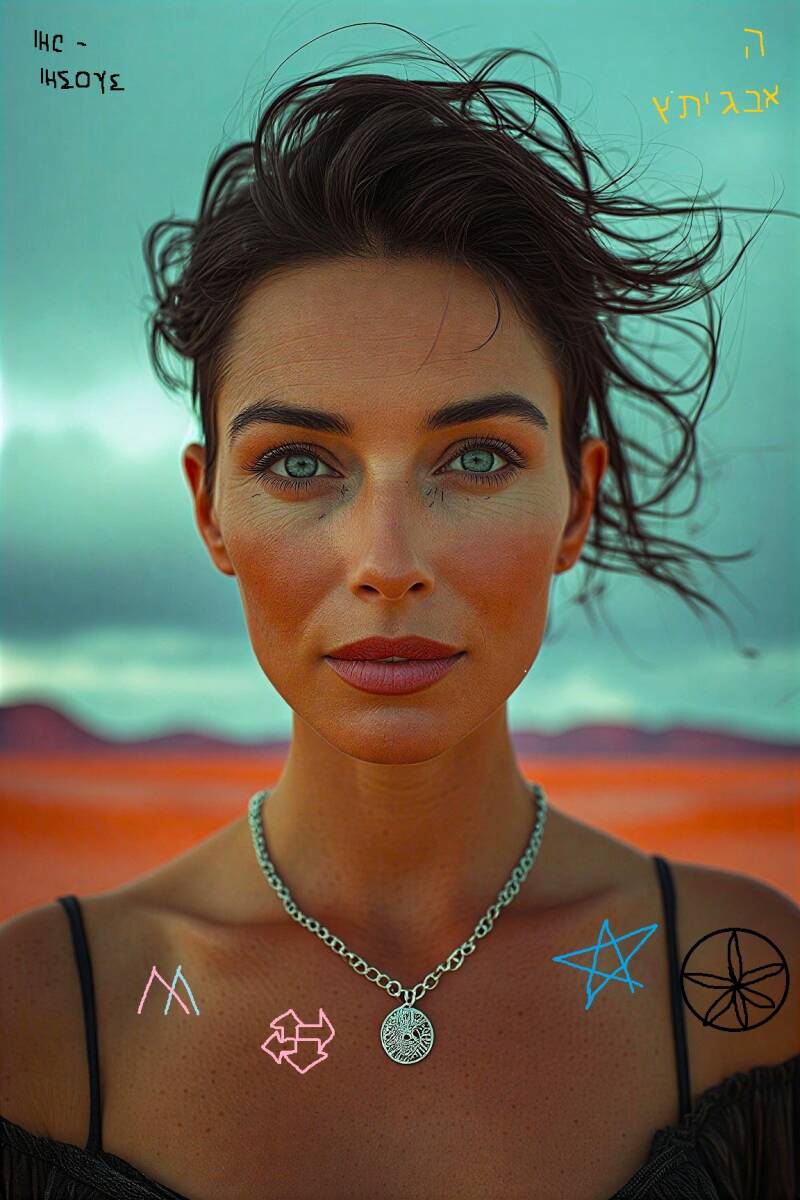
Some of the topics discussed in the photo description above the photo above bring us again to the question of whether or not these symbols were used purely for supernatural protection, or whether or not they were also used to invoke these energies, taking for example the way in which the Tursaansydän symbol is associated with a dangerous primordial God associated with disease, but here is used to protect a person. Likewise, star symbols are used both as apotropaic markings and are used by some to do magic, whilst VV like markings are also found in Neolithic tombs, and I think, from the archaeology, that it is entirely possible that Neolithic people did invite such forces into this world.
Another thing which I wish to bring up is how the Neolithic world, and also how a lot of these ancient apotropaic markings, and arrangements of standing stones and monuments etc, and Neolithic petroglyphs, show geometry, lines, angles, which do not form clear or coherent pictures when understood in terms of linear language and in terms of purely-euclidean geometry. I have commented on this elsewhere, with regard to "proto-Ogham" and other things, but am discussing more information here.
It is also noteworthy how Neolithic people, who, as I have often written about before, are connected to these gwrach beliefs, and the inability to not move in straight lines etc - how the Neolithic people possessed incredible examples of non-euclidean geometric language in their petroglyphs, and incredible mathematics and also "unknown" forms of alignment and geometry in the layouts of their ancient sites - yet how, by and large, many of the Neolithic cultures in Britain seemed to lack the individual urge or even awareness of what we would call "art", and seemed to not use written language in the strictest sense that frequently, although I have researched and published about many examples of this. Some ancient cultures absolutely did create "art", images of things, but a lot of these megalithic cultures did not. They created things in the likeness of things sometimes, but there seems to have been no "art" in terms of something that was inherently separate from the geometric and symbolic language in their non-euclidean petroglyphs - which again connects back to my unrelated article on a different website, edited extensively earlier today. Note that in that article I also describe an account of how Ancient Egyptians levitated rocks along "straight lines", in relation to the topics in the aforementioned article, which was actually published a while ago before being extensively edited earlier this morning.
This really is a fascinating and strange paradox - and, I honestly think it entirely possible that the megalithic peoples of Britain that we call "Neolithic", were actually experiencing reality and time in a very different way to how we, and to how many other ancient cultures did. We have to ask - why did they have such advanced megalithic building techniques, why did they have such an immense understanding of nature, and of science, yet, at the same time, why did they generally have no strict "artwork", and why was their material culture seemingly quite primitive? The same question can be asked regarding for example polygonal masonry - these sites show a high degree of cognitive ability to interface with material at what seems to be a universal-geometric and linguistic level, yet these sites are remarkably uniform and show no evidence of "art" in the strictest sense. Linking back in with my edited publication earlier today - to some degree the "sacred advanced technology" of these cultures was not I think a material technology, but a vibrational and linguistic one. And this linguistic reality and its written, geometric forms, are seemingly very different to our more "linear" forms of language that we speak today. I have discussed other aspects of these things elsewhere and will discuss more in the future.
I think the megalithic, Neolithic mind, and linguistic symbolism in their petroglyphs, indicate a level of connectedness and geometric understanding that is beyond linear time, and I think that it is precisely this "mind", attuned to eternal, non-linear time, which was naturally more suited to polyamory, and which later manifests in witchcraft traditions surrounding polyamorous relations among witches, and orgies, etc. From a Neolithic, eternal-time perception, where all time is simultaneous and there is no difference between the spiritual and human worlds, they are instead different wavelength expressions of the same fundamental reality and creation - adult relationships and polyamory may well be perceived on a more profound level. For example, even in polyamorous, adult MMF triad relationships, or adult FFM triad relationships, there is always some "fear" that a primary partner will end up falling for the second person deeper, and feeling more romantically about them than they do about their first partner. But from a Neolithic, "timeless" perception of reality, where consensual adult relationships can be even more fluid between adults, where there is no distinction between consensual love and consensual erotica and desire, less distinction between light and day - a person's partner coming to love the second person more is arguably not going to be painful, instead, it just becomes a part of the erotic tapestry of adult community, a new shape to the greater form. The idea that for example a man's lady ends up romantically loving the second man more than him, is in this scenario hypothetically no problem, instead the first man just takes a different role, and because the love is communal, and there is no difference between consensual romance and consensual lust, nothing is lost. And actually the woman in this scenario could play into this naturally and tease the first man with it, for he knows that she still loves him and cares about him, and wants to be his partner, she just doesn't feel the specific romantic feeling so much with him. I do not think that that makes it less loving. I have touched on this idea in other publications, too.
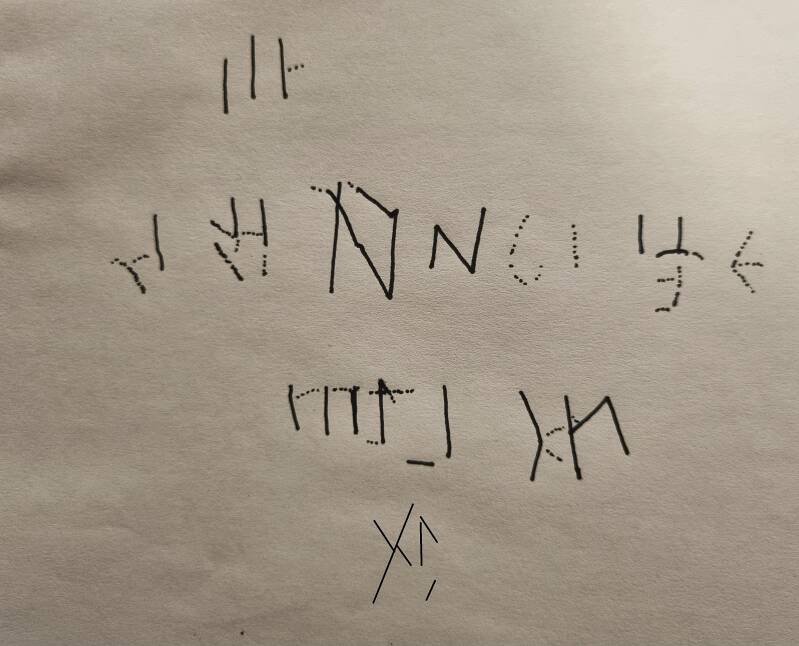
Small apotropaic or magical markings are also found at megalithic Neolithic sites, which again I think implies more connection between the polyamory of witches and that that I believe existed in Neolithic Britain, I have explained why I believe this, in much more detail elsewhere. But Neolithic people, as I have discussed before, also made presumably-formulaic inscriptions more akin to runic inscriptions. As I have also discussed recently in detail there are many other examples throughout Europe, often of unknown date. Below is a photo description and photo below that pertaining to yet another of these inscriptions.
Photo below: a drawing I made with guidance showing the possible ancient inscription on the Fundul Pedestrii Menhir in Romania, I discussed this a little in another recent blog post on this website about the Sitovo inscription in Bulgaria, and many other topics. The image below is the best I could do by looking at an image of the inscription posted by the user Mfrincu on the UK megalithic portal website, this image below is what I have been able to work out from that image, and it is not perfect, but it is to my knowledge the only detailed drawing ever published of this inscription. I am grateful to Mfrincu for photographing this site, and the image below is not a copy of his image but is simply my extraction of the inscription upon the rock he has photographed. One of the letters resembles a little the Cyrillic и, [i], whilst others resemble the symbols or letters in other ancient inscriptions in the Balkans and elsewhere. Could this inscription and the Sitovo inscription have had a partially-apotropaic or -formulaic meaning? I hope that the image below is useful for researchers on this subject, as the first - to my knowledge, drawing of this inscription ever published, and I urge you to look at the original photo by Mfrincu. Several parts of the inscription below also show several vertical lines, e.g. the two or three vertical lines at the top of the image, whilst I suspect that the lowermost group of seemingly interlocking markings are a kind of stave or magical "seal" or written "phrase" of some kind.
I also recently explored a fascinating theory about the Neolithic people, their "more-collective" sense of identity, and possibly polyamorous lifestyles. I feel that something happened, something took place, and the Neolithic World of megalith builders is not so much in the past, but is outside of our sphere of reality. In other words, they are still there, but distant from us in terms of how present they are in our awareness, with dragons, serpents, and gwrachs, arguably being how they continue to reach our dreams in our sense of "time". I feel that something happened, cutting them off from us, yet with aspects of their culture, genetics and language continuing to exist in our World. I feel that the megalith builders may have viewed interconnectedness in a much different way to how we do, they may have seen less difference between day and night, alive and undead, male and female, romance and lust, and that in their "time" this way of seeing and doing things functioned perfectly. But I feel that something happened, which, as I have it may have with other hominids - cut us off from them, and in many ways I think the reason why their practices and, gwrachs, appear sometimes to be "scary" or "dark", is in part due to the dissonance in our their sense of time and reality interacts with ours.
I came up with this idea that perhaps love and connection to them were inherent, but that they may have abused this power, and so our current World and "our" sense of being human is in many ways about about learning to love, and appreciating connection, but without being attached or bound to it. I feel that what we are experiencing in our current World now, where witchcraft and polyamory are becoming more normalised - is the point where this "individual human" existence based on self discovery and learning to love from the heart, comes to rejoin that ancient polyamorous, interconnected World, except that now we will be interfacing with that World with the compassion and love we have learned through our experiences in this human World. Of course, this does not apply to everybody, but these polyamorous, Neolithic and other more left-hand cultures "are" present within us and within our World, and I do feel that we are currently at that stage in humanity where we come to interface with those things again.
However, what form this will take - who knows. And polyamory and connection of this left hand type are not necessarily better or worse than other consensual forms of love and connection. It might also be that once our World balances again, polyamory will seem less exciting, or at least, no more exciting than monogamy is. This is currently my own perspective, too. What an exciting time to be alive.
I hope that this article/blog post was an interesting read, and may it inspire. It is dedicated to all ancient things mentioned in this article/blog post, made their spirits be pure. Note that whilst I describe gwrach entities in a positive light in this publication, please be very cautious and take spiritual precautions if encountering these beings in dreams, and push them away using traditional metaphysical deterrent methods if necessary. On no account try to dream of these beings nor go to their places without understanding or being respectful of their immense power, and I would argue it is better to leave the places of these spirit beings well alone, but to still be respectful and empathic towards them and towards their places.
Add comment
Comments