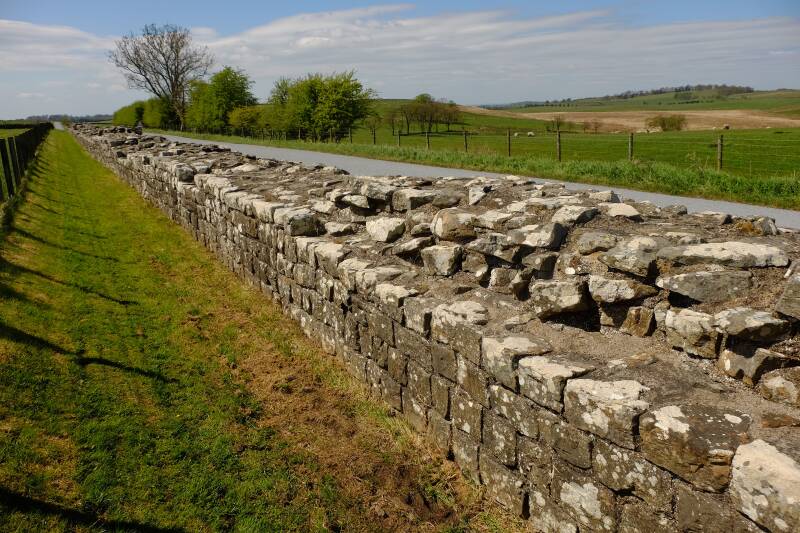
Written and published by Linden Alexander Pentecost, published on the 29th of January 2026 and only published on this website, www.languages-of-linnunrata.co.uk . This publication was published in the UK on this UK website, the author also lives in the UK and is from the UK. This publication is unrelated to and separate from any and all of my other publications. No AI was used in this or in any of my writings. The photo of Hadrian's Wall in this blog post was taken by the author. This blog post/article contains 1623 words.
Hadrian's Wall, or as Cockney people pronounce it: Ëƴdriynz WɔWw, is the famous Roman wall that runs, kind of, in relation to the Scotland-England border, but not really actually. In places it does, but the wall, especially towards the east, runs quite a way south of the present Scottish border. Hadrian's Wall is not quite like the Great Wall of China - it is much smaller, and is not very high. The actual purpose of this wall in terms of how effective it was as a defensive feature is open to debate. It is known that the Romans had access to lead ore, which occurs abundantly in the North Pennines, so one idea is that this wall effectively protected the trade routes of this lead ore from the "Pictish" tribes north of the Wall.
According to the traditional view of British history, where supposedly, the Britons north and South of the Wall spoke more or less the exact same language and were the same culture - this does not really make any sense. It does make more sense however when we consider how Northern England does possess evidence, as I have discussed in detail elsewhere, of Goidelic and pre-Goidelic language, but that the evidence for these linguistic influences greatly increases when we go north of Hadrian's Wall and into what is now Scotland. So it might be possible that Goidelic and pre-Goidelic language influences coincide in some way with those tribes in Northern England and Scotland which refused to become a part of the Roman empire. Of course, what we call the Pictish language in central east Scotland, and other tribes in Scotland in general and their languages, were also in many cases unique from those in England, even during Roman times I would suspect.
Close to Hadrian's Wall lies Mithra's Temple, a temple eerily reminiscent, albeit cruder in construction, to certain temples in South America that I have discussed. This again leads into this vaster subject of the idea of pre-Roman indigenous influences, as of yet unidentified, and the strange possible links between ancestral cultures and mythology between Yorkshire, South America and elsewhere. The Roman constructions in Northern England also, in a more general way, show some similarities to Incan architecture - which is not to say the pre-Inca peoples who used polygonal masonry, but rather the Incas themselves, who's empire and even language sometimes shares similarities with that of Rome. Although, the connections with Finnish and Northern Eurasia are doubtless greater, as I have discussed a lot.
Around Hadrian's Wall itself, we see evidence of pre-Goidelic or Goidelic language, of pre/extra-Brittonic or Brittonic language, and of Anglic languages, including Northumbrian. In the areas around the western wall both extra-Brittonic and extra-Goidelic influences seem more common than in the east.
Photo below: a part of Hadrian's Wall in Cumbria, taken in summer some years ago.
In an article recently published on a different website, yesterday, I mention the River Gelt. I will mention some separate information here though: the etymology of this river name has been connected to both (extra-)Brittonic and (extra-)Goidelic words, demonstrating the ambiguousness of the ancient language in this region. I will also mention here that the river banks contain a Roman inscription in Latin, although this is I believe difficult to locate in the present time. I would still, nevertheless, love to visit it, and for other reasons.
Of course the Roman presence in the landscape left a Latin influence, although this seems to have barely impacted upon the indigenous languages. Similarly, the indigenous languages seem to have barely impacted upon the impressions of the Romans. We have a few inscriptions showing British names, but these are I think likely rendered using the Gallo-Brittonic formulaic system which is akin to how Latin names are written, meaning that these names do not necessarily represent how the majority of people spoke. There is also the possibility that Latin in some way had an earlier, indigenous presence to earlier languages in the landscape. And it is also possible that Latin was used mainly in certain contexts, perhaps most of the people the Romans interacted with were already speaking a form of English/Anglic at this time as their everyday language? This might seem unlikely to some, but the other possibilities, e.g. that everyone in Northern England spoke Cumbric at this time, are not backed up by workable evidence either. A few Celtic or extra-Celtic names written in formulaic language, plus extra-Brittonic and extra-Goidelic place-names, demonstrate the existence of Celtic-like languages in this area, but do not by any means prove that most people during that time spoke a Celtic language.
Certainly, in later periods, this region became greatly under the control of the Northumbrian and Border Reiver Clans. Whether or not the Angles truly invaded, or if they and their language evolved from already existing pre-Germanic cultures and languages present in Britain, which is what I believe - during the 5th century the dynamics of power certainly changed, and this is when the Angles first "appear" to take political control, which is not to say that they and their ancestors were not already there. Perhaps these peoples had been suppressed for a long time, and what we know of the Reivers in the post-medieval period could actually be a continuation of the potential suppression that the Romans were already acting upon other indigenous peoples in the region. The Reiver Clans are often explained away as robbers or bandits whose own identity and way of life was negatively impacted by the division of England and Scotland. But there is no good reason to assume that these clans only existed independently during this time, it being far more likely I think that the Reiver Clans descended from much earlier, ancient clans of this region, who had been suppressed for a far longer period of time.
In a sense, the actual Englishness or Anglicness of Northumberland has often been overlooked. Many people fail to notice that that part of England is in many senses more "Anglic" than other parts of England are generally Anglo-Saxon. This is why so many of the place-names in Northumberland are easily readable for speakers of Anglic languages. This strong Anglic presence also exists in southeastern Scotland, although this has again been, seemingly, deliberately suppressed, as it doesn't coincide with the simplistic notion of "Gaelic Scotland" and "Germanic England", a concept that is so black and white and untrue that one has to ignore most of the linguistic and historic evidence in order to believe it. The presence of Goidelic and extra-Goidelic in Scotland does of course make a divide, as I mentioned, but these influences are also found South of Scotland, just as extra-Brittonic/Cumbric influences are found on both sides of the border, and just as Anglic is found on both sides of the border. The mountains of Southern Scotland often have such Anglic names that the place-names are in a sense "more Anglic" than they are in many parts of England! The whole concept of Hadrian's Wall being built to protect lead mines and lead trade, also doesn't make a great deal of sense. For one, why would the people north of the wall necessarily care about this lead trade? Mining can be destructive, but the lead mining in the North Pennines during the Roman period could hardly have been enough to upset people north of the Wall. Furthermore, the people north of the Wall would probably not have needed lead anyway. We like to think in England that the Romans are understandable, that we can predict, and talk about their reasons for being here, with accuracy and certainty. Whilst we certainly can prove and say a lot of things about them, we still, fundamentally, do not understand what they were really doing around Hadrian's Wall, and what kind of relationships they had to other linguistic groups. In essence, there remain a lot of unanswered questions. And England's pretentious worship of Rome as a "civilised society" has arguably slowed down progress in finding the truth, just as often assumptions tend to put the brakes on the pursuit of knowledge and truth, rather than aiding them. This is precisely why I do not like watching BBC documentaries anymore, the modern ones so often "worship" the kings and queens and Romans, and say absolutely nothing of use about the actual indigenous people in this country as a whole. This certainly comes across like propaganda and social conditioning; but what do I know?
I hope that this article was an interesting read. Over the coming weeks, I will be publishing some things on this blog on this website, but also plan to publish several unrelated PDF books and some articles on my other websites. I also need a bit of a break from writing so much about Northern English archaeology, linguistics and mystical history in blog posts (but not in upcoming books and articles on other websites to the same extent), although, I will be writing on some of these subjects in upcoming blog posts in the next few weeks too.
Add comment
Comments