Written and published by Linden Alexander Pentecost, published on the 6th of February 2026. This blog post/article is unrelated to and separate from any and all of my other publications. This article/blog post is only published on this website (I have other websites too with unrelated content, and books etc with unrelated content from all the aforementioned). This article/blog post was published in the UK, on this UK website, and the author, myself, is also from the UK and I live in the UK. No AI was used in this publication nor in any of my writing. The photos in this article are also important, as are the photo descriptions above them in Italics, which contain details not in the main text. The photos were taken by the author, me, Linden Alexander Pentecost, except for that two of them were taken by my father showing me beside some of the megaliths, to show their scale. The photos taken by my father are included with his permission and this is stated in the relevant photo descriptions, I took all the others. This article/blog post contains a total of 2018 words and a total of 7 photos showing this important archaeological site. This article discusses the site, and related topics including local place-name etymologies.
Only a few days ago I found out about the existence of an archaeological site I had not previously known about nor visited. It is located in what is known as Dovedale, a valley area between Brothers Water/Brudderswatter and Kirkstone/Kirkstian pass in the Lake District National Park, Cumbria. I am used to coming across megaliths in Cumbria - and this site does not have any megalithic walls or a great number of megaliths - but my gosh, the megaliths that are there, if they are indeed "megaliths" that have been moved by people, are enormous.
We drove along, past what may be a pub at Sykeside, and then parked up. Before visiting the site, I walked further along the road towards Kirkstone Pass, to get a view of Dovedale Prehistoric Enclosure from above, and my gosh, again, it was impressive. I could easily see the embankment or earthwork, which, when I got to the site, I realised was partially constructed of small stones, like those from a river, probably from the river in the valley in fact. In this sense the site reminded me of Hayburgh Henge back towards the east and Eden Valley. From a distance I could also see several gigantic rocks placed in and around the enclosure, at least some of which, including one very large megalith, appear to be either sitting on bedrock beneath the enclosure, or, which, even more bizarely, seem to have been placed on top of the embankment! The giant megalith placed on top of the embankment, although which could theoretically be upon bedrock beneath it, with the enclosure having built to incorporate, could weigh approximately 80 tonnes - according to my dad's estimate, and I trust him. He also thought that it looked as though this megalith was placed upon the embankment. Having looked at Lidar maps of the site, I also cannot see any bedrock immediately beneath this gigantic megalith - which would perhaps suggest with more certainty that the megalith could indeed have been placed there, somehow, upon the embankment. Wow, just wow. But of course I cannot absolutely confirm that this is the case.
Photo below: a photo of the Dovedale Prehistoric Enclosure taken from the road up towards Kirkstone/Kirkstian Pass. note the shape of the enclosure, although not as visible in the photo below as in others, which forms a sort of semicircular embankment, and note the enormous rocks. The megalith which may have been placed on the embankment and which may weigh around 80 tonnes, is visible as the large, pointed megalith sitting on the enclosure embankment to the left. Other giant megaliths are visible elsewhere. Note that the "pointed" megalith weighing approximately 80 tonnes, is shaped like a tall or elongated head. Other megaliths of this shape are common in Cumbria, but usually are a lot smaller. I wonder why they are shaped like this, since there are not to my knowledge any reports of cranial elongation or of elongated prehistoric skulls having been found in Cumbria, although in many other cultures, as I have gone into, this was seemingly the way in which certain groups of gods were thought to appear, and I suspect that this elongated head megalith is representative of the "guardian" of this site.

Photo below: a shot showing the approximately 80-tonne, elongated head-shaped megalith. Note how it appears to be lying within or upo the enclosure embankment. Note also how the elongated back of the "head" shape is facing out of the enclosure, perhaps implying that the figure or stone guardian is facing inwards towards the centre of the enclosure.
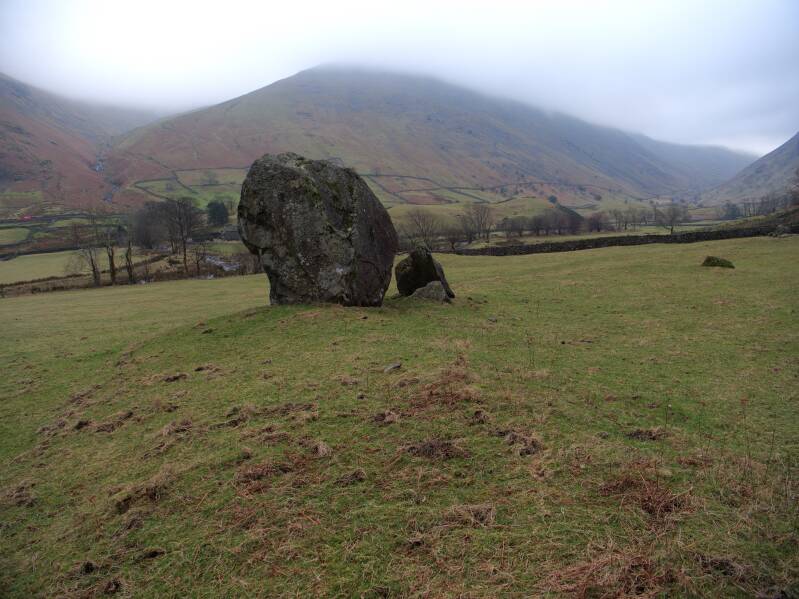
Another curious aspect to this site, is what I think could be a passage tomb, located slightly to the east of the main enclosure. The formation of these stones could of course relate to more recent field clearance, but I don't see why, and the structure does to me resemble a passage tomb. According to mainstream archaeology, passage tombs do not exist in Cumbria - although I've noticed several sites which indeed appear like passage graves, albeit of a somewhat different design, hence why perhaps they are not so easily identified.
Photo below: the possible passage tomb, although in some senses it also resembles a long barrow - I am not entirely sure. The site looks too degraded to say for sure what it is, almost as though large flooding and sediment movement has partially obscured its original shape.

Photo below: a large megalith which appears clearly to be "propped", to the right can be seen the edge of the giant megalith that probably weighs over 100 tonnes.
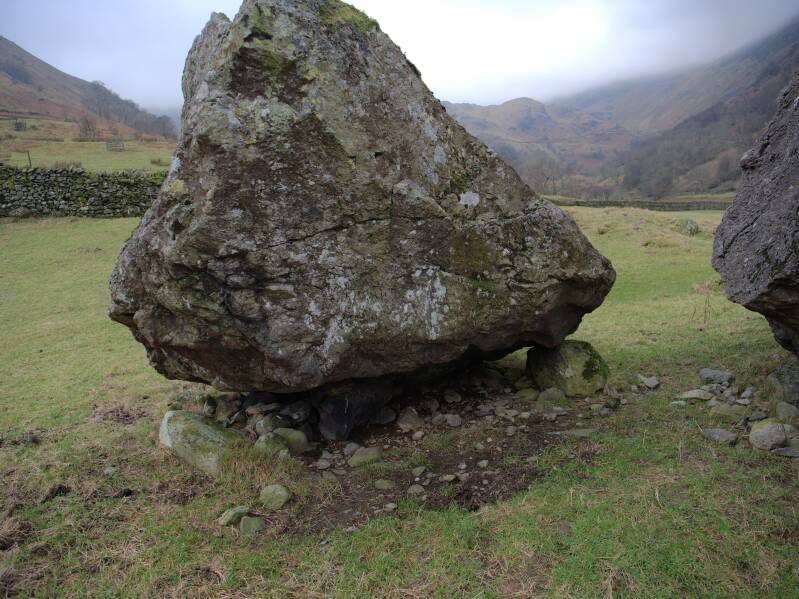
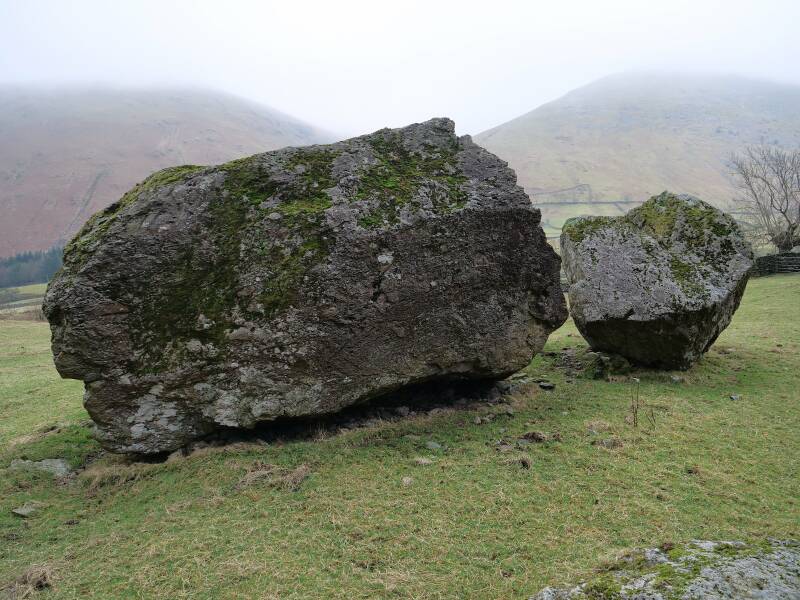
Photo below: the two other giant megaliths, the one on the right is also shown in the photo above. Although these are not so clearly placed into an embankment and may have arrived into their present positions through more natural means. However, the smaller, but still massive megalith to the right, does appear to be propped up, and there is perhaps some evidence that the massive megalith to the left is also propped up, although this may be natural in the case of the giant rock to the right. The rock to the right may weigh approximately over 100 tonnes, but I am again less confident that the rock on the right has been moved through human or supernatural means, although certainly from an animistic perspective, it was I believe moved by supernatural means in some sense. Note how the giant, long megalith on the left also appears to have some kind of "face" on the far left end, looking somewhat akin to the face of a lion or fish with an elongated head. This is separate from the other "tall" elongated head megalith shown in some of the other photos. On the megalith to the left of the photo below, an eye, nose and indendation of a mouth can clearly be seen.
When at this site, I got the impression that it was not very "active", that it was so old, and that the purpose and traditions had been forgotten for so long, that the ancestral presences did not interact with it very much. I also, stupidly, broke a spiritual protocol when on the site by being present there without asking permission from the guardians, and spent some of the time trying to apologise and say sorry to the guardians.
It was also extremely windy, and cold, and the atmosphere felt empty. It did not feel in any way unfriendly, and towards the end of my visit, I made an extra effort to try and ask the presences at the site if they wished to make mental contact with me, or to share anything. This did not happen, but when standing at the centre of the enclosure, I did feel their presences on some level, and some of the nearby sheep were looking at me very intently, as if recognising my attempts to communicate, and recognising the presence of ancestors. It is entirely possible that the ancestors and guardians of this site have not had anyone speak to them directly for a very long time - this was certainly the impression I got. But also of course, I lack the cultural framework and understanding of the people who prayed at this site in the past, so in a sense the key is missing for me.
Photo below: the author stood next to the giant elongated head-shaped megalith, which may weigh around 80 tonnes. The photo was taken by my dad and included with his permission, it was taken to show the immense scale of the megalith, which is I feel important to demonstrate in a photo.

Photo below: a photo taken by my dad of me, included with his permission, showing me in front of the megalith weighing probably over 100 tonnes, with the more-obviously propped megalith visible to the left. The face on the giant megalith on the right is less visible in the photo below.

The Kirkstone, or in Cumbrian dialect: T' Kirkstian or T' Kirkstyan - or, for those from Southern Westmorland: Th' Kirkstëan, is located not far from Dovedale Prehistoric Enclosure, at the top of Kirkstone Pass. I did not have time to visit The Kirkstone on this trip, but have done and published about it previously. It, also, resembles an elongated or tall head in a sense.
Going back to Dovedale Prehistoric Enclosure, I became curious if it there were any place-names in the immediate vicinity which might connect to a highly localised linguistic survival outside of the Germanic and pre-Germanic language groups. The name "Dovedale" could be of Anglo-Norse origin, although its name is clearly readable through modern English and Middle English. Kirkstone or more correctly Kirkstian is Cumbrian dialect, both elements, like the elements in Dovedale, probably existed in pre-Germanic, but the names are easily readable through Germanic. The name Brothers Water or in local dialect Brudderswatter is also clearly readable through Germanic, and is likely I think Anglo-Norse in origin.
The nearby Hartsop Dod, a mountain, does contain the interesting word dod however. Whilst this word existed dialectally in English, I think it is likely of pre-Indo-European origin, and I have discussed possible cognates elsewhere, including one in my first blog post on this website. However, whilst it could I think be indicative of ancient presence, it is impossible to say if this was in any way also localised to the cultures connected with Dovedale Prehistoric Enclosure.
The name Glenamara Park, a short distance past Brothers Water/Brudderswatter - is a bit more likely as a possible localised ancient place-name. This name appears in various other forms over time, including as "Glemorya Park", "Blemara Park", "Glenmer Park" and "Glenner Park". It seems likely that the first element of this place-name is connected to the Irish word gleann - "valley, glen", and to the Welsh word glyn - "valley", or "glen." The second element may I think be the same as that which occurs in the mountain name of Glaramara, being that of a mountain close to Borrowdale/Burradal south of Keswick, although one obvious possible explanation is that this root represents a word connected to Irish mór - "big, great", Welsh mawr - "great, big" and Pembrokeshire Welsh mowr - "great, big". The presence of an additional vowel after this is unusual however, and so I am not by any means confident that Glenamara means "Big Glen" or "Great Glen". The language of this name could perhaps be connected with those cultures who created and prayed at the Dovedale Prehistoric Enclosure,
I hope that this article/blog post was a fascinating read, it is dedicated to my family and to the ancient ancestors of Dovedale.
Add comment
Comments