Written and published by Linden Alexander Pentecost on the 9th of February 2026. This article/blog post was published only on this website www.languages-of-linnunrata.co.uk . I have other websites too and other further places where I publish unrelated articles and books etc. The photos in this article were also taken by the author some years ago. I have published about this site elsewhere, years ago, in three places, but only in a small way, and this blog post/article on this page is unrelated to and separate from those other publications, as it is separate from all of my other publications. The photos in this article/blog post are either completely different from those I have published elsewhere, or are edited differently from where I have published about this site elsewhere. The photo descriptions in italics above the photos contain important information not in the main text, and the photos, as well as their descriptions and the main text, are also very important in the discussion of this site. Note that I have published a lot of other things recently, including articles and another PDF book via different website, I will also be publishing another unrelated publication on a different website later today. This article/blog post in front of you contains 5 photos showing important parts of the Mêni Arthur, Tongue Gill megalitic site, and this article/blog post contains a total of 1363 words. This article is published in the UK on this UK website and I the author am from the UK and a resident of the UK. No AI was used in this article nor in any of my written works.
This site is one of several potential megalithic archaeological sites, located on the mountains to the east of Ambleside and Grasmere. The site is located west of, and slightly north of where Tongue Gill becomes Little Tongue Gill heading north, and Tongue Gill itself continues upwards in a northeasterly direction. The site is located around the GPS coordinates of 54°28'48.6"N 3°01'20.4"W . I originally named this site Mêni Arthur, which would be "Cumbric" or extra-Brittonic for "Arthur's Stones", the reason for this being that the mountain of Stone Arthur is located nearby, whilst "stone" or in Cumbrian Lake District dialect stian/styan is a Germanic word, "Arthur" is a Celtic name, and "Stone Arthur" as a place-name also preserves a Celtic adjective order, hence it is quite likely that this mountain and the nearby area have some Celtic, or pre-Celtic connection to Arthur as a figure and potentially as a deity. Not far to the north there is also Dunmail Raise, a burial mound associated with a Cumbric or extra-Brittonic speaking king, known as Dunmail or Dyfnwal. The exact pronunciation of his name in extra-Brittonic is unknown.
I have discussed some of this elsewhere, but this is why I named the potential archaeological site discussed in this article (not Dunmail Raise nor Stone Arthur as mentioned in the previous paragraph), as Mêni Arthur, although because this name is one that I gave given to the site, from a perspective of Brittonic and extra-Brittonic connection, I also think that naming the site "Tongue Gill Possible Megalithic site" is equally important, although I ask that we use this name interchangeably with Mêni Arthur, as Mêni Arthur invokes the historic and mythic connections to this area and to the Britons and to their ancestors.
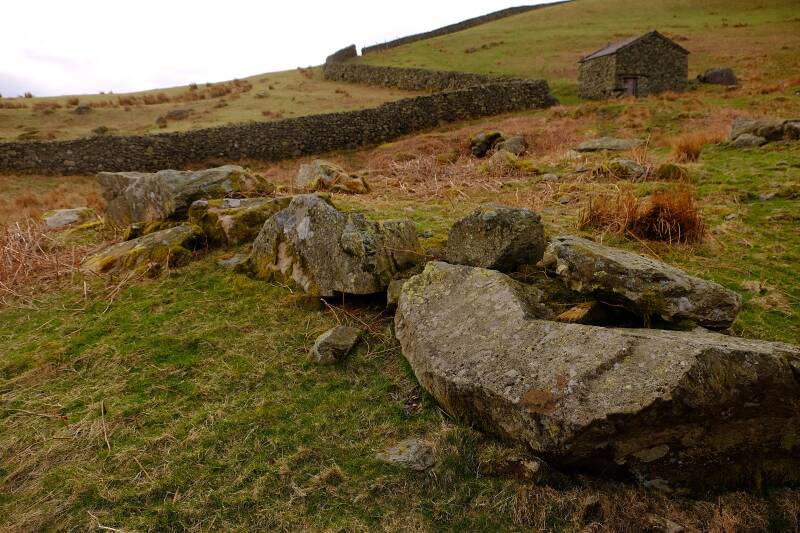
This site appears from a distance like several clearance cairns, but upon closer inspection one can see what appear to be placed stones among these cairns, some of which are propped, whilst the site also contains a kind of megalithic wall and a sanctuary or enclosed structure made from large rocks.
Photo below: the sanctuary or enclosed structure surrounded by large stones, a small barn is visible behind. Note how these stones seem to form an enclosure, although it is not circular, and from certain angles appears instead like two short rows of large stones, parallel to each other.
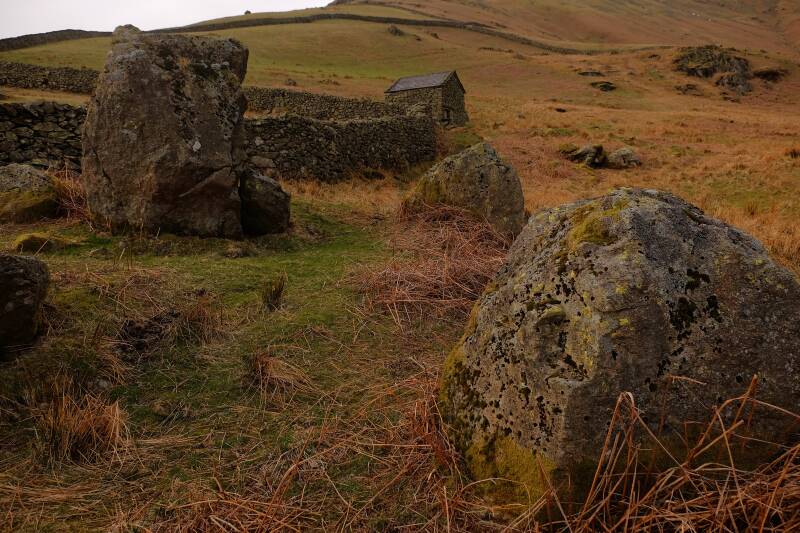
Photo below: two megaliths, seemingly placed against each other. Similar possible megalithic structures (which I have discussed elsewhere) can be found elsewhere in Cumbria, ones particularly similar to that in the image below can be found in the woods below the Fairy Steps, near Beetham in Southern Cumbria, a site which I have discussed in detail elsewhere.
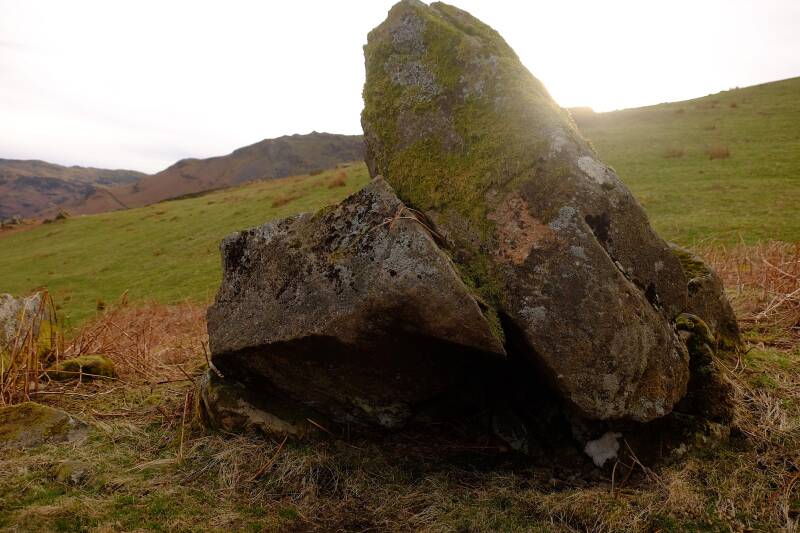
Photo below: another couple of placed stones or a type of primitive dolmen, similar to that shown in the photo above, except that the one in the photo below has the two stones placed onto a small rock outcrop. Note I am unsure just how many of these propped stones or primitive dolmen type structures are on this site, at least two of them, shown in these photos, but I think there may be others too, or possible other examples, if my memory serves me correctly.
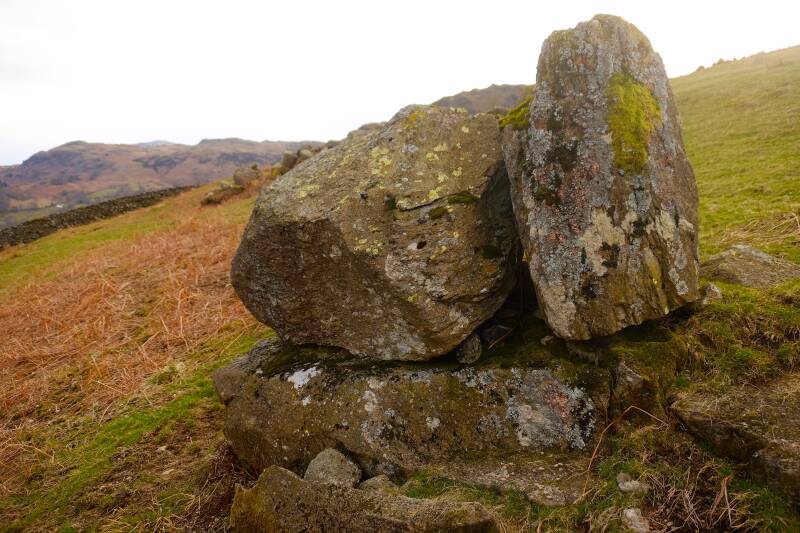
Photo below: what looks like it could simply be a clearance cairn on this site, although the cairn has some level of structure, and it could have served another prehistoric purpose, perhaps before being later used as a clearance cairn.
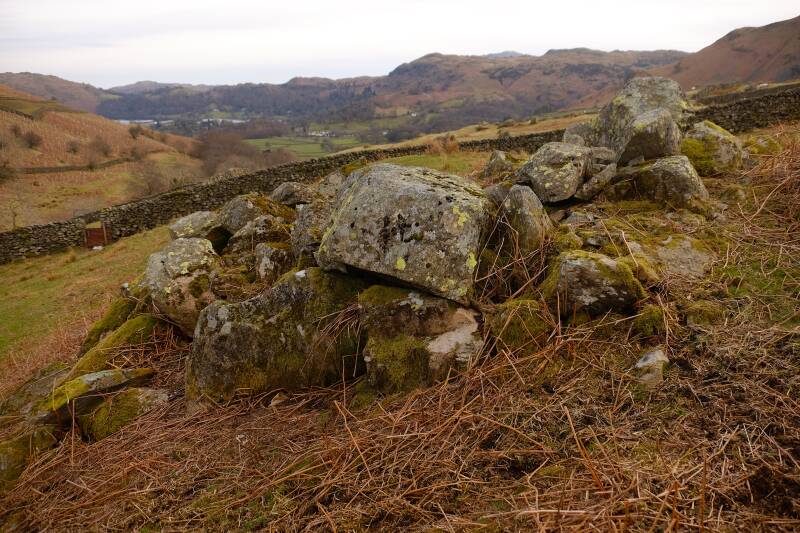
Photo below: the megalithic-wall type structure a short distance below the small barn. The presence of this wall, whatever its purpose, is intriguing, and I find it unlikely that such a structure would have been built in recent times, nor do I think that the other features of this site are in any way recent.
This site is a very interesting one, and I hope that those who read this article or blog post will be encouraged to visit it and to do their own research and investigations into it - provided of course that they do not destroy, steal from nor damage the site in any way.
There are some other potential megalithic sites further south along this range of mountains, and closer to Ambleside, but sadly, at this moment in time I cannot locate my photos of these other sites, and I may have to re-visit them. Also I cannot quite remember where they are. I discovered the other sites during a time when I was feeling somewhat heartbroken and longing for romantic love - as I generally am when I am the Lake District - for some reason, it just seems to be a part of my experience there, and one of the more difficult ways in which The Great Spirit teaches me to be in touch with the spirituality of the land and of myself, even if this process has been often lonely.
Other publications on this site include (all of which are unique from the blog post/article on this page):
.Ancient Cumbrian Megalithic Sites - an article I wrote under a pseudonym and published on Scribd, it contains some of the same photos as shown in this blog post, but those in this blog post are of better quality and have been edited
.One of my Silly Linguistics articles about Cumbric (I cannot remember which)
.The megalithic UK website has a page for this archaeological site which I added
I hope that this blog post/article was an interesting read, and I do hope that others take an interest in this site and visit it, as it is in quite a popular walking area. This article/blog post was written in honour of the ancient ancestors and guardians of the Lake District - and in honour of my family. I am enjoying at the moment discussing some more on sites that I discovered many years ago - in many ways I didn't want to think about these sites for years because of my intense romantic sadness I feel associated with this part of the Lake District, so to write about these sites again feels like returning to and completing work and aspects of myself which I had not completed and avoided til recently. Many thanks for reading. Note that in my blog post previous to this I discuss the Dovedale Prehistoric Enclosure, which is not too far from the Mêni Arthur or Tongue Gill possible megalithic site discussed in this article/blog post on this page.
Add comment
Comments