Written and published by Linden Alexander Pentecost, published on the 10th of February 2026, and only on this website www.languages-of-linnunrata.co.uk . This article was published in the UK on this UK website and the author also lives in the UK and is from the UK. This article is unrelated to and different from any and all of my other publications. No AI was used in this article/blog post. The photos in this article were also taken by the author, three of which show panels showing possibly ancient symbols, and another shows the entrance to Victoria Cave. Neither the photos nor the words in this article have been published before now, although I have discussed one symbol at this site in an unrelated article published on a different website. This article/blog post contains 4 photos and a total of 1480 words. Note that I also published two articles yesterday, one of which was an unrelated blog post on this website, another which was on another website. I will also publish more different things in the near future, including another blog post on this website which will be published in a short while from now today, concerning more information and also photos of polygonal masonry around Hämeenlinna. I often publish late at night/early in the morning at the moment. The photos and the photo descriptions in Italics above them in this article are also very important I think for demonstrating the examples which i discuss in the subjects in the main text.
Victoria Cave is a famous archaeological site, located in North Yorkshire. Today, the landscape is wild and largely tree-less, but this was not always so. I have discussed already on this blog some of the ancient sites in this region, but from what can be gathered, several of the caves in this area have even more ancient evidence of human archaeology, with Upper Paleolithic human evidence also having been found at the cave, in the form of a harpoon, around 11,000 years old. When it comes to evidence of prehistoric writing and of ancient and later but still old VV-marks, I have found examples of what I think is both, and the two are interrelated, some examples of which I discussed in a recent ebook, whilst, and having discussed other examples of both in many publications. However, the possible examples I have noticed around the two entrances to Victoria Cave near Settle in North Yorkshire - I am less certain about, for the simple reason that the entrance of this cave was significantly widened in the past, and I personally am unclear on which parts of the rockface would have been open-air in former and in earlier prehistoric times. This is something that perhaps could be determined for a further publication, but in the meantime it will suffice to say that I am aware of at least one example of what seems to be an ancient symbol at Victoria Cave, which I discussed in an unrelated article with different content on a different website without photos, but am unsure, which, if any, of the photos below it may appear in, and I know that these symbols, especially VV symbols are found around other caves around Victoria Cave, as detailed in the publication: Meeting Report British Cave Research Association (BCRA) Cave Archaeology (CA) Special Interest Group (SIG) Field Meeting based at Lower Winskill, near Settle, Yorkshire Dales 03 to 05 June 2022 Vince SIMMONDS, Linda J WILSON, and Andy HALL Cave and Karst Science, Vol.49, Number 2, 76 – 84, 2022.
Nevertheless, the examples of writing and possible symbols in the three photos of these in this article/blog post, are an interesting subject, and do in some cases closely resemble VV-symbols, crosses, and proto-writing or ancient writing at other sites in Britain. As I mentioned, I have discussed elsewhere several examples of this, including in different articles and books, some examples of which and aspects of which are discussed and shown in my recently published PDF-book published via a different website to this, the PDF-book being titled: Further explorations of Old Tongues of Orkney and beyond, more on North-Germanic, & more on prehistoric writing & Other Topics, PDF-only book published via BookofDunBarra on the 03/02/2026 . Other examples of potential prehistoric writing and VV marks in Britain are discussed in other different books I have written.
If in fact the markings shown in the three photos below are not ancient, which is entirely possible, this article/blog post nevertheless is an interesting effort in documenting and looking at the later graffiti in this cave, although some of these signs are quite profound, some look like ancient writing, and many of them look very ancient. Nevertheless, this is not something for me to try and make any conclusions about yet. The nearby Attermire Cave, also has some examples from what I understand, although, despite its proximity to Victoria Cave, I have not yet been there to look for ancient markings and symbols. The individual panels showing different carvings in the three photos below this paragraph are discussed in detail in the photo descriptions in Italics above the photos, after which is another section of writing concerning yet another dream, this one involving VV symbols. After this there is a photo showing the outside of the cave with a photo description above, and then some more writing. Note that I personally do not think that these VV markings were originally from any language known to us, nor that they originally represented two V's or an M, I think instead as I have discussed in other details elsewhere, that they hark back to Neolithic (or earlier?) traditions of creating these kind of protection symbols at Neolithic sites, several of which I have discussed in other publications with photos.
Photo below: some heavily lichen-encrusted writing or symbols on one of the walls within Victoria Cave, close to the surface. Note that whilst this could be graffiti, and whilst it is hard to work out what these signs are, several of them do resemble interlocking VV symbols, in some sense they are akin also to zigzag markings. The area where the carvings are in the photo is surrouded in a black oval to show their position.
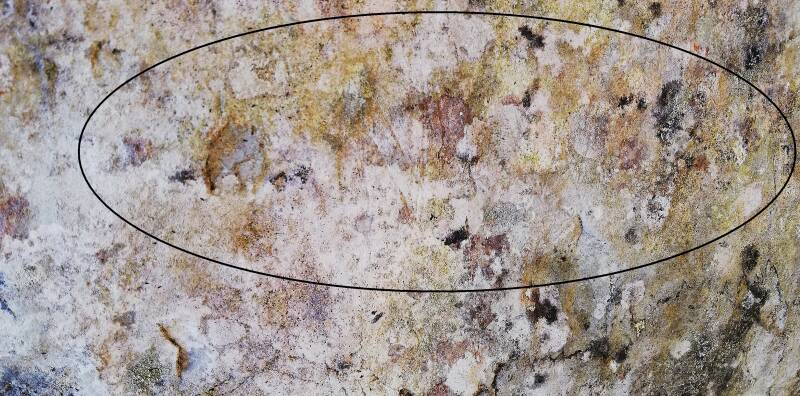
Photo below: markings or carvings on one of the external walls outside of the main cave entrance, again I am not sure how much of this might have been exposed before the entrance was enlarged, but in the photo below, various groups of markings are pointed out within different coloured oval shapes. The two orange ovals or circles have within them what could be cross symbols, whether Christian or pre-Christian. The marroon ovals show areas where there appear to be box-like symbols in both cases, perhaps graffiti, perhaps not, and also within the marroon ovals can be seen W or VV markings. The yellow ovals show within them other possible markings.

Photo below: another panel, I think taken within another entrance to the cave - again, I am not sure for how long the entrance to this cave has been open, and so do not know how old these carvings might be. The blue oval on the left marks out what could be natural, but which could also be some kind of symbol or other marking. The yellow oval has within it other markings which resemble runes. The larger orange circle on the right has within it a great many symbols, several of which look like runes, others of which look like M or VV symbols.

If my memory serves me correctly, some while back I had a curious dream, just before a woke up, more akin to a vision experienced with the eyes closed. In the vision I vividly saw the VV marks, interlocking and not one after the other, almost "coming forth" from a background that looked like a deep blue-green mist of very subtle colour. To be honest, I do not know exactly whether or not I had this dream, or if I am in fact confusing it with a very similar dream I had about a rune which appeared in a similar dream vision and in a very similar way, which I discussed elsewhere. But, nevertheless I do have some memory of also having a dream a while later in which I saw a VV symbol.
Photo below: the enlarged main entrance to Victoria Cave, standing out as a mysterious entrance to an ancient world, contrasting with the grey of the surrounding limestone rock.

I hope that this article was an interesting read. I also think that there is a lot more to discuss and research on this subject, and I hope that this publication also encourages further interest into it. Many thanks for reading.
Add comment
Comments