Written and published by Linden Alexander Pentecost, published on the 10th of February 2026 and onto onto this website. This article/blog post is unrelated to and separate from any and all of my publications. No AI was used. This blog post was published in the UK onto this UK website, the author is also from the UK and lives in the UK. The photos in this article have not been published before and are also important, as are the photo descriptions above the photos which contain information not in the main text. Three of the photos show polygonal masonry sites around Hämeenlinna, the fourth shows a view of the walk which I found myself on when returning from these sites. All of these photos were taken by me. This article/blog post contains a total of 1259 words. Note also that I have also already published a different unrelated blog post on this website today, and yesterday I published another unrelated one, as well as publishing yesterday another article on a different website, wherein I mention, among other interesting topics, another newly found Quechua-Finnish group of similarities, a great number of which I have discussed elsewhere, including in relation to other polygonal masonry sites in Finland, for example I have published two online articles elsewhere on two other websites from this, each discussing a polygonal masonry site in Finland along with unique Finnish-Quechua similarities in each one, with a lot more published in other publications.
In November 2024 I published a different article on a different website in which I discuss Hämeenlinna Castle and its polygonal masonry, and other topics. I have more extensively published about other examples of polygonal masonry in Finland , with photos I have taken and other photos, throughout several distinct publications since then. Since writing the article more connected to that of Hämeenlinna however, I have also visited Hämeenlinna, and looked at the different examples of polygonal masonry in person, which are located at and within the walls of Hämeenlinna Castle itself, and at a separate site, a folly, in the nearby forest, within the Hämeenlinna City Park.
It is difficult to tell how ancient any of this polygonal masonry is, as is the case with other sites in Finland, although I am inclined to think that some of these sites are actually very old, and there are a few, what in my opinion are potentially ancient polygonal masonry sites in the forests of Finland, but these sites I have not yet been to. Nevertheless, of the sites I have been to, I am inclined to think that some of it is very old. In the case of Hämeenlinna Castle, this might be more acceptable to many, but if the folly in Hämeenlinna City Park is also potentially older, it would imply that the aforementioned site is not a folly, but for now I will accept that it probably is, or is at least not that ancient. I discuss more on it in the photo description in Italics above the photo in this article which shows it, and similarly I discuss the Hämeenlinna Castle moat polygonal walls in further details in the descriptions in Italics above the photos showing the Hämeenlinna Castle moat polygonal walls.
It is also difficult to tell, with Hämeenlinna Castle, how much of this polygonal masonry work has been replaced or altered at a later date, and from what I understand, war prisoners in the past did re-build some of it or a large proportion of it. In the article published in late 2024 I imply that the walls of the castle have examples of polygonal masonry, and yes they do, but much of it uses mortar, or at least has come to possess mortar, so it is not technically polygonal masonry in the strictest sense, and I found instead that the walls around the mote, lacking mortar, fit much more akin to how an ancient polygonal masonry wall would, without mortar. I leave it up to the individual to decide how this polygonal masonry looks, although the photo descriptions and photos below help very much to demonstrate this too.
Photo below: a section of polygonal masonry next to the moat at Hämeenlinna Castle. The upper part of the polygonal masonry in the photo below, having much more moss growing upon it, is probably older, whilst the lower sections have by the looks been replaced or at least cleaned up at a later period. Note the five sided stone centre upper right.
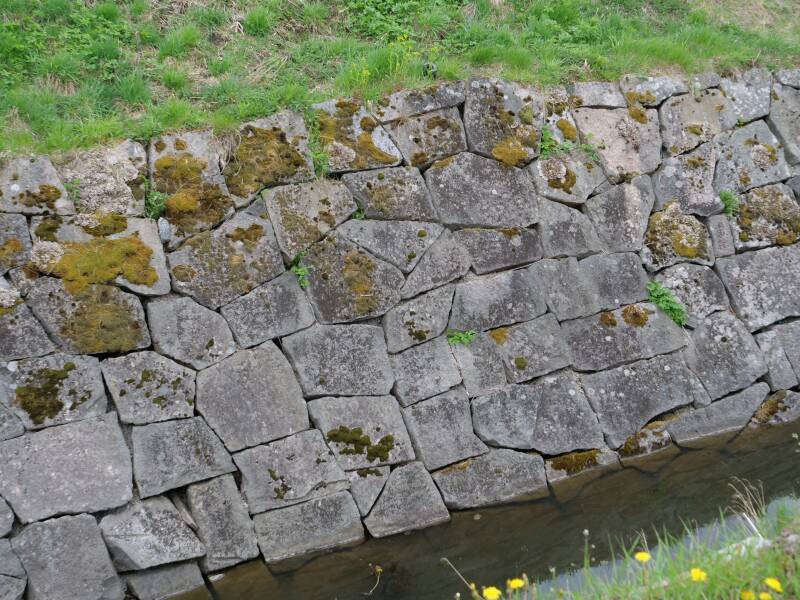
Photo below: another part of the polygonal masonry on the inner bank of the moat at Hämeenlinna Castle. Note that this may be an older section of wall, and shows some beautiful examples of polygonal masonry, but not also the much lighter-coloured stones which look as though they could have been added later, perhaps to replace better-fitting but broken stones.

Photo below: a part of the "folly" structure located within Hämeenlinna City Park, this structure is built using in-part polygonal masonry. Whilst this site is said to be a folly, it is still interesting, and one can see in the image how certain joints between the blocks seem to "fit" much better than others do, and I wonder if this is in part because some parts of the structure are possibly older than others? A further wall inside the structure can just be seen ahead of the entranceway in the photo below. Some of the blocks do show evidence of drill holes, although it is hard to date them and thus to tell if these were from powered drills after the 1800s or were the result of the much older hand-drilling technique. Even though I am not convinced that the structure below is truly ancient (it would be cool if I was wrong, though), the site is very interesting, and helps to demonstrate again how knowledge of this masonry existed in Finland into later times, whilst most other places where polygonal masonry is found have no later examples at all. As can be seen in the photo above showing part of the moat at Hämeenlinna Castle, so the site in the photo below also shows polygonal masonry alongside much smaller stones which seem to have been added later, how much later I am uncertain.
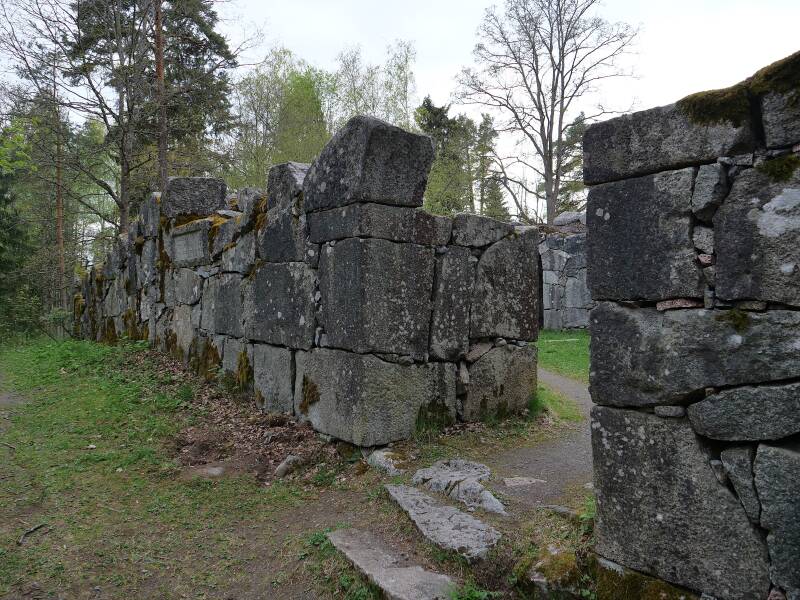
Photo below: part of a path I took when heading back to Hämeenlinna Railway station, after having crossed a bridge from the forest where the "folly" is located. In this area I chatted with some really lovely people, initially because I was having problems locating where the folly actually was. When walking along the path shown in the photo below, and whilst keeping out of the way of cyclists and runners, I observed various trains go past from the path side of the fence. An amusing thing happened actually when I visited the castle, as I somehow managed to find myself in a part of the castle where visitors go, and then found myself talking to a tall blonde woman dressed in medieval attire, and asking her about the history, only to then discover that she was at a fancy dress party, and that she wasn't in fact dressed that way because she worked at the castle. We both found this amusing, then I left and headed back towards Helsinki.

I hope this blog post/article was an interesting read and I encourage others to check these places out. This article/blog post is dedicated to all Finns.
Add comment
Comments